dBFS, dBu, "nominal" levels ... huh?

sleroux

Member
Until recently I never bothered with such things as "audio levels". Audio/video recoding is not my primary business, and for the few videos we've made so far, we have mostly used "plug-and-play" solutions (aka Rode Podcaster USB mic) -- keeping the level "as it" as it was "loud enough".

Now, I'd like to do a better job. But I lack basic understanding of some elementary rules of audio engineering. As an example, on an other thread I learned from Steve House that speeches levels should be recorded at -12 dBFS peak level. I had no idea about that. So, since two days I spend a lot of time searching and reading through this forum and the web. But I'm not sure to have a clean understanding of all I have read so far. So here are some assertions, please feel free to comment of correct them!

Thanks is advance for all your comments!

- Sylvain


» Assertion 1:
dBFS measures a digital signal relative to the maximum value that can be represented.

» Assertion 2:
A signal that reaches 0 dBFS at any point would reach the maximum that could be possibly represented.
A signal that reaches -6 dBFS at any point would reach 50% of the maximum that could be possibly represented.
A signal that reaches -12 dBFS at any point would reach 25% of the maximum that could be possibly represented.
A signal that reaches -18 dBFS at any point would reach 12.5% of the maximum that could be possibly represented.

(source https://en.wikipedia.org/wiki/DBFS)

» Assertion 3:
Bit depth does not change the meaning of dBFS: 0 dBFS is the maximum both at 16bits/sample or at 24 bits/sample. -6 dBFS is 50% of the maximum both at 16bits/sample or at 24 bits/sample.

(source ??? I don't remember)

» Assertion 4:
The dynamic range is the ratio expressed as dB between the level of the largest and the smallest signal we could have (or represent?).

» Assertion 5:
In the digital domain, each bit count for 6 dB of dynamic range. 16 bit/sample has a dynamic range of 96 dB. 24 bits/sample has a dynamic range of 144 dB.
(source http://dbzeebee.blogspot.fr/2009/10/digital-recording-levels-rule-of-thumb.html)

» Assertion 6:
In the analog domain, dBu is a measure of the ratio between a signal and a normalized signal (sinus 1kHz @ Vrms = .775V).

(source http://www.dvxuser.com/V6/showthrea...h-boy!&p=1986375320&viewfull=1#post1986375320)

» Assertion 7:
Per European broadcast regulation, digital audio acquisition chain should be calibrated (how?) such as 0 dBu matches -18 dBFS
For American market (and most UK), digital audio acquisition chain should be calibrated (how?) such as 0 dBu matches -20 dBFS

(source http://www.proav.de/index.html?http&&&www.proav.de/audio/meters.html)

» Assertion 8:
dB SPL is a measure of the acoustic pressure of the air caused by sound waves. This has nothing to do with electronics!
As all "dB" unit, dB SPL is a ratio, in that case between the acoustic pressure of a sound and the human hearing threshold (around 20 µPa @ 1kHz)

(source https://en.wikipedia.org/wiki/Sound_pressure)

» Assertion 9:
Sound pressure level drops by 6 dB (SPL) per doubling of distance.

» Assertion 10:
Conversation speeches @ 1m is arround 60 dB SPL.
The sound pressure of normal speech level at 2m of the speaker's mouth is about 54 dB SPL.
The sound pressure of normal speech level at 50cm of the speaker's mouth is about 66 dB SPL.
The sound pressure of normal speech level at 3cm of the speaker's mouth is about 90 dB SPL.

(source http://www.sengpielaudio.com/TableOfSoundPressureLevels.htm)


» Application:
(highly doubtful ??? )
Given a headset microphone of sensibility 21mV @ 94 dB SPL:
- @90 dB SPL (speaker mouth at 3cm of the capsule), the output of the mic capsule is arround 14mV [ 21mV/10^(4 / 20) ]
- according to european braodcast recommendations, in order to reach -12 dBFS in the digital domain, the mic has to be recorded at +6 dBu in the analog domain
- +6 dBu is 1.5Vrms (2 times .775V). So the required gain on the mic preamp should be set a little over 40 dB [ 20×log[SUB]10[/SUB](1.5V/14mV) ]
 
Last edited:
It may be easier to simplify around the math for now. The absolute basics that you need to start with:


A deciBel (dB) is not a set value. It is a relative value, calculated based on a given reference value. That reference value is indicated as 0dB. An increase of 3dB is a doubling of the signal level or amplitude.


In terms of acoustic sound (sound that moves from the source, through the air, to your ear) the dB scale used is SPL (Sound Pressure Level) with 0dB being the threshold of human hearing. Because we cannot hear below 0dB, the scale does not use any negative dB values.


In terms of analog sound, the dB scale is measuring the strength of the signal moving through the mixer's (or recorder's) gain controls and meters. This is dBVU (measured with a VU, or Volume Unit, meter). Signals stronger than 0dB have a positive value (e.g. +3dB) whereas signals weaker than 0dB have a negative value (e.g. -7dB).


In analog audio, 0dB is the point that offers the best ratio of signal to noise while maintaining good headroom. Headroom is the amount of space between the signal level and the point at which distortion occurs, and the analog signal can go well above 0dB without distortion. Further, in the analog music recording world especially, analog distortion can be a desired sound. In dialog for film and TV, not so much.


Once audio has been converted to digital, the signal is transmitted as binumerics (1s and 0s). Where analog audio is a constant flux of electrical signal, digital is a periodic cross-section of the signal flow. Sample rate is how many times per second a snapshot (or "sample") of the signal is recorded. 44.1kHz = 44,100 Hertz = 44,100 samples recorded per second. 48kHz = 48,000 Herts = 48,000 words per second. To reproduce the sound in playback, the playback device essentially connects the dots and fills in the places between each sample with a "best guess" system. The more samples per second, the less information has to be filled in.


Each sample records a word, or a string of 1s and 0s. Bit-rate defines how many 1s and 0s are recorded in a single word. 16-bit means each word has 16 characters (bits) per word. 24-bit has 24 bits per word. The more bits per word, the more information can be recorded in any given sample.


The dB scale used for digital audio is dBFS, or Full Scale, with 0dB being the point at which all bits per word are full and no other information can be included. Because no more information can be added, it is full, and there are no values above 0dB. Try and go past 0dB and you get into digital clipping which has a very nasty sound to it.


Since 0dBFS is the top and the point where digital clipping occurs, the target value must be set lower to allow for ample headroom. So an analog mixer must be calibrated to a digital recorder to make sure that the target values of each (0dB in analog, -12dB in digital) are matched. That way, you know when you see the signal averaging around 0dB on the mixer you know that it is averaging around -12dB peak on the recorder.

You also should pay attention to which type of meter ballistics you're watching. An older, analog mixer with VU meters featuring needles is an averaging meter. That means you aren't seeing the true value at any given moment. For that, dialog usually averages between -7dB and -3dB, peaking at or just above 0dB for sudden, loud sounds. If you're watching the meters on, say, a Sound Device mixer, you're watching a much more responsive LED meter (PPM, selectable to other types of ballistics), and dialog should actually be averaging around 0dB with peaks at +3dB or +6dB.

There is another dB scale that applies, which is dBv, or the measure of the signal's nominal amplitude running through the cables. The first thing to know about this is the difference between a professional, balanced line-level signal of +4dB and an unbalanced, "consumer" line-level signal of -10dB, and a mic-level signal of (give or take) -58dB. Balanced signals run through three-conductor cables and connectors and feature positive, negative, and ground leads. Unbalanced signals run through 2-conductors and have a positive lead and a shared negative/ground lead. Unbalanced signals can run through three-conductors, and often do when wired as stereo cables (left positive, right positive, common ground).

If you try and feed a +4dB balanced signal into an input calibrated for mic-level signal (a difference of 60dB), you will get massive distortion (and possibly fry the input circuits). Always match your outputs to your inputs. Also, a pre-amp's job is to take a mic-level signal and bring it up to line-level for proper recording.

Last, the reference you found to a halving of the distance being an increase of +6dB references the Inverse Square Law. This is crucial for working with mic placement, because half the distance from the mic to the source means 4 times the amplitude. Double the distance and you get 1/4 the amplitude. The rule for mics and dialog for TV/video/film is generally, "The closer, the better." Moving the mic closer by half and getting 4x the amplitude of the source also increases the ratio of the direct source to any background noises that may interfere.
 
Last edited:
Sorry for the math! I easily have the feeling to grasp things better when I can put numbers and formula on them. I will try to restrain myself in that area. Promise. Anyway, a great thank you Alex for your detailed reply. That made many things much more clear ... and raised some more questions.


It may be easier to simplify around the math for now. The absolute basics that you need to start with:
An increase of 3dB is a doubling of the signal level or amplitude.
That's what I was told at school when I was younger. But my later readings are a little bit confusing. If I understand it well, this will depend if we use dB to measure "power quantities" (power, sound intensity, sound energy) or "field quantities" (amplitude, voltage, sound pressure).

For "power quantities", +3dB is doubling. -3dB is dividing by 2.
For "field quantities", +6dB is doubling. -6dB is dividing by 2.

Still, if I understand it well, dBV, dBu, dB SPL are "field quantities", and so use the rule "+6dB is doubling". dBFS seems to apply the same rule, as one of my source states that "1 bit is 6dBFS" (i.e.: 16bit has a dynamic range of 96dBFS, that is 6×16).
On the other hand, dB SIL (sound intensity level) and dB SWL (sound power level) are "power quantities", and so use the rule "+3dB is doubling". But I don't think those two units are relevant for our discussion.

(sources: https://en.wikipedia.org/wiki/Decibel#Definition, http://www.sengpielaudio.com/calculator-FactorRatioLevelDecibel.htm)


So an analog mixer must be calibrated to a digital recorder to make sure that the target values of each (0dB in analog, -12dB in digital) are matched. That way, you know when you see the signal averaging around 0dB on the mixer you know that it is averaging around -12dB peak on the recorder.
I've seen that formulation at other places too, but I don't really get the "averaging around -12dB peak". This is probably just a problem with my english, but does that mean -12dB on average? Or the average of the peaks is at -12dB? Or something else?


There is another dB scale that applies, which is dBv, or the measure of the signal's nominal amplitude running through the cables. The first thing to know about this is the difference between a professional, balanced line-level signal of +4dB and an unbalanced, "consumer" line-level signal of -10dB, and a mic-level signal of (give or take) -58dB. Balanced signals run through three-conductor cables and connectors and feature positive, negative, and ground leads. Unbalanced signals run through 2-conductors and have a positive lead and a shared negative/ground lead. Unbalanced signals can run through three-conductors, and often do when wired as stereo cables (left positive, right positive, common ground).
I spend a fair amount on time this afternoon exactly on that subject. I understand clearly the difference between balanced and unbalanced signals. Moreover, I've read here and there about the difference between "consumer" and "professional" line-levels. But none of them explaining clearly how you know if your input is of one kind or the other. Still if I understand it well, when I have a balanced line input, I must assume this use "professional" line-level a +4dBu. If I have unbalanced line input, I must assume this input use "consumer" line-level at -10dBV.

BTW, I've read that dBu and dBV are two ways of measuring voltage amplitude, but relative to two different reference levels (0dBu is .775Vrms whereas 0dBV is 1Vrms).

(source https://en.wikipedia.org/wiki/Line_level#Nominal_levels)


Finally I found two charts summarizing the relationship between various "dB" on a carefully calibrated system:

View attachment TSM_LineLevels_SignVideo_v5.pdf
http://2.bp.blogspot.com/_EMM4IuTpx...5O9CJr0/s1600-h/zb-reflevel-analogdigital.png

There are some inconsistencies between them, probably (?) because of the choice of a different reference level for A/D conversion. Anyway, those two charts state about a "Nominal peak level". I can't find an explanation of what this level is concretely. Is the "nominal peak level" some kind on "theoretical maximum" that shouldn't be exceeded? Or the peak value for recording sound "not loud nor soft"?
 
Last edited:
Anyway, those two charts state about a "Nominal peak level". I can't find an explanation of what this level is concretely. Is the "nominal peak level" some kind on "theoretical maximum" that shouldn't be exceeded? Or the peak value for recording sound "not loud nor soft"?

Nominal peak level is not a theoretical maximum, it's a practical target. If recording dialog, you want to see your "average peaks" hitting right around this level. The reason the level is so low, is to leave head room for the above average peaks, like a loud laugh, or an energetic scream. On top of this, a good preamp will have limiters to handle the off-the-chart peaks. But you'll understand the concept of "nominal peaks" by slipping on a pair of headphones and watching the meters while you listen. It will make perfectly good sense right away in the field. Not so much sitting at a desk trying to analyze the situation though. :D

Let me give an example from the field. I've got a small location audio kit. A Sound Devices MixPre-D field mixer feeding a Tascam DR-100mk2 recorder. I use the mixer's tone oscillator to feed the recorder a 1 kHz tone a 0 dBu. I set the mixer to send this at professional line level (+4 dBu) over XLR cables. I set the recorder to accept professional line level inputs at its XLR inputs. I then adjust the recorder input levels to -20dBfs. Setup is complete, so I turn off the tone oscillator and put the recorder in the bag -- I'm not going to touch it in subsequent recording sessions other then to start / stop recording. From now on, all adjustments to the signal will be made at the mixer.

When recording, I set my nominal peak levels (this is what you are asking about, yes?) to be around +10dBu on the mixer. This is just the beginning of the red LEDs on the mixer, so it's easy to see at a glance if I'm "in the red". I adjust my gain settings so getting "in the red" seldom happens, but does happen on occasion. This results in a nominal peak level at the recorder of around -10 dBfs, which is what I want -- an excellent signal to noise ratio, but with a reasonable amount of headroom.

For safety, I set the mixer's limiters at +18dBu. This way if something unexpected happens, like a really loud laugh or a really loud scream, the limiter catches and heavily compresses anything at +18dBu or above. The +18dBu level at the mixer is still at -2dBfs at the recorder, so I'm not clipping. No matter what happens, I'm basically immune from clipping with this setup. It would take something like a gun shot to send me into clipping, and that's not going to happen while recording dialog.

So what do I have? I've got a nice large signal to noise ratio, yet with little danger of clipping. And I control it all from my mixer. And that's how I've reduced the theory down to practice in the field, for the kind of work I do.
 
Last edited:
...
Once audio has been converted to digital, the signal is transmitted as binumerics (1s and 0s). Where analog audio is a constant flux of electrical signal, digital is a periodic cross-section of the signal flow. Sample rate is how many times per second a snapshot (or "sample") of the signal is recorded. 44.1kHz = 44,100 Hertz = 44,100 samples recorded per second. 48kHz = 48,000 Herts = 48,000 words per second. To reproduce the sound in playback, the playback device essentially connects the dots and fills in the places between each sample with a "best guess" system. The more samples per second, the less information has to be filled in.
...

With all respect, this is an incorrect and misleading way to describe digital audio.

Human hearing has limits. Frequency response limit for human hearing = 20 khz. Various results that seem to indicate sensitivity to higher frequencies have not been shown to be reproducible. And very few of us can hit 20 khz, with the percentage going down with age.

Sampling theory says that sampling at twice the frequency limit gives a perfect representation of the incoming signal. In practical implementations some padding is needed because filters do not have perfect cutoff, so 44.1 khz sampling leaves 2 khz of wiggle room.

A DA process with sufficient sampling rate and proper reconstruction filter does not "fill in" or "estimate" or "guess" - it recreates the sampled waveform precisely. More precisely than any analog medium.

Fran
 
Sorry Fran but your explanation is off.
The biggest is the "Sampling theory says that sampling at twice the frequency limit gives a perfect representation of the incoming signal. ".
You are referring to the Nyquist frequency and it's not the point of "perfect" reproduction but the point where you just have enough to guess at the waveform. The D/A converter is going to take two points and make a sine wave out of it. So for instance a 20kHz square wave will turn into a 20kHz sine wave. not really close to "perfect".

Also while you may have an issue with "guess" and "estimate" that IS what is happening. The D/A converter uses capacitors to average out the digital samples and smooth them out into a continuous wave. Just like the above example the smoothing will approximate the original, and for most sounds it will be very close but not always. Frequencies near the Nyquist frequency are not anywhere close to as good a "guess" as those farther away. This is also true for complex waves. The more complex and the more overtones the more the sound will be changed.

As you correctly pointed out there are very few people who have decent hearing up there so hardly anybody can tell if the sound changes or not.

The frequencies of digital were not chosen for the best fidelity but for $$$. 44.1 is about as low as they could go and get decent fidelity and 48 was created so consumers couldn't copy their CD's to DAT. There was a time when that was seen as a serious piracy issue believe it or not.

Also perfection is not really in the cards. You can get better reproduction by upping the sample rate and by increasing the bit depth. The first lets you catch smaller bits of complexity in the waveform, higher frequencies and high frequency complexity on all frequencies. The second make the samples more accurate and this also allows you to pick up more complexity in the waveform. In practice the higher sample rate doesn't add much perceived quality because most of it is out of most peoples hearing, but bumping the bit depth to 24 is quite noticeable to most people.

But even then you are not "perfect". In the real world though close is fine for 99.99% of the people.
 
Last edited:
First, thank you all for your answers. Specifically Noiz2 for your explanation on the sampling rate vs bit depth. As this is more into my business, I'm able to confirm each and every bit you stated. I'm even able to confirm that at one time, DAT was considered as a thread by most major music companies. As a matter of fact, I remember that time...

I can add that as an analog signal is continuous, you don't suffer of artifact caused by "rounding errors" while amplifying, attenuating or somehow filtering it. On the other hand, digital signals are discrete (both in amplitude and time domain), so they can only change "by steps". I just saw a perfect illustration of that while watching a DR-60D review (http://www.youtube.com/watch?v=Kl-7vmShkgs). Around 2:40 from the start of the video, there is a test of the volume knob, and you can clearly hear that the audio level change by discrete steps. Increasing the number of steps would reduce each step "height". Up to the point where they won't be humanly identifiable, but anyway those steps would remain.


Nominal peak level is not a theoretical maximum, it's a practical target. If recording dialog, you want to see your "average peaks" hitting right around this level. The reason the level is so low, is to leave head room for the above average peaks, like a loud laugh, or an energetic scream. On top of this, a good preamp will have limiters to handle the off-the-chart peaks.

All of this is much more clear now.


But you'll understand the concept of "nominal peaks" by slipping on a pair of headphones and watching the meters while you listen. It will make perfectly good sense right away in the field. Not so much sitting at a desk trying to analyze the situation though. :D
A very clever advice :tongue:
Unfortunately, I don't have any meter on my low-end gears. At least, I understand now why this is so important to "visualize" the level while recording. The closer I can achieve for now is using the meter on the recording software I use while capturing audio from mic to laptop, through an USB converter. Not much fun "in the field". I definitively have to upgrade my setup...


Speaking of that:
Let me give an example from the field. I've got a small location audio kit. A Sound Devices MixPre-D field mixer feeding a Tascam DR-100mk2 recorder. I use the mixer's tone oscillator to feed the recorder a 1 kHz tone a 0 dBu. I set the mixer to send this at professional line level (+4 dBu) over XLR cables. I set the recorder to accept professional line level inputs at its XLR inputs. I then adjust the recorder input levels to -20dBfs. Setup is complete, so I turn off the tone oscillator and put the recorder in the bag -- I'm not going to touch it in subsequent recording sessions other then to start / stop recording. From now on, all adjustments to the signal will be made at the mixer.
By what I've read here and there, this appears to be a very common setup. I have the feeling the is the "good way" of doing things. But, as I haven't (yet!) experienced that myself, I just can't tell for sure what you would loose by using only the recorder without the separate mixer?

My guess is, with your current setup, you use mostly the Tascam DR-100mk2 as an A/D converter. Relying on the Sound Devices MixPre-D and its good preamps to boost signal from MIC to Line level, and to mix and adjust the various levels, all of this on the analog domain. Or do I totally missed the point here?


Of course, you understand that I am asking all of this because I'm in the mood for buying some equipment. Audio/video is not my primary job (I teach computer sciences and digital electronics), and for now, my main goal would be to record professional training videos for our students with good sound, as I think this is really important, both for the "feeling of quality", and also because a great and clear sound definitively helps with the comprehension. But even if this is (mostly) for work, I will have to buy the required stuff with my own $$$. So...
 
Last edited:
...I just can't tell for sure what you would loose by using only the recorder without the separate mixer?

A good field mixer give you better sounding and less noisy pre-amps, better limiters, controls that both work and sound better, easy to see and use meters, and greater flexibility.

...with your current setup, you use mostly the Tascam DR-100mk2 as an A/D converter. Relying on the Sound Devices MixPre-D and its good preamps to boost signal from MIC to Line level, and to mix and adjust the various levels, all of this on the analog domain. Or do I totally missed the point here?

The Tascam does the A/D and the recording. You are exactly correct about how it works; you aren't missing the point at all.

That said, there are an increasing number of devices on the market that do both functions in a single box. On the entry level (my end of the equipment market) the Fostex DC-R302 is getting good reviews for example. I've never used one so I can't vouch for them. I don't remember anything about their limiters, but I quit investigating when I ran into a really good deal on the MixPre-D I managed to buy. So clearly, YMMV.

...my main goal would be to record professional training videos for our students with good sound, as I think this is really important, both for the "feeling of quality", and also because a great and clear sound definitively helps with the comprehension.

You have a seemingly rare grasp of quality. Most people seem to hear experienced pros say that 70% of video is audio, yet they put all their time, money, and effort into cameras. An audience can forgive all kinds of video sins, but they'll walk out if the audio is poor. I've seen it, and I've done it myself.

Your students are lucky to have a mentor who sets such a fine example.
 
Sorry Fran but your explanation is off.
The biggest is the "Sampling theory says that sampling at twice the frequency limit gives a perfect representation of the incoming signal. ".
You are referring to the Nyquist frequency and it's not the point of "perfect" reproduction but the point where you just have enough to guess at the waveform. The D/A converter is going to take two points and make a sine wave out of it. So for instance a 20kHz square wave will turn into a 20kHz sine wave. not really close to "perfect".

Also while you may have an issue with "guess" and "estimate" that IS what is happening. The D/A converter uses capacitors to average out the digital samples and smooth them out into a continuous wave. Just like the above example the smoothing will approximate the original, and for most sounds it will be very close but not always. Frequencies near the Nyquist frequency are not anywhere close to as good a "guess" as those farther away. This is also true for complex waves. The more complex and the more overtones the more the sound will be changed.

As you correctly pointed out there are very few people who have decent hearing up there so hardly anybody can tell if the sound changes or not.

The frequencies of digital were not chosen for the best fidelity but for $$$. 44.1 is about as low as they could go and get decent fidelity and 48 was created so consumers couldn't copy their CD's to DAT. There was a time when that was seen as a serious piracy issue believe it or not.

Also perfection is not really in the cards. You can get better reproduction by upping the sample rate and by increasing the bit depth. The first lets you catch smaller bits of complexity in the waveform, higher frequencies and high frequency complexity on all frequencies. The second make the samples more accurate and this also allows you to pick up more complexity in the waveform. In practice the higher sample rate doesn't add much perceived quality because most of it is out of most peoples hearing, but bumping the bit depth to 24 is quite noticeable to most people.

But even then you are not "perfect". In the real world though close is fine for 99.99% of the people.

Please show me a 20 khz square wave after it has passed through the bandwidth limiting filter in front of the A/D. Perhaps you're not aware that a square wave is made up of odd harmonics above the fundabmental. That means that the first harmonic of a 20 khz square wave is 60 khz!! Even a 10 khz square wave will not pass the bandwidth limiting filter used for 44.1 khz sampling, since that first harmonic will be 30 khz!

If a waveform gets through that filter, what comes out of the reconstruction filter is an accurate reconstruction, not a "guess."

Greater bit depth decreases quantization noise which lowers the noise floor and increases dynamic range.

Complex waveforms are composites of simple waveforms. Those simple waveforms must be below the Nyquist frequency. Which gets them past the bandwidth limiting filter, which gets them out the of the reconstruction filter accurately, which results in accurate reproduction of arbitrarily complex waveforms.

Fran
 
Last edited:
First, thank you all for your answers. Specifically Noiz2 for your explanation on the sampling rate vs bit depth. As this is more into my business, I'm able to confirm each and every bit you stated. I'm even able to confirm that at one time, DAT was considered as a thread by most major music companies. As a matter of fact, I remember that time...

I can add that as an analog signal is continuous, you don't suffer of artifact caused by "rounding errors" while amplifying, attenuating or somehow filtering it. On the other hand, digital signals are discrete (both in amplitude and time domain), so they can only change "by steps". I just saw a perfect illustration of that while watching a DR-60D review (http://www.youtube.com/watch?v=Kl-7vmShkgs). Around 2:40 from the start of the video, there is a test of the volume knob, and you can clearly hear that the audio level change by discrete steps. Increasing the number of steps would reduce each step "height". Up to the point where they won't be humanly identifiable, but anyway those steps would remain....

The steps evident in the level control of the DR60 are an engineering decision, not an inevitable result of digital audio processing. I suggest that you download a simple digital audio editor and confirm for yourself that it quite possible to make changes in level that are barely detectable, and to do smooth gradations in level changes.

Fran
 
Please show me a 20 khz square wave after it has passed through the bandwidth limiting filter in front of the A/D. Perhaps you're not aware that a square wave is made up of odd harmonics above the fundabmental. That means that the first harmonic of a 20 khz square wave is 60 khz!! Even a 10 khz square wave will not pass the bandwidth limiting filter used for 44.1 khz sampling, since that first harmonic will be 30 khz!
You definitively made a point here.

If I'm not too wrong, you talk about Fourier analysis. By searching a little in order to refresh my mind about that, I found this illustration:
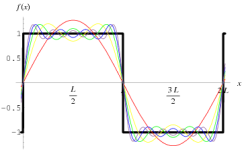
fourier_square_wave.png

I think the illustration shows exactly what you are explaining. A "square wave" is a "sum of sine wave". The first sine wave (the "fundamental") has the same frequency as the original square wave. But it requires higher frequency harmonics in order to reconstruct "correctly" the "squareness" of the wave. In fact, the Fourier series corresponding to a square wave has an infinite number of harmonics. An other interresting (?) fact is each sine has an amplitude beyond the one of the original square wave.

Back to audio now. Does that mean that at 48kHz we can only reproduce "sinus-shaped" sound up to 24kHz? Practically speaking, are all the "natural" sounds "sine-shaped"? Does the human hear made a difference between a square wave at a given frequency and a sine wave of the same frequency?


- Sylvain
 
Last edited:
Please show me a 20 khz square wave after it has passed through the bandwidth limiting filter in front of the A/D. Perhaps you're not aware that a square wave is made up of odd harmonics above the fundabmental. That means that the first harmonic of a 20 khz square wave is 60 khz!! Even a 10 khz square wave will not pass the bandwidth limiting filter used for 44.1 khz sampling, since that first harmonic will be 30 khz!

If a waveform gets through that filter, what comes out of the reconstruction filter is an accurate reconstruction, not a "guess."

Greater bit depth decreases quantization noise which lowers the noise floor and increases dynamic range.

Complex waveforms are composites of simple waveforms. Those simple waveforms must be below the Nyquist frequency. Which gets them past the bandwidth limiting filter, which gets them out the of the reconstruction filter accurately, which results in accurate reproduction of arbitrarily complex waveforms.

Fran

Guess then that your agreeing that it is not a "perfect" reproduction...

I can hear a 10K tone and a sine wave tone sounds quite different than a square wave one does.

But if your point is that not being able to reproduce a 10K square wave constitutes "perfection" then, well that puts everything else you said in perspective.

Bit depth gets you no additional head room. Digital tops out at 0 and nothing gets you more. YOU may be in effect creating more headroom if YOU record at a lower level. The bit depth gives you higher resolution samples so you can record lower if you want and basically trade resolution for headroom. But it's you making that choice, the greater bit depth just let you make that choice with out taking a resolution hit.

Or you can record at the same level and take advantage of the higher resolution.

I understand harmonics, I don't think you understand the electronics. For instance the "reconstruction filter" you keep talking about is not some smart computer regenerating device. It is some capacitors and resisters that are smoothing out the digital steps. It's not a reconstruction at all, it has no idea what the original looked like and all it is doing is averaging the levels between samples. You are right it is not "guessing", that would imply some intelligence in the process and there isn't any. The "guess" is on the engineering side and that isn't really a guess either it's a trade off of cost and fidelity and what will pass with the end user. This is an analog circuit so the goal is to do the best in the most circumstances.

Your argument seems to be that the brick wall filter on the input heavily modifies the sound and the filter on the out put accurately reconstructs back to the heavily modified version and that constitutes "perfection".

This is wrong first because even the heavily modified signal doesn't get perfectly reproduced because it's only knocked down to the Nyquist freq. and that means that anything close the cut off will be only loosely sampled.

But the bigger issue is nobody on the user side compares the post brick wall sound to the post D/A sound. THey want to know how the input sound compares to the output sound. So if all the damage occurs with the brick wall it isn't "perfect". One way to minimise the damage by the brick wall filter is to sample at a higher rate. This is done in various ways in almost all the gear you can now buy. It's what "over sampling" is all about.

BUT there is no "perfect" analog to digital to analog loop today. The closest is probably bit stream, or 1bit recording. They kind of emulate tape and that at least gets the data rate up to a point where you don't loose as much.

The point you can make, and it may be the one you are trying to make, is that for most people 44.1/16 is good enough. Actually it would seem that for most people MP3 is good enough.

The only catch in that is that "good enough" is really talking about delivery and most of us are in the capture business. You really want to capture as much as you reasonably can. You can always go down to "good enough' but you can't go the other way.
 
Back to audio now. Does that mean that at 48kHz we can only reproduce "sinus-shaped" sound up to 24kHz?
Yes, or more accurately whatever comes in a sine wave will come out (BTW the brick wall filters are set at 20K so you won't get anything at 24k).

Practically speaking, are all the "natural" sounds "sine-shaped"?

Depends on how you look at it. No natural sounds are almost all complex waveforms. And Yes because with additive synthesis you can in theory reproduce any complex wave with a combo of sine waves.

Does the human hear made a difference between a square wave at a given frequency and a sine wave of the same frequency?

Absolutely Flutes are close to sine waves and oboes are closer to a square wave. You can tell the difference between those right?
 
Last edited:
There was a rather detailed discussion on this and other audio science issues over on the JW Audio group http://jwsoundgroup.net a few months back which may be of interest. However I don't have a direct link or the time to search at present.
 
Please show me a 20 khz square wave after it has passed through the bandwidth limiting filter in front of the A/D. Perhaps you're not aware that a square wave is made up of odd harmonics above the fundabmental. That means that the first harmonic of a 20 khz square wave is 60 khz!! Even a 10 khz square wave will not pass the bandwidth limiting filter used for 44.1 khz sampling, since that first harmonic will be 30 khz!

If a waveform gets through that filter, what comes out of the reconstruction filter is an accurate reconstruction, not a "guess."

Greater bit depth decreases quantization noise which lowers the noise floor and increases dynamic range.

Complex waveforms are composites of simple waveforms. Those simple waveforms must be below the Nyquist frequency. Which gets them past the bandwidth limiting filter, which gets them out the of the reconstruction filter accurately, which results in accurate reproduction of arbitrarily complex waveforms.

Fran

For a 48k sampling rate, the input signal should be filtered with a cut off of at least 24 KHz, to avoid aliasing. Hence one could never reconstruct a 20 KHz 'square wave' because of this fact.

I believe there is also a not typically mentioned criteria that the signal is a sine wave that has this 'perfect reconstruction' quality.

Since any 'square wave' has odd harmonics that reach out to infinite frequency... it can never be 'perfectly reconstructed' at any sampling rate, there will always be some small amount of error due to the missing harmonics. (Gibbs phenomena addresses this sort of thing.)

Naturally a slow Hz wise square wave that has more odd harmonic energy in the band pass of the input filter, that will be more 'perfectly' reconstructed, than a square have that is near the band pass cut off...

Where this sort of thing probably figures into film making audio recording is when one is recording 'impulse' sounds, such as gun shots, or loud sharp noises.
 
Last edited:
The reason sound reproduction systems need extended bandwidth and high sample rates is to minimize the intermodulation effects of poor harmonic reproduction on lower frequencies we can hear. It is the same as modulation transfer functions for photographic systems. The 24bit/48kHz digital standard is the minimum bit depth and sample rate that can approach the harmonic and temporal/spatial resolution of human hearing accurately with minimum audible side effects below 10kHz.

The decibel scale provides a constant value unit of measure across different physical and electronic mediums, analog and digital. Whether measured referenced to voltage, power, SPL, or an encoded digital scale a dB is a dB is a dB. A 3dB change in SPL at a microphone will produce a 3dB change in voltage, and encoded digital values right through the entire audio chain to a 3dB change in SPL at the output of a speaker or headphone.

All systems that capture and reproduce human sensory experiences are analog systems. Sound is captured, stored, and output as an appropriate sensory analog of the original experience. Digital encoding is just a way of applying a numeric scale over a defined range of values to an analog signal for capture, mathematical manipulation, and storage.
 
Last edited:
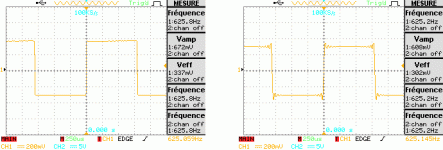
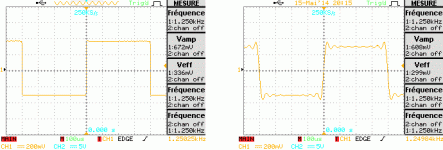
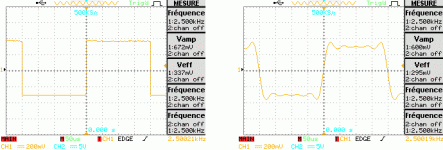
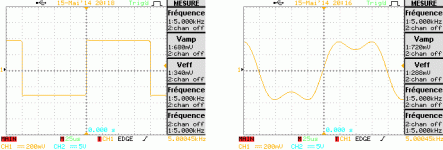
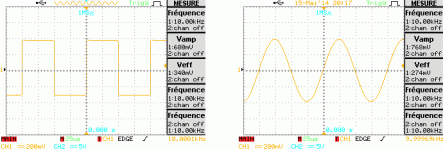
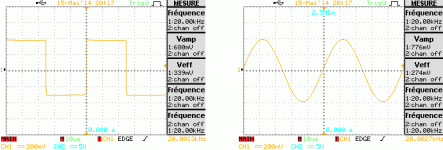
For what it worth, I made the following experiment this afternoon: I took a function generator and feed the Mic input of my laptop with a square wave of various frequencies @-10dBu. I recorded that signal @16bits/48kHz. And then replayed the captured signal out of the headset output. I visualized with an oscilloscope both the original input signal, and the reconstructed output signal in order to compare them.

Here are the corresponding screen captures:

625Hz square wave (http://www.chicoree.fr/pub/dvxforum/audio-tests/Square-00625-sample-16-48000.wav)
625Hz-square@16bits-48kHz.gif

1250Hz square wave (http://www.chicoree.fr/pub/dvxforum/audio-tests/Square-01250-sample-16-48000.wav)
1250Hz-square@16bits-48kHz.gif

2500Hz square wave (http://www.chicoree.fr/pub/dvxforum/audio-tests/Square-02500-sample-16-48000.wav)
2500Hz-square@16bits-48kHz.gif

5000Hz square wave (http://www.chicoree.fr/pub/dvxforum/audio-tests/Square-05000-sample-16-48000.wav)
5000Hz-square@16bits-48kHz.gif

10000Hz square wave (http://www.chicoree.fr/pub/dvxforum/audio-tests/Square-10000-sample-16-48000.wav)
10000Hz-square@16bits-48kHz.gif

20000Hz square wave (http://www.chicoree.fr/pub/dvxforum/audio-tests/Square-20000-sample-16-48000.wav)
20000Hz-square@16bits-48kHz.gif

It is quite obvious that only lower-frequency (say <2500Hz) square wave could "decently" be reconstructed from sampled signal.
 
Last edited:
For what it worth, I made the following experiment this afternoon: I took a function generator and feed the Mic input of my laptop with a square wave of various frequencies @-10dBu. I recorded that signal @16bits/48kHz. And then replayed the captured signal out of the headset output. I visualized with an oscilloscope both the original input signal, and the reconstructed output signal in order to compare them....
It is quite obvious that only lower-frequency (say <2500Hz) square wave could "decently" be reconstructed from sampled signal.

Precisely as predicted by sampling theory.

In order to address the issue of audio recording, play your square wave samples through any playback system you have handy, record the output, then compare that recording to that playback.

Fran
 
Last edited:
Guess then that your agreeing that it is not a "perfect" reproduction...

I can hear a 10K tone and a sine wave tone sounds quite different than a square wave one does.
...

Seriously? Do you really think you're hearing a 10 khz square wave?

What sort of gain section, let alone transducer, is delivering an audible 10 khz square wave?

Fran
 
Well let's see how about just about any tone generator. If we are only talking about A/D > D/A then that run through a 96K converter. But even at 48K you can still hear the difference, and see the difference.

BUT the entire point of your posts are that 44.1/16 provides "perfect" reproduction and even what you claim to support your claim CLERLY show that it's no where close to perfect.

But really this is silly and I'm stoping.

If you can not hear the difference between a 10K square wave and a 10K sine wave it's pretty pointless talking sound quality.
 
Back
Top