GH2 crop factor 1.86x or 2x ?

every other forum, site, spec sheet, etc, that is discussing these cameras is doing so in relation to 35mm FF. We would be the odd man out, as a film making forum. If we want to accept some sort of universal standard, shouldn't it be what everyone else is using?

I come from a studio photography background, where I was very familiar with wide-angle, standard, and telephoto lenses on 35mm Nikon, 6x6 cm Hasselblad, 6x7 cm Mamiya, 6x9 cm Fuji, 4x5 inch and 8x10 inch Sinar cameras. Getting familiar with 35mm Motion Picture formats is duck soup compared to understanding all of these professional still photo cameras.

Since most of us here are shooting video, we should forget about the 35mm Full Frame Still Photo format, as it makes no sense in the world of cinematography. It's a Still Photo format NOT a video format. It's also a lousy format for video because it's depth of field is far too shallow when shooting wide open. Razor thin planes of focus are a nightmare to focus pull and it looks ridiculous when a whole narrative film is shot this way.

If you want to standardize on one video format, then I agree with Barry that it should be the Super 35mm Motion Picture format, because that is what most people are using to shoot professional film/video with today.
 
Since most of us here are shooting video, we should forget about the 35mm Full Frame Still Photo format, as it makes no sense in the world of cinematography. It's a Still Photo format NOT a video format. It's also a lousy format for video because it's depth of field is far too shallow when shooting wide open. Razor thin planes of focus are a nightmare to focus pull and it looks ridiculous when a whole narrative film is shot this way.

Stanley Kubrick famously shot candlelight scenes with F/0.7 glass. You think full frame is hard to focus with??

Additionally, you don't need to shoot wide open, and that's sometimes the appeal of shooting with a 5D (especially in regard to sharpness, etc- most folks will tell you not to shoot wide open if you can help it anyway!). If you want to say APS-C is more standard if emulating lens selection used in cinema, that's fine. But saying you'd rather NOT shoot with full frame if the opportunity presents itself, I mean, it'll take more than that to stop me from shooting with a 1Dx if I had the choice.

If you want to standardize on one video format, then I agree with Barry that it should be the Super 35mm Motion Picture format, because that is what most people are using to shoot professional film/video with today.

Only its not. If shooting with film stock perhaps, but how many cameras on the market have some sort of crop or another? When measuring that crop, the manufacturers are referring to full frame in the specs. Just feels like an uphill battle for no reason anymore. But hey, to each their own.
 
Last edited:
Only its not.
But it is.

If shooting with film stock perhaps, but how many cameras on the market have some sort of crop or another? When measuring that crop, the manufacturers are referring to full frame in the specs. Just feels like an uphill battle for no reason anymore. But hey, to each their own.
Sure all of these cameras have some sort of crop from one another. But I believe most people here are film makers and they are all looking at this from a film maker's perspective. Not a stills shooter perspective. This ball of confusion only started with the advent of "video shooting DSLRs."
 
Nobody in their right mind would characterize a two dimensional object with a one dimensional metric in "technical" literature - that's just marketing BS. If that's how "all technical literature" is written then all technical literature you are reading is incompetent. According to that logic I could build a sensor that is one pixel high and 86.5mm wide and claim a 0.5 crop factor. The only thing a diagonal measurement is good for is to determine lens field coverage. Everything else, like pan speed, FOV (which applies to still photography too), etc... requires that you know both dimensions.
 
Sure all of these cameras have some sort of crop from one another. But I believe most people here are film makers and they are all looking at this from a film maker's perspective. Not a stills shooter perspective. This ball of confusion only started with the advent of "video shooting DSLRs."

Fair enough, but the ball of confusion IS there. It would appear that more than just a few of us are using lenses originally purchased for full frame still cameras. Heck, I walk into B&H and chat up the reps about lenses for video, and everything is spoken about in reference to FF. Then again, to be fair, they are also a camera store that just happens to outfit film and TV crews as well.

But when you see videos of Phillip Bloom discussing the AF100, and reminding us to multiply our focal distance 2x because of the crop, it all kind of makes sense. ::shrug::

To be honest, I recall you explaining this to someone a few months ago, and also referring to the crop size relative to FF. This discussion is beginning to take on a circular behavior. It doesn't matter what we are comparing it to as long as it is defined in context. If someone says the GH2 is a 1.3x crop of cinema FOV, that's all find and well. But if you don't say what you are comparing it to, it seems to very often imply that you are referring to FF. Or at least, that is how it appears to be elsewhere.

If we want to actively change that status, I'm all for it, but expect there to be a lot of confused newbies.
 
Additionally, how many of us are coming from a background in shooting with s35? I'm sure that there are more than a few, but even before the DSLR craze I recall seeing them refer to lenses on 16mm and 35mm using the full frame 35mm FOV equivalents. Many more of us have backgrounds in digital video, and using still photography as our reference for lenses. I know what a 28mm 50mm and 85mm look like from shooting photographs on film 15 years ago. Comparing it to s35 would be really confusing.

It doesn't matter if you come from that background or not. S35 is the standard for movie making, so that's what we follow. And more and more cameras are starting to use S35-sized sensors. I never heard of FOV being talked about in terms of full frame until the DSLR's starting shooting video, though admittedly my actual film background is limited.

If you want to standardize on one video format, then I agree with Barry that it should be the Super 35mm Motion Picture format, because that is what most people are using to shoot professional film/video with today.

Only its not. If shooting with film stock perhaps, but how many cameras on the market have some sort of crop or another? When measuring that crop, the manufacturers are referring to full frame in the specs. Just feels like an uphill battle for no reason anymore. But hey, to each their own.

Yes it is. Sony, Red, Arri, Canon, and others are all now using S35-sized or near S35-sized sensors for cameras that are primarily (or entirely) meant for video and filmmaking. Movies that are actually still shot on film are usually S35 or mostly S35. S35 is the standard. That could certainly change at some point, but since most cinema lenses in existence and use today won't cover much more than an S35 frame that could be a long long way off.


From this discussion I think I've started to realize that maybe there needs to be 2 crop factors in use for all cameras, one for still lenses and one for cinema lenses. However, can we verify that the FOV of a still lens and a cinema lens are different? In my current thinking, they should be, but could someone do a test? It would require someone with a GH2 to use say a 50mm still lens and a 50mm PL cinema lens (will need a PL adapter) and shooting the same subject from the same distance so we can see the difference. Anyone here that can do that? Kholi, maybe? I've never seen the comparison, so it would be interesting to see. And if they are different (and I think they should be), then with the GH2, if you're using a still lens you need to use a crop factor of 1.9x. If you're using a cinema lens you need to use a crop factor of 1.3x. The AF100 would be a little higher of a crop factor.

Any takers on that experiment? I'd do it, but I don't have a PL lens or adapter.

HAPPY NEW YEAR!!!
 
Stanley Kubrick famously shot candlelight scenes with F/0.7 glass. You think full frame is hard to focus with?

In shooting the famous 5D MK2 episode of House MD, the biggest problem the camera crew had to deal with was focus pulling with the 5D MK2 with lenses that were wide open or close to it. This was their nightmare in choosing to use the Canon 5D MK2.

Additionally, you don't need to shoot wide open, and that's sometimes the appeal of shooting with a 5D

But lots of people do, partly because of exposure. ( i.e. night scenes and interiors where a big lighting package may not be in the budget ) This is where the an APS-C or M4/3 camera would be a better fit because you can shoot wide open and record greater depth.

But saying you'd rather NOT shoot with full frame if the opportunity presents itself, I mean, it'll take more than that to stop me from shooting with a 1Dx if I had the choice.

It depends on what you are choosing. For the price of a 1Dx you could have a Sony FS-100 with a 4:2:2 external recorder and built in XLR audio. Unless there is something very special when shooting video with the 1Dx, the FS-100 might be the better camera. A lot will depend on what the 1Dx brings to the table. If it's not better than an FS-100, then it's a bit of an expensive dud in the video world.

Only its not. If shooting with film stock perhaps, but how many cameras on the market have some sort of crop or another?

...But we're not really shooting with crop cameras when viewed from a cinematography perspective. The APS-C and M4/3 formats are almost identical to the Super 35mm / Standard 3-perf Motion Picture formats. The odd man out is the Full Frame Still Photo format which is not the norm for film work.

When measuring that crop, the manufacturers are referring to full frame in the specs. Just feels like an uphill battle for no reason anymore. But hey, to each their own.

How many professional film / video camera and lens manufacturers ( NOT still photo camera and lens manufacturers ) are using the 35mm Full Frame Still Photo format as their reference point ?
 
From this discussion I think I've started to realize that maybe there needs to be 2 crop factors in use for all cameras, one for still lenses and one for cinema lenses. However, can we verify that the FOV of a still lens and a cinema lens are different? In my current thinking, they should be, but could someone do a test? It would require someone with a GH2 to use say a 50mm still lens and a 50mm PL cinema lens (will need a PL adapter) and shooting the same subject from the same distance so we can see the difference. !

Woah ... you've lost me. If they are both 50mm lenses, why would there be any difference???
 
From this discussion I think I've started to realize that maybe there needs to be 2 crop factors in use for all cameras, one for still lenses and one for cinema lenses. However, can we verify that the FOV of a still lens and a cinema lens are different? In my current thinking, they should be, but could someone do a test? It would require someone with a GH2 to use say a 50mm still lens and a 50mm PL cinema lens (will need a PL adapter) and shooting the same subject from the same distance so we can see the difference. Anyone here that can do that? Kholi, maybe? I've never seen the comparison, so it would be interesting to see. And if they are different (and I think they should be), then with the GH2, if you're using a still lens you need to use a crop factor of 1.9x. If you're using a cinema lens you need to use a crop factor of 1.3x. The AF100 would be a little higher of a crop factor.

Any takers on that experiment? I'd do it, but I don't have a PL lens or adapter.

No no, I think you have misunderstood. The focal distance is measured in mm, and has a constant definition no matter where it is used. A smaller sensor will crop the image inward, but as was mentioned earlier, a 50mm lens is a 50mm lens, regardless of whether or not it was designed for cinema (however a cinema lens may not fully cover a full frame sensor, causing a vignette).

But therein lies the rub- unless you are using PL mount cinema lenses or other lenses designed for smaller sensors/film, it would appear that most of us are using photography lenses to shoot video. Those Nikon, Minolta, FD, etc lenses are usually designed to cover a full 35mm film frame. So, when discussing crop values, or how much of the lens is actually visible, it seems logical to compare it to the format it was designed for. My 50mm Nikkor was designed for a 35mm film Nikon camera. I can crop inward with a smaller sensor (as I am), but I can't go bigger (love the imax reference earlier in the thread, btw). So, how much of it am I actually able to use with this sensor? Well, on the GH2 about 1.9 or so. Simple, right?

I understand that many of us are not coming from the same perspective, and that's cool, I'm just trying to explain why so many others do. And while we're at it, why it doesn't seem logical for anyone to switch at this point.

The difference in FOV between my GH2 and APS-C Canon are noticeable. These cameras are not all exactly s35 size, as the charts and numbers everyone shared prove. So how do we discuss their relative size and FOV?

The answer: it doesn't matter, as long as the context is understood. How did we get here again?
 
I cannot believe there is 7 pages of debate on the crop factor in this forum. What has become of DVX user? It is getting so that no one can even write a few simple sentences here without being challenged, virtually aggressed here. It is very tiring.

What's the big deal? Since most of the lenses people are shooting on DSLR's were originally designed for photography on a FF camera, it makes sense that people refer to a crop factor for those very same lenses based on that. Like it or not, "Full Frame" (FF) is the easiest standard for most folks to relate to because the world of moving images has changed. It has grown exponentially and is populated by another culture. That of still photography.

People's feathers are being ruffled because the frame of reference now comes from the photo world rather than the video one?

Gimme a break, don't we have better things to do than worry about this?
 
Last edited:
I cannot believe there is 7 pages of debate on the crop factor in this forum. What has become of DVX user? It is getting so that no one can w even a few simple sentences without being challenged, virtually aggressed here.

What's the big deal? Since most of the lenses people are shooting on DSLR's were originally designed for photography on a FF camera, it makes sense that people refer to a crop factor for those very same lenses based on that.
Like it or not, "Full Frame" (FF) is the easiest standard for most folks to relate to because the world of moving images has changed. It has grown exponentially and is populated by another culture. That of still photography.

People's feathers are being ruffled because the frame of reference now comes from the photo world rather than the video one?

Gimme a break, don't we have better things to do than worry about this?

^ this.
 
No no, I think you have misunderstood. The focal distance is measured in mm, and has a constant definition no matter where it is used. A smaller sensor will crop the image inward, but as was mentioned earlier, a 50mm lens is a 50mm lens, regardless of whether or not it was designed for cinema (however a cinema lens may not fully cover a full frame sensor, causing a vignette).

But therein lies the rub- unless you are using PL mount cinema lenses or other lenses designed for smaller sensors/film, it would appear that most of us are using photography lenses to shoot video. Those Nikon, Minolta, FD, etc lenses are usually designed to cover a full 35mm film frame. So, when discussing crop values, or how much of the lens is actually visible, it seems logical to compare it to the format it was designed for. My 50mm Nikkor was designed for a 35mm film Nikon camera. I can crop inward with a smaller sensor (as I am), but I can't go bigger (love the imax reference earlier in the thread, btw). So, how much of it am I actually able to use with this sensor? Well, on the GH2 about 1.9 or so. Simple, right?

I understand that many of us are not coming from the same perspective, and that's cool, I'm just trying to explain why so many others do. And while we're at it, why it doesn't seem logical for anyone to switch at this point.

The difference in FOV between my GH2 and APS-C Canon are noticeable. These cameras are not all exactly s35 size, as the charts and numbers everyone shared prove. So how do we discuss their relative size and FOV?

The answer: it doesn't matter, as long as the context is understood. How did we get here again?

I'm not saying 50mm isn't 50mm. What I'm saying is that the size of the image between a still lens and a cinema PL lens at the same focal length are different sizes. They show the exact same image because they are the same focal length, but in different size projections. That's what I want to see and verify. If that is the case then you need 2 different crop factors (or more than 2) depending on the type (still, cinema PL, etc) of lens being used. The reason being because, by this logic, if I take a cinema PL lens and put it on a 5D, it won't cover the sensor, right? Aren't most cinema PL lenses about 32mm diameter image circle? The 5D FF when shooting video is about 41mm. So if you take the cinema PL lens and put it on a GH2 it will cover the GH2. You wouldn't use 1.9x crop factor for the cinema PL lens because it's made to cover a S35 FF, and so you would use the 1.3x crop factor because you'd compare it to S35 frame size.

Why does this matter? Because, if you take the F3 as an example, it has a PL mount and a near S35-sized sensor. You'd put a cinema PL lens on it, and so you would use the S35 based crop factor, whatever that is. Then if you take the FS100, it has the same sensor, but a different mount. If you use a cinema PL lens on it with an adapter, you'd have the same crop factor as the F3. But if you put a still lens on it that's made to cover a FF sensor, then you'd have to use a different crop factor because more of the image circle is getting cropped with the still lens vs the cinema PL lens.

Does that make sense? I think everyone is right, it just depends on what lens you're using and what cameras you're thinking you'd compare it to. I think having 2 crop factor figures (still and cinema) would really clarify it for a lot of people. For example, I'd say that the GH2 has the following

- still lens crop factor of 1.9x (ex. 50mm still lens=95mm FOV)
-cinema lens crop factor of 1.3x (ex. 50mm cinema PL lens=65mm FOV)

I think that would really help a lot of people understand better what they're looking at and why they might choose certain lenses, and reduce the amount of confusion.

I cannot believe there is 7 pages of debate on the crop factor in this forum. What has become of DVX user? It is getting so that no one can even write a few simple sentences here without being challenged, virtually aggressed here. It is very tiring.

What's the big deal? Since most of the lenses people are shooting on DSLR's were originally designed for photography on a FF camera, it makes sense that people refer to a crop factor for those very same lenses based on that. Like it or not, "Full Frame" (FF) is the easiest standard for most folks to relate to because the world of moving images has changed. It has grown exponentially and is populated by another culture. That of still photography.

People's feathers are being ruffled because the frame of reference now comes from the photo world rather than the video one?

Gimme a break, don't we have better things to do than worry about this?

Actually, I think this is very important stuff. A lot of people find it confusing and unclear, even me apparently, and so we want to discuss it. And that's all this is, a discussion. Everyone is getting along. There's no one saying you have to read the thread, so if you don't want to be a part of it then go to another thread. No need to come in here like this. And no, FF is not the easiest standard for most folks to relate to. This is a filmmaking forum and many and possibly most don't come from a photography background. And FF is not the standard in cinematography and we are talking about cinematography here, not photography.
 
Last edited:
Actually, I think this is very important stuff. A lot of people find it confusing and unclear, even me apparently, and so we want to discuss it. And that's all this is, a discussion. Everyone is getting along. There's no one saying you have to read the thread, so if you don't want to be a part of it then go to another thread. No need to come in here like this. And no, FF is not the easiest standard for most folks to relate to. This is a filmmaking forum and many and possibly most don't come from a photography background. And FF is not the standard in cinematography and we are talking about cinematography here, not photography.

Whatever.
 
Well I'm glad to see that everybody saw in the New Year in style! Lol

Why can't people just pick up an m43 camera and look through a zoom lens? At 14mm it's a standard wide. At 25mm it's a standard. At 50mm we're in tele land. 12mm and below we're in ultra wide territory.
If you shoot S16, then you just learn that wides are around the 5-12mm mark, in Full Frame wides are around 16-35mm.
The focus on the "crop" term is misleading and confusing. As m43 is now becoming a new standard for shooting motion, then just learn what the various focal lengths mean. That's it. No need to argue whether the point of reference is Imax or whatever. If you're new to system, then use a calculator.
I can see the benefit of working out the exact FOV numbers, for matching on VFX and mixing different format cameras on a shoot with one set of lenses, but for most people new to the system, all they really need to know is what their beloved 85mm lens will look like ( a nice short tele ).

Happy New Year and here's to more endless discussion of crop factors, banding, highlight handling and DOF
Cheers
 
Folk who own a GH2 DO know what their lenses look like. This issue rears up periodically because someone like the OP asks a question and folk who apparently don't own the camera answer incorrectly, or at least unclearly.
 
For example, I'd say that the GH2 has the following

- still lens crop factor of 1.9x (ex. 50mm still lens=95mm FOV)
-cinema lens crop factor of 1.3x (ex. 50mm cinema PL lens=65mm FOV)

I think that would really help a lot of people understand better what they're looking at and why they might choose certain lenses, and reduce the amount of confusion.

I don't see how posting things like this is going to help anyone at all! The focal length of a lens doesn't change -- 50 is always 50 -- and the imaging chip dimensions (except in special cases like the T3i) don't change either, so the type of mount or the make of lens or whatever makes no difference. The quoted example will only lead to confusion, not clear any up!

Cheers,
GB
 
Even though the projections are different all 50mm lenses will have the same fov on the same camera. A 50mm full frame still lens, a 50mm pl cinema lens, and a 50mm m4/3 lens will all have the same fov on a gh2. The crop factor is merely a way to compare fov across different sized sensors. In the end it's all pretty irrelevant anyway if you understand how lenses will behave on your particular camera. On a 5dmkii a 24mm lens is wide. On s35 or aps-c it's slightly wide, and on a gh2 it's standard. Get some lenses that you can afford and go shoot. I'm in to geeking out as much as anyone else, but this beating to death of semantics and trivial details is ridiculous.
 
Actually, comparing a single dimension is the more valid way to calculate crop factor, you just have to pick the right one to compare. Decide on an aspect ratio, crop image area(s) to match that aspect ratio, and then take the ratio of the vertical, horizontal, or diagonal dimensions - all will yield the same answer. For example, if you crop 35MM FF (24mm x 36mm) to have a 16:9 aspect ratio you get an image size of 20.25mm x 36mm. Whether you compare the diagonals, the verticals, or the horizontals you get the same answer - a crop factor of 1.89. So the easiest way to do it is to compare whichever dimension - horizontal or vertical - which is not cropped to achieve a common aspect ratio (assuming you pick one or the other's native aspect ratio). If you are interested in 35mm FF aspect ratio (3:2) the crop factor becomes 2.24 because it is the vertical dimension which is not cropped (24/10.7). If you are interested in ND 16:9 aspect ratio the crop factor becomes 1.89 because it is the horizontal dimension which is not cropped (36/19).

If you are comparing with an academy 33mm motion picture frame, you get two different answers depending on which aspect ratio you choose. If you want the academy 35mm aspect ratio it is calculated by comparing vertical sizes (because the horizontal one has to be cropped on the GH2); the crop factor is 16/10.7 = 1.5. If you want the HD 16:9 aspect ratio the ratio is calculated by comparing horizontal sizes (because the vertical one has to be cropped on the academy 35mm camera); the crop factor is is 22/19 = 1.16.

Arguably, the worst way to calculate crop factor is to use the ratio of diagonals if the aspect ratios do not match.
absolutely, if you want it accurate
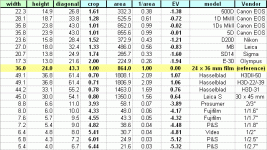
where aspect ratios are different what you ought be doing is using the e/v in stops from FF. Looking at the native diagonals of each, 4/3rds is 21.6 to FF 43.3, that makes it exactly 2x, but its wrong
using e/v accounts for the area of each sensor, where 4/3rds being 4x3 is more efficient (864 vs 224.9). Using area makes 4/3rds -1.9417 stops from FF. Work it out from ²log(area ratio)
(incidentally if it where 5D the sensor is 35.8x23.9, not exactly FF with an e/v difference of -0.0141)

Assuming 5DII 16x9 is 36x20.25 which is as far as we can go on FF width, thats 729sq mm, and an e/v from FF of -0.2451
GH2 16x9 is 18.8x10.6 for 199.28 sq mm, and has an e/v from FF of -2.1162
with that information you can work out the e/v difference between the two, simply 2.1162 - 0.2451 = 1.871

OK so now we have 2 things going on, the difference in stops e/v between formats (as above), and the FL of lenses, which I believe should be worked out from the diagonal
FL relates to getting the same angle of view, where e/v difference in stops relates to aperture selection for the same DoF, among other attributes such as noise etc.
And it is only that relationship between formats that makes this important, otherwise it isnt of any importance at all.
 

Attachments

  • EV-relative.gif
    EV-relative.gif
    18.5 KB · Views: 0
Last edited:
Back
Top