Coronavirus Impact

Status
Not open for further replies.
One thought I had on the great depression -

Some people are wondering if this pandemic will leave a lasting imprint on us like that depression did. My guess is that it won't, because in the worst case scenario covid will last 1.5-2 years. The GD lasted 10 years, followed by a major 6-year war that imposed rationing (or devastation, depending on where you lived). So the GD was a factor of magnitude longer.

But maybe we'll come out of this more germophobic and neurotic about hand-washing. Maybe mask-wearing will become more common. I, for one, will be much more afraid of the next epidemic that gets reported.

But the real lesson this drives home for me, on top of the 2008 recession, is that a recession could happen at any time and for reasons that even clever people can't predict.
 
Official guidance is now looking to become "wear a masK" as they think the virus may be transmitted airborne easier than initially suspected.

Does anyone know - can surface particles be disturbed and become airborne by handling?

Say for example handling a package (cardboard box) or a grocery store item (plastic bag of chips) that theortetically may be contaminated. Can the act of picking up the package and handling it disturb the surface particles, send them airborne, and then lead to inhalation?

Reason I ask: is the risk of handling items delivered to your home a matter only of touching surfaces without a need for a mask? Or is it advised to wear a mask when handling delivered items?
My system, to be honest, is I open packages (just did an hour ago), after they've sat on my balcony for 2 days, wearing a mask and gloves.
And I mist them lightly with 91% spray alcohol.
Overkill? Perhaps, but my wife has COPD, and I want to reduce risk as much as possible.
Took my wife to the pharmacy today to pick up an Rx, only her second time out in an N95 mask, and I got a queasy feeling in my stomach...

Grocery dry goods I leave out for one day. Don't ask why the discrepancy, but that's what I do.

Probably more an abundance of love and caution than science...
 
But the real lesson this drives home for me, on top of the 2008 recession, is that a recession could happen at any time and for reasons that even clever people can't predict.
The more we think we know everything, the more it turns out we don't. ©
 
Looks like Japan is declaring a state of emergency: https://www.bbc.com/news/amp/world-asia-52184375

But they will not be restricting business and movement as much as elsewhere, I'm sure Knoop will happy to hear. People are afraid that Tokyo is about to have a major outbreak. But from what I read, they have about double the number of cases there from one week ago. NYC before social distancing was doubling every 2-3 days. Could widespread mask-wearing in Tokyo be slowing the spread?

""In Japan, even if we declare a state of emergency, we will not close cities as seen in foreign countries. Experts have told us that there is no need for such a step," said Mr Abe."
 
No, it is because Hydroxychloroquine doesn't work and has caused deaths in the USA.

Trump has continued to tout the unproven remedy Hydroxychloroquine which is not not approved in anywhere in the world for Covid-19 treatment.

Most of the world is actually working together.

Wrong, bro. India is hoarding it for themselves. The proven effects of hydroxychloroquine are modest and larger studies are required, but the drug is widely being used in the US with covid patients even though it hasn't been fully studied. But no, I don't think Trump should be touting it. And yes, most of the world is being more cooperative. People have died taking the wrong drug or taking it without medical supervision. It's an anti-malarial in use for a long time.

From CNN: "In India, the eligible individuals for use of the drug are "Asymptomatic healthcare workers involved in the care of suspected or confirmed cases of Covid-19 and asymptomatic household contacts of people testing positive for Covid-19."
 
I don't know how much overseas coverage you guys are reading but we are seeing some rather lurid reporting re the state of affairs in the States. What sort of reactions do you guys have to conments in articles like this.

Chris Young.

https://www.theguardian.com/news/da...T-bcXBxQWrsZJXN0sgWBDZnwfo-B-YuVerp3TxGYMG3VI

Well, I'm a regular reader of the Guardian - possibly my favorite newspaper - and you'll hear no argument from me.

Of course, for hospital beds per capita the US ranked closely with Spain, but obviously far from the top of the heap.

The popular saying here is that we have the best medical system in the world. People who toe that line will go on to say that people fly here from all over the world to get treatment.

My conceptualization is that if you're rich, you can get excellent care in a private hospital. Which is why rich people fly here.

Our current insurance system leaves some people uncovered and some people unable to practically afford going to the doctor with the coverage they have, or at least forced to make a difficult financial choice when they get ill. I'm not a fan.

Decades of austerity and closing hospitals because they weren't profitable enough, along with a general downsizing of hospitals in favor of trading bed capacity for more lucrative services (I'm not sure what - outpatient stuff?) have left us with little capacity to spare.

My 2 cents.
 
I was listening to "The Daily" podcast the other day (the most essential news podcast IMO), and they were talking about the reasons for shortages of various things needed to fight the virus (PPE, ventilators, hospital beds). There's a different answer for each item, but the hospital bed situation is the way it is because of cost. Hospitals aren't actually that profitable usually and are run by some strict accounting. Since about 30 years ago, there is a calculation that they need to keep hospital beds to the minimum they need, which in normal times is about 90% capacity. Like so much else, the system is run with finance in mind and not anticipating a crisis like this.

How is it that US healthcare is the most expensive anywhere and yet many hospitals struggle to stay in the black? I've wondered that and many people have answers, but there are certainly doctors, pharmaceutical companies, and various specialists that make a great deal of money. But they also usually send you their own bills, separate from the hospitals.

I was in London years ago for a few months, and went to a clinic to see a doctor, who referred me to a hospital where I got an X-ray. It was almost shocking to me how great, easy and inexpensive that whole process was. And many years before that, I lived in Prague, and it was much the same. But, if you're wealthy in the US, you may have an excellent insurance plan, paid through your job, and you will probably get excellent care and might never know what money has changed hands behind the scenes.
 
Yes maybe "lurid" was the wrong word to use, as some said the Guardian is not known as a sensationalist paper.

The Guardian article does though tend to ouline the shortcomings of a medical system where there is no levy paid by all tax payers to fund a nation wide health system. Sure like us in AU you will be levied or taxed to fund a system whereby all of us are covered 100%. What private health cover gives us here is your choice of doctor and a private room with a bigger TV and uglier nurses. We pay 2% of our taxable income whether you are a millionaire or a poor underappreciated camera person. Many medical practices bulk bill. In other words you produce your Medicare card, they swipe it, you sign, job done. They get paid by the government. I've always wondered why in the States medical costs are so high and why so many people are totally without medical cover. Why is this? Vested interests in the private sector I guess? IMHO Health care should not be commercialized. No person, corporation or country should look to make a profit out of health services. Sure it might sound a bit altruistic to say this but in reality is there any fairer way to deliver equal health quality to all other than make all who can pay i.e. tax payers pay for a universal health system? Or does that sound to socialist to many of you? Feel I'm getting onto dangerous ground here as these views can be perceived as political so I'll stop.

As an outsider it's just a massive sadness to see a country that so many other countries look to for for global leadership, organizational ability, preparedness and inspiration have such a tough time over these demanding times. Stay distant stay well folks.

Chris Young.
 
No, it is because Hydroxychloroquine doesn't work and has caused deaths in the USA.

Do you mean the one certifiably crazy lady that fed herself and her husband fish tank cleaner (totally different compound of chloroquine) with no medical advice, consequently poisoned themselves, and then got written up in certain media as an “orange man bad” warning? HCQ has existed for half a century, and it’s side effects in clinical use are limited to possible retinal damage with prolonged dosage. There's one contraindication if the patient is on metformin. I have zero clue why a huge swath of people are virulently resistant to even seeing if it works as preliminary data suggest it may. Ok... I know why drug companies itching to sell something new, proprietary, and expensive are resistant, but reasonable people?
 
Last edited:
I don't know how much overseas coverage you guys are reading but we are seeing some rather lurid reporting re the state of affairs in the States. What sort of reactions do you guys have to conments in articles like this.

Chris Young.

https://www.theguardian.com/news/da...T-bcXBxQWrsZJXN0sgWBDZnwfo-B-YuVerp3TxGYMG3VI

The easiest way to understand the reporting in the US is to understand that almost all of the news has become extremely partisan. The more respected institutions have become part of the resistance against the Trump administration and any federal or state authority that appears to be working with him. Then, there is Fox News and some more fringe news sites that try to encourage people to like what Trump is doing. Even if news isn't related to the Trump administration, it will somehow be painted that way. News that isn't related to the Trump administration is generally ignored. Although their editorial content is on the Trump side, I find Real Clear Politics to be the best way to sort through the current narratives being pushed. It basically gives a list of various opinion pieces directly contradicting each other from either side of the partisan divide.

The Guardian is very much a part of the resistance. Personally, when I see articles like the one you posted from the Guardian, I just lose respect for the resistance narrative. Those illustrations are bizarrely dumbed down. The point seems to be that the US has less per capita hospital beds than the average "developed" economy. Here is an article comparing the number of critical care beds per capita. https://www.forbes.com/sites/niallm...are-beds-per-capita-infographic/#762f61097f86. Only Germany comes close in the ability to care for critically ill patients.
 
The Guardian is very much a part of the resistance. Personally, when I see articles like the one you posted from the Guardian, I just lose respect for the resistance narrative. .

But the Guardian is a British paper. And the shortcomings of the medical system long predate Trump. Doesn't seem like a resistance piece to me.

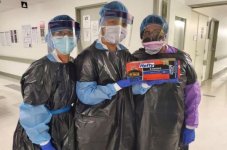
What American isn't embarrassed by the pictures of nurses wearing garbage bags for protection?

90912113_10218530223061135_4086051939169599488_n.jpg
 
3 words...Medical Malpractice Insurance.

That is one that a lot of people don’t think about. Your average doctor’s annual malpractice insurance can run from 4-5 figures with “high risk” dr’s(like surgeons, obstetricians, anesthesiologists, etc.) well into the 5-6 figures. And we all know how litigious the US is.

As much as I dislike the government being more involved in anything, I think at some point a ‘single payer’ system is going to have to happen, here. Our current system is just unsustainable. I’ve been fortunate and have had insurance continuously from the day I was born, but the country is full of people that don’t have it, because they can’t afford it or if they do have it, they can’t afford to actually use it, because the coverage is so bad. I had a friend that I grew up with lose a foot and part of the leg up to his knee about a year or so ago. He had become diabetic and couldn’t afford his insulin, either because he couldn’t afford insurance or his insurance was so bad he just couldn’t afford the co-pay for his prescriptions. Insulin is not a drug that you can ration out(in the traditional sense) and only take every other day to make it last longer.

Sorry for the slight diversion, but it’s just one of the countless tales of our broken healthcare system here. And unfortunately, the decisions about our health care insurance, policies and laws are made by those that are covered by a separate “insurance” system unavailable to anyone else.
 
Status
Not open for further replies.
Back
Top