Coronavirus Economics/Finance

Then what to do - lean into producing? Or lean into the high-end?

I have no desire to produce, at least in the typical, all-encompassing sense. By high-end, I was largely meaning narrative/narrative-type work. It would be a huge pivot for me and that's not the world I've lived in for last two decades, so the chances of me becoming an op in that world are probable very slim, if I was even trying to go that route. I'm sure I could adapt and succeed at it, if I was put into that world, though.

There's one thing I've learned in my 40+ years, "Never say never".
 
People have been saying this for a while, but it's just further confirmation that "good enough" iphone shooting will take over some of the easier stuff

It's the same with live streaming. The lower IQ people look at professional live streaming like we produce with professional graphics, well mixed sound, professional cameras and lighting and then
wonder, "Why don't we just do this on Zoom? It's free."

If you can't see and hear the difference between professionally produced live stream media and Zoom with everyone's crappy wi-fi, dropouts, freezes,
terrible and or nonexistant lighting, framing, horrible, undecipherable sound, you're right, you should just use Zoom.

OTOH, we have been increasing our live streaming prices and have had two follow ups this week from potential clients that we thought my proposals had given sticker shock to.
If they come through, both are multi-day, all day, multi camera, pro quality level streams, one for a marketing guru and one for a well know food retailer. These are live streaming
projects in the $30k-$45k range. If they come through, it will grow my optimism and direction that we MUST move away from the bottom feeder clients because the bottom feeders
are just doing it themselves, for free, on Zoom, Teams, Webex. But just like in regular video production, when you have to come across as professional, you have to hire pros to do it right.

Not booked yet, but at least in play. Fingers crossed.
 
Last edited:
... If you can't see and hear the difference between professionally produced live stream media and Zoom with everyone's crappy wi-fi, dropouts, freezes, terrible and or nonexistant lighting, framing, horrible, undecipherable sound, you're right, you should just use Zoom.

A friend in Belarus posts an article about "Morozko", a trippy Soviet era children film. The article writer wonders quite earnestly why it was perceived as such in the US (someone did the overdub for it and titled the film "Jack Frost"). My response to her, "Most Soviet era films would be given failing grades as a film school project". And the reasons would be pretty much the same as you gave above - horrible lighting, horrible framing, horrible sound, horrible film stock. And most who grew up in the USSR don't care. They grew up with that and they still love it.

PS. Kalatozov, having already won the Golden Palm for the "Cranes are flying", was afforded the East German B&W film for "I am Cuba". It may not have been the top notch West German quality but it was made in an old Nazi era AGFA factory and was deemed good enough. Buying something like Kodak was out of the question.
 
OTOH, we have been increasing our live streaming prices and have had two follow ups this week from potential clients that we thought my proposals had given sticker shock to.
If they come through, both are multi-day, all day, multi camera, pro quality level streams, one for a marketing guru and one for a well know food retailer. These are live streaming
projects in the $30k-$45k range. If they come through, it will grow my optimism and direction that we MUST move away from the bottom feeder clients because the bottom feeders
are just doing it themselves, for free, on Zoom, Teams, Webex. But just like in regular video production, when you have to come across as professional, you have to hire pros to do it right.

Not booked yet, but at least in play. Fingers crossed.

Good luck with those bookings, puredrifting! That sounds like a very promising development.

It's generally true that a high-quality, refined service in whatever type of production will be less vulnerable to replacement by consumer tools. But I do worry about macro-level shifts that could impact demand. Like what if you invest a lot of time and energy in live-streaming but then the demand for it plummets after the pandemic. If you can retool your business fast enough and move to a different service, maybe it doesn't matter.

Or for me, I used to do about 25% editing and 75% shooting. Now, those proportions are reversed (mostly due to decreased business volume). So, I could say - I should lean more into editing since it's more pandemic-proof. But what if editing is more vulnerable to AI replacement and sees a decrease in demand in the future?

I think the lesson for me is that you shouldn't put all your eggs in one basket. (I'm not saying that you do, puredrifting, you're obviously a man of many talents and a remarkably varied career)

All valid points Abe and ones that I discuss with two new business partners almost daily.

On the live stream front, we have to face it, live streaming is rapidly becoming commoditized. There are a bunch of new Cloud-based live stream switching, CDN, and auction/fundraiser sites like Givergy, Give Smart. etc.
On the low end, we have thousands of out of work video people, many who are thinking, "We already have the skills, cameras, lighting, let's buy an ATEM Mini Pro and start offering live streaming services!". So live streaming, as a business is quickly becoming a commodity from competition, not to mention
from DIY solutions like Zoom, Teams and Webex/Skype. Like all businesses that become commoditized, the services, gear and resources will rapidly become better and better, easier to use, higher quality, cheaper. After things return to "normal", I'm betting that live streaming isn't going to fall off the map
simply because the past six months have show businesses and corporations that a lot of things that they THOUGHT had to be done face to face with air travel, hotels can be done with live streaming with as good if not better results to the bottom line
at a much lower cost. Seems like business 101 to me, the same or better results for signficiantly less money? I'm not saying live streaming is replacing all travel and location events, but it will replace some permanently without a doubt. The fundraiser we did for the LA Zoo on-line
with Joel McHale, the Beastly Ball 2020, raised many times what they ever raised the Zoo's live event Beastly Ball. In 90 minutes, we raised $1.2 million dollars. I see that event and a lot of events like that going on-line permanently.

I personally see live streaming as supplementing and in some cases replacing at least some traditional corporate video forever. I think we are looking at Quarantine and outbreaks for at least 1 more year and some sources are even saying 1.5 to 2 more years until things return to "normal" as far as business,
production, etc. So short term, demand is rising, quickly followed by the commoditization of what live streaming is. There are a bunch of niches though that hopefully will protect us for a while. I've been telling my live stream partner, "This is why we need to differentiate ourselves not only by quality and sophistication,
but also by redefining the medium of what live streaming is and can be. We have to offer the market something that nobody else or at least few others are and are capable of producing. It's that simple. We cannot compete with the bottom feeders and DIYers, just like we have not been able to with
regular video production the past ten years.

Why don't you ever see a large corporation live streaming messages that are framed as a comedy, drama, game show, high end talk show, town hall, outdoor marathon coverage, multi-modal infotainment with lots of quality live content interpersed with really well produced
roll in segments? Simple, because to most people, live streaming means a podcast with cameras. Mostly boring people sitting at computers with bad video and sound, droning on about boring things. Completely unengaging content because nobody is utilizing the potential of the medium. All live streaming is is television on people's phones,
tablets and computers. So why is almost nobody producing entertaining, engaging television in live streaming? I think it's partly because of pre-conceived notions about what live streaming is. As a medium, live streaming today is mostly boring, badly produced content for small, unengaged audiences who are there because they are
required to be there. Really, a lot of it is just the modern version of cable access TV. The tools to do amazing quality live streaming are so cheap now, but you still need pros who know what they are doing behind the cameras. You still need and will need a webcast engineer for the foreseeable future. To do these concepts, sure, it will require sets, propos, wardrobe, production value, to a point, but as we all know, with some cleverness and good creative execution, you can be entertaining on a smaller budget, it's what many of us have done our entire career.

If we and a bunch of other creatives can start innovating in pushing the boundaries of what live streaming can be, even with live streaming events like this https://thedarkzone.tv/ I'm not saying this will be a success. But the producers are doing what I am suggesting, they're doing a long form TV event
as a live stream for a concentrated, rabid, pay per view audience who eats this sort of content up. This may not work or it may, but at least it has a concept, a lot of the TV show Ghosthunters angle to it and it's not boring people sitting at their computers talking about boring things.
 
Last edited:
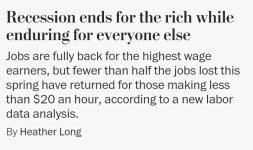
What the fudge is going on with the stock market? My little group of friends gets together once a week (we meet outside at a park n ride. 10' -15' apart, no masks). We discuss our retirement funds and the Dow always comes up. We can't make any sense of it. How can the market be skyrocketing? Sure, some companies like Amazon are cleaning up, but then others like airlines are tanked. Gold is going up at the same time. It makes no sense. Amazing.
 
What the fudge is going on with the stock market? My little group of friends gets together once a week (we meet outside at a park n ride. 10' -15' apart, no masks). We discuss our retirement funds and the Dow always comes up. We can't make any sense of it. How can the market be skyrocketing? Sure, some companies like Amazon are cleaning up, but then others like airlines are tanked. Gold is going up at the same time. It makes no sense. Amazing.

Paul Krugman:
For the recent rise in the market has been largely driven by a small number of technology giants. And the market values of these companies have very little to do with their current profits, let alone the state of the economy in general. Instead, they’re all about investor perceptions of the fairly distant future.

Take the example of Apple, with its $2 trillion valuation. Apple has a price-earnings ratio — the ratio of its market valuation to its profits — of about 33. One way to look at that number is that only around 3 percent of the value investors place on the company reflects the money they expect it to make over the course of the next year. As long as they expect Apple to be profitable years from now, they barely care what will happen to the U.S. economy over the next few quarters.

Furthermore, the profits people expect Apple to make years from now loom especially large because, after all, where else are they going to put their money? Yields on U.S. government bonds, for example, are well below the expected rate of inflation.
 
What the fudge is going on with the stock market? My little group of friends gets together once a week (we meet outside at a park n ride. 10' -15' apart, no masks). We discuss our retirement funds and the Dow always comes up. We can't make any sense of it. How can the market be skyrocketing? Sure, some companies like Amazon are cleaning up, but then others like airlines are tanked. Gold is going up at the same time. It makes no sense. Amazing.

Have you checked the recent interest rate?

PS. Given Krugman's history with the stock market prediction, he should stay away from making the stock market predictions. Yes, some companies are grossly overvalued but that's how it's always been. That's why top stock pickers know the difference between the value and the momentum. Krugman just sells pablum to the like minded NYT readers.

Gretchen Morgenson had integrity and knowledge. Paul's quite willing to be a hack.

Wow do you even read his column? He doesn't pick stocks lol.

In this column, he is explaining the macroeconomics behind the strange valuations.

To what are you referring regarding his stock market predictions? The one time he was wrong and corrected himself a few days later well before the predictions had a chance to bear out?
 
Wow do you even read his column? He doesn't pick stocks lol...

Back in the mid-90's Krugman was on Charlie Rose and, naturally, peddling some nonsense. Rose, at least, dared enough to ask, "But what about the long term effects?" Krugman replied, "To quote my favorite economist John Maynard Keynes, "In the long run, we're all dead".

Ah, yes, follow him at your own peril. Keynes, I meant. Who's in his favorite long run state.
 
Krugman has been wrong on virtually every economic prediction he has made.

Oh? Can you name them?

"He’s been right on austerity. Said it would be bad, and it has been. He also nailed the stimulus. He predicted that it was too small/indirect to have noticeable impact, and thus people would reject it saying “spent all that money on nothing!!” and fuel even more anti gov sentiment.
That is exactly what happened."

He predicted the housing bubble

He was right that the corporate tax cuts would not lead to capital investment.

He was right that reopening the economy early would lead to a resurgence of the virus followed by an economic contraction

I'm willing to bet good money that neither of you actually read his columns
 
Back in the mid-90's Krugman was on Charlie Rose and, naturally, peddling some nonsense. Rose, at least, dared enough to ask, "But what about the long term effects?" Krugman replied, "To quote my favorite economist John Maynard Keynes, "In the long run, we're all dead".

Ah, yes, follow him at your own peril. Keynes, I meant. Who's in his favorite long run state.

Your story is meaningless without context.

Incidentally, Keynes was proven 100% correct by the aftermath of the last recession whilst Friedman's theories crashed and burned.

But it's not really about growing a bigger pie, is it. It's about taking more for themselves.

Rose was probably asking him about deficit spending. And frankly, there are people still working in government and getting published who have been predicting economic collapse was just around the corner due to debt for decades.

Yet once they're in power, they pile on the debt...
 
Your story is meaningless without context.

Incidentally, Keynes was proven 100% correct by the aftermath of the last recession whilst Friedman's theories crashed and burned...
Uh, no.

But, if you like to engage in an economics debate, you may want to expand your Weltanschauung. Reading Krugman's NYT articles gives you about ten percent of the pie. Ten percent that think they're hundred percent.

The links are at your disposal.
 
What the fudge is going on with the stock market? My little group of friends gets together once a week (we meet outside at a park n ride. 10' -15' apart, no masks). We discuss our retirement funds and the Dow always comes up. We can't make any sense of it. How can the market be skyrocketing? Sure, some companies like Amazon are cleaning up, but then others like airlines are tanked. Gold is going up at the same time. It makes no sense. Amazing.

My opinion is that it is a small bubble created by lots of new people who had entered the market because they can't get out and do anything else. Also, the Robinhood app made the barriers to entry super low - you can trade stocks and options completely for free. Other brokers have followed suit with lower cost trading as well.

The market is also not the economy and people are reasonably betting that this will all go away at some point in the future and the economy will go back to normal.
 
I'm not going to go at any great length, because this can easily slip from economics into "politics", but those who claim that Krugman has never been right about anything have no idea what they're talking about.

Because while there's always room for discussion about smaller controversies and predictions, what really matters is the big picture. And on the big picture there's been a fundamental divide among economists - an epic and long standing argument between the austerity folks (some aspects of which were represented by the Austrian School - something that started all the way back in the late 19th century!) and broadly Keynesians. The crux of the most fundamental predicition was the impact of stimulus and deficit spending on inflation and interest rates. This has been an experiment that's been running for the past 30 years more or less - with predictions by both sides. Well, guess what. Krugman has won that argument decisively and the past 30 years illustrate that conclusively. The predicted inflation and high interest rates claimed by one side, specifically as it expresses itself in the bond market, simply did not come to pass - in fact the exact opposite has happened - instead, exactly as Krugman and others predicted, if anything, the bond market and interest rates indicated a deflationary tendency. We've had increasingly outlandish debt and deficits, and yet... consistently low interest rates with the bond market participation. The exact opposite of what Krugman's opponents predicted. This is not an argument any more - after 30 years, it's settled fact, delivered by history. That cannot be argued away. In fact Krugman has been making fun of his opponents predictions of "bond vigilantes" and "confidence fairies" for many years now. So - there you go, Krugman got it right on the biggest questions facing us. Of course, there is a flip side to all this - it doesn't mean that Keynes policy recommendations were actually followed by our government (or really any government out there) - you're supposed to deficit spend during a recession/depression to avoid a deflationary spiral, and you're supposed to raise taxes to curb wild speculation during times of expansion. Unfortunately, we don't have the discipline to do that - so we never tax the expansion and so never have the funds put away for a rainy day as Keynes recommended - because the voters hate taxes even in "good times". This means we end up running deficits and going into debt during times good and bad... which is unsustainable. One day, the piper will have to be paid. Krugman is right and has been right about the Keynesian dynamics of the economy - what he neglects to add is that unfortunately, nobody has gotten the political dynamics right... and what good is a recommendation that you know ahead of time will not be taken? It's unrealistic. Still, that doesn't make his opponents right - he's beat them fair and square and he's been right. But that doesn't mean we're off the hook - we'll still have to pay for our lack of discipline one way or another... sadly, there is no free lunch. And that's about as "unpolitical" as I can make it.
 
Back
Top