Cinema EOS Announcement on 19th Jan - EOS R5C

Haven't done the DR test yet, unfortunately. I haven't even opened up and powered on my a7iv that came 2 weeks ago. It's been one of those months

Well, if you need a kick in the butt to to turn on that camera and do some camera exploration, i’ll say go for it!

I’ve been working with a lot of retro style cameras lately. Film, miniDV etc. The R5C has been the first real interest i’ve had in a mirrorless camera since the A7S3 announcement.

But working with MiniDV certainly sheds light on the resolution wars. On the one hand, you don’t need specifically high resolution to tell a story or depict a scene. the low quality standard definition of minidv does well enough to get an idea out there. In some ways, i really like how low resolution works in favour of the director, as a wide shot or a close up is an extremely important part of revealing visual information, whereas as with 8K, the difference betweeen a wide and a close up might be purely psychological. 8K allows a slightly more passive or patient approach to editing, as details are there and the viewer can roam the screen looking for whatever interests them in a scene.

It makes me really appreciate the uniqueness of 8K in that way, and the R5C is certainly the cheapest and most accesible option (well, in April, anyways).
 
I see these ultra low profile HDMI parts, and looks like they allow a build-your-own cable approach, which has me thinking i can reroute the R5C side hdmi to a better placement, and convert to full size female HDMI, and then 3D print an enclosure that closely follows the contours of the camera body.

Will have to wait and test R5C when they are available, but this has given me a renewed interest in mirrorless. I’m sure these hdmi parts were available years ago, but this is the most customizable i’ve found so far:


https://www.ebay.com/itm/0-2M-FPV-Du...-127632-2357-0

they’re sort of advertised as for drones.
 
Last edited:
That’s what’s inside my special box.. animom transmitter hdmi splitter and some of these leads -also inside my pi camera enclosure

being new to 3D print I’ve not mixed the two technologies yet bu will do :)
 
That’s what’s inside my special box.. animom transmitter hdmi splitter and some of these leads -also inside my pi camera enclosure

being new to 3D print I’ve not mixed the two technologies yet bu will do :)

Pictures or it doesn’t count! haha!

I can do 3D design ok, but have very little printing experience. Haven’t bought one yet.
 
Can't you submit the plans to a printer and they'll ship you the finished thing? Or something

Yes, but can end up costing like $50-$200 and a printer is like $300-$1000. But luckily i have a few friends that print.

For metal, i’d have to do as you suggest. I think metal 3D printers are much more expensive to buy.
 
Cool. Look forward to seeing what you make of the R3.

I know this was mostly a friendly comment in passing the other week, but my extreme attention to detail and OCD just has me circling back to let you know that I won't be testing out the R3 anymore. lol
 
Well, if you need a kick in the butt to to turn on that camera and do some camera exploration, i’ll say go for it!

I’ve been working with a lot of retro style cameras lately. Film, miniDV etc. The R5C has been the first real interest i’ve had in a mirrorless camera since the A7S3 announcement.

But working with MiniDV certainly sheds light on the resolution wars. On the one hand, you don’t need specifically high resolution to tell a story or depict a scene. the low quality standard definition of minidv does well enough to get an idea out there. In some ways, i really like how low resolution works in favour of the director, as a wide shot or a close up is an extremely important part of revealing visual information, whereas as with 8K, the difference betweeen a wide and a close up might be purely psychological. 8K allows a slightly more passive or patient approach to editing, as details are there and the viewer can roam the screen looking for whatever interests them in a scene.

It makes me really appreciate the uniqueness of 8K in that way, and the R5C is certainly the cheapest and most accesible option (well, in April, anyways).

Is also a bit of a waste in that regard. If a user is going to sit a normal distance for an immersive experience they will likely never see that extra detail anyway so its all rather pointless. Editing up close on a monster monitor sure you can see every pimple on a persons face in a wide shot but in a normal situation likely the same rules will still apply. Its not just about seeing every detail in a wide shot. Its about how comfortable is it to see every detail. A closeup is still less effort to pick up detail and it directs our eyes to focus on just that detail. The normal distance viewing will not be able to pick up any extra detail anyway.

I'm all for 8k in cameras if one finds a use for it but realistically even if delivering in 8k we have to factor in how far away people will sit.

Its exactly like retina in mobile app design. Just because phones have 2x and 3x retina image assets doesn't mean the apps should be microscopic. App design is still based on display pixels or what 1x would look like. Thats so physically the apps are a size that works for users. The retina just makes it impossible to see pixels and increases visual perfection. One may even argue there is no point to 3x retina but in the case of phones we can move them insanely closer to pick up on tiny details like a desktop website scaled down to fit the device.

We are at the point where we have to kind of treat TV the same way. We can get more resolution but now its more like 2x vs 4x retina.4k being the 2x retina for almost perfect visual acuity at given normal viewing distances. 8k is like 4x retina where if you get insanely close it looks better but it does absolutely nothing at a normal distance. So we still need to shoot as if viewers can only see so much from a certain distance. Just like a mobile app still has to be designed the same way. If a 8k production is being shot thinking a viewer will see everything in a wide shot it will greatly miss the mark and fail to deliver. Unless its very specific like a massive touchscreen lobby display where users will be literally inches away from the screen. 99% of viewers will be watching on 1k, 2k and 4k displays at normal distances and close ups will still greatly matter to those people.
Woah! So true!


I was reading this article by Steve Tedlin, and and he said that we should listen to general advice and not have control over our own projects. He said people should not do 8K, and to not do 480p either, because 480p is too little, and 8K is too much reaolution. Also he recommends not to go past GO, and to NOT collect $200.
 
A 65mm/70mm film is roughly 8K in resolution. And it's been around a while. It's just that having a 65/70mm home film projector has been cost prohibitive for even a well-to-do film buff. Even if he could get his hands on a decent quality print.
 
A 65mm/70mm film is roughly 8K in resolution. And it's been around a while. It's just that having a 65/70mm home film projector has been cost prohibitive for even a well-to-do film buff. Even if he could get his hands on a decent quality print.

I've seen plenty of IMAX films in proper theaters. 2 words: marketing ploy. Dark Knight, Hateful Eight, etc... the extra resolution does nothing
 
Canon R5C - CineD Asked, Canon Answered

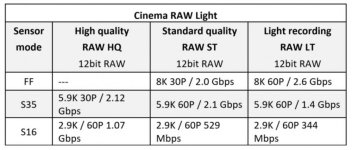
Table of Content: 00:00​ - Jump to Chapters 0:50 - Top 3 things Aron from Canon loves about the new EOS R5 C 2:05 - Why is this camera part of the Cinema line 2:41 - Who is this camera aimed at 3:45 - What are the new RAW variants 5:01 - Is there a difference in quality between RAW LT and ST 6:09 - Why is RAW HQ is limited to Super 35mm sensor mode 6:46 - What is the difference between the RAW found in the EOS R5 C and EOS R5 and R3 8:21 - The RAW found in EOS R5 is equivalent to what RAW type in the EOS R5 C 11:38 - Why is there no 8K/50p in HEVC 14:10 - Explaining the new Anamorphic de-squeeze mode 16:41 - Why is there no IBIS? 25:39 - Why is there no C-Log 2? 28:13 - Why a Micro HDMI? 30:00 - Why is there no better tripod support on this camera? 31:00 - AF explained - is it like in the EOS R5 or C70? 35:00 - EOS C70 firmware update details 38:33 - Is there “best settings” for “best video quality”? 40:13 - Availability


THANK YOU!!!! excellent breakdown. i’ll check it out soon.
 
There are a few RAW options - but yeah, why not the heavier ones for the best mode.

[EDIT: Previous comment above this one was deleted by the user.]

Click image for larger version  Name:	R5 C RAW Chart.jpg Views:	0 Size:	55.6 KB ID:	5685446
 
There are a few RAW options - but yeah, why not the heavier ones for the best mode.

[EDIT: Previous comment above this one was deleted by the user.]


Because that would be 4Gbps and the camera or media probably can't handle that
 
Back
Top