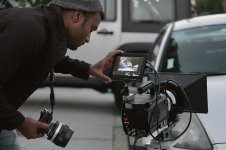
Chinese 2K RAW S35 Cinema Camera, 8000 dollars

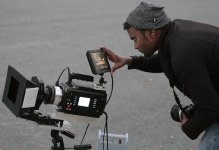
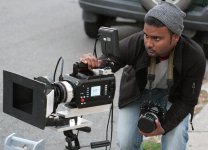
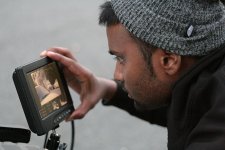
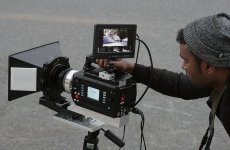
KineRAW-S35 (tm) behind the scenes photos.

KineRAW-S35 (tm) behind the scenes photos.

Here are some behind the scenes photos of Actor/Director Alvin Somwaru reviewing some shots on the KineRAW-S35 (tm) while we were shooting a few days ago in San Francisco, see the text conversion of one frame from one of the shots in my previous post above.

Kinefinity.com (sm) are still working on their web site as far as I know, they asked me to make some additional 3200K "look" files for their KineRAW-S35 (tm) so they could shoot something under lights. Just a few more days to get everything ready to bring to BIRTV 2012 booth 2B222 to show what they have been up to the last year since they showed S35 prototype #1, now they have several of the second version getting ready for sales to start and they have the HD-SDI working at 1920x1080 for live view and playback they say...

Alvin seems to like the camera he keeps asking when we can shoot some more tests and asks questions about its operations and such...
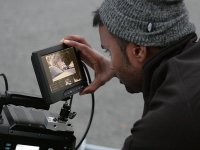
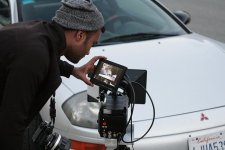
Alvin_Somwaru_with_KineRAW-S35_D.jpg
Alvin_Somwaru_with_KineRAW-S35_E.jpg
Alvin_Somwaru_with_KineRAW-S35_F2.jpg
Alvin_Somwaru_with_KineRAW-S35_A2.jpg
Alvin_Somwaru_with_KineRAW-S35_C.jpg
Alvin_Somwaru_with_KineRAW-S35_B2.jpg
 

Attachments

  • Alvin_Somwaru_with_KineRAW-S35_G2.jpg
    Alvin_Somwaru_with_KineRAW-S35_G2.jpg
    87.5 KB · Views: 0
Thank you Dan. I wll visit their booth at BIRTV and hopefully I could grab some valuable info. BTW they have announced the first batch pre-order price for kineraw s35 is starting from 39,800 in Chinese yuan which is USD6,300. I will post some test clips at a faster server later.
 
Last edited:
The new Kinefinity.com (sm) web site is under development, I have seen what they are working on but they don't want it public yet because the text is being revised and they don't have all the pages filled in yet.

They tell me that the links of the Cineform (tm) MOV and 3D-LUT should still work under their URL, so email me if you have a problem with that other than long download times, some of those clips I sent them are around 500GB and I made some new ones of over 1GB each, so the download times are going to be longer because this is high quality raw sensor data even with the light Cineform (tm) wavelet compression.

I shot some tests yesterday using the 1280x720p 59.94fps mode and attached are the ungraded shot from XNVIEW (tm)'s processing of the data under the DNG tags (which will be adjusted better in the released "look" files for the camera's monitoring probably) and a 'graded' version that is a bit lighter. XNVIEW (tm) is only a 8bit core program and clips the highlight detail off as part of its AGC ISO adjustment, but is useful for general exposure, noise, and focus checks of the DNG frames (I was shooting in BOTH mode that records CinemaDNG (tm) 100% uncompressed True RAW, and Cineform (tm) raw that is Bayer data wavelet compressed but does not have the block artifacts that H.264 cameras can show and is low compression high bandwidth for high quality results with less disk space needed.)

I don't know when the web site will be back up, maybe a while, but you can talk to them at BIRTV 2012 booth 2B222 in a few weeks if you are going to that trade show, they may have three working KineRAW-S35 (tm) there to show, and they may be demoing the 1920x1080p monitor HD-SDI output working live and for playback (it also does 1280x720p for larger text and bigger zoom size in EVF and on small monitors).


View attachment 58306
View attachment 58307


==

Hi Dan

Thankyou for volunteering your time regarding this camera. Just a few questions:

1. Have you used noise reduction and sharpening in the above frames?

2. When your program converts 12bit footage to 16bit for processing, is that the same as After Effects using 32bit float?

Cheers

Adam
 
KineRAW-S35 (tm) shutter types

KineRAW-S35 (tm) shutter types

Dan, do you happen to know if the S35 has a global shutter like the S16 and S8?

The KineRAW-S35 (tm) has a rolling shutter, but the readout time is optimized to some extent so the skew and jell-o are not as pronounced as they would be if it was not optimized. You should use a tripod or stedi-cam for most shooting even with a wide anlgle lens on the camera.

I don't have any samples from the S16 yet, you can talk to them about its status. The original information was that the S16 would be CCD with global shutter, but there may be other options now so you can ask them what the details are going to be.

The prototype KineRAW-S8p (tm) that the videos I made on Vimeo were shot with has rolling shutter but its fast enough to do hand held to some extent, you can see the hand held video I shot with a Kowa 3.5mm (about like an 14 to 18mm on S35). The production S8 may have a sensor that is twice as fast so would have less rolling shutter and might have a mechanical shutter to aviod rolling shutter issues when the shutter angle is 180 degrees or less. If you want the mechanical shutter option you should email them and say so as they have not made their mind up as far as I can tell if that will be included.
 
KineRAW-S35 (tm) samples processing

KineRAW-S35 (tm) samples processing

Hi Dan

Thankyou for volunteering your time regarding this camera. Just a few questions:

1. Have you used noise reduction and sharpening in the above frames?

2. When your program converts 12bit footage to 16bit for processing, is that the same as After Effects using 32bit float?

Cheers

Adam

You can see maybe less compressed versions of the frame samples in my posts on Cinema5D as they don't seem to re-compress the examples like DVXuser does. You cannot judge noise from JPG images since they add their own block artifact noise, you need to look at the full size TIF frames given full finish processing from the uncompressed DNG frames to tell much of anything with regard to image quality, if you are interested in seeing full size TIF you can email me at: tempnulbox [at] yahoo [dot] com with "dvxuser reader wants TIF frames" in the subject line.

In direct reply to your points,

1) The two shots of Alvin in front of the garage door in the previous page are as I said half size processed in XNVIEW (tm) an 8bit freeware program for windows that can convert DNG to BMP, those BMP were re-sized converted to JPG in a program that came with my flat bed scanner as a qucik focus check, the darker one is ungraded, the DNG tags in the DNG frame file header control the color balance and XNVIEW (tm) uses AGC it seems to try to find the ISO curve needed to bring the average brightness up to monitor viewable levels (the raw data is gamma 1.0 and the monitor is gamma 2.4 plus the images are underexposed at least one to two stops to get more highlight latitude aka headroom). So you see an ungraded result as what you would get from XNVIEW (tm) if you batch process DNG frames with it, and the lighter one is slightly gamma and saturation adjusted. Both have anti-OLPF sharpen applied as is needed, but in the case of XNVIEW (tm) there are not separate paths for luma and chroma so better results should be possable. XNVIEW (tm) produces something similar what my software calls Engineering mode or Workprint quality.

As far as I know XNVIEW (tm) does not use noise reduction automatically on reading DNG frames.

Sharpen needs to be applies in order to counter the OLPF filter in all correctly designed Bayer sensor cameras. The 1280x720p 59.94 mode that was used for that shot is a little under blurred to start with because it uses 3xX 3xY binning from the 4K sensor, the OLPF is more blurring on the 2xX and 2xY 1920x1080 and 2048x1080 modes so they need maybe higher sharpen levels. How the software does the anti-OLPF sharpen can impact the nose you see in the final results, so what software you use will make noticeable differences in the results when processing Bayer data because there is no standard way of processing Bayer data as there is no "best" solution to doing the interpolation, its a matter of opinion as to which de-Bayer method works best and there are patents on some methods that require other software makers to use less effective methods and such..

2) My processing, not use in that example you are referring to, MSB aligns the sensor data to 16bit linear for most steps because using 32bit float for all steps was too slow for motion picture work were 250,000 or more frames would need to be converted from DNG to TIF or DPX.

I do use 32bit integers and 32bit float for some steps in the processing where fractional numbers are involved, in some cases I shift the 16bit data to MSB align in 32bit then back to 16bit after processing. 16bits is enough to not see histogram gaps with a reasonable number of re-grades, you need 9 bits without histogram gaps, and if you allow for the gamma correction you then get about 14 good bits so 14-9 is 5, 2^5 = 32x as much image tonal detail as will be needed in the final result. When the 12bit data is interpolated you get fractional bits so that is why MSB alignment in a larger bit space is needed. Since 14bits is enough for film scans which are exposed well, the additional two bits is about enough for the additional under exposure of the Digital Cinema Camera sensor data, which is always exposed quite dark to preserve the highlights.

Nothing is the same between my programs and other programs as they do things differently and use different methods, and how the processing is done does not mater other than what the final results look like, so you should only pay attention to the final results from your own footage, as anything else like published specs and basing an assumption of final quality on some arbitrary byte format is not looking in sufficient depth to reach a useful conclusion, as far as I can tell.

There is nothing wrong with noise reduction if its done in the right ways as to be constructive rather than destructive, film scans are de-grained now so you do not see what "film" looks like, but rather what a de-noised, de-grained, and dust busted version looks like. Those steps are needed for processing Digital Cinema Camera footage as well because all release formats are compressed now, and you want the Blu-ray (tm) or DVD (tm) version to have as few block artifacts as possible, it does not matter how great the uncompressed footage looks if it turns to utter c##p when its converted to compressed Broadcast or cable, or put on a DVD (tm) or Blu-ray (tm). There is no real choice, you must de-noise footage for release now, as 35mm uncompressed film prints will not be project-able when just about all the projectors are removed form the movie theaters before long.

The temporal noise reduction and film look processing steps in my de-Bayer program are meant to simulate so of the things that go in in the four generation film printing process for working with 35mm negative-positive process. If you use other programs you will probably get very different kinds of results, what is better or worse depends on your opinion for the most part and the subject matter and camera used, the lens and the lighting etc.
 
this all looks very nice, S35 and 2K Raw will be a huge competitor for the BMC i guess...

Dan, we can see a Canon EF Mount offered on the website... is iris control and IS provided by this mount?

regards, Steve
 
My only fear is the fan.
Dan, can you tell us a bit about how loud it actually gets?
Would that be a problem in a closeup shot with dialogue?

Thanks, Frank

P.S. Jeeeeez, those Chinese servers are slow - downloading 150 GB takes forever.
 
Last edited:
Any more footage Dan?

You should really get paid as the spokesman for this camera. Red and Black magic design have someone full time so why not yourself. Otherwise being the US distributor would be such a great opportunity that many would jump at the chance..
 
this all looks very nice, S35 and 2K Raw will be a huge competitor for the BMC i guess...

Dan, we can see a Canon EF Mount offered on the website... is iris control and IS provided by this mount?

regards, Steve

I'm just using the Canon mount they sent for an M42 adapter to use my Screw mount lenses, I had to adjust the FFD on our lathe to get it to go a bit past INF focus because the Screw mount lenses do not all have INF set to the same distance and there is some interaction with the OLPF being between the lens flange and the sensor so is best to set the FFD short unless you are using true Zoom or Anamorphic lenses in which case you should get an adapter for each lens and tweak the FFD for each lens, that's true of using fast film lenses on a camera with a glass plate between the lens and the image plane even if people that don't want you to know that say otherwise, you get negative spherical aberration and negative curvature of field so you need to optimize the FFD for the f/ stop you will be shooting at, or if you just use lenses that that focus as one group set the FFD a few thousands short.

I don't see any contacts on the camera's mount to connect to the adapter, maybe one of the connectors on the front could hook up by cable, the camera I have for testing is just part built, some of the connectors are not hooked up inside and some of the circuit boards are not installed. It shoots for doing the "look" file calibrations which is the part I offered to help with since my software has tools built in to make those, later they will probably have their own tools but developing a camera is hard enough without also developing custom software at the same time, so since I had the software part done, it could be used until they make their own. Since I understand my software it was simpler for me to just do the calibrations here in San Francisco and email them the "look" files and calibration values, which should improve in a few weeks, I'm making progress in adjusting the calibration values to the latest firmware so things should get better looking and be more stable as time goes on, unlike the early days were the calibration points were under development.

You can just email them about the possibility of having IRIS control from the camera, but for the most part with lenses that have an IRIS ring, you just adjust the shutter angle between 90 and 216 degrees to control the exposure outdoors and have a few IR+ND filters or a Cir. Pola. Indoors you set 144 or 288 degrees under 60Hz lights or 172.8 degrees under 50Hz lights and overexposure is generally not a problem, but you can always add a IR+ND or Cir. Pola there as well.
 
My only fear is the fan.
Dan, can you tell us a bit about how loud it actually gets?
Would that be a problem in a closeup shot with dialogue?

Thanks, Frank

P.S. Jeeeeez, those Chinese servers are slow - downloading 150 GB takes forever.

It may not be just their server as I understand the US has/had something called "Carnivore" (now under a new code name?)

http://en.wikipedia.org/wiki/Carnivore_(software)

The Chinese Government may have something similar to check what is going out, and the sea cables may go through Japan on their way here, so maybe its getting slowed down in more than one place? I get upload times of like 5 hours of a 500MB MOV file.
 
Last edited:
Any more footage Dan?

You should really get paid as the spokesman for this camera. Red and Black magic design have someone full time so why not yourself. Otherwise being the US distributor would be such a great opportunity that many would jump at the chance..

I have lots of footage, the best clips have been sent to Kinefinity.com (sm) as MOV files. I have set the MOV from the camera when shooting BOTH mode, Cineform (tm) and CinemaDNG (tm) at the same time to compare the compressed and uncompressed on the same subject. I processed and de-noised some of the CinemaDNG (tm) frames and sent them YUV 4:2:2 Cineform (tm) made from the uncompressed AVI I made because they did not have a computer fast enough to play the AVI files, the Cineform (tm) compression looks vastly better than the MPEG4v2 I was using for upload to Vimeo, so that is the way to go if you cannot play uncompressed 2K AVI on your computer.

I tried uploading a night shot to Vimeo as YUV 4:2:2 2K but Vimeo says it does not support that, even to re-compress to its own format, so how you can see these high quality clip versions needs to be worked out, as was pointed out it can take days to download them from China and if the connection breaks the hours start all over again etc.

I'm not a spokesman for the camera, I have been talking about using various DNG recording cameras in connection with my freeish DI system.
 
Last edited:
website was working fine until about an hour ago. now its 404'ing!

They may be updating the site so they were just testing it and have it down again for additional changes or something, they have some text to fill in on the English pages last time I looked, I would not worry about things until a few days after Aug 25 when they are back from BIRTV 2012 and can answer email and such.

BTW that cropped image from the Asian art museum in San Francisco was taken with a B&L 50mm f/1.1 lens, I sent two clips one shot T/1.3 at EI ISO 320 and the other T/2.8 EI ISO 1280. It looks sharper and with less grain from the CinemaDNG (tm) I processed, the EI ISO 1280 one looks better and the grain is about the same with my processing. The camera works well up to about EI ISO 5120 where dark parts of the image get harder to kill all the noise in, but with fill lighting you should be able to go even higher if you need to, the top end is about 81920 but that shows quite a bit of grain at full resolution right now with the current firmware I'm testing. I think that they took that still from the Cineform (tm) so its not maybe as good looking as it could be, its better to look at the fill size 2048x1080 frame on a 2K monitor 1:1 pixel to get an idea of how good the DCP will look on the movie screen of your local multiplex movie theater...

==

Update, the site is up again, but my shot of the museum is gone, replaced by a image of the camera, which is probably better anyway.

http://www.kinefinity.com/index.asp

It looks like a notice about BRITV 2012 booth 2B222 in place of the night shot...
 
Last edited:
Oh, when I read that there were pre-orders I assumed, you know, thet they were accepting pre-orders. I guess I can't trust the internet anymore. Darn.
 
Last edited:
KineRAW-S35 pre-Orders?

KineRAW-S35 pre-Orders?

Quote: [Oh, when I read that there were pre-orders I assumed, you know, thet they were accepting pre-orders. I guess I can't trust the internet anymore. Darn.]

You need to talk to them directly, they say the web site is back up and they are getting emails asking about people outside China getting one.

As I understand things they are taking pre-orders, but they said something about orders first being shipped inside China, so if you need a camera before various issues are worked out you might be able to contract for a camera to be made special, that was all I was saying.

I do not get involved in sales, you can talk to them about custom orders or retail sales, it depends on what your intentions are as to how you can thread the needle.
 
Back
Top