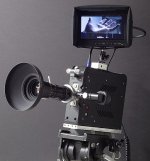
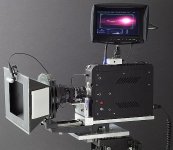
Chinese 2K RAW S35 Cinema Camera, 8000 dollars

Nab 2012

Nab 2012

will this camera be at NAB in april?

I offered to take the S8p and S35 for them to NAB for a day if they could get a small booth. I think as a Software rep I could get in for free on rep day, so I could demo how my software works with their cameras at their booth that way maybe?

You would need to email Kinefinity.com (tm) at their contact to ask them as they did not tell me what they thought of my suggestion, maybe they are not sure what day the camera could be shipped or something. Right now there are two of the second prototypes working, I have been getting DNG to measure signal levels in, they are shooting between about EI/ISO 400 and 800 to see the S/N and such. They tell me the Cineform (tm) recording is working, and the 3D-LUT have been implemented from the monitoring tables, so you get WYSIWYG for color matching to some extent although there are some more things to calibrate with the many workflows possible.

I'm not sure our car can make it to Vegas and back, but I might be able to take a Casino tour bus if there was a space, I'm in San Francisco.

The S8p (tm) is still here for calibrations and testing with my workflow, I'm working on the anamorphic demo 1828x1556 Cineon (tm) Panavision (tm) pixel resolution, doing the last shot tonight, its a sync sound demo so there are some more sound mixing and sound effects to finish but its mostly done, hope to put it on my Vimeo page before the end of the Month if things go well...

BTW: Someone on another forum complained they did not get a reply back from Kinefinity (tm) about a question, so I asked them about that, and it seems they did get delay on answering some information requests, in part I guess because they have been busy shooting calibration frames to check the EI/ISO and to make the monitoring tables with so that S35 demo shooting can start ASAP. If you do not get a reply right back and not after some time as well, email me at tempnulbox (at) yahoo (dot) com with 'dvxuser has question for kinefinity (tm)' in the subject line and I will try to ask them and forward your email address if you give me permission so you can get a reply if your email gets lost in the flood of requests. My KineRAW-S8p (tm) lens test demos on Vimeo have gotten to almost 20000 views (?!!) so as you can think kinefinity (tm) has a lot to do plus find time to reply to requests for frames and such that are not quite ready for public release because the DNG tags need to be adjusted a bit better and it takes time to shoot and re-shoot such calibrations, but as far as I know thing are moving forward, I have a photo they sent of their lights and the camera on a tripod shooting the color checker etc. so as far as I can tell its real...
 
Last edited:
Thanks for your updates Dan. I sent an e-mail asking questions regardind the s16 camera and have not heard back. No issue as I know this camera is the last to be developed. If I could ask you, is the s16 camera sort of what Red Scarlet was going to be? Am I off base to think that one could put a 2/3" B4 mount broadcast lens on this camera and treat it like a Varicam so to speak?

Thanks
 
Great updates as always Dan! No sarcasm here Dan, ....tell them about this: http://www.dvxuser.com/V6/showthrea...16-Super-16-sensor-size-costs-less-than-MkIII

I think you'll see a lot of excitement surrounding the S8, S16 stuff if it's in the sub 3K realm. These guys need to give folks a better idea of what their products will look like and when they will be available for purchase. Heck....for 2500usd, I just might buy a Digital Bolex. I'd love to see these folks give us another option so we can see who produces the better image. Anywho....I appreciate your updates!!! Cheers!
 
See these links,

http://www.alliedvisiontec.com/emea/products/cameras/gigabit-ethernet/prosilica-gx.html

http://img850.imageshack.us/img850/1788/allied.jpg

Notice that the camera they are shooting with seems to say Allied on the side like the prosilica camera. It may be that they purchased a prosilica camera to shoot the demos with and have not shot with their own circuit yet, or they plan on licensing the prosilica design since there was some comment about Canada with regard to the camera it seems perhaps?

What does the Prosilica camera cost with the same Kodak sensor. That sensor has large pixels, and so may show some softness in the corners, you can see that in the cloud and tower time lapse shot.

But if you get the same Prosilica camera, you need a fast computer with RAID SSD to record to, so its like using the old Sumix (tm) camera sort of?

Here is info on the Prosilica Kodak sensor they seem to want to use,

http://www.kodak.com/ek/US/en/Image_Sensor_Solutions/Products/Interline_CCD.htm

http://www.kodak.com/ek/uploadedFil...nsor_Solutions/Products/KAI-04050LongSpec.pdf

http://www.kodak.com/ek/uploadedFil...olutions/Products/KAI-04050ProductSummary.pdf

If I read the spec sheets right, the sensor for the digital Bolex has about 1 stop less dynamic range than the KineRAW-S8p (tm) I've been testing. The larger sensor may show less noise and cleaner colors, but has fewer pixels, note that their Vimeo videos seem to only be 1280x720? Mine are 1920x1080. I think Acam dII (tm)'s Veimo are only 1280x720 as well.

The Arri Alexa used 2880x1620 to reduce by 1.5x to 1920x1080, that hides some de-Bayer artifacts. In camera like Acam dII (tm) that starts wt 1920 wide you have no oversample to reduce with, and so can't gain quality and reduce de-Bayer artifacts that way. The KineRAW-S8p (tm) can shoot 2592 wide so is only 288 pixels less that Arri Alexa (tm) in its Horizontal oversample.

You should look at the 1920x1080 videos from the digital Bolex (tm) if you want to make a fair comparison to the KineRAW-S8p (tm) or Acam dII (tm) etc.

I thought of talking to OptimaCine.com (tm) and Kinefinity.com (tm) about doing a deal with Paillard in Switzerland for marketing their digital cinema cameras under the Bolex brand several years ago, but thought they would want too much royalty and that would increase the MSRP of their cameras without adding any real functional value because there would not be anything Paillard in the camera other than some general design features and the name Bolex (tm).

Digital Bolex (tm) says they are going to develop their own de-Bayer software it seems (?) so I wonder if they will have that as a free download on their web site and if they will key it to only work with their cameras or if it will work with all CinemaDNG cameras. Or if they plan on selling their software for use with other brands of CinemaDNG cameras, and if so what is the license fee?

Maybe the Allied camera maker is going to license its camera's software for use with the digital Bolex, so its development consists of changing the name of their program in that programs screens?

A stand alone camera is more useful for filmmaking for the most part, so one wonders why Prosilica did not just make the camera on their own, but I have run into that issue with various camera makers, they don't want to do anything unless you pay a huge up front cost for the most part, so I guess that is where kickstarter.com comes in, but anyone can do that, find a camera maker and ask how much they need to re-package their design for stand alone use?

==

Found these links:

http://prolost.com/blog/2012/3/13/digital-bolex.html

Quote: [
http://www.graftek.com/pages/GX2300.htm

$5660]

Quote: [
http://www.1stvision.com/cameras/AVT/Prosilica-GX2300-GX2300C.html
http://www.1stvision.com/cameras/AVT/dataman/Prosilica_GX_DataSheet_2300.pdf
http://www.1stvision.com/cameras/AVT/dataman/70-0067_GX_TechMan.pdf
]
 
Last edited:
Dan, how big is the KineRAW S8? And what lenses are available for it? Are they sharp enough for 1080p/2K?
 
I emailed Kinefinity about the S16 and received a response a few hours later for those interested:

1. KineRAW-S35 is in pre-production, and it will be launched in China Mainland in this coming May probably. It may come to other countries in next half year. 2. As of KineRAW-S16, it may be available in next half year too.
3. KineRAW camera is opened one which means you may choose other accessories including SSD, Batteries, monitor, EVF.
 
Sharp Lenses

Sharp Lenses

Dan, how big is the KineRAW S8? And what lenses are available for it? Are they sharp enough for 1080p/2K?

The sensor in the KineRAW-S8p (tm) is 2592x1940 and 2.2 micron pixel so,

2592*0.0022mm = 5.7024mm

1940*0.0022mm = 4.268mm

In the two videos up on Vimeo I was shooting 1104 height so it come out to:

1104x0.0022mm = 2.4288mm

the diagonal is found this way,

sqrt((5.7024^2)+(2.4288^2)) = 6.1980mm

The prototype I have as mount rings for C mount, CS mount (about 5mm shorter in flange to focal), and D mount 8mm movie lens mount.

Super8 lenses made for reflex Super8 movie cameras are in C mount, 8mm movie lenses are D mount.

The active image area depends on the sensor resolution selected, like 1280x720p works with D mount lenses maybe, and 1920x1080 or 2048x1152 works with Super8 lenses, the mode I was using works with 1/2" megapixel lenses, 2/3" megapixel and high quality video lenses, and C-mount lenses as well as any larger format lenses that can resolve enough to work well by way of adapters such as Zeiss Super16 lenses in PL to C adapter maybe, or Schneider regular 16mm lenses in a Arri Standard to C mount adapter.

You can see some results of various lenses in these videos, the compression losses reduce some of teh fine datail though, you can email me directly if you want to see the uncompressed BMP frames used to make the compressed AVI used to upload to Vimeo which then re-compressed the AVI I uploaded. My email is tempnulbox (at) yahoo (dot) com put "DVXuser wants uncompressed BMP frames" in the subject line so I know its not junk mail.

http://vimeo.com/33997025

http://vimeo.com/35148088

I'm finishing up a third video shot Cineon (tm) Panavision (tm) resolution 1828x1556 using C mount lenses (Schneider 25mm f/0.95, Schneider 17mm f/0.95, Switar 50mm f/1.4 etc.) and an ElmoScope-II 2x anamorphic adapter. The KineRAW-S8p (tm) now supports 200% zoom plus anamorphic un-squeeze for adapters ratio 1.25:1, 1.33:1, 1.5:1, 1.75:1, and 2.0:1 (CinemaScope (tm) Panavision (tm) are 2.0:1 squeeze).

I can see detail in the full size 2.5K frames that is lost a bit in the 1920x817 reduction (letter boxed 1920x1080) so the camera itself may shoot higher than 2K luma detail with the anti-OLPF sharpen set high, but the maximum resolution of a 1920 wide image is limited by the facts of digital images that if you push the sharpness past about 1920x0.707 = 1358 at high MTF you may see aliasing, and that is true no mater what camera you shoot with more or less, even from film scans reduced to that width if they were sharp to start with.

The KineRAW-S8p (tm) shoots various resolutions and frame rates from 1fps to 220fps with the image size related to the maximum fps.

It also shoots 2400x1200 for 2:1 ratio, and oversample for 16:9 as well as 2048x1080 for DCP and 2048x1152 for filmout use compatible with 1.85:1 aspect and 16:9 for Blu-ray and HD.

Also it can shoot both 23.976 and true 24.000fps in addition to 25.000fps and 29.97 and 59.94 etc.

More modes may be added.

It also shoots 1920x1440 for people that want to make 4:3 TV shows for downsample to SD with good results or to downsample to stamp box in 1920x1080 for 4:3 movies, that can also be used to shoot 4:3 movies in Black and White. For DCP it would be stamp boxed since DCP have a maximum of 1080 height unless you use a 4K projector with a short focus lens on it (non standard, most digital theaters do not have curtains to close on their wide screens to show 4:3, but that's another issue).

The image sizes for various lenses seem to be:

Quote: [8mm film (from web), 4.8mmx3.5mm, 5.5mm diagonal

1/3" sensor (from web), 4.8mmx3.6mm, 6mm diagonal

Super8 film (from web), 5.30mmx4.0132mm, 6.647 diagonal

1/2.5" Micron P401 (from pdf), 5.7mmx4.28mm, 7.124 diagonal

S8p 2592x1102, 5.7mmx2.426, 6.19mm diagonal (within C mount Super8 lens area)

S8p 2048x1152, 4.5mmx2.536mm, 5.165mm diagonal (within D mount 8mm lens area and CS mount 1/3" lens)

2/3" lens (from web) 8.8mmx6.6mm, 11mm diagonal (for 4:3 ratio)

16mm (from web)=10.4mmx7.5mm, 12.82mm diagonal

Super16 (from web)=12.4mmx7.5mm, 14.49 diagonal (<seems right)

ARRI SR3 Super16 image (measured off negative) about 0.486"x.295" or 12.34mmx7.493mm, 14.44mm diagonal (close to values from web of 12.4mmx7.5mm, ARRI SR3 has thick frame line and clear band on outside edge of sound area on film).

KAI-02150 sensor (from pdf) 10.56mmx5.94mm, 12.12mm digonal

Scarlet 2/3" sensor (from RED.COM) 10.1mmx5.35mm, 11.43 diagonal

1" sensor (from web) 12.8mmx9.6mm, 16mm diagonal

===

This link gives,

8mm film as 4.9 mmx3.7mm, 6.11 mm diagonal
Super8 as 6.2 mmx4.2mm, 7.5 mm diagonal

http://en.wikipedia.org/wiki/Normal_lens


========

From REDUSER,

16mm is 10.26mm wide but I suspect most 16mm lenses will cover 2K, 11mm isn't much more than 10.26mm.

Super-16 is 12.52mm wide.

========]

I have some CS mount lenses to try, there are 48fps and 72fps shooting modes for better hand held results, so a lens that is in the 5 to 2.5mm focal length range would be good for wide angle hand held shots.

I have a Schneider Ultrawide III add on lens that works on my Computar-Ganz 5mm f/1.4 3MP 1/2" format lens but adds some chromatic aberration, so I need to see if the chromatic aberration compensation in my de-Bayer program can work well enough with that, maybe more so for the smaller sensor area resolutions for slow motion use.

The Angenieux 6-80mm f/1.2 Super8 Zoom lens looks usable on the 1280x720 viewfinder, I have also a 6-66mm f/1.8 macro zoom from Schneider in C mount and a 6-70mm f/1.4 macro zoom from Schneider to test some more, there is one shot from the 6-66mm in the lens demo reels but I backed off on the sharpen because that was very low light exposure, it can be sharper in the center with adjustments to the de-Bayer and more light.

When I get this anamorphic test done, its sync sound and is testing various parts of my freeish DI system.

Watch out though for Bolex lenses marked RX as they are under-corrected for spherical aberration to compensate for the thick glass prism in the Bolex REX cameras, lenses not marked RX were made for non-reflex cameras and may be sharper wide open on the digital cameras that have a thin enough OLPF filter. The OLPF filter adds some negative spherical aberration but how that impacts the image depends on the thickness of the OLPF+IR_UV_cut filter and the state of correction of the lens in the first place as the negative aberration may correct some positive aberration in lenses that were not sharp to start with.

Some lenses that seem to cover the frame with light, may not look sharp in the corners of the frame when you look at the 1920x1080 or 2K size images, so you need to test lenses, Regular 16mm and 2/3" lenses cover more than the KineRAW-S8p (tm) sensor so you probably get more uniform resolution over the image. 1/2" MegaPixel lenses also have some room to spare and should be sharper in the corners than 1/3" video lenses on the higher resolutions, although if you are not too fussy and can stop down to f/6.3 some very low cost lenses may give a usable image.

With the smaller sensors you don't want to stop the lens down too much as the diffraction will reduce the peak resolution, f/8 is where you start to see some loss maybe on the KineRAW-S8p (tm) on the S16 size sensor cameras maybe between f/11 and f/16 you see some loss in peak resolution looking at the uncompressed images full size. You can stop down to f/22 on both cameras and gain sharpness in the foreground and background, but in the plane of best focus there will be a loss past a given f/ stop. For longer lenses where the subject is large in the frame, more DOF is more important that peak resolution so even shooting at f/32 on an 800mm lens would not be unreasonable under some conditions maybe, you need to resolve more than 240 lines per image height as a minimum for things not to look just wrong.
 
Thanks for your updates Dan. I sent an e-mail asking questions regardind the s16 camera and have not heard back. No issue as I know this camera is the last to be developed. If I could ask you, is the s16 camera sort of what Red Scarlet was going to be? Am I off base to think that one could put a 2/3" B4 mount broadcast lens on this camera and treat it like a Varicam so to speak?

Thanks

I think I have read that there are two types of B4 lens, one for SD cameras and another for HD cameras, the glass block in the adapter may need to be a bit different in the B4 to C mount adapter to compensate.

Using SD lenses on a high quality camera does not make much sense to me, you would probably get better resolution with good prime lenses, but if you can stop down and compensate for the high lateral chromatic aberration of TV zoom lenses, maybe you can get usable results. Shooting True RAW gives you maybe a better chance to compensate for the chromatic aberrations in the Zoom lens, but maybe you need separate adjustments to the compensation for each focal length adjustment and to some extent with large focus adjustments. 3-chip cameras exhibit lateral chromatic aberration which may be compensated for in the camera by scaling the RED, GREEN, and BLUE images. You should look into those issues before you invest in high cost HD lenses. The block of glass in the B4 to C mount adapter needs to simulate the prism in the 3-Chip camera, but it seems the flange to focal distance in 3-Chip cameras is NOT the same for red, green, and blue so using a single chip sensor even with a good adapter that has a glass plate may result in some color fringe from un-corrected lateral chromatic aberration that is in the innate design of B4 lenses maybe.

I'm probably making things sound worse than they are, but some people want real HD resolution, and others are satisfied with SD resolution in a HD pixel size, so what you get depends on the lens and adapter used and also the de-Bayer program used and what software settings are used to compensate for the lens aberrations etc. so there are no simple answers if you are fussy about things that cannot be seen after the image are compressed for broadcast and watched from a safe distance.
 
Sorry, Dan, when I said how big is the KineRAW-S8p, I mean what are the weight and dimensions of the camera?
 
Sharp Lenses

Sharp Lenses

Dan, how big is the KineRAW S8? And what lenses are available for it? Are they sharp enough for 1080p/2K?

The sensor in the KineRAW-S8p (tm) is 2592x1940 and 2.2 micron pixel so,

2592*0.0022mm = 5.7024mm

1940*0.0022mm = 4.268mm

In the two videos up on Vimeo I was shooting 1104 height so it come out to:

1104x0.0022mm = 2.4288mm

the diagonal is found this way,

sqrt((5.7024^2)+(2.4288^2)) = 6.1980mm

The prototype I have as mount rings for C mount, CS mount (about 5mm shorter in flange to focal), and D mount 8mm movie lens mount.

Super8 lenses made for reflex Super8 movie cameras are in C mount, 8mm movie lenses are D mount.

The active image area depends on the sensor resolution selected, like 1280x720p works with D mount lenses maybe, and 1920x1080 or 2048x1152 works with Super8 lenses, the mode I was using works with 1/2" megapixel lenses, 2/3" megapixel and high quality video lenses, and C-mount lenses as well as any larger format lenses that can resolve enough to work well by way of adapters such as Zeiss Super16 lenses in PL to C adapter maybe, or Schneider regular 16mm lenses in a Arri Standard to C mount adapter.

You can see some results of various lenses in these videos, the compression losses reduce some of teh fine datail though, you can email me directly if you want to see the uncompressed BMP frames used to make the compressed AVI used to upload to Vimeo which then re-compressed the AVI I uploaded. My email is tempnulbox (at) yahoo (dot) com put "DVXuser wants uncompressed BMP frames" in the subject line so I know its not junk mail.

http://vimeo.com/33997025

http://vimeo.com/35148088

I'm finishing up a third video shot Cineon (tm) Panavision (tm) resolution 1828x1556 using C mount lenses (Schneider 25mm f/0.95, Schneider 17mm f/0.95, Switar 50mm f/1.4 etc.) and an ElmoScope-II 2x anamorphic adapter. The KineRAW-S8p (tm) now supports 200% zoom plus anamorphic un-squeeze for adapters ratio 1.25:1, 1.33:1, 1.5:1, 1.75:1, and 2.0:1 (CinemaScope (tm) Panavision (tm) are 2.0:1 squeeze).

I can see detail in the full size 2.5K frames that is lost a bit in the 1920x817 reduction (letter boxed 1920x1080) so the camera itself may shoot higher than 2K luma detail with the anti-OLPF sharpen set high, but the maximum resolution of a 1920 wide image is limited by the facts of digital images that if you push the sharpness past about 1920x0.707 = 1358 at high MTF you may see aliasing, and that is true no mater what camera you shoot with more or less, even from film scans reduced to that width if they were sharp to start with.

The KineRAW-S8p (tm) shoots various resolutions and frame rates from 1fps to 220fps with the image size related to the maximum fps.

It also shoots 2400x1200 for 2:1 ratio, and oversample for 16:9 as well as 2048x1080 for DCP and 2048x1152 for filmout use compatible with 1.85:1 aspect and 16:9 for Blu-ray and HD.

Also it can shoot both 23.976 and true 24.000fps in addition to 25.000fps and 29.97 and 59.94 etc.

More modes may be added.

It also shoots 1920x1440 for people that want to make 4:3 TV shows for downsample to SD with good results or to downsample to stamp box in 1920x1080 for 4:3 movies, that can also be used to shoot 4:3 movies in Black and White. For DCP it would be stamp boxed since DCP have a maximum of 1080 height unless you use a 4K projector with a short focus lens on it (non standard, most digital theaters do not have curtains to close on their wide screens to show 4:3, but that's another issue).

The image sizes for various lenses seem to be:

Quote: [8mm film (from web), 4.8mmx3.5mm, 5.5mm diagonal

1/3" sensor (from web), 4.8mmx3.6mm, 6mm diagonal

Super8 film (from web), 5.30mmx4.0132mm, 6.647 diagonal

1/2.5" sensor (from pdf), 5.7mmx4.28mm, 7.124 diagonal

S8p 2592x1102, 5.7mmx2.426, 6.19mm diagonal (within C mount Super8 lens area)

S8p 2048x1152, 4.5mmx2.536mm, 5.165mm diagonal (within D mount 8mm lens area and CS mount 1/3" lens)

2/3" lens (from web) 8.8mmx6.6mm, 11mm diagonal (for 4:3 ratio)

16mm (from web)=10.4mmx7.5mm, 12.82mm diagonal

Super16 (from web)=12.4mmx7.5mm, 14.49 diagonal (<seems right)

ARRI SR3 Super16 image (measured off negative) about 0.486"x.295" or 12.34mmx7.493mm, 14.44mm diagonal (close to values from web of 12.4mmx7.5mm, ARRI SR3 has thick frame line and clear band on outside edge of sound area on film).

KAI-02150 sensor (from pdf) 10.56mmx5.94mm, 12.12mm digonal

Scarlet 2/3" sensor (from RED.COM) 10.1mmx5.35mm, 11.43 diagonal

1" sensor (from web) 12.8mmx9.6mm, 16mm diagonal

===

This link gives,

8mm film as 4.9 mmx3.7mm, 6.11 mm diagonal
Super8 as 6.2 mmx4.2mm, 7.5 mm diagonal

http://en.wikipedia.org/wiki/Normal_lens


========

From REDUSER,

16mm is 10.26mm wide but I suspect most 16mm lenses will cover 2K, 11mm isn't much more than 10.26mm.

Super-16 is 12.52mm wide.

========]

I have some CS mount lenses to try, there are 48fps and 72fps shooting modes for better hand held results, so a lens that is in the 5 to 2.5mm focal length range would be good for wide angle hand held shots.

I have a Schneider Ultrawide III add on lens that works on my Computar-Ganz 5mm f/1.4 3MP 1/2" format lens but adds some chromatic aberration, so I need to see if the chromatic aberration compensation in my de-Bayer program can work well enough with that, maybe more so for the smaller sensor area resolutions for slow motion use.

The Angenieux 6-80mm f/1.2 Super8 Zoom lens looks usable on the 1280x720 viewfinder, I have also a 6-66mm f/1.8 macro zoom from Schneider in C mount and a 6-70mm f/1.4 macro zoom from Schneider to test some more, there is one shot from the 6-66mm in the lens demo reels but I backed off on the sharpen because that was very low light exposure, it can be sharper in the center with adjustments to the de-Bayer and more light.

When I get this anamorphic test done, its sync sound and is testing various parts of my freeish DI system.

Watch out though for Bolex lenses marked RX as they are under-corrected for spherical aberration to compensate for the thick glass prism in the Bolex REX cameras, lenses not marked RX were made for non-reflex cameras and may be sharper wide open on the digital cameras that have a thin enough OLPF filter. The OLPF filter adds some negative spherical aberration but how that impacts the image depends on the thickness of the OLPF+IR_UV_cut filter and the state of correction of the lens in the first place as the negative aberration may correct some positive aberration in lenses that were not sharp to start with.

Some lenses that seem to cover the frame with light, may not look sharp in the corners of the frame when you look at the 1920x1080 or 2K size images, so you need to test lenses, Regular 16mm and 2/3" lenses cover more than the KineRAW-S8p (tm) sensor so you probably get more uniform resolution over the image. 1/2" MegaPixel lenses also have some room to spare and should be sharper in the corners than 1/3" video lenses on the higher resolutions, although if you are not too fussy and can stop down to f/6.3 some very low cost lenses may give a usable image.

With the smaller sensors you don't want to stop the lens down too much as the diffraction will reduce the peak resolution, f/8 is where you start to see some loss maybe on the KineRAW-S8p (tm) on the S16 size sensor cameras maybe between f/11 and f/16 you see some loss in peak resolution looking at the uncompressed images full size. You can stop down to f/22 on both cameras and gain sharpness in the foreground and background, but in the plane of best focus there will be a loss past a given f/ stop. For longer lenses where the subject is large in the frame, more DOF is more important that peak resolution so even shooting at f/32 on an 800mm lens would not be unreasonable under some conditions maybe, you need to resolve more than 240 lines per image height as a minimum for things not to look just wrong.

I should add that the specs on any production KineRAW-S8 (tm) camera may not be the same as the KineRAW-S8p (tm) prototype used in the testing, calibration, and Vimeo videos above etc. All specifications are subject to change without notice, so check with Kinefinity (tm) about the specs before you make you mind up to purchase anything etc.
 
size

size

Sorry, Dan, when I said how big is the KineRAW-S8p, I mean what are the weight and dimensions of the camera?

It a bit large in the prototype, I was hoping for 2" wide and 6" deep and 4" high, but they could not fit all the circuit boards and the 2x 2.5" drive slots into that space for the first prototype, they may re-design it to be smaller later, one reason that are going to sell the S35 and S16 first is to get some cash to invest maybe in doing additional design work on the S8 before release.

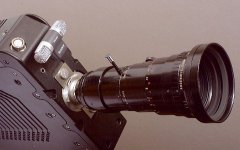
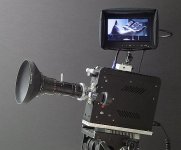
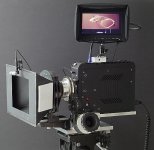
Attached are two photos you can see the size form the Super8 Angenieux 6-80mm f/1.2 lens. I will have some more photos in the behind the scenes of the third Vimeo video I hope to post soon. You can see some in the #B1 video that is up now.

The width is so two can be mounted side by side to shoot 3D stereo, well when they get the sync working and there are two cameras in the same room...

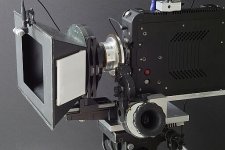
In the one with the Konvas matte box you can see the general size, as I noted this is not the same as the production camera, I'm just doing some lens tests and developing software support for the special meta-data features like SMPTE time code and auto-slate data etc. The LCD monitor is rated for 7" size, so that gives some scale, the black area is some menus they did not want me to show as those are being worked on and will be different in the production cameras perhaps, if and when the go on sale.

I made an adapter plate, you can see it on the bottom in the matte box shot below, to take an old Bolex electric trigger pistol grip, the Camera has an external run and zoom button input it could be wired to, holding it with the pistol grip is not too hard for a while, less so if you work out, but the 7" LCD is a bit awkward for hand held use more so outdoors where the light is very bright, so I'll be looking into some alternative viewfinder option for shooting outdoors without the tripod. I may mount the 7" LCD on the side, there are 1/4-20 holes there like is done on some 'handycams' since that would allow for easier eye level shooting.

I've gone over ergonomics with Kinefinity (tm) so don't think I'm the one that does not understand the need for those factors, but at any given price point they seem to have issues about things being other than box shaped.

Notice the lens mount, it has adjustments for centering and flange to focal distance, so you can get "micron" accurate calibration of the lens, that is needed for ultra-HD with zoom lenses, and for having 3D-Stereo pairs in alignment as well as not getting dark corners because the lens is a bit off center.
 

Attachments

  • KineRAW-S8p_with_Konvas_matte_box_L1Xs.JPG
    KineRAW-S8p_with_Konvas_matte_box_L1Xs.JPG
    38.1 KB · Views: 0
  • KineRAW-S8p_with_Angenieux_Zoom_Sony_plug_in_power_microphone_001E_480.jpg
    KineRAW-S8p_with_Angenieux_Zoom_Sony_plug_in_power_microphone_001E_480.jpg
    41.2 KB · Views: 0
Last edited:
Dan,

Thank you for the detailed response about the s16 camera. It look like my hopes or expectations of treating this camera like a 2/3" broadcast camera might be more theory than reality. All of that data is quite a lure burpose built for cinema production is just a little too far afield. Best of luck with the project.
 
Broadcast use

Broadcast use

Dan,

Thank you for the detailed response about the s16 camera. It look like my hopes or expectations of treating this camera like a 2/3" broadcast camera might be more theory than reality. All of that data is quite a lure burpose built for cinema production is just a little too far afield. Best of luck with the project.

When they get the S16 working fully it supports Cineform (tm) GoPro (tm) workflow, and GoPro (tm) is used in broadcast type applications and TV shows so there must be a usable workflow there?

For CinemaDNG there are advances in realtime processing for people with broadcast type budgets,

http://provideocoalition.com/index....nounce_real-time_raw_debayering_with_mosaict/

And the previous Iridas Speed Grade. Kinefinity.com (tm) has the 3D-LUT working for Speed Grade as far as I can tell, so the camera monitoring matches the results from that work flow well.

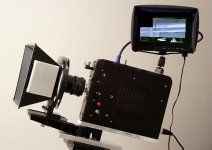
You can see renders of the current S35 prototype here,

http://nofilmschool.com/2012/02/lat...-cinema-camera/comment-page-1/#comment-141244

I have a photo they sent me of the camera shooting test subjects for frames I have been processing to align some calibrations with the ISO etc. It shows something that looks like those renders but has the control pannel off and some wires showing, don't know why it was open maybe they are doing some circuit adjustments so they had the panel removed.
 
Thanks so much for keeping us all in the loop. Thanks so much for your detailed posts. You DA MAN!!! :)
 
When they get the S16 working fully it supports Cineform (tm) GoPro (tm) workflow, and GoPro (tm) is used in broadcast type applications and TV shows so there must be a usable workflow there?

There probably will be a way to make it work but I wonder about the simple things like power for a servo driven lens? Speaking of power, I was surprised to read the s35 version of the camera will draw over 30 watts of power. That is right up there with the big broadcast cameras and a little higher than I expected.
 
Third KineRAW-S8p video, anamorphic test reel

Third KineRAW-S8p video, anamorphic test reel

I posted the third test reel for the KineRAW-S8p (tm) last night.

It stutters a bit from the Vimeo playback on my Brother's computer, and there are some spots left behind in the scrolling titles from the compression it seems, but you get the general idea of what shooting at f/0.95 with a 2:1 squeeze lens gets you,

 
As you can see in the behind the scenes videos I've been using a medium side lead gel battery, it can run the camera non stop for more than like 6 hours, so far we have not had any power downs due to the battery going dead even leaving the camera on shooting for long periods. I tried a smaller led gel battery to pack around in my back pack and it ran the camera for at least 90 minutes before I turned it off, so its not a major issue maybe, I made a Y cable that has 4 pin XLR on the battery box end, and 4 pin XLR for the camera and barrel DC connector for the LCD monitor on the other end, so I can power both the camera and monitor off a single lead gel battery, the same kind used in UPS etc., its like a motor cycle battery but sealed and the electrolyte is gel form so it ill not leak of give off hydrogen gas when being charged.
 
New photos of KineRAW-S8p (tm) in different configurations for shooting

New photos of KineRAW-S8p (tm) in different configurations for shooting

I made some new photos of the KineRAW-S8p (tm) with different shooting configurations, with anamorphic lens and matte box, with follow focus gear on 12.5mm f/1.4 Fujinon 5MP lens and matte box with Mitchell follow focus, and using a 9.5-57mm f/1.6 reflex zoom that has optical view finder.

The color on the viewfinder looks better than how it shows up in the photos, its hard to take a photo of the LCD monitor and get the light on the subject the same contrast ratio and color balance, but to the eye the monitor image show more saturation and tonal range.
 

Attachments

  • KineRAW-S8p_with_reflex_zoom_lens_C2s.jpg
    KineRAW-S8p_with_reflex_zoom_lens_C2s.jpg
    35.7 KB · Views: 0
  • KineRAW-S8p_with_follow_focus_lens_B1s.jpg
    KineRAW-S8p_with_follow_focus_lens_B1s.jpg
    42.7 KB · Views: 0
  • KineRAW-S8p_with_follow_focus_lens_B2s.jpg
    KineRAW-S8p_with_follow_focus_lens_B2s.jpg
    33.4 KB · Views: 0
  • KineRAW-S8p_with_reflex_zoom_lens_C1s.jpg
    KineRAW-S8p_with_reflex_zoom_lens_C1s.jpg
    45.9 KB · Views: 0
  • KineRAW-S8p_with_anamprphic_lens_A1s.jpg
    KineRAW-S8p_with_anamprphic_lens_A1s.jpg
    40.6 KB · Views: 0
This will be rubbish. China dont have any good designers or artists working on technology items. period. If it were an exact copy of the alexa, for 8k it might be worth it, but still the operating system will be rubbish and hard to navigate. The buttons will have a lifetime 1/100th of the lifetime of those buttons used on true professional gear. the mounts will be made from cast pewter, the fans will be cheap, and when it goes wrong, no one will be able to make head or tail of the horrid electronic design, blobbed with hot glue gun to hold them all in place. Cant believe this garbage is getting such interest!.
 
Back
Top