Cheapest Daylight Lighting

How many Lux do you need for lighting a medium sized scene with 2 people, standing up, dancing, about 2 metres apart from each other?

is there any cheap alternative for daylight temperature lighting?

How many "LUX" do you need? (lighting tends to work in LUX nowadays)

Is this any good? http://www.amazon.co.uk/SAD-Light-000-High-Lamp/dp/B000YSDHZ8/ref=pd_sim_kh_13

The light you linked to will not cut the cheese (not even close) for a mid shot with 2 people standing 2 metres apart.

Your going to need a decent sized HMi to achieve something like you've described. You may get away with an 575 Hmi. It really depends on your shot size.
 
Are you trying to light humans outdoors IN daylight?

Or indoors?

Anything less than like 4K (HMI) won't do much outdoors in full daylight.

If indoors, try the 85 watt CFL lamps. Cheap.

.
 
Can't find anywhere that sells them at daylight temp.. any more suggestions - or if anyone knows where to source them? :) thanks
 
Arrisun 1.2k HMI minimum.

thanks but I live in the Uk, and still can't find anything like that. I can see lots of suppliers in the US, 'but I don't live over there.
http://www.google.co.uk/products?q=Arrisun+1.2k+HMI

Also note that that doesn't look like a cheap alternative..

I like Chris Santucci's suggestion of the 85watt CFL lamps, but still can't find a supplier in the UK. Any links or suggestions? Thanks :)
 
Last edited:
thanks but I live in the Uk, and still can't find anything like that. I can see lots of suppliers in the US, 'but I don't live over there.
http://www.google.co.uk/products?q=Arrisun+1.2k+HMI

Also note that that doesn't look like a cheap alternative..

I like Chris Santucci's suggestion of the 85watt CFL lamps, but still can't find a supplier in the UK. Any links or suggestions? Thanks :)

What your trying to achieve won't throw up any cheap alternatives because there are none, in saying that you could try and utilise exactly what your trying to balance too and use reflection from the sun but then you have no real control of your lighting situation.

The CFL Lamps are, by there very nature, soft lights so you'd have to be very close to your subjects for them to work effectively negating the mid shot your looking at trying to achieve.

If budget is a problem then just hire an HMi for a day. You can probably get a 1.2 or 575 for around £40 for the day.
 
Why daylight? Do you have a lot of daylight ambiance you are trying to balance to? Are you seeing windows, doors?

Give us more information and we may be able to provide a more intelligent response.
 
Cheapest Daylight Lighting

What your trying to achieve won't throw up any cheap alternatives because there are none…. The CFL Lamps are, by there very nature, soft lights so you'd have to be very close to your subjects for them to work effectively negating the mid shot your looking at trying to achieve. If budget is a problem then just hire an HMi for a day. You can probably get a 1.2 or 575 for around £40 for the day.

I have to agree with Steadcamsteel. Daylight CFLs won’t be enough to fill talent against the windows and hold detail outside the windows. When shooting interiors with windows you have two basic problems: color temperature and contrast. Without either gelling the windows or substantially boosting the light levels inside, when you expose for your talent, your exterior will blow out. If you expose for the exterior to hold detail, your talent will be underexposed and become a near silhouette.

If there are not many windows you can cover the windows with a combination of 85/ND9 gel. The gel both converts the exterior daylight from 5500K to 3200K and knocks down the level outside by three stops, so that 3200K CFLs will be effective as fill lights. But, where a roll of 85/ND9 gel will set you back $140.00, it will be expensive and time consuming to gel the windows if there are a lot of them.

Without gelling the windows to 3200K, using 3200K balanced lights doesn’t make a lot of sense. Balancing tungsten to 5500K is not very efficient because full color temperature blue correction gel (Full CTB) cuts the output of the light by 70% in converting it to 5500K. A 1000W 3200K light becomes a 300W 5500K light when you put Full CTB on it. The output you get after correction is not enough to fill talent in a shot with the windows uncorrected.

In my experience, if you can’t gel the windows you probably need at least a 4k HMI par to pick up the interior levels in wide shots. For example, my company, ScreenLight & Grip, lit a segment of a special two-hour program for British Television’s Channel 5 that presented the same problem that you are facing.

piratefilmstrip1lg.jpg

Host June Sarpong interviewing a marine archaeologists
​

The show told the story of the Whydah - a pirate ship that sank off Cape Cod nearly 300 years ago. In a unique TV experiment, marine archaeologists on Cape Cod dove to the wreck to salvage pirate booty live on air. In addition to the dive on the wreck, the program also included specially shot dramatic recreations of the story of the Whydah’s notorious pirate captain Black Sam Bellamy. To link between the modern-day adventures of the marine archaeologists and those of Black Sam Bellamy, co-presenter June Sarpong hosted marine archaeologists and pirate historians from a makeshift studio under a tent situated on a bluff overlooking the dive site.

piratefilmstrip1.25lg.jpg

Host June Sarpong interviewing a marine archaeologists
​

Where they wanted the dive site to serve as a backdrop to the makeshift studio, the show's producers wanted the Salvage Ship to be seen clearly on the water in the shots of June and her guests. This requirement created a similar interior/exterior contrast problem to the one you are facing.

The task of balancing interior levels to exterior levels was further complicated by the fact that it was a clear sunny day. We rigged a couple of 4kw and 2.5kw HMI Pars into the frame of the tent in order to get them as close as possible to our subjects, but even then we didn’t have quite enough output to compete against the sun outside.

piratefilmstrip2.25lg.jpg

A 4k HMI Par was rigged overhead as a key for each subject
​

The final ingredient for success was a double net strung across the open backside of the tent. The net further reduced the contrast by bringing the exterior levels down and in line with the pumped-up interior. The trick in situations like this is to strike a delicate balance between the interior and exterior light levels so that the net disappears to the camera without the exterior becoming overexposed and losing important detail – the Salvage Ship out on the water in this case. Another advantage to netting the background is that it takes the hard edge off of HD. It creates the illusion of a shallower depth of field or the selective focus we associate with film.

piratefilmstrip3lg.jpg

A double net was stretched across the open side of the tent facing out onto the water.
​

Where it took a 4k Par on each of the talent, plus a double net across the back, you can see that you need a lot of light to balance interiors to exteriors. The problem with using 4k HMIs is usually powering them. If you know how, you can plug them into wall outlets that are available on most locations – but, I should leave that to a latter post.

Guy Holt, Gaffer, ScreenLight & Grip , Boston
 
As they say, seeing is believing. That is one amazing post. Great explanation and example pics to back it up.
Thanks for educating me on this Guy. :thumbup:
 
If you know how, you can plug them into wall outlets that are available on most locations – but, I should leave that to a later post.
Okay, but make that post soon... I'd love to see a simple solution for how to plug in a 2.5k or 4k into wall outlets, rather than having to haul along a noisy gas-drinking generator...
 
Okay, but make that post soon... I'd love to see a simple solution for how to plug in a 2.5k or 4k into wall outlets, rather than having to haul along a noisy gas-drinking generator...

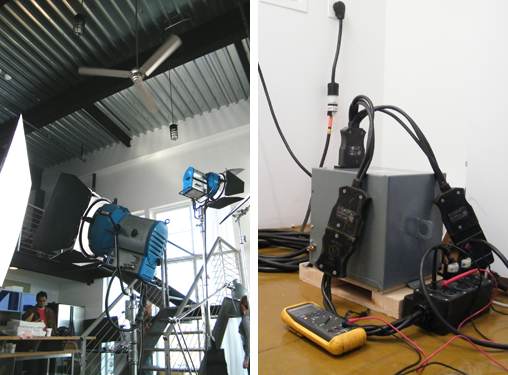
A lot of gaffers may rule out using a 4k HMI par as we did on the Bose still shoot pictured below because they think it requires either a tie-in or renting a generator - both of which can be an expensive proposition. They don’t realize that common 240V wall receptacles, like the dryer outlet in this loft, can power HMIs as large as 4kw. How it is done depends on whether the 4k has a magnetic or electronic ballast, and whether the electronic ballast has Power Factor Correction (PFC) or not (Arri calls it ALF for Active Line Filter.)

Transformer-Distro_SamBosePS

Samples from still shoot for Bose where a 4k HMI par was used to fill talent against windows (Bob Packert Photography)​


A multi-volt 4k electronic ballast with Power Factor Correction (PFC) will give you the most options. If you are not familiar with Power Factor Correction, a PFC circuit realigns voltage and current and induces a smoother power waveform at the distribution. As a result, the ballast uses power more efficiently with minimized return current and line noise. 4kw electronic ballasts with PFC (like the Power Gems (PG) 425CDP, the Power-to-Light (P2L) 425LVI, and Arri 2.5/4 EB w/ALF) typically have an operating range of 90–125 & 180-250 Volts. At 120V they will draw approximately 37 Amps. At 240V they will draw 18.5 Amps on each leg of a 240V single phase power supply.

These ballasts draw too much at 120V for a 20A wall outlet. But, fortunately there are a number of 240 volt outlets in a typical house, office, or industrial plant in this country that you can also use to power a 4k with PFC electronic ballast. The most common are air conditioner outlets, dryer outlets, range outlets, outlets for large copy machines in offices, and the outlets for motorized equipment in industrial plants. Many of these household and industrial 240V receptacles use a three wire system (no neutral) because they are designed to power single phase motors or heating elements that draw a perfectly balanced load and return no current because the single phase service legs are 180 degrees out of phase and cancel each other out. Where a 4kw HMI with PFC electronic ballast, operating at 240 Volts draws roughly 18.5 Amps on each leg of a single phase 240V circuit, its’ load is well within the capacity of these circuits. You will also be able to operate a non-PFC 4k electronic ballast off of most 240V receptacles like range plugs and dryer plugs because they draw 26 Amps per leg and these circuits are fused at minimally 30 Amps. Where most magnetic 4k ballasts operate at only 120V and draw 40 Amps this method is not an option with magnetic ballasts. Where 4kw ballasts are typically wired with a 120V 60Amp Bates Plug (Stage Pin), you will need a 120V Female Bates to 240V adapter. I keep an assortment of adapters because all these 240V receptacles use a different pin configuration.

Transformer-Distro_Sam2.jpg

4k & 1.2ks HMI Pars powered from 30A/240V dryer outlet through step-down transformer/distro for Bose still shoot.​


The only way to power 120V 4kw HMI magnetic ballasts on wall receptacles is from 240V circuits through a 240v-to-120v step down transformer like the one my company, ScreenLight & Grip (SL&G), manufactures for the Honda EU6500is generators that we modify. Like it does with the enhanced 240V output of our Honda EU6500is Generator, a step down transformer can be used to convert the 240 volts supplied by these industrial and household 240V receptacles to 120 volts in a single circuit that is the sum of the two single phase legs of 30/50 amps each. In other words, out of a “30A/240v” or a “50A/240v” circuit our transformer makes a 60A/120v circuit that is capable of powering bigger 120V lights, like 4kw HMIs with magnetic ballasts (even Quartz 5ks, mini brutes (5850W) or Six Light Mole Par (6000W)).

There are benefits to be gained by powering even 4kw electronic ballasts (PFC or not) on 240V circuits through a 240v-to-120v step down transformer. For instance, you will be able to run additional large lights (like 1.2kws) on the same circuit if, rather than plugging the 4kw electronic ballast directly into the 240 receptacle (operating it at 240V) and monopolizing it, you plug it in through a transformer (operating it at 120 Volts), you will be left with 25 - 37 Amps to power additional lights on the same circuit. That’s a lot of additional power to waste by plugging the 4k directly into the 240V receptacle. And, since an electronic ballast “ramps up” gradually during the striking phase, you don’t have to leave head room as you would with a magnetic ballast. By operating the light through a transformer you can more fully utilize the capacity of the 240V circuit. For example, since the P2L 4/2.5 LVI ballast at 120V operates a 4k HMI luminary at 37 amps, you will still be able to power an additional 1.2kw HMIs (if operated by P2L 575/1200 ballast (11 Amps)), as well as a 800 Joker HMI (if operated by a P2L 800/1200 ballast (8 Amps)), off of the same circuit. That’s a lot of additional light to be gained by not plugging the 4k directly into the 240V receptacle.

A transformer will also greatly simplify your set electrics by automatically splitting the load of whatever you power through it. As long as you plug lights in through the transformer, you no longer have to carefully balance the load over the two 120V circuit/legs because the transformer does it for you automatically. If, like our 60a Full Power Transformer/Distro, the transformer is outfitted with a 60 Bates receptacle, you can use 60A GPC extension cables, 60-to-60 Splitters, and fused 60A GPC-to-Edison Breakouts (snack boxes) to run power around set - breaking out to 20A Edison outlets at convenient points (rather than one central point.) The best part about using a transformer with a 240V receptacle in this fashion is that no matter where in the distribution system you plug in, the transformer automatically balances the additional load, so that you don't have to. It is so simple that you don’t have to be an experienced electrician to distribute power on set. Use this link for more details about using step-down transformers to power larger lights on interior sets.

HD_PP_Demo_Transformer-Distro.jpg

A PFC 2.5 & 1.2 HMI Pars, PFC 800w Joker HMI, Kino Flo Flat Head 80, 2 ParaBeam 400s, and a ParaBeam 200 powered by a modified Honda EU6500is through a 60A Full Power Transformer/Distro ​

Everything I have said thus far is also true when it comes to operating HMIs off of portable gas generators with 240V outputs. Where before you could not operate more than a couple 1200W HMIs on portable generators because of their limited 120V power outlets, with a step-down tranformer you can operate bigger lights, or more small lights, on portable gas generaotors than has been possible before. And if the generator is one of our modified Honda EU6500is inverter generators, you will be able to run a continuous load of up to 7500W as long as your HMI and Kino ballasts are Power Factor Corrected. But, where I have covered this in another post in this forum I won’t go into more details here. For more details read my posts at http://www.dvxuser.com/V6/showthread.php?t=129369

Guy Holt, Gaffer, ScreenLight & Grip , Boston
 
Last edited by a moderator:
That's all nice, Guy, but the OP did mention his needs were "cheap alternative for daylight temperature lighting", for "2 people, standing up, dancing, about 2 metres apart."

How much you wanna bet he has NO idea wtf you're talking about?

.
 
You can obviously hire HMI's in for the day?

Talk to Take2Films (they're in London but their lighting comes out of Manchester). Otherwise in London you can rent from Direct Lighting (they have great kit - 575 upto 18k HMI), Pannalux (everything), VMI (smaller selection, often cheaper).

Good luck
Bruce
 
Back
Top