Cheapest Daylight Lighting

So yeah, the follow-up question is -- what do I do if I'm not in New England and can't rent these proprietary-tech devices? Are there commercially-available 240v transformer/distro boxes you'd recommend?
 
I've come to this a bit late, but you said dance, not documentary?
I light dance quite often, and it's all to do with emotion, movement, form and mood. In the dance world the light sources that wok best are very different from video 3 point, or super soft area lighting. Shin height sources put light under arms and legs, create shadows (the opposite from normal TV, where getting rid of shadows is the usual quest), and adding colour is the usual thing - great for mood and emotion. Colours add and subtract where shadows fall, and all this is really important to reveal the form the dancers create.

If you softlight the entire thing, it will be dancers moving, it won't be dance. You will rob it of all the things that dance needs. Dance, outside on a sunny day looks dreadful - you see the dancers, but it just doesn't work.

As for lux - or even footcandles, 2000 lux or thereabouts is a usable figure, but more if you can means less focus issues if they move fast, or you don't want to split focus.

In practice a couple of 1Ks could wash a room to this level from a reasonable distance in open white - if you want to colour it up, then you're going to need much, much more.

I've never used HMI for dance - it's great for blasting away, but not very moody!
 
I meant the OP.

I know....it was more a general defense of an all encompassing answer.

Nejuicer is better than a subscription to Popular Science. It's rare to find

somebody who knows this stuff, and is also willing to share.

I shouldn't have picked your post to make that point. Sorry.
 
I've never used HMI for dance - it's great for blasting away, but not very moody!

If you use the HMI's to frontlight your talent, yes, it won't be very moody. But if you bring around to the side, or even behind them, that's all you need. Sometimes you just need bigger units to compete with other light already in the scene (the sun!), and HMI's provide you with a simple way to do that.

You can create dramatic shadows with any light, you just have to know where to put it and how to control it.
 
That's all nice, Guy, but the OP did mention his needs were "cheap alternative for daylight temperature lighting", for "2 people, standing up, dancing, about 2 metres apart."How much you wanna bet he has NO idea wtf you're talking about?.

I wouldn’t insult Matt9b intelligence by suggesting that he couldn’t understand the reasons I give in my first post for why a couple of CFLs won’t accomplish what he wants. My second post was in response to Barry’s question below and not directed at Matt9b at all.

Okay, but make that post soon... I'd love to see a simple solution for how to plug in a 2.5k or 4k into wall outlets, rather than having to haul along a noisy gas-drinking generator...

Besides “cheap” is relative. Movie generators are not only expensive to rent, but they come with hidden costs that usually break the budget of independently funded HD projects. Movie generators require special tow equipment not found on Ryder or Penske rental trucks. For that reason, movie generators require that you rent a more expensive grip truck from a lighting and grip rental company in order to tow them. Lighting rental companies will not send out a grip truck without a company driver - further adding to the expense of renting a movie generator (driver rates run about $400/10hrs with overtime after 10hr). By eliminating the need for a tow generator in order to have feature style production capability, our step down transformer/distros saves you the expense of not only the generator, but also the added expense of a rental house grip truck and truck driver. Compared to the cost of renting a generator (with all it’s hidden cost) to power a 4k, my approach is cheap.

Guy Holt, Gaffer, SreenLight & Grip, Boston
 
If you use the HMI's to frontlight your talent, yes, it won't be very moody. But if you bring around to the side, or even behind them, that's all you need. Sometimes you just need bigger units to compete with other light already in the scene (the sun!), and HMI's provide you with a simple way to do that. You can create dramatic shadows with any light, you just have to know where to put it and how to control it.

I completely agree with Ryan. In order to make a scene look natural you usually have to do more than just fill the interior, you should also bring in a sun source. If the sun is shining directly on the window you should silk it for two reasons. First, it will be hard to balance direct sunlight. Second, the sun moves. If it is a big scene that takes a while to shoot you will notice the movement of the sun when you edit it all together. The best approach is to silk the real sun so that you take any directionality out of it, and then bring in your own sun source for consistency.

If you are shooting on a low budget, your best bet is to use a 4k outside as well because you can operate them on a 6500W generator. A set-up that would give you the most natural look would be to silk the sun, use a 4k Fresnel outside for a consistent sun feel, and then use a heavily diffused 4k Par inside to fill. Diffusing the 4K inside will take the “source-i-ness” out of it and using a 4k Fresnel outside will give you the crisp direct sunlight feel. To operate both 4ks without having to tie-in or rent an expensive diesel tow generator (with all its hidden costs), I would suggest you use a step-down transformer/distro on a 240v receptacle to power the inside 4k. To power the outside 4k, I would suggest a second step-down transformer/distro powered by one of our modified Honda EU6500is inverter generators.

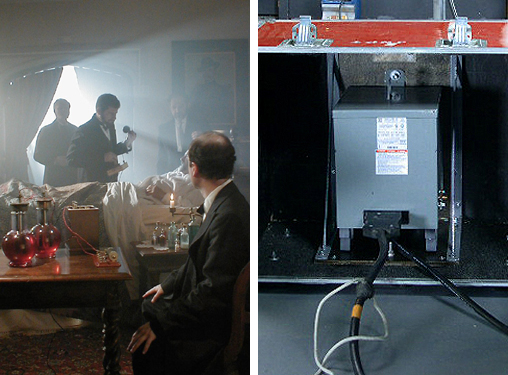
When shooting interiors (like the one discussed here), you use one of the transformers on a 240V range or dryer receptacle to power a larger light inside; while using the other transformer to run a 4k Fresnel along with a 1200 Par on the Honda EU6500is outside. I have used this same combination of wall outlets, 60A step-down transformer distros, and Honda EU6500is generators to eliminate the need for tie-ins or a tow genny on many of the historical documentaries I have gaffed. For example, I have used this same package repeatedly at a historical mansion in Easton MA called the Ames Estate.

Transformer-Distro_Sam1.jpg

(Scene from "Unsolved History" powered from 50A/240V range outlet through step-down transformer/distro at the Ames Estate)​

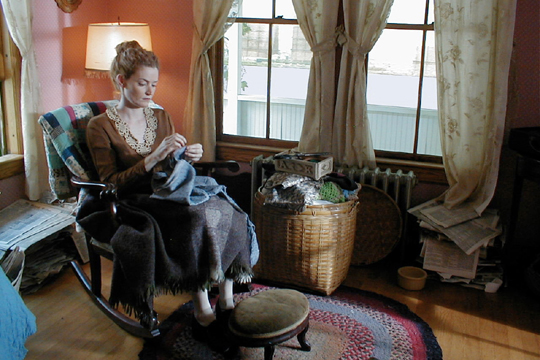
A popular state fee free location, the Ames Estate, like many historical house/museums, does not permit tie-ins and the electrical wiring in the house is so antiquated that it is unusable. Fortunately, they have a 50A/240 volt circuit in the carriage house for a welder they use to repair the mowers they use at the park. Our standard mode of operation when shooting there is to run 250V extension cable from the welding receptacle to a 60A Full Power Transformer/Distro placed in the entry hall of the house. Using a 60A Siamese at the Transformer/Distro, we then run 60A 6/3 Bates extensions, down to the library, to the second floor, and back to the maid’s pantry. At the end of each run we put another 60A Siamese. A 60A snackbox on one side of the Siamese gives us 20A branch circuits. The other side we leave open for a large HMI or Tungsten Light. Now we can safely plug 1200 - 4000W HMIs (or even a 5k Quartz) into our own distribution anywhere in the house to balance the interior levels to the exterior. A good example of this approach is an American Experience program titled “The Most Dangerous Women in America” about Typhoid Mary that I lit for PBS. For part of her life Typhoid Mary was quarantined on an island in New York's East River.

tmfilmstrip1lg.jpeg

(Typhoid Mary in quarantine on an island in New York's East River. Note the view out the window of the East River shoreline at the turn of the century.)​

Because New York’s East River today looks nothing like it did when she was in quarantine, we used a 30' blowup of a picture of the East River at the turn of the century rigged outside the windows of a house in Arlington MA. As you can see by the production stills I have attached, the requirements of this production were very similar to the “Pirate Ship Live” production I described earlier. We had to strike a delicate balance between the interior and exterior levels. We wanted to overexpose the exterior by one stop so that it would look realistic and hide the fact that the exterior was a blow-up. As you can see in the production still of the exterior of the actual location used for the quarantine island, we rigged a solid over the porch windows and the blow-up to keep the sun off both. That way we could light the blow-up and interior so that it remained consistent even though the sun moved on and off the porch in the course of the day. To take the edge off the blow-up, we used a single scrim outside the window to help throw it out of focus.

tmfilmstrip2lg.jpeg

(The actual exterior of Mary’s cottage was the backyard of a house in Arlington Ma with a 30’ blow up of a picture of New York’s East River shoreline at the turn of the century.)​

To maintain continuity between shots, we brought a 4kw HMI Par in a window on one side of the room as a sun source and a 1200 par through a window on the other side as a northern light source. We powered both heads off a dryer plug in the laundry room of the house using one of our transformer/distros. The two 2.5k Par lights used outside to light the blow-up were powered by a Honda EU6500is through a second 60A Full Power Transformer/Distro. Since the Honda EU6500is could be placed right on the lawn, we were saved from running hundreds of feet of feeder back to a tow generator.

tmfilmstrip3lg.jpeg

(A child dying of Typhoid Mary filmed in a bedroom of the Ames Estate)​

We have been able to use this same basic package at numerous museums and historical houses throughout New England including Sturbridge Village. Fortunately for us, to make ends meet, many historical houses rent themselves out for events and weddings. For that reason, they usually have at least one updated service with 30 or 50 Amp 240 volt circuit for the warming ovens of caterers.

tmfilmstrip5lg.jpeg

(The New York City Health Inspector filmed in the library of the Ames Estate)​

Use this link - http://www.screenlightandgrip.com/html/HDPP_Transformer.html - for more production stills of PBS and History Channel historical documentaries shot entirely, or in part, with our 60A Full Power Transformer/Distros and modified Honda EU6500is inverter generators at the Ames Estate.

Guy Holt, Gaffer, SreenLight & Grip, Boston
 
I wouldn’t insult Matt9b intelligence by suggesting that he couldn’t understand the reasons I give in my first post for why a couple of CFLs won’t accomplish what he wants. My second post was in response to Barry’s question below and not directed at Matt9b at all.

Besides “cheap” is relative. Movie generators are not only expensive to rent, but they come with hidden costs that usually break the budget <snip>


So you think that by asking about this particular fixture as an option, and mentioning "cheapest" as a prerequisite, you're anywhere near in the ballpark?!?!:


B000YSDHZ8
31PqT6Ci5iL._SS400_.jpg


.
ref=dp_image_0
 
So you think that by asking about this particular fixture as an option, and mentioning "cheapest" as a prerequisite, you're anywhere near in the ballpark?!?!

My contributions are well within the "ball park" of this thread. If you look back I entered into this dialogue in support of this post by Steadicamsteel.

What your trying to achieve won't throw up any cheap alternatives because there are none,... The CFL Lamps are, by there very nature, soft lights so you'd have to be very close to your subjects for them to work effectively negating the mid shot your looking at trying to achieve. If budget is a problem then just hire an HMi for a day. You can probably get a 1.2 or 575 for around £40 for the day.

The purpose of my original post was to reinforce Steadicamsteel's contention that CFL wouldn't cut it and that Matt9b should look into renting HMIs. To that I wanted to add a sense of scale so that Matt9b could see what is required under similar situations. All my subsequent posts have been in response to direct questions or statements regarding my original post. Not only am I in the ballpark, I am on third base.

Guy Holt, Gaffer, SreenLight & Grip, Boston[/QUOTE]
 
My contributions are well within the "ball park" of this thread. If you look back I entered into this dialogue in support of this post by Steadicamsteel.

If you say so. You have something to sell - fine. Why hijack a thread posted by some kid with a camcorder shooting a music video? You can say "cheap is relative" all you want, but your approach is more akin to sending a man to the moon when compared to the intention and (apparent) abilities of the OP.

The purpose of my original post was to reinforce Steadicamsteel's contention that CFL wouldn't cut it and that Matt9b should look into renting HMIs. To that I wanted to add a sense of scale so that Matt9b could see what is required under similar situations. All my subsequent posts have been in response to direct questions or statements regarding my original post. Not only am I in the ballpark, I am on third base.

A more modest post would have sufficed. You have a big brain, I'll give you that, and even though the OP never followed up and answered questions, it's nice to see you asserting yourself and assuming you know without asking what the conditions are for the OP's setup.

As it is, it's absolutely very possible the OP could shoot what he described with high output CFL's depending upon a number of variables.

.
 
If you say so. You have something to sell - fine. Why hijack a thread posted by some kid with a camcorder shooting a music video?

It has been suggested in this thread that the motives for my posts are suspect because I "have something to sell." I would like to make clear that I post as a professional gaffer and can offer the following credentials:

Gaffer, Set Electrician, and Generator Operator on numerous features and television productions (for a partial list of credits see my imdb listing at
http://www.pro.imdb.com/name/nm1471247)

IATSE Local 481 Certified Generator Operator

Certificate Holder of the MQ Power "MQP Special Generator (Crawford) Technical Service Seminar"

Owner of ScreenLight & Grip, a lighting and grip rental company providing motion picture production equipment for 18 years.

So yeah, the follow-up question is -- what do I do if I'm not in New England and can't rent these proprietary-tech devices? Are there commercially-available 240v transformer/distro boxes you'd recommend?

If it were my objective to “hijack” this thread to market products that we rent and sell the question by Barry Green above would have presented the perfect opportunity for me to mention that we sell and rent the transformers all over the country – but I did not do so.

You can say "cheap is relative" all you want, but your approach is more akin to sending a man to the moon when compared to the intention and (apparent) abilities of the OP.

As you can see by how it starts (below), the purpose of my original post was to simply reinforce Steadicamsteel's contention that CFL wouldn't cut it and that Matt9b should look into renting HMIs.

I have to agree with Steadcamsteel. Daylight CFLs won’t be enough to fill talent against the windows and hold detail outside the windows. When shooting interiors with windows you have two basic problems: color temperature and contrast. Without either gelling the windows or substantially boosting the light levels inside, when you expose for your talent, your exterior will blow out. If you expose for the exterior to hold detail, your talent will be underexposed and become a near silhouette.

As you can also see by the posts that I site below, I was not the only one to think that daylight CFLs wouldn’t cut it.

Your going to need a decent sized HMi to achieve something like you've described. You may get away with an 575 Hmi. It really depends on your shot size.

Arrisun 1.2k HMI minimum.

You can obviously hire HMI's in for the day.

What your trying to achieve won't throw up any cheap alternatives because there are none….The CFL Lamps are, by there very nature, soft lights so you'd have to be very close to your subjects for them to work effectively negating the mid shot your looking at trying to achieve. If budget is a problem then just hire an HMi for a day. You can probably get a 1.2 or 575 for around £40 for the day.

To the building consensus that Matt9b would need to use HMIs, I simply wanted to add a sense of scale so that Matt9b could see what is required under similar situations. In my original post I make no reference to any product that I sell. All my subsequent posts are in response to direct questions or statements regarding my original post and as I have demonstrated above I steered clear of using them as an opportunity to market our products.

A more modest post would have sufficed. You…. assum(e) you know without asking what the conditions are for the OP's setup. As it is, it's absolutely very possible the OP could shoot what he described with high output CFL's depending upon a number of variables.

I don’t disagree. In fact, I covered one of those variables in my original post:

If there are not many windows you can cover the windows with a combination of 85/ND9 gel. The gel both converts the exterior daylight from 5500K to 3200K and knocks down the level outside by three stops, so that 3200K CFLs will be effective as fill lights. But, where a roll of 85/ND9 gel will set you back $140.00, it will be expensive and time consuming to gel the windows if there are a lot of them

I know I can have a tendency to go on too long, but when it comes to handling electricity a little knowledge can be a dangerous thing. I think that an emphasis on brevity can create misunderstandings like it is OK to use a “splitter box” on a 240V receptacle instead of a transformer.

I am not hijacking “a thread posted by some kid with a camcorder shooting a music video” to market a solution to a problem that doesn't exist. As Steadicamsteel, HuckLBerry, and Mcgeedigital also pointed out the problem exists. Now, Matt9b could remain ignorant of it and be worse off for it. Or, he could be aware of it and in his awareness of these effects come up with a lighting design that avoids or mitigates both the contrast and color temperature problems he will face on set. Incidentally, this is all that I have tried to do in my posts.

Guy Holt, Gaffer, SreenLight & Grip, Boston
 
Last edited:
You can say "cheap is relative" all you want, but your approach is more akin to sending a man to the moon when compared to the intention and (apparent) abilities of the OP.

If you think renting an HMI is beyond the apparent abilities of the original OP than I might suggest he try renting LED Light Panels or Kino Flo Parabeam 400s instead of HMIs. Both these options will be better than Daylight CFL bulbs. Of these two options the Kino Flo Parabeam 400s will be more effective than the LED Light Panels, or any other Flo fixture.

What distinguishes the Parabeam fixtures from LED Panels and other fluorescent lights is their throw, power efficiency, and the innovative accessories Kino Flo makes available for the fixtures. Accessories include barndoors, a gel frame, a diffusion panel, and Honeycomb Louvers. These accessories enhance the production capabilities of the Parabeam fixtures and make them suitable to serve as a Key source in situations like this where conventional fluorescent movie lights and LED light panels will not cut it.

Both conventional fluorescent movie lights (Kino Flo’s included) and LED light panels have a very broad light output that tends to drop off rapidly which means that to serve as a Key source, the units need to be positioned close to the subject they are lighting. These characteristics make them best suited to serve as Key sources in documentary interview set ups where the Keys are typically positioned close to the interview subject. In that capacity conventional fluorescent lights and LED light panels (with heavy diffusion) can generate a wonderful soft light that wraps around the interview subject without wilting them. But, given these characteristics, conventional fluorescent movie lights and LED light panels will have only limited effect in dramatic set ups like two people dancing.

The ParaBeam fixtures, on the other hand, have computer aided designed (CAD) parabolic reflectors that focus their light output where it is needed most for lighting dramatic scenes - at a medium distance – making them better suited as a Key source in situations like this. If you compare the photometric tables of the Parabeam 400 and the Diva 400 (which uses the same four lamps), you will notice that at 16’ the Parabeam 400 puts out almost three times the light level (28FC) than the Diva 400 (10FC) even though they both use the same tubes. You can always diffuse a Parabeam to create a soft source, but nothing you do will make CFLs, a Diva 400 or LED light panel punchier.

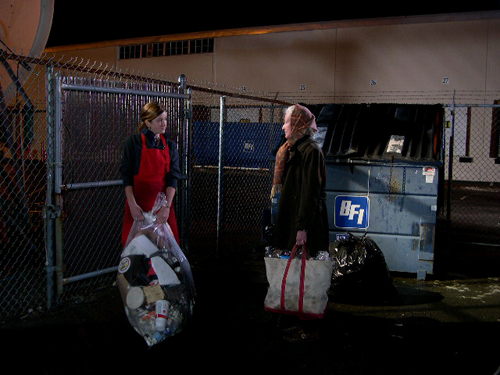
HD_PP_DemoCU.jpg

Two Shot of Night exterior scene lit with our HD P&P Pkg​


In fact, a Parabeam 400 generates as much light at 16’ as the 4’ 8-Tube Kino Flathead 80 fixture, yet uses less than a quarter of the power (2 Amps verses 9.2 Amps.) While the seven amp difference is not a major consideration when using house power, it can make a difference when your power is limited (coming from a portable generator) because you can use four Parabeam 400s for the same power as a 4’ – 8 Bank Kino Flathead 80. And unlike the ballasts of Kino Flo’s fixture that use the T12 tubes, the Parabeam ballasts also include filters to reduce the return of harmonic currents into the power stream and improve their power efficiency. This makes them an especially efficient fluorescent light source that is comparable to the power efficiency of LED light panels and suitable for battery operation. For instance a Parabeam 400 puts out more light than even Zylight’s new high output LED light panel yet draws just .2 Amps more power.

HD_PP_DemoWS.jpg

Wide Shot of Night exterior scene lit with a pkg. consisting of PFC 2.5 & 1.2 HMI Pars, PFC 800w Joker HMI, Kino Flo Flat Head 80, 2 ParaBeam 400s, and a ParaBeam 200 powered by a modified Honda EU6500is.​

While the newest LED light panels (that use the higher output LEDs) approach the Parabeams in output, the Parabeam fixtures are more easily controlled – an essential requirement in a Key source if you are lighting for dramatic effect rather than just filling. Parabeam fixtures are controlled by interchanging Kino Flos’ innovative Honeycomb Louvers. Louvers are available in 90, 60 and 45 degrees. Swapping louvers provides beam control similar to that of swapping lenses on an HMI Par. These features enhance the production capabilities of the Parabeam fixtures and make them suitable to serve as a Key or Backlight source where conventional fluorescent movie lights and LED light panels will spill all over the set.

HD_PP_Demo_SetUp_Night.jpg

Note Distance at which the two ParaBeam 400s are serving as Keys.​

Like every other DP & Gaffer, I have put together my favorite lighting package based upon my more than 20 years operating a lighting rental and production service company. The power that I save by using Parabeam 400s for key sources in my package, enables me to power more lights on the enhanced 7500W output of my modified Honda EU6500is generator. Using a 60A Full Power Transformer/Distro on my modified Honda EU6500is I am able to power a lighting package that consists of a 2.5kw, 1200, & 800 HMI Pars, a couple of Parabeam 400s and Parabeam 200s, and a Flat Head 80. Given the light sensitivity of cameras today this is all the light I need to light a large night exterior. (Use this link - http://www.screenlightandgrip.com/html/emailnewsletter_generators.html - for a detailed description of the benefits to using Kino Parabeam 400s on portable generators (the section on the Parabeams is about three quarters of the way through the article.)

Offering better light quality, output, beam control, and versatility than any of the other cheaper options, Kino Flo ParaBeam 400s with daylight tubes are the best alternative to HMIs in situations like this that require a punchy daylight balanced light source.

Guy Holt, Gaffer, ScreenLight & Grip , Boston
 
I appreciate Guy's contribution to the thread, his posts are always informative and cover topic that are usually glossed over.

As to the OP's post I think he was already shooting for the moon when he asked it. Sure, under very specific conditions you can use CFL to accomplish what he needs but then it becomes extremely impractical.
 
If you think renting an HMI is beyond the apparent abilities of the original OP than I might suggest he try renting LED Light Panels or Kino Flo Parabeam 400s instead of HMIs.

I don’t want to leave the impression that the Parabeam 400s will provide sufficient output to balance windows without treating the windows. Anything short of a 4k Par will require that you put ND Gel on the windows. For example we lit an episode of “Electronic Field Trip,” an educational program that is broadcast on PBS and streamed over the internet to schools. Co-produced by Ball State University and the National Park Service, each episode of “Electronic Field Trip” features a different National Park. In addition to live satellite casting from the Carlsbad Caverns, this episode of “Electronic Field Trip” included then First Lady Laura Bush leading a 4th grade class garrisoned in the Mess Hall of the Navy Barracks overlooking the USS Constitution in science experiments related to cave geology. 


bushtitlepage.jpg

Then First Lady Laura Bush leading a 4th grade class in a science experiment.​

Given the importance of their special guest and the scenic setting outside the windows, the show's producers wanted the USS Constitution to be seen clearly through the windows. Under the circumstances it was a difficult task to create flattering light on the First Lady, while balancing the interior lighting to the exterior, so that the USS Constitution would be seen clearly through the windows.

bushfilmstrip3lg.jpg

Navy Mess Hall overlooking the USS Constitution and Boston Skyline seen clearly out the windows.​

What I did was rig Kino Flo Flat Head 80 fixtures (4’- 8 tube fluorescent lights) flush against the ceiling over each table as high frontal key lights for the participants around the tables. The lights were then dressed with black show card so that they looked as if they were permanent fixtures.

bushfilmstrip4lg.jpg

Opposite wall of Mess Hall with Flathead 80s and book lights.​

To securely rig the Kino Flat Head 80 fixtures to the drop ceiling we used Porta-Grid Clamps (pictured below). A new style of drop ceiling clamp that I developed several years ago, which has been used on major network television shows like NBC’s ED, the Porta-Grid Clamp turns an ordinary drop-ceiling into a full-blown studio grid.

bushfilmstrip4.5lg

We used our patented Porta-Grid Clamps to securely rig heavy Flat Head 80 fixtures into the drop ceiling of the Navy Mess Hall.​

To fill in this soft high frontal key light, we then rigged 6’x6’ book lights with 4k HMI Pars. A light source that large creates a wonderful soft light that doesn’t throw shadows, which was important because cameramen moved constantly back and forth in front of the book lights. Not only were the book lights very clean looking, with the light and hardware hidden from view, but if seen reflected in the large plate glass windows, they looked like a window on the opposite side of the room. The final ingredient for success was a layer of ND 9 gel on the plate glass windows overlooking the USS Constitution to bring the exterior levels down three stops and in line with the pumped up interior.

bushfilmstrip4.25lg.jpg

A 4k HMI par bounced into ultrabounce and then through silk makes up a super soft booklight.​

Where the output of Parabeam 400s are similar to that of Flat Head 80 fixtures, these production stills clearly demonstrate that even with Parabeam 400s you need to be able to rig them close to talent as well as put heavy ND on the windows if you are going to hold detail out the windows.

Guy Holt, Gaffer, ScreenLight & Grip , Boston
 
Oh-my-god! Dude! Seriously. Write a book or something.


He hasn’t written a book, but Guy has compiled for his company news letter what is probably the best information regarding HMIs that I have seen anywhere. In his article, he undertakes a comprehensive survey of the prevalent lighting and portable power generation equipment, describes how he systematically tested how well they work together, and has made the results available online.

To paraphrase what he found, harmonic distortion of set power by HMI electronic ballasts is an increasing problem in HD production. It is becoming an issue because portable generators were not designed for the abundance of non-linear loads, like the electronic HMI and Fluorescent lighting, that make up lighting packages today. The problem is being further compounded by the increasing prevalence on set of sophisticated electronic production equipment like computers, hard drives and HD monitors which require clean power, but are themselves sources of harmonic distortion.

Normally, when you plug an HMI light into a wall outlet you need not be concerned about the current harmonics generated by HMI ballasts producing voltage distortions. The impedance of the electrical path from the power plant is so low, the distortion of the original voltage waveform so small (1-3%), and the plant capacity so large, that inherently noisy loads like HMI ballasts placed upon it will not affect the voltage at the load bus.

However, it is an all together different situation when plugging HMIs and Flos into conventional portable generators. Given the large sub-transient impedance of conventional portable generators, even a small degree of harmonic noise being fed back into the power stream will result in a large amount of distortion in its’ voltage. Add to that, the likely hood that the percentage of the generator’s capacity taken up by electronic HMI & Kino ballasts will to be very high given its small size relative to typical lighting packages, and given the increasing prevalence of these types of light sources in production. Finally, add that the original supply voltage waveform of a conventional generator is appreciably distorted to begin with, and you have a situation where the return of any harmonic currents by an HMI or Flo ballast will result in significant waveform distortion of the voltage at the power bus.

The power waveform below left is from his article and is typical of what results from the operation of a couple of 1200W HMIs with non-power factor corrected ballasts on a conventional portable generator. The adverse effects of the harmonic noise exhibited here, can take the form of overheating and failing equipment, circuit breaker trips, excessive current on the neutral wire, and instability of the generator’s voltage and frequency. It is for these reasons, he argues, that it has never been possible to reliably operate more than a couple of 1200W HMIs with electronic ballasts on a conventional 6500W portable gas generator. Harmonic noise of this magnitude can also damage HD digital cinema production equipment, create ground loops, and possibly create radio frequency (RF) interference.

waveform_AVR-Inv_Pkg.jpg

In the past, attention was given to generator features such as automatic voltage regulation and crystal speed regulation. But, given the rise in production problems associated with harmonic noise, an increasingly more important feature today is the quality of the generated power waveform and how well it interacts with the lighting units predominantly used today. For that reason, he did a series of tests that he summarizes in the article.

His tests have resulted in some rather startling conclusions. They show that when your lighting package consists predominantly of non-linear light sources, like HMI and Fluorescent lights, it is essential to have PFC circuitry in the ballasts and to operate them on an inverter generator. The combination of improved power factor and the nearly pure power waveform of the inverter generator creates clean stable set power (like that in the power waveform above right) that is capable of reliably operating larger lights (HMIs up to 6kw or Quartz lights up to 5kw), or more smaller lights, off of portable gas generators than has ever been possible before. The second startling result of the tests was that If you don’t have access to the newest PFC electronic ballasts, you are better served by using the older magnetic ballasts on an inverter generator like the Honda EU 6500is over non-PFC electronic ballasts.

I highly recommend that anyone using HMIs on a set read his article. While the HMI lighting package he has developed as a result of his tests is new (introduced Jan 09), the set power issues caused by HMI ballasts have been vexing electricians for years. The article explains the electrical engineering principles behind these issues, and how his lighting package resolves them, in a way I have not seen elsewhere. In fact his tests will be cited in the upcoming 4th edition of the “Set Lighting Technician’s Handbook.” The article is posted on their website at:
http://www.screenlightandgrip.com/html/emailnewsletter_generators.html

Eileen Ryan, Gaffer, Boston
 
Back
Top