Cheaper alternative to kino flo?

As for night shooting on a budget, you really don't need daylight balanced lighting at all and the attendant expense involved (with HMI). Open face quartz fixtures are great and you can gang these up to have a nice powerful single source for simulated moonlight.

I can’t agree with Chris on this point either. Incandescent lights are the least efficient of all the available light sources that you can run on generators. Since eighty percent of the energy consumed by an incandescent light goes into the generation of heat, they generate less lumens per watt of any other light source. Add to that, the fact that the Full CTB gel required to convert incandescent lights to daylight has a transmission factor around .3 (it takes a 1000 Watt incandescent source to generate 300 Watts of day light balanced light) make them the most impractical light source from an efficiency standpoint to operate on a portable generator. If you absolutely can’t afford an HMI, I would suggest you use the Kino Flo Parabeam for the reasons discussed above.

The Kino Flo Parabeam 400 fixture is similar to a 2,000 Watt incandescent softlight in both quality and intensity. But unlike a 2k softlight, they can operate both 5500K (daylight) & 3200K (quartz) lamps and use 1/10th the power of comparable incandescent soft lights. These features make the Kino Flo Parabeam fixtures, like all fluorescent lights, a more efficient light source to operate off of portable generators.

But, what distinguishes the Parabeam fixtures from other fluorescent lights is their throw, power efficiency, and the innovative accessories Kino Flo makes available for the fixtures. Accessories include barndoors, a gel frame, a diffusion panel, and Honeycomb Louvers. These features enhance the production capabilities of the Parabeam fixtures and make them suitable to serve as a key or backlight source where conventional fluorescent movie light fixtures are not.

As discussed in this thread conventional fluorescent movie lights (Kino Flo’s included) have a very broad soft light output that is hard to control. The light also tends to drop off rapidly which means that to serve as key source, the units need to be positioned close to the subject they are lighting. These characteristics make them best suited to serve as key sources in documentary interview set ups where the keys are typically positioned close to the interview subject. In that capacity they generate a wonderful soft light that wraps around the interview subject without wilting them. But, given these characteristics, conventional fluorescent movie lights have only limited applications as fill sources in dramatic set lighting.

The ParaBeam fixtures have computer aided designed (CAD) parabolic reflectors that focus the light output where it is needed most for lighting dramatic scenes - at a medium distance – making it an ideal key source for HD Digital Cinema. If you compare the photometric tables in my post above of the Parabeam 400 and the Diva 400 (which uses the same four lamps), you will notice that at 16’ the Parabeam 400 puts out almost three times the light level (28FC) than the Diva 400 (10FC) even though they both use the same tubes. In fact a Parabeam 400 generates as much light at 16’ as the 4’ 8-Tube Kino Flathead 80 fixture, yet uses less than a quarter of the power (2 Amps verses 9.2 Amps.) While the seven amp difference is not a major consideration when using house power, it can make a difference when your power is limited (coming from a portable generator) because you can use four Parabeam 400s for the same power as a 4’ – 8 Bank Kino Flathead 80. Kino Flo Parabeam ballasts are one of the few Kino ballasts to include filters to reduce the return of harmonic currents into the power stream and improve their power factor. The Parabeam fixtures have power factor ratings of over .9 making them an especially suitable fluorescent light for use on small portable generators.

If by chance you are shooting with the Red Camera, Kino Flo Parabeam fixtures are ideal for filming with the Red One. Since the Red’s native color balance is 5000K, it looks best when the lighting package consists of 5500K sources. Using tungsten light sources doesn’t make a lot of sense because balancing tungsten to 5000K is not very efficient for the reasons given above.. A 1000W 3200K light becomes a 300W 5000K light when you put Full CTB on it. It makes more sense to use HMIs to light for the Red’s native color balance of 5000K because they provide more lumens/watt and require less filtration with gels. A 400 W HMI will give you considerably more output than a color corrected Tungsten 1k, and use up a lot less of the limited power available from your generator. Unfortunately HMIs are expensive to buy or rent.

Kino Flo Parabeam fixtures are a cost effective alternative to HMIs because they can use 5500K tubes. The provide beam control similar to that of swapping lenses on an HMI by interchanging their honeycomb louvers. And, they are even more efficient sources than HMIs. When using 5500K tubes to light for the Red’s 5000K native color balance, you can warm the lights without losing output to CTO gels by simply mixing in 3200K tubes with the 5500k tubes.

Compared to LED Fixtures, Kino Flo Parabeam fixtures offer greater versatility. Able to interchange different color temperature tubes, and vary beam spread with their interchangeable honeycomb louvers, the Parabeam fixture can do what it takes four different Lite Panel LED fixtures to accomplish – Spot and Flood in both 5500K and 3200K. If you absolutely can’t afford HMIs I would recommend the Kino Parabeams because they have great light quality, output, beam control, and versatility making them an ideal key or back light source for HD cinema production.

Guy Holt, Gaffer, ScreenLight & Grip , Boston
 
The only thing you can do with soft lights is to use reflectors to make sure most of the light is going the right direction. That is why octagon boxes are great versus flo tubes in kino fixtures.

CFL Octagon boxes are harmonic noise generators and are therefore not the light to use at night on generators (see my post at http://www.dvxuser.com/V6/showthread.php?t=204478 for details. ) If you want a Flo source that will throw a distance I would recommend the Kino Flo Parabeam 400 over CFL Octagon boxes because it is Power Factor Corrected.

As it does in HMI ballasts, this advanced electronics contributes to a more economical use of power than conventional electronic ballasts and reduces the return of harmonic currents into the power stream. For example, a Kino Flo Parabeam 400 draws less than half of the power (2 Amps) of a comparable 4’ – 4 Bank “shop light” (4.6 Amps). While this nearly 3 amp difference is not a major consideration when using house power, it can make a difference when your power is coming from a portable generator because you can use two Parabeam 400s for the same power as a 4’ – 4 Bank “shop light”. With a Power Factor Rating of over .9, the Parabeam 400 fixtures are especially well suited for use on small portable generators.

Another big difference between the Kino Flo Parabeam ballasts and the ballasts of CFLs pertains to the effect that leading power factors have on portable generators. If you haven't already, I would suggest you read the article I wrote for our company newsletter on the use of portable generators in motion picture lighting. In it I cover some of the basic electrical engineering principles behind harmonic distortion and how it can adversely effect generators. The article is available on our website at http://www.screenlightandgrip.com/html/emailnewsletter_generators.html.

There is a popular misconception that all fluorescent fixtures, CFLs in particular, are a good choice for operation on small portable generators because they use a quarter of the power of a comparable tungsten soft light. However, the ballasts of CFL bulbs are not Power Factor Corrected (PFC) and return harmonic currents into the power stream. For this reason, on their website Lowell warns about their compact fluorescent (CFL) fixture, the Lowel Ego, that: “The lamps may cause interference with radios, cordless phones, televisions, and remote controls. If interference occurs, move this product away from the device or move to a different outlet” (http://www.lowel.com/ego/lamp_info.html.) The same harmonic currents that can cause RF interference, also cause fixtures using the bulbs to draw double the current on the neutral of the electrical system powering them. For a detailed explanation for why harmonic currents cause unusually high neutral returns see my article on the use of portable generators in motion picture production available on our website.

In the residential lighting applications for which CFLs are designed, harmonic currents are less of a concern than they are in motion picture lighting applications. Put simply, when you plug a CFL Octagan Box into a wall outlet you need not be concerned about harmonic currents. As is the case with non-PFC HMI ballasts discussed elsewhere in this forum, the impedance of the electrical path from the power plant is so low, the distortion of the original voltage waveform so small (1-3%), and the plant capacity so large in comparison to the load of the one light, that the inherently noisy load of a CFL Octagan Box will not affect the voltage at the distribution bus.

wwaveform_no-load.jpg

Left: Grid Power w/ no load and a THD of less then 3%. Center: Conventional Generator w/ no load and a THD of 17-19%. Right: Inverter Generator w/ no load and a THD of 2.5%.​

It is, however, an all together different situation when plugging the same fixture into conventional portable generators. Like the non-pfc ballasts of the older style Kino fixtures that use T-12 ballasts (the Single, Double, & 4 Bank Fixtures, the Wall-o-Lite fixture, as well as the Image 20, 40, & 80 fixtures), CFL bulbs return harmonic currents into the power stream that can generate voltage distortion. As a comparison of the oscilloscope shots above and below indicate, given the large sub-transient impedance of conventional portable generators, and the fact that the original supply voltage waveform of conventional generators is appreciably distorted (a THD of 17-19%) to begin with , you have a situation where the return of any harmonic currents, whether by a CFL or non-PFC electronic ballast (HMI or Kino), results in significant waveform distortion of the voltage in the distribution system.

wwaveform_kino.jpg

Left: Grid Power w/ Kino Flo Wall-o-Lite. Center: Conventional AVR Power w/ Kino Flo Wall-o-Lite. Right: Inverter Power w/ Kino Flo Wall-o-Lite.​

The generation of harmonic currents by production equipment should be eliminated whenever possible, otherwise it can build to a point where it will have an adverse effect upon other equipment running on the same power. For example, the adverse effects of the severe harmonic noise generated by non-pfc light fixtures (exhibited above center), can take the form of overheating and failing equipment, efficiency losses, circuit breaker trips, excessive current on the neutral return, and instability of the generator’s voltage and frequency. For these reasons it has never been possible to reliably operate more than a couple of 1200W HMIs along with non-pfc Fluorescents on conventional portable gas generators. Harmonic noise of this magnitude can also damage HD digital cinema production equipment, create ground loops, and create radio frequency (RF) interference that Lowell warns about. For a detailed explanation for why this is, see my article on the use of portable generators in motion picture production available on our website.

But, as Eileen said at the outset, all this talk about Flos is crazy. It seems that most people are in agreement that a HMI point source would cover a lot more area and would in fact cost no more than a new Parabeam 400 does.

Guy Holt, Gaffer, ScreenLight & Grip , Boston
 
Large amount of light, large area.

I'm thinking carbon arc. Cheap to rent (depending on where you are), if you need more light than that, wait for sunrise. Sky-view (http://www.sky-view.com ) is one source. <G>.

edit: They've got one that's rated 1 BILLION candlepower . . . .
 
Well , since i got a solid electronic background, i understand what you say, but most of us just want to plug stuff and flip switches......
 
I can’t agree with Chris on this point either. Incandescent lights are the least efficient of all the available light sources that you can run on generators...

Too bad my argument has nothing whatsoever to do with efficiency or generators. But don't let that stop you from reposting your sine wave images and promotional materials here.


Since eighty percent of the energy consumed by an incandescent light goes into the generation of heat, they generate less lumens per watt of any other light source.

No kidding, and again, not part of my original assertion. The truth is, anyone can gang 6 - 1K quartz fixtures together and run them off of three 20 amp circuits and light a large area at night. End of story. No generator needed. No fancy Guy Holt transformer and cabling needed. No expensive HMI lighting needed. 6,000 watts of light. Done.

Add to that, the fact that the Full CTB gel required to convert incandescent lights to daylight has a transmission factor around .3 (it takes a 1000 Watt incandescent source to generate 300 Watts of day light balanced light) make them the most impractical light source from an efficiency standpoint to operate on a portable generator.

*sigh*

As far as i can remember, the OP was talking about night exterior lighting. Why would you need to ever gel tungsten fixtures for night exteriors?


<remaining 800 words of post snipped>


.
 
Well...yea, that's exactly what's you'd expect considering you're adding more light.

It's not about adding more light, it's about one fixture having more or less output than another and that alone being the sole reason for more or less "reach."

Take a 150 watt cfl which puts out the equivalent of like 600 to 700 watts of light and put it next to a 650 fresnel fixture on full flood and I'm guessing they'll each throw the same distance.

Yes, the fresnel will throw farther when it's spotted in, but that's a function of the lens and reflector which increases light output.

Fluorescent fixtures may "fall off" quicker than pars or fresnels or open face focusable fixtures, but that's only because the fluorescent fixtures don't use reflectors and lenses to amplify output.

.
 
Last edited:
Too bad my argument has nothing whatsoever to do with efficiency or generators. But don't let that stop you from reposting your sine wave images and promotional materials here.... The truth is, anyone can gang 6 - 1K quartz fixtures together and run them off of three 20 amp circuits and light a large area at night. End of story. No generator needed. No fancy Guy Holt transformer and cabling needed. No expensive HMI lighting needed. 6,000 watts of light. Done... As far as i can remember, the OP was talking about night exterior lighting. Why would you need to ever gel tungsten fixtures for night exteriors?

I for one don’t think Guy’s post are off base. The OP clearly states that he wants “… something that will give off a large amount of light, for a large area … for some night shots.” In my experience that usually entails a generator of some kind. And where simulating moonlight usually involves a cool color temperature, I have to agree with him that ganging up 6 – 1k Quartz fixtures together and gelling them blue is not the most efficient way of simulating moonlight. If you use full CTB on the 6 – 1k Quartz fixtures you have the equivalent of a 1800W daylight source. You can get that from a 1200 HMI par and run it off just one 20A circuit. And since cost is always a major consideration when renting generators on low budget productions, it only follows that efficiency of the light source would be a consideration.

I don’t see where he is trying to sell anything in his posts. He is only trying to make the point that when your lighting package consists predominantly of non-linear light sources, like HMI and Fluorescent lights, and you will likely power them from a putt putt, it is important to have power factor correction (PFC) circuitry in the ballasts and operate them on an inverter generator. He is only trying to help the OP by pointing out that the combination of improved power factor and the nearly pure power waveform of inverter generators makes it possible to power larger lights, or more smaller lights, than has been possible before on a small portable gas generator. Where before you could not operate more than a couple 1200W HMIs with non-PFC ballasts on a conventional generator because of the consequent harmonic distortion, now you can load an inverter generator to capacity as long as your HMI and Kino ballasts are Power Factor Corrected.

In fact, the “fancy Guy Holt transformer and cabling” is needed to power Chris’ 6 – 1k Quartz fixtures on a putt putt. There is no portable gas generator that I know of that has three 20A circuits, so the only way you are going to be able to run his 6 – 1ks is to step-down the 240V output of a generator to a single 120V circuit with a transformer. And only the enhanced 7500W output of ScreenLight & Grip’s modified Honda EU6500is will give you the 60A/120V circuit required to power 6 – 1ks or a 2.5 HMI with magnetic ballast for that matter.

As Guy rightly points out in his very informative article, you will not be able to run a 2.5 HMI mag ballast reliably on the 30A/120V twist-lock receptacle on the generator’s power panel even though a 2.5 magnetic ballast draws approximately 26 amps. That is because even though the twist-lock receptacle is rated for 30 Amps conventional 6500W generators are only capable of sustaining a peak load of 27.5 Amps per leg for a short period of time. Their continuous load capacity (more than 30 minutes) is 23 Amps per leg. And if there is any line loss from a long cable run the draw of a 2.5 magnetic ballast will climb to upward of 30 Amps. To make matters worse magnetic ballasts have a high front end striking load. That is, a magnetic ballast draws more current during the striking phase and then they “settle down” and require less power to maintain the HMI Arc. By contrast, an electronic ballast “ramps up”. That is, its’ current draw gradually builds until it “tops off.” For this reason, you must always leave “head room” on the circuit for the high front end striking load of magnetic ballasts. And to complicate matters even more, the lagging power factor caused by the inductive reactance of the magnetic ballast kicking harmonic currents back into the power stream causes spikes in the supply voltage that can cause erratic tripping of the breakers on the generator or ballast (for a more detailed explanation of why that is I suggest you read Guy’s newsletter article.) In my experience the load of a 2.5kw magnetic ballast is too near the operating threshold of a 6500W generator for it to operate reliably on the 30A/120V outlet.

The only sure way to power a 120V 2.5kw (or even a 4kw) HMI magnetic ballast on a portable gas generator is from its 240V circuit through a 240v-to-120v step down transformer like the one SL&G manufactures for their modified Honda EU6500is. Guy Holt’s fancy 60A Full Power Transformer/Distro will step down the 240V output of the generator to a single 60A 120V circuit that is capable of accommodating the high front end striking load, and even the voltage spikes, of either a 2.5kw or 4kw magnetic ballast at 120V.

As I have mentioned in a previous post, I used one of SL&G’s modified Honda EU6500is Generators on a Red shoot to power a lighting package that consisted of PFC 1200, & 800 HMI Pars, a couple of Kino Flo ParaBeam 400s, a couple of ParaBeam 200s, and a Flat Head 80, in addition to a PFC 2.5kw HMI Par. Given the light sensitivity of the Red Camera, this was all the light we needed to light a large night exterior like the one Azmyth is trying to light. And since, as Guy rightly points out in his article, magnetic HMI ballasts are in fact Power Factor Corrected, I still think a 2.5kw HMI Fresnel with mag ballast is the cheapest practical approach to lighting a large area at night.

- Eileen Ryan, Boston Gaffer
 
Well , since i got a solid electronic background, i understand what you say, but most of us just want to plug stuff and flip switches......

That’s one of the big benefits to using ScreenLight & Grip’s Transformer/Distro. It greatly simplifies your power distribution by automatically splitting the load of what ever you plug into it evenly over the generators two 120v legs. Which means you no longer have to carefully balance the load as you plug in lights because the Transfomer/Distro does it for you. As long as you are using power factor corrected lights you simply plug in lights until the load wattage displayed on the generator’s iMonitor reaches 7500 Watts. An overload alarm on the iMonitor display will tell you if you inadvertently overload the Transformer/Distro. Now that you are able to fully utilize the generator's available power, you are able to power larger lights, or more smaller lights. And you don’t have to be an experienced electrician to safely distribute power around your set.

- Eileen Ryan, Boston Gaffer
 
We have not used, nor plan to use a generator of any kind on this production. We have power available at all locations.
 
We have not used, nor plan to use a generator of any kind on this production. We have power available at all locations.

You don’t have to rule out using a 2.5kw HMI with 120V mag ballast because you are restricted to plugging into house power. There are a number 240 volt outlets in a typical house, office, or industrial plant. The most common are air conditioner outlets, dryer outlets, range outlets, outlets for large copy machines in offices, and the outlets for motorized equipment or compressors in industrial plants. You can use a step-down transformer to convert the 240V available from these outlets into a large 120V circuit capable of powering large HMI lights. By utilizing 240V “house power” this way you can avoid an electrical tie-in ( see this thread - http://www.dvxuser.com/V6/showthread.php?t=192041 - for more details.)

- Eileen Ryan, Boston Gaffer
 
hehe it is the new marketing.
Saturate internet with your stuff until there is only one truth left...yours.
 
hi all,

come on chris...when you are wrong man up and admit it

dont shoot down the messenger and get all nasty.

i have been a gaffer for 20 years and i apreciate the info guy and eileen are putting up, it adds to my growing need to learn.

what is it with everyones obsession with cfl's, give me hard light every time.

if i arrived on location and told the dop i only had flouros to light the scene i would be laughed off the set.

use the right tools for the job. if you cant afford them let someone who can, do it.

cheers,
ian
 
hi all,

come on chris...when you are wrong man up and admit it

dont shoot down the messenger and get all nasty.

i have been a gaffer for 20 years and i apreciate the info guy and eileen are putting up, it adds to my growing need to learn.


Are you kidding? Uhhh, no, this isn't about being right or wrong, unfortunately. It's about an obvious campaign by Guy Holt et al to market and promote his goods and services on free online forums. Those same 2 people seem to pop up with the same "informative" posts over and over and over and over again anytime there's the slightest remote possibility the discussion involves or might involve use of generators or now - use of CFL lighting.

The posts were all very informative the first few times I saw them. Now they're overbearing and annoying. I thought DVXuser had a policy against this kind of thing but I guess some can get away with it. That said, it's still not going to stop me from calling BS when I see it no matter how many sock puppets show up to prop up their lame marketing campaign.

.
 
i have been a gaffer for 20 years and i apreciate the info guy and eileen are putting up, it adds to my growing need to learn.

Thank you Ian for your comment. I don’t know why, but like a new age paranoid, Chris sees the invisible hand of marketing everywhere. In the posts he cites I also strongly promote the use of Battverters. But since Battverters are a battery/inverter rig ScreenLight & Grip custom built for a film I worked on, "Shuttle", and are not for sale - how does that constitute marketing? I also repeatedly promote the light sensitivity of the Red camera. Does that make me marketing the Red? No! So why is it that when I promote the use of transformers (not just their's) in motion picture production that constitutes marketing? Is it because I also work in Boston (occasionally with Guy) and quite often rent equipment from Guy’s company ScreenLight and Grip. You see the same production stills in my posts because they are from productions that either I worked on that Guy served as the Rigging Gaffer (“Shuttle”), or that rented their HD Plug & Play Pkg. and they are featuring on their website. Boston is not that large a production market - our paths cross.

Is it because after learning a great deal from the article Guy wrote on the use of portable generators in motion picture lighting, I highly recommend it to anyone using HMI or Fluorescent fixtures on a set? Anyone who has read his article (I doubt Chris has) knows that it is about a lot more than the use of transformers in production. His article explains the electrical engineering principles behind problems that have been vexing set electricians for years in a very understandable way that I have not seen elsewhere - so why shouldn't I recommend it. Or, is it because I steal from his article in my posts? Guilty as charged! Simply because he also developed a better portable power generation/distribution system as a result of his research, does not make the research marketing. For example, one startling result of his research is in direct conflict to the marketing that Chris accuses us of. Namely, that if you don’t have access to the newest power factor corrected electronic ballasts (which he sells), you are better served by using the older magnetic ballasts (which incidentally he doesn’t sell or rent) over non-power factor corrected electronic ballasts (which he does sell and rent.) If that’s marketing, it is not very good marketing. I agree with Ian:
...when you are wrong man up and admit it... dont shoot down the messenger and get all nasty.


Eileen Ryan, Gaffer, Boston
 
Last edited:
I have to agree with Chris on this. Guy and his friends information is useful but it has been posted over and over. I think we get it by now. If you have any new information to share, please share it. All information is appreciated but please do not hijack every thread.
 
hi all,

with all due respect chris how can you argue against education.

with new technology appearing every day on set we need information like this to keep our sets problem free and SAFE.

when you have questions from newbies thinking they can light a film with a couple of cfl's and a softbox purchased cheaply from china we need this information.

everybody seems to know and understand the limitations of all the cameras available, i think the same should apply to all the new lighting technology.

last time i looked this was a lighting forum.

as for marketing i imagine 90% of the people on this site would live and work nowhere near boston.

i live in melbourne australia....not much chance of me hiring anything from guy.

as this new technology floods our market i think it only sensible
to learn its capabilitys and limitations to keep our work place safe.

cheers,
ian
 
Those same 2 people seem to pop up with the same "informative" posts over and over and over and over again anytime there's the slightest remote possibility the discussion involves or might involve use of generators or now - use of CFL lighting. The posts were all very informative the first few times I saw them. Now they're overbearing and annoying.

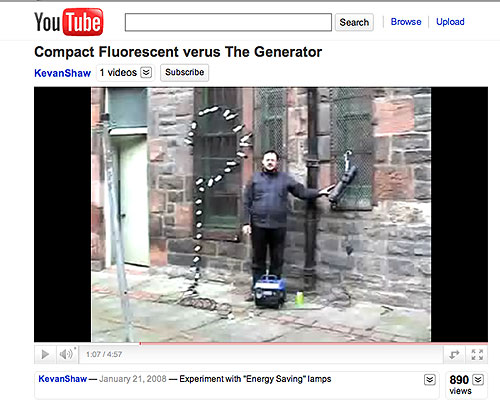
I resent Chris’s suggestion that my post in this thread was nothing more than marketing. I thought nosys70 was promoting the use of CFL Octagon boxes in a situation (generated power) where the harmonics they generate is a very good reason not to use them. Now, I could either say nothing, and let Azmyth find himself out of ignorance in the situation depicted by Kevan Shaw in his You-Tube Vide, “Compact Fluorescent verses the generator,” (available at http://www.youtube.com/watch?v=LeCqreRMzKM), or I could post yet again on harmonics and potentially save Azmyth from wasting a lot of time and money.


CFL_vs_Gen_Dem.jpg

For anyone who hasn’t already seen the video, it is a very good illustration of what can happen if you use CFLs on a conventional generator. In the video Lighting Designer Kevan Shaw compares the effect of equal wattages of CFLs and Incandescent lights on a small portable generator. In his test, he first operates a 575W ETC Source Four Leko with Quartz Halogen bulb on an 850W two stroke gas generator without problem. However, when he tries to operate an equivalent wattage of CFLs (30-18W bulbs) the generator goes berserk. Only after turning off half the CFL Bulbs does the generator operate normally with a remaining load of 15 - 18W CFLs (270 W.) What accounts for the erratic behavior of the generator in this video under a smaller load of CFLs? It is a combination of the poor Power Factor of the CFL bulbs and the harmonic currents they generate.

Even though the 15 CFL bulbs have a True Power of 270W, the Watt indicator on Kevan's generator indicates that they draw twice that in Apparent Power (535W), or have a Power Factor of .5 (270W/535W =.504.) The fact that CFL bulbs consume double the energy (Apparent Power) for the 18 Watts of light (True Power) they generate, is only half the story here. Kevan Shaw’s video also clearly demonstrates the severe effect that leading power factor loads - like CFLs, HMIs, & Fluorescents - can have on the governing systems of conventional AVR generators.

When Kevan turns off the 18W CFL bulbs one at a time until the generator stabilizes, he is not only demonstrating that 15 – 18W CFL bulbs has roughly the same Apparent Power (535W), according to the generator’s Watt meter, as a 575W incandescent light; but, also that the maximum Leading Power Factor load a 850W conventional generator can operate satisfactorily is 270 Watts (15 – 18WCFL bulbs). Looked at from another angle, 576 Watts of Apparent Power with a Leading Power Factor (16 - 18W CFL bulbs) overloaded the generator, while 575 Watts of Apparent Power with a Unity Power Factor (the 575W Quartz Leko) did not. What accounts for this difference? Since the load is almost the same (576 & 575 Watts of Apparent Power respectively), the only factor that can account for the generator going berserk with the equivalent load of CFL lights is the harmonic currents that they generate, that the Quartz Leko does not. Without a doubt, Kevan Shaw’s video is a clear demonstration of the adverse effect that harmonic currents have on the governing systems of conventional AVR generators.

For the same reason that Kevan Shaw was not able to operate more than 270 Watts of CFL bulbs (15–18W bulbs), it has never been possible to reliably operate more than a couple of 1200W HMIs with non-PFC electronic ballasts on 6500W conventional AVR generators. The adverse effects of the harmonic currents they generate, so
graphically demonstrated in Kevan’s video, limits the total amount of Leading Power Factor loads, as compared to Unity Power Factor loads, that can be reliably operated on conventional AVR generators.

I have put many hours into researching generators, the harmonic noise generated by lighting sources that utilize Switch Mode Power Supplies (HMI & Fluorescent electronic ballasts), and the effect it has on set power and other equipment operating on it. I have made this information available for free on our website (available at http://www.screenlightandgrip.com/html/emailnewsletter_generators.html.) I post in threads like this one where this information might help someone avoid a bad situation. How does this constitute marketing? If anything I am supporting the community by sharing this information so freely.

Guy Holt, Gaffer, ScreenLight & Grip, Boston
 
with all due respect chris how can you argue against education.

I don't think Chris' point has anything to do with education. It has to do with the fact that these same long winded duplicate posts keep getting popping over and over again.

I haven't said anything in the past I don't mean this to come off harsh either and if I'm wrong I completely apologize, but reading these posts, the way they seem to come back to back and always play off each other. It just seems odd to me that both Netjuicer and Eileen have a such very similar writing styles with very wordy long explanations, which both seem to stick on like sore thumbs on an internet forum where most people seem to want to keep their posts relatively short and sweet.
 
I wouldn’t be too sure about that. The OP said he wants “… something that will give off a large amount of light, for a large area (need lots of light for some night shots.)” The only flos that are capable of that are the Kino Flo VistaBeam 600, Image 85, Flathead 80. When you consider what those lights cost ($4,449.75, $2,460.75, $3,547.95 respectively),

As a matter of fact I would be sure about that. My previous statement still holds true. I've seen many posts by Azmyth on several different boards and he is just getting started with film making and working with a limited budget, so I'd place money of the fact that he won't be budgeting in any lights in the 1k-2k price range anytime soon.
 
Back
Top