Cheaper alternative to kino flo?

Azmyth

Veteran
I'm looking at expanding lighting for our film, I want something that will give off a large amount of light, for a large area (need lots of light for some night shots). We have a ton of CFL's... several 350s and 400s. We also have a few 500w tungstens. And 2 cheap 800w redheads that almost never work more than an hr or two before something goes haywire in them.
 
For a cheaper alternative, there is always Cool Lights. Richard is a member here and a really helpful guy...

http://www.coollights.biz

As for you intended use, I don't know if Kino Flo's are really your best option for lighting large areas at night.
 
Yeah, define "Large area". Kino flos or other Fluorescent lights look great, but drop off quit quickly over distances. For soft light over a large area you may want to go with large tungsten or HMI lights either bounced off of foam core, or other reflector, or shot through a large diffusion frame. I have had pretty good luck using open faced tungsten lights, shooting through a white umbrella, at night outside. That gave me a beautiful soft light and more throw than the flos would.
 
It depends on what you are shooting with as to how much grunt you need. (and the look you want.)

I recently gripped and gaffed this music video using my cool lights.

http://www.youtube.com/watch?v=p6Yg_rlgygg

All the shots except for the lady walking around the big bright windows are shot entirely using the following kit

1 x led600 (thats the only light on the piano)
3 x cdm150s
1 x cl-455p fluoro

Its all shot on a 7d, which has pretty sweet low light sensitivity, but I was impressed it was able to work such a large space with such small fixtures.

Not saying this is your ideal gear, just giving an example of real-world application of some inexpensive fixtures.

cheers!
 
So they would give more output that some fresnel, or the only advantage is the fact that they are cool?

Fluorescents have a lower wattage but higher output. For example, a 200w CFL would output an equivalent of a 700w tungsten. So they are considered "cooler" because they don't operate at such high wattage per equivalent output which equals lower heat. But the two problems are they don't throw as far and they are only soft light. It is easy to turn a hard light into a soft light, (shoot through diffusion, bounce off white surface) but it impossible to make a soft light hard.
 
... I want something that will give off a large amount of light, for a large area (need lots of light for some night shots).

All this talk about Flos is crazy. The OP wants “… something that will give off a large amount of light, for a large area (need lots of light for some night shots.)” The problem with Flos is that, like LEDs, their output drops off rapidly so they are not good for lighting “a large area.” What is needed is a HMI in the 2.5 to 4k range. But to keep it affordable you want to look at used 2.5/4k Fresnels with a magnetic ballast which you can find on ebay for the price of a Kino 4’ 4 Bank and will throw a lot more light.

To power an older magnetic HMI ballast outside at night without getting “flicker” you will need to use an inverter generator. Inverter generators put out a true sine wave with low distortion and stable voltage in addition to stable frequency. For anything larger than a 1200 you will need a 6500W generator like the Honda EU 6500is and a step-down transformer to convert the 240V output to 120 Volts in a single circuit large enough to power a 2.5-4k. Because it passes the power its generates through an inverter, the Honda EU6500is is rock solid and its’ frequency varies only hundreths of a cycle which eliminates the need for costly crystal governors. I won’t address the issue of flicker and frame rate/shutter angles because it is well established elsewhere in this forum that there are safe windows that are “flicker free” as long as the power supply is stable. As long as you shoot at one of the many safe frame rates, magnetic ballasts are “flicker free.” The EU 6500is is ideal for frequency and voltage fluctuation-sensitive equipment such as HD Camcorders, laptop computers, back up hard drives, and HMI ballasts – and they are so quiet that you won’t have to do any tenting if you place the generator in the right place.

Besides the extra bulk and weight, magnetic ballasts offer the distinct advantage of being less expensive and drawing less power (once they have come up to speed) than the commonly available non-PFC electronic equivalents. In fact, according to recent research done by a Boston Gaffer I work with by the name of Guy Holt, if you don’t have access to the newest Power Factor Corrected (PFC) electronic ballasts, you are better served by using the older magnetic ballasts on an inverter generator (like the Honda EU6500is) over non-PFC electronic ballasts on conventional AVR generators (like the Honda EX5500 or ES6500.) For details read the article Guy wrote for his company newsletter on the use of portable generators in motion picture lighting. It is available at www.screenlightandgrip.com/html/emailnewsletter_generators.html.

As a Gaffer of a lot of tight budgeted independent shorts, I think these machines are a major development in portable power. Since magnetic HMI ballasts will operate flicker free at all standard frame rates on them (without the need for a crystal governor), inverter generators like the Honda EU6500is give new production life to older 2.5kw & 4kw HMIs with 120V magnetic ballasts. And where you can pick up the lights very cheaply, they give you a lot of bank for the buck.

Eileen Ryan, Gaffer, Boston
 
What is needed is a HMI in the 2.5 to 4k range. But to keep it affordable you want to look at used 2.5/4k Fresnels with a magnetic ballast which you can find on ebay for the price of a Kino 4’ 4 Bank and will throw a lot more light.

Your advice about HMI's is all fine and good, but he also mentioned wanting to find a cheaper alternative to Kino's. Unfortunately while they might be the best choice for his need, I'm pretty sure 2.5-4k HMI's are going to be pretty far out of his budget, even used magnet ballast units.
 
Fluorescents have a lower wattage but higher output. For example, a 200w CFL would output an equivalent of a 700w tungsten. So they are considered "cooler" because they don't operate at such high wattage per equivalent output which equals lower heat. But the two problems are they don't throw as far and they are only soft light. It is easy to turn a hard light into a soft light, (shoot through diffusion, bounce off white surface) but it impossible to make a soft light hard.

Ok got it, thanks man.
 
a nice solution is to use umbrella reflectors (the silver ones) and fluo lamps.
you can find cheap ones from KONOVA
http://konovaphoto.com/continuous-lighting/fluorescent/et550.html
it is very light on Amps and weight and stay cool so you can use it anywhere and as much as you need. You can install them in 3 minutes.
the quad bulb adapter allows to choose how much power you need, just screw in as many bulb you need.
the only problem is the bulb transport , but unless you go led, this is the same problem for every lighting using bulbs.
I use them with 25, 60 and 85W bulbs.
 
Your advice about HMI's is all fine and good, but he also mentioned wanting to find a cheaper alternative to Kino's. Unfortunately while they might be the best choice for his need, I'm pretty sure 2.5-4k HMI's are going to be pretty far out of his budget, even used magnet ballast units.

I wouldn’t be too sure about that. The OP said he wants “… something that will give off a large amount of light, for a large area (need lots of light for some night shots.)” The only flos that are capable of that are the Kino Flo VistaBeam 600, Image 85, Flathead 80. When you consider what those lights cost ($4,449.75, $2,460.75, $3,547.95 respectively), a 2.5kw HMI Fresnel with Mag ballast is less expensive. A quick search turned up the following 2500 HMI systems that are considerably cheaper than the Kino Flos that you would use to light a large area at night.

Strand/Sirio 2.5K Fresnel HMI Package: $1600.00

DeSisti 2.5K Fresnel HMI Package: $1600.00

LTM 2.5K HMI Par Package: $1995.00

A 2.5 Fresnel is going to be more versatile than a Kino too. As NextWave G pointed out:
It is easy to turn a hard light into a soft light, (shoot through diffusion, bounce off white surface) but it impossible to make a soft light hard.

Since magnetic HMI ballasts will operate flicker free at all standard frame rates on inverter generators like the Honda EU6500is without the need for a crystal governor, older 2.5kw & 4kw HMIs with 120V magnetic ballasts might be his best approach.

Eileen Ryan, Gaffer, Boston
 
Yeah, define "Large area". Kino flos or other Fluorescent lights look great, but drop off quit quickly over distances. For soft light over a large area you may want to go with large tungsten or HMI lights either bounced off of foam core, or other reflector, or shot through a large diffusion frame. I have had pretty good luck using open faced tungsten lights, shooting through a white umbrella, at night outside. That gave me a beautiful soft light and more throw than the flos would.


I keep hearing people say fluorescent fixtures "fall off" quickly which just isn't anywhere near true. Light output is light output. If 2 lights have the same light output at the radiating face of the fixture, then guess what? They're both going to throw the same distance.

As for night shooting on a budget, you really don't need daylight balanced lighting at all and the attendant expense involved (with HMI). Open face quartz fixtures are great and you can gang these up to have a nice powerful single source for simulated moonlight. I'd stay away from bouncing though if starting with anything low powered. You're going to be better off going through some diffusion instead of bouncing because bouncing will subtract quite a bit from what you're starting with.

.
 
I keep hearing people say fluorescent fixtures "fall off" quickly which just isn't anywhere near true. Light output is light output. If 2 lights have the same light output at the radiating face of the fixture, then guess what? They're both going to throw the same distance.
.

Um, no. You can pretty easily demonstrate this fact by taking a flourescent fixture and an equivalent fresnel fixture, then measure their output at various distances. The flo is going to have a very fast falloff compared to the fresnel.
 
The only reason one fixture would throw farther than another is because it's putting out more light at its face. A fresnel fixture is focused and hence will seemingly "throw farther" than a fluorescent fixture (but still, it IS only doing so because it IS brighter), but if you put some diffusion material in front of the fresnel fixture in order to make it a larger radiator and comparable to a fluorescent fixture, with both fixtures emitting the same level at their face, I guarantee you they will emit the exact same amount of light and will fall off to the exact same degree.

.
 
but if you put some diffusion material in front of the fresnel fixture in order to make it a larger radiator and comparable to a fluorescent fixture, with both fixtures emitting the same level at their face, I guarantee you they will emit the exact same amount of light and will fall off to the exact same degree.

.

It's sorta like saying "Superman doesn't run faster than me, just weight him down with some kryptonite and we run at exactly the same speed." I guess technically it's true, but does it ever matter? Practically, when we say that flourescent has a shorter throw, it's in comparison to a hard light source, so the advice runs true: if you want to cover a larger area, don't use a flo.
 
Last edited:
problem is, if you use hardlight (focused a way or another), you will hardly be able to cover large surface. The only thing you can do with soft lights is to use reflectors to make sure most of the light is going the right direction.
That is why octagon boxes are great versus flo tubes in kino fixtures.
 
Practically, when we say that flourescent has a shorter throw, it's in comparison to a hard light source, so the advice runs true: if you want to cover a larger area, don't use a flo.


OK, yeah. But "fall off" is a function of output only.

Typically how large areas are lit at night is to put a bunch of heads on top of an aerial lift (or a multi-globe fixture) and put a 12X or 20X silk in front of it and have it about 100 to 300 feet away. Would you light a large area with a bunch of Kinos from a hundred feet away? No. But that's only because they just aren't as bright as point source fixtures with reflectors and lenses.

If you ganged up four 4 foot 4-bank Kinos, they'd throw just as far and put out as much output (more or less) as a single 750 watt fresnel fixture set to full flood.

.
 
If you ganged up four 4 foot 4-bank Kinos, they'd throw just as far and put out as much output (more or less) as a single 750 watt fresnel fixture set to full flood.

.

Well...yea, that's exactly what's you'd expect considering you're adding more light. But if it takes 4 Kinos fixtures to equal a single fresnel source, then doesn't that sort of prove my point? If you put two fixtures in front of me, a Kino Diva and a fresnel, and tell me to light a background that's 10 ft away using just one, I'd reach for the fresnel, and so would you I think. The only reason I wouldn't is if the Kino somehow manages to output WAY more light than the fresnel to compensate for the fact that it's not a point light source, but in 95% of all situation it's still sound advice to say that flourescent fixture doesn't throw as far as an equivalent hard light fixture.
 
Last edited:
I keep hearing people say fluorescent fixtures "fall off" quickly which just isn't anywhere near true. Light output is light output. If 2 lights have the same light output at the radiating face of the fixture, then guess what? They're both going to throw the same distance.

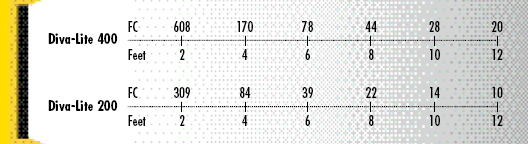
But, no two lights have the same output at the radiating face of the fixture because each light uses a different system (concave reflector, parabolic reflector, white reflector, silver reflector, polished reflector, stippled reflector, stippled spreader lens, Fresnel lens, etc. etc. etc.) to project and control light. An illuminating comparison is the Kino Flo Diva 400 to the Kino Flo Parabeam 400. They both use the same 55W biax tubes, yet throw very differently.

diva400photometrics.gif

The Divas, like Flos in general, have a very broad soft light output. The light tends to drop off rapidly (see photometrics above) which means the units need to be positioned close to the subject they are lighting – making them best suited to documentary interview set ups.

kinoparabeam400photometrics.gif

The Kino Flo ParaBeam fixtures have computer aided designed (CAD) parabolic reflectors that focus the light output at about 16 feet (5 meters). If you compare the photometric tables of the Parabeam 400 and the Diva 400 (above), you will notice that at 16’ the Parabeam 400 puts out almost three times the light level (28FC) than the Diva 400 (10FC) even though they both use the same tubes. In fact a Parabeam 400 generates as much light at 16’ as the 4’ 8-Tube Kino Flathead 80 fixture, yet uses less than a quarter of the power – making it the Flo of choice if you were going to use it on a portable generator.

ParaBeams are well suited for HD Digital Cinema, because it doubles the light output of the lamps where it is needed most for lighting dramatic scenes - at a medium distance. Compared to the Diva-Lite, which uses the same four 55Watt compact lamps and the same ballast, the ParaBeam has twice the throw (is twice as bright at 12'.)

Guy Holt, Gaffer, Boston
 
Back
Top