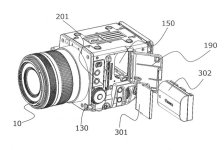
Canon's Upcoming RF cinema camera rumored specs

This sounds like the update to the xc series that we’ve been asking for. But some of it sounds off. For one, I’m sure it isn’t the exact same sensor as is in the C200 just due to the fact that it is an RF mount. Also, the three card slots, two batteries, and mini xlr is odd in a smaller camera. I wished they'd just kept the external audio unit rather than mini XLR.
 
I’m sure it isn’t the exact same sensor as is in the C200 just due to the fact that it is an RF mount.

Does EF really make more sense than RF for a S35 sensor? The best EF glass is FF. The EF-S glass doesn't even cover S35. If you want to use S35 glass on this RF camera, just use an adapter. You have only to gain from putting the sensor behind an RF instead of an EF mount (more lens options + speedbooster)

Consider the other rumored adapters - PL to RF, locking EF to RF, speedbooster EF to RF
 
Last edited:
To me, moving forward, RF makes more sense as the mount, regardless of sensor size(“FF” or s35). Opens up a way bigger selection of glass by just using adapters.
 
Old Inferno could too, and new ones from Blackmagic can but I think only BM RAW.

Yes Shogun Inferno can record 120fps. I used to use it to record 12-bit 4k/120fps Pro-Res Raw as a burst out of my FS5. Crazy to think that camera did that 4 years ago and we are just seeing implementation of this resolution/frame rates to external recording by competitors today.
 
Are people really disappointed it's ONLY 6 stops of ND? That takes f/22 to f/2.8 no?

The problem is if your base ISO is 800. I think I can live with 6 stops ND. But I've been at f/16 or f/22 at ISO 160 outside when I had no ND. So, at that illumination level and ISO 800 i would not be able to reach f/2.8 (let alone f/1.4) with 6 stops ND. So, better have some extra ND on hand
 
Random thoughts from someone waiting for a C100MK3 for years:
  • Don't know how they can get internal NDs into that mount.
  • No mention of an EVF?
  • No mention of IBIS?
  • Why on earth use 5D batteries when they already make actual professional video batteries that last much longer?
  • What does this add over the C200? 4K 120p and 10-bit? I don't see myself sprinting to buy a new camera just for those features, especially if it removes EVF, IBIS, and professional batteries.
 
The problem is if your base ISO is 800. I think I can live with 6 stops ND. But I've been at f/16 or f/22 at ISO 160 outside when I had no ND. So, at that illumination level and ISO 800 i would not be able to reach f/2.8 (let alone f/1.4) with 6 stops ND. So, better have some extra ND on hand
ISO 160 on C-series is cleaner than ISO 800. Gain dynamic range in the shadows, lose it in the highlights compared to 800. I do like being able to have 10 stops of ND, but I'm also not hesitant to lower the ISO when shooting outside if need be. Amira is up to 7 stops of ND so more often needs to lower the ISO if wanting to shoot wide open in daylight. Think people get too caught up on the "Native ISO" myth, but I've said that before.
 
ISO 160 on C-series is cleaner than ISO 800. Gain dynamic range in the shadows, lose it in the highlights compared to 800. I do like being able to have 10 stops of ND, but I'm also not hesitant to lower the ISO when shooting outside if need be. Amira is up to 7 stops of ND so more often needs to lower the ISO if wanting to shoot wide open in daylight. Think people get too caught up on the "Native ISO" myth, but I've said that before.

Sure but I often find that if it's nuclear bright, I need the DR in the highlights. And at some point lowering it down, you have less absolute DR (like if you go below 160 on most Canon stills cameras AFAIK)
 
Speaking from years of personal experience, the 6 stops of ND in the OG C300/C100 gets you in the ballpark almost always in actual shooting conditions.
 
Speaking from years of personal experience, the 6 stops of ND in the OG C300/C100 gets you in the ballpark almost always in actual shooting conditions.

Yeah my OG c300 nd always worked for me. Sometimes I have to lower ISO or close aperture when I dont want to, but not by much
 
Random thoughts from someone waiting for a C100MK3 for years:
  • Don't know how they can get internal NDs into that mount.
  • No mention of an EVF?
  • No mention of IBIS?
  • Why on earth use 5D batteries when they already make actual professional video batteries that last much longer?
  • What does this add over the C200? 4K 120p and 10-bit? I don't see myself sprinting to buy a new camera just for those features, especially if it removes EVF, IBIS, and professional batteries.

10-bit is a big deal. They'll probably sell that cheap add-on EVF for the C500ii with it.

In any case, this has b-camera/gimbal camera written all over it, so lack of EVF may not be a deal breaker
 
... What does this add over the C200? 4K 120p and 10-bit? I don't see myself sprinting to buy a new camera just for those features, especially if it removes EVF, IBIS, and professional batteries...
This looks to slot for C100, whether in a very small XC form or the usual C-series. Personally, I think there could be two different cameras at some point anyway.

But my visit to Canon's HQ has not yet been scheduled.
 
Yes Shogun Inferno can record 120fps. I used to use it to record 12-bit 4k/120fps Pro-Res Raw as a burst out of my FS5. Crazy to think that camera did that 4 years ago and we are just seeing implementation of this resolution/frame rates to external recording by competitors today.
The reason that the Shogun Inferno was able to record the 4K 120 RAW burst from the Sony FS5 and FS700 was that the camera buffers the 4K 120 clip internally, then plays it out over SDI at 4K 60fps. So the recorder doesn't have to actually deal with a full 4K 120fps bandwidth on input.

The Convergent Design Odyssey7Q could record this camera-buffered 4K 120 RAW burst as well, but was similarly limited to 4K 60fps for continuous recording.

The Blackmagic Video Assist 12G HDR recorders can only record RAW video from 3 cameras at the moment: Panasonic EVA1, Canon C300 Mark II, and Sigma fp. But none of these cameras can do 4K at 120fps.

As far as I know, none of the current portable monitor/recorders can handle continuous 4K recording at higher than 60 fps. Most of the existing recorders have HDMI 2.0 or 12G SDI inputs which are only capable of transmitting 4K 60 video (although I suppose it might technically be possible to do some kind of compressed RAW format to squeeze it through the bandwidth limits of such ports). And even if there were a way to transmit this higher frame rate signal, it's not clear that the processors on the existing monitor/recorders would be able to handle the processing and recording of it.

At the moment, only the dedicated camera-specific recording units can do continuous 4K 120 RAW, like the Sony AXS-R7 or the Codex CDX-36150 for the Canon C700.

Canon seems to have moved away from external RAW recording since the C700, as all of their more recent Cinema EOS camera releases (C200, C500 Mark II, and C300 Mark III) support internal RAW recording instead. It is also worth pointing out that in terms of the amount of pixel data per second, 8K 30fps RAW (as supported on the R5) is identical to 4K 120fps.

Used to run into something similar several years ago with the PIX and F55/5's. The cameras don't actually output anything higher than 60fps, but guys with PIX would shoot slow-mo in-cam and then play it out in real time into the PIX(totally do-able when you only have a handful of shots) and the producers would be happy as clams, because they got ProRes instead of having to deal with bad 'ole XAVC(insert eye roll). Then they'd call and want to do these massive slow-mo shoots and ask you to get a PIX so they could have it in ProRes immediately instead of transcoding. Then you'd spend half an hour trying to explain to them what the other guy REALLy did when they weren't looking and why it's not going to work for their shoot with 100 72fps slow-mo shots that end up being 5-7 minutes each when played back(true story).
 
Are people really disappointed it's ONLY 6 stops of ND? That takes f/22 to f/2.8 no?

I'm being a bit harsh because we're speaking about a prosumer level camera (which doesn't exist yet), so you're right in that 6 stops of ND probably shouldn't disappoint.

In the medium-level cinema camera bracket I would definitely be disappointed in only 6 stops of ND. Changing ISO is fine but it's still slower than the single button to add ND or not doing a single thing when using the sony variable ND.

For most situations the 6 stops is fine but I like quickly checking what a silhouette looks like or if it's better to keep exposing for the person in the frame.
 
I'm wondering why it would include a CFast Slot, when there's no internal RAW?
The card slots also hint that this camera has been sitting finished in the drawer some time.
UHS-III came out in 2017 and could spare the CFast slot, saving space and giving the camera an even more "entry level" stamp.
(and UHS-III even looks dated compared to the latest SD standards...)

If 120fps at 4K will happen, this would take a big chunk out of the higher end EOS-C cameras.
The R5 offers it, it would also be a typical Canon move NOT to include it in this low-end EOS-C cam...

All that being said, the rumoured specs surpass a Canon C300m2 so far, now that camera in a smaller body for under
5K$ would make a lot of shooters happy.
The smaller body alone makes me very exited, the recent Cs have gotten larger and I always believed the C100s form factor
was the best for non-rigged-up shooting.
 
Last edited:
Ok Canon rumors is now saying there will be 4 new Canon video cameras:

2 RF-mount "R" series S35 cameras and 2 1" XC and XF series cameras.

The only one that looks interesting to me is the "R300" but as a cheaper alternative to the C300iii and not as a B camera.

What do you guys think?

https://www.canonrumors.com/multipl...campaign=Feed:+canonrumors/rss+(Canon+Rumors)
Canon Cinema EOS R200 (Name not confirmed)

Super 35mm 4K sensor (same as the Cinema EOS C200)
No IBIS
RF Mount
Internal ND (10 Stops)
CLog 2 & CLog 3
4:2:0 8bit internally onto SD cards up to 4K60 & 1080/120
No RAW
Dual LP-E6NH battery slot
Price: $3499 USD

Canon Cinema EOS R300 (Name not confirmed)

Super 35mm 4K DGO sensor (same as the Cinema EOS C300 Mark III)
No IBIS
RF Mount
Internal ND (10 Stops)
CLog 2 & CLog 3
4:2:2 10bit onto SD cards up to 4K120 and 2K180
No RAW capability internally at launch
BP-A batteries
Price: $6299 USD

Canon XF505

Replacement for the XF205
Same 1″ sensor as the XF705
12G-SDI output and SD cards
An integrated zoom lens with 15x zoom
BP-A batteries

Canon XC20

Replacement for the XC10/XC15
Same 1″ sensor as the XF705
CFexpress slot for internal RAW recording
SD cards for XF-AVC/MP4 recording
An integrated lens with 10x zoom and constant f2.8 aperture
LP-E6NH batteries
 
Last edited:
Back
Top