Canon Sales Continue to Plummet

The devil is in the detail, obviously, but the Olympus production facility may be made profitable without it having to carry the corporate tail. If an independent was interested in moving in on it, he might hire its engineering staff too. And then try to find a different sensor manufacturer beside Sony.

Considering that 70 mm2 Galaxy S20 Ultra sensor has 108 MPX while Sony's 225 mm2 MFT is only 20 MPX, there's definitely enough room for higher resolution. That would break Olympus out of cartel's clutches and set its performance and value apart from others.

Then they could also enter the lower end of the video camera business, a niche abandoned by Panasonic half a decade ago.

And if it felt really adventurous, it could make an MFT mount APS-C and FF cameras.

A controlled market always has potential for the smaller fry willing to step out on its own.
 
Why buy Olympus? There's no point in being burdened with an old division with who knows how much overhead and old ways if you're going to start a hot new camera company. If they have some good engineers, you poach them. They hear the rumors as loud as anyone and are ready to go. Maybe some patents?
 
Olympus chose not to release their financials until next quarter (or the end of May). A reasonable interpretation of the patient is that he's bleeding profusely and his survival chances are nearing bleak. There is, however, a bunch of sales on the Olympus gear.

One interesting tidbit from their management's interview was that, while their production was negatively effected by the Covid situation in China, the overall sales decline "made up" for it and there's no shortage of gear available. Which is what I thought was the likely scenario with Canon as well. Olympus could be lauded for being somewhat prescient and moving its main production facility to Vietnam. Canon has moved some of theirs into Thailand and some - I assume their higher end models - back to Japan.

Putting on my official Olympus Visionary hat......

Olympus has many facilities. Yes, they opened a major optics plant in Vietnam recently, but they are still operating in a few arenas.

Been hearing m4/3 is dead ever since they launched it.

Not so well known is that Olympus, as a chiefly optics based company, make a lot of lenses for other people. Some would surprise you. You think you're buying a "XXXX" lens but really it's made by Olympus...

They started off making microscopes....

They also make the vast majority of their income not from cameras, but from another business. Medical.

So imaging (cameras) has struggled to pay it's own way, but the medical business is VERY profitable. Next time you need a camera inserted from up top or down below, 75% chance it will be an Olympus.

And the main reason Olympus medical is so successful ? Because they can leverage the R&D from their imaging side of things.

So they use cameras to "pay" for the R&D of their medical business.

Ever since m4/3 was launched it's been dead and the full frame sycophants have been saying it for like what...a decade now ?

Meanwhile SLR's died. Mirrorless is barely keeping the traditional camera players in the game. (from a photo point of view)

Like others, times are tough for sure. But I think Nikon would be in more trouble than Olympus. Canon are big and diverse and have a lot of IP. Sony and panny are too.

Olympus are small, but they are true leaders and innovators in a few key areas where the others don't play. I don't think they're in trouble like the rumours I read here and elsewhere say.

JB
 
Last edited:
Why buy Olympus? There's no point in being burdened with an old division with who knows how much overhead and old ways if you're going to start a hot new camera company. If they have some good engineers, you poach them. They hear the rumors as loud as anyone and are ready to go. Maybe some patents?
There are plenty of ways to acquire a full company, its branches, its distribution, its production assets, its R&D patents, et cerera, et cetera. I'm no Meshulam Riklis but there's usually a way to isolate the money making portions of a business vs. the money losing.

Olympus is a publicly listed company with a market value of ~ $20B. It may or may not make sense to buy all of it and then sell off he money losing operations or negotiate for the purchase of its parts. In terms of photo-video, I believe Olympus stands no chance as a junior player in a cartel. As a minor independent, it may.

Putting on my official Olympus Visionary hat......

Been hearing m4/3 is dead ever since they launched it.

JB
I don't believe MFT dead but, as I've stated above, I do believe Olympus is boxed into a corner by its partners. And the trend there doesn't look all that promising in the long run.

PS. Insofar as using the photo-video imaging as an R&D for the medical, with the corresponding cost attribution, it's more of a PR line than a sound business reasoning. If the company has a solid roster of engineers, let it count in segments where their work brings the most profits. Otherwise, it's typical Hollywood accounting (but in reverse).
 
Net sales for the first half of this term decreased by 10.0% year on year...

DLD said:
Map Camera is Japan's largest camera store, they have decided to release their Top 10 seller list for the month of November 2019.

PaulF said:
Sony's financial report looks good for the last 2 years.

Yes this happens when you use the cripple hammer and keep pushing cameras no one wants to buy.

In comparison, just look at Sony's last few golden years here. Soaring like an eagle. You can't pick up a Sony body one handed without your fingers touching five spots that couldn't be turned into a bullet point on a spec sheet:

Sony-all-time-low-Alpha-camera-sales-1.jpeg


Annecdotally, the drop from 2018-2019 is 22%.

I don't have the chart for "people-who-decided-to-ditch-their-camera-and-just-use-their-mobile-phones-for-photography" readily available, but if you're on a laptop, just turn the computer upside down and look a Sony's numbers here. Should work pretty well.

poor Sony. only 3million cameras sold. How will they ever make a profit?
 
Last edited:
poor Sony. only 3million cares sold. How will they ever make a profit?

I think we're all being a bit cavalier with our brand-bashing. No, I don't empathize with large corporations, and no there's nothing we can do to stop these trends.

But if the people making our cameras lose 90% of their business, that can't be good for us, right? The lower demand will cause prices to rise, right? (At least, after some of the weaker players exit the market and leave us with fewer choices.)
We are seeing it a little backwards.

The digital transition created a huge boom and unrealistic sales numbers. We are now getting back to more realistic numbers. Millions of camera sales still seems good. We act like these companies are failing, when any other business would be happy with millions of sales.

This isn't brand bashing. This is forum bashing.

Maybe petapixel isn't a reliable source, but look at how this graph just sky rockets between 2000 and 2013 during the heaviest part of the digital transition. many of those numbers include cellphones.

https://petapixel.com/2015/04/09/th...a-sales-looks-like-with-smartphones-included/

Basically, these camera companies didn't "lose 90%" of their business, they had a huge boom, and things are settling down and getting back to something more normal.
 
Last edited:
We are seeing it a little backwards.

The digital transition created a huge boom and unrealistic sales numbers. We are now getting back to more realistic numbers. Millions of camera sales still seems good. We act like these companies are failing, when any other business would be happy will millions.

This isn't brand bashing. This is forum bashing.

Maybe petapixel isn't a reliable source, but look at how this graph just sky rockets between 2000 and 2013 during the heaviest part of the digital transition. many of those numbers include cellphones.

https://petapixel.com/2015/04/09/th...a-sales-looks-like-with-smartphones-included/

I suppose you're right. Camera companies did good business in the 90s but I hadn't realize how much the DSLR boom inflated sales numbers above historical averages.
smart-phone-effect-on-camera-shhipments.jpg

That being said, I'm really not crazy about these smartphone trends. I don't think a smartphone will ever be a tool I want to use professionally, so all that R&D is a waste from my perspective.

Meanwhile, I was supposed to shoot a conference at Christie's auction house in March. It got postponed. Now they're gonna do a webinar instead and the speakers are largely self-recording. They asked me to recommend a cheap lighting/audio set-up for the director to self-record with his iPhone. The iPhone seems good enough for this sort of application, which makes it not good enough for me to use but good enough to make me redundant, and I don't like that. (That being said, they told me that they would ideally have me come film him in the gallery for something like this. Hopefully those norms will return post-pandemic.)
 
There a bunch of YouTube smartphone vs camera videos. Smartphone vs. DSLR, smartphone vs. 1DXIII, smartphone vs. MFT. Trying to establish a consensus is difficult, as smartphone cameras keep getting better and better. Eyeballing the tests, new high end phones with 40-108 MPX sensors and periscope zooms are as good as a sub-$1,500 ILC camera with a kit lens. The smartphones do some things better than a stand-alone camera, some not as well. Overall, there's very little reason for an amateur to purchase an ILC anymore. Even for longer zooms, one can buy external attachments like Moment or Olloclip.

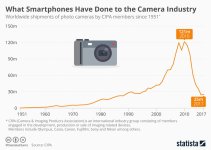
In the film days, there was very little substitute for a film camera. There were different types - from cassettes to medium/large format, from stills to "film" - but nothing else took images. Now there is. And the photo-video cartel, with its rigid control of performance, features and pricing, has helped its sole rival make much faster inroads toward complete domination. In terms of units sold, it's already ~ 90% off its peak and is steadily marching to "100% off" number. Well, maybe 99.999% off. Some people still buy typewriters, vinyl records and horse carriages.
 
That being said, I'm really not crazy about these smartphone trends. I don't think a smartphone will ever be a tool I want to use professionally, so all that R&D is a waste from my perspective.

That cell phone market pays for a lot of the R&D that makes the sensors we're interested in possible. Sony pioneered several new technologies like back-side illumination and stacked sensors in cell phone sensors, then gradually scaled them up to professional cameras. Since the cell phones sensors are making enough money to recoup the R&D costs, it lowers the costs for deploying those technologies into higher end sensors.
 
There a bunch of YouTube smartphone vs camera videos. Smartphone vs. DSLR, smartphone vs. 1DXIII, smartphone vs. MFT. Trying to establish a consensus is difficult, as smartphone cameras keep getting better and better. Eyeballing the tests, new high end phones with 40-108 MPX sensors and periscope zooms are as good as a sub-$1,500 ILC camera with a kit lens. The smartphones do some things better than a stand-alone camera, some not as well. Overall, there's very little reason for an amateur to purchase an ILC anymore. Even for longer zooms, one can buy external attachments like Moment or Olloclip.

I assume you're talking about stills shooting? I feel like most of the features that make smartphones competitive are rooted in computational photography (fake bokeh + auto-composited enhancements for low-light and cropping). Maybe those features will come round to shooting video, but I don't know if they can pull it off for a series of images, at least in a convincing and consistent way.

That cell phone market pays for a lot of the R&D that makes the sensors we're interested in possible. Sony pioneered several new technologies like back-side illumination and stacked sensors in cell phone sensors, then gradually scaled them up to professional cameras. Since the cell phones sensors are making enough money to recoup the R&D costs, it lowers the costs for deploying those technologies into higher end sensors.

I forgot. I guess I should be grateful.
 
I have not shot with the latest generations of smartphones like the iPhone 11 or the latest Samsungs. I bought my iPhone 8 Plus thinking that I could use it instead of my DSLRs, mirrorless and occasionally as a video camera with a Gimbal. Let's just say that the results, for professional use, have been, let's say, disappointing. I shoot a lot out in nature, remote areas,
on sets. etc. The stills are, at best, acceptable for social media use, but compared even to a $500.00 DSLR, there is no comparison. For video, I find it looks better than a Go Pro but not nearly as good as even my Canon 80D, much less the Fuji X-T3. But for the average non-pro, I can see why ILC cameras are dying.
I love good image quality. But to be honest, I was happy on the AG-DVC30 and I am happy on the iPhone. I really enjoy shooting and making images with all cameras. I really hope that IQ continues to improve, and I can see so many ways that it can, but if it doesn't, I'll also be ok.

Pure, I feel you are similar, I believe you have been making amazing images regardless of the current tech.
 
I forgot. I guess I should be grateful.

Appreciative, at least. Cell phones are also now driving process technology... when Apple shifted its orders from 7nm to 5nm at TSMC it freed up a crazy number of 7nm EUV wafer starts that AMD and nVidia are snapping up in droves.
 
I assume you're talking about stills shooting? I feel like most of the features that make smartphones competitive are rooted in computational photography (fake bokeh + auto-composited enhancements for low-light and cropping). Maybe those features will come round to shooting video, but I don't know if they can pull it off for a series of images, at least in a convincing and consistent way...

If it's done well enough, it's very hard for a casual viewer to tell.


PS. A lot of people signing checks are, as has been opined on these forums, are "casual viewers".
 
If it's done well enough, it's very hard for a casual viewer to tell.


PS. A lot of people signing checks are, as has been opined on these forums, are "casual viewers".

Good compositions and camera moves never get old and can happen with any camera. There are some very cool moves in there, especially.

Not sure this video tests the limits or range of the camera? If you only look at what a camera can do, you're not looking at what it can't do (low-light, shallow DOF etc)

That being said, we'll see some interesting things be made on these iphones by young folks without money
 
If you only look at what a camera can do, you're not looking at what it can't do (low-light, shallow DOF etc)

And isn't that the right approach? Look at what a certain format is good at and then go with that?

One of my cameras' picture quality is, if pixel peeped—sort of what Puredrifting was alluding to regarding Smartphones—abysmal. Or, well. Maybe not that bad, but. It shares similarities with today's Smartphones.

Yet:

StAndrewsSun.jpeg


StAndrewsCoast.jpeg


This camera's strengths are: being portable, being able to position itself in the air. It turns out, that goes a long way.

If you tell a golfer that the town in the background is St Andrews in Scotland, these images are interesting enough that you don't need to peep.
 
Back
Top