Canon R5 Announced with 8k

I'll say this, I've been F'd over more times by an editor than I've been saved.

One of the funniest things to me about this business has always been the tug-of-war between cameramen and editors over the footage. The cameramen want to shoot everything in oners and feel like the editors can only screw things up from there. The editors want unlimited takes from unlimited coverage and consider the cameraman to be a glorified security camera just there to capture what happened. The REAL style and art happen in post!

Naturally, the editors are wrong.
 
However once cameras got kind of good, like the C300mk1, we started running into issues where the camera looks soooo good when everything is safe, but once the light gets a little spicy, the thing clips and clipping on such a pretty image is like finger nails on a chalk board sometimes. And if one is avoiding clipping to make pretty images, than why not have more DR to keep those images pretty even when there are a few bright spots in the frame.

That's an interesting way to look at it. I'm not sure I ever thought about it like that.
 
I recently watched a video I shot around a year ago to find that of the two interviews, for one of them the editor properly muted the on-camera mic on track 3 & 4 so it was just the proper overhead boom feed which sounded great, but for the second interview (starting at 2:46), the editor did not mute the on-camera mic so the audio sounds pretty crappy. I really don't know how an editor can be smart enough to mute the on-camera mic for one interview but not smart enough to do it for both interviews.

Part of me wants to never have the on-camera mic on for an interview, but the other part appreciates that backup, as well as always having it on can save you in non-sit down interview situations where if you keep turning it on and off you may end up screwing yourself when you do eventually need it. But then there's always incompetent editors you have to worry about.

It seems like audio is a complete mystery to so many in post. I've lost track of the times where editors have left the nat mic up or used it instead of the "real" audio.

We used to get some complaints from a client about audio a lot. One day we were shooting at one of their studios and they were taking the stuff we shot and turning it around and getting it on the air throughout the day continuously. At one point one of the directors or producers comes back to our room and says the audio is low. My audio guy, who actually worked in the studio, and had for years, almost exploded. I immediately popped-up and said that's impossible. They took us back to the edit bay and showed us. They had the bay set-up expecting audio levels at much higher levels than are normally recorded in-camera. Basically they were set-up for audio to come in "zeroed out" at -12 instead of -20, like everyone else on the planet. And trying to explain that to them was like trying to explain algebra to a cucumber.

Another one that I loved was after we fed in some sound from the racetrack one evening and the called the producer back nd complained because there was a buzz/hum in the audio. Anyone that has shot at a racetrack knows what the ballasts on the big Musco lights sounds like. A big 'ole giant 60hz hum. Again, trying to explain to them that that is what it actually sounded like out there and that it was not a technical problem was like beating your head against the wall, without the pleasure you get when you stop hitting your head on said wall.
 
One of the funniest things to me about this business has always been the tug-of-war between cameramen and editors over the footage. The cameramen want to shoot everything in oners and feel like the editors can only screw things up from there. The editors want unlimited takes from unlimited coverage and consider the cameraman to be a glorified security camera just there to capture what happened. The REAL style and art happen in post!

Naturally, the editors are wrong.

Especially when the editor in the nice climate controlled building with cushy chair and anytime access to food, beverage and restrooms wants the crew in the field to do something they normally don't do that could F them or adds two hours to their day, so that it save them two keystrokes.
 
They must be applying different gain to each pixel in a quad Bayer array. Exactly what I'm hoping the A7SIII will do.

I don't think you can call that bracketing though, calling it HDR would be more accurate IMO. And ideally it just gives you wider DR, like DGO but moreso. And I don't see how the camera's computer will guess the exposure any differently than they currently do, but it'll be harder for it to miss. (As an aside - the "face priority" exposure mode on the Sony ZV1 is pretty much all decent autoexposure needs to do. I mean, it's basically what an actual cameraman does, plus maybe a little tweaking to accommodate the rest of the scene.)

I am fairly certain you're correct. And I actually don't recall what it was called on the company PR release. I doubt they're blending actual exposures - though it is possible in the negative gain, if that's a term to use, or exposure compensation - rather than offering a sequence of multiple ISO frames and then blending them for the final output. In either case, it probably works kind of/sort of like a dual gain sensor.

Here's a DP Review discussion on ARRI dual gain setup. And it has a post by Eric Fossum. Which one would find hard to debate.

https://www.dpreview.com/forums/thread/4308592

They are kind of.

So what happens in dual gain which arri and some BMD cameras have is that each pixel has two data paths out of the pixel. You basically apply two different amplifications to the SAME pixel readout, both at a reasonable high bit depth.

In Arris' case it's a 2 x 14 bit images, on of a low amplification and one of a high amplification. You then put those together to get a 28 bit image. Reducing that to a 16 bit linear allows you to roll all that dynamic range down into a single high dynamic range image. This is what's kept arri so far ahead. 28 bit source images...

BMD do the same thing, but at quite at not quite as high a bit depth. 2 x 11 bit to make 22 bit down to 16 bit lin. Still very very high bit depth.

There are artifacts from this process by the way. Arri are really genius at hiding them, but they are there. You can sometimes see this in areas of transition from a high gain to low gain part of the image. Melding the two images together is actually really really hard and honestly I think it's why no one else has tried to do it.

A dual ISO sensor is different in that there are two set's of modes for each pixel. One is a high mode, one is a low mode. So you can't do both at the same time. The pixel can only do one of the other, Not both. There's also only one data path out of the senor. Dual gain has two discrete paths out of the sensor at the same time.

JB
 
Right but .... I think the smartphone version will be a less demanding simultaneous multiple ISO system. No dual gain per se or even dual ISO. And it'll probably have artifacts up the wazoo.

Having said that, BMD makes an affordable line of cameras with the dual gain sensor. It stands to reason that the engineering portion is well known and the computational power is trickling down to that level as well.

And it'd be nice to see it on Olympus also.
 
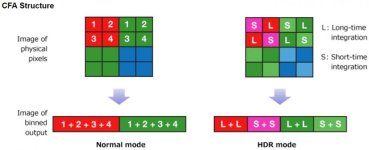
I think a quad Bayer HDR implementation should be relatively artifact-free as you're only taking one reading of the whole sensor. You aren't combining multiple exposures. The downsides are lower resolution and a longer readout time as now you're reading 4x as many pixels as your final capture resolution.

This diagram shows an implementation wherein half the pixels in a 4x4 patch have longer exposure times than the others. That doesn't make much sense to me except maybe for photography. With that implementation, I think there would be a lot of artifacts. I don't see why they can't apply different amounts of gain to different pixels and give them all the same exposure time.

quad-bayer-hdr-mode-sony-image.jpg
 
Jeepers... We editors sure are getting bashed around in this thread!

I can confidently tell you the footage and audio coming in from the field is not always sunshine and rainbows. Can’t tell you how many times I’ve been handed files with issues that you’d excoriate a first-year film student for, much less seasoned pros. But I just deal with it and discreetly try to let the team know without creating drama or throwing anyone under the bus.

And as for audio issues in the final mix, it’s often the audio post house screwing things up. Trust me, I’m often shaking my head at the screwups on that end... So save your torches and pitchforks for those bastards with their insanely expensive Genelecs and gazillion-track mixing boards!

Or maybe it’s the producers creating division and in-fighting between us. I mean, they are basically the politicians of the film world...

;)
 
... This diagram shows an implementation wherein half the pixels in a 4x4 patch have longer exposure times than the others. That doesn't make much sense to me except maybe for photography. With that implementation, I think there would be a lot of artifacts. I don't see why they can't apply different amounts of gain to different pixels and give them all the same exposure time.
It seems like the DR of the CMOS sensors is reaching - or has reached - its limits in the law of physics sort of way and the scientists and the engineers now have to resort to tricks to eek out the tricks for that extra gain.

That said, I saw an article for a 140 db (23 stops) HD sensor that is aimed at the auto market.

And the next big hope isn't Obi-Wan Kenobi, ASC but organic sensors that are promising another couple of stops. Those have been teetering near the edge of production for a while and may achieve an actual production status in the near future. In a galaxy far far away. Or Japan. Whichever is closer to the 2021 Olympics.
 
Having said that, BMD makes an affordable line of cameras with the dual gain sensor. It stands to reason that the engineering portion is well known and the computational power is trickling down to that level as well.

And it'd be nice to see it on Olympus also.

Having been a part of the behind the scenes with both those ecompanies, you realise how frickin hard it is to make a nice picture.

The dual gain requires a certain level of...commitment... in terms of engineering. It's far easier to go to a sensor that makes a picture. Much much harder to use a sensor that makes two pictures that YOU have to stitch together seamlessly....

As I understand it anyone could access similar base versions of those sensors, but the amount of work required to make them cinema friendly put's most people off. Most of BMD's customisation is in the designing of the CFA (which affects colour) and in the image processing pipeline.

This is what's irritating when people say "off the shelf" sensor and infer how easy it all is... because here's a dual gain off the shelf sensor. Yet it's not exactly flooding the market.. Because it really isn't off the shelf. Still a massive investment of resources to bring it to market. It's very telling that you haven't (yet) seen a Z cam or Kinefinity attempt it.

JB
 
As a DP/Director who often edits and as someone who owned an audio post facility for five years, I may have a unique vantage point on the blame game.

1. DPs, ACs, videographers and really anyone wielding a camera OFTEN forget to shoot for the edit. They don't shoot enough coverage or if they do, they often don't make the shots long enough and or leave handles on either end of the shot. When I shoot and or edit
I am VERY careful to shoot for the edit and to try to get as much coverage as humanly possible. I can't tell you how many shoots I've been on where as I was shooting, I kept thinking, "No way I will ever need this shot or this long of a shot", then I get into the edit and
save my own rear by shooting all of those dumb extra shots/angles/coverage which turn out to be lifesavers.

I don't edit too many projects I didn't shoot but those few times I do, I almost always find myself yelling at the monitor as I skim the footage, yelling, "Would it have killed you to just give me
actual coverage of a scene, wide, medium and CU!!!!". "Maybe some reverses and cutaways?" It's astounding how many "pro" shooters shoot inadequate or poor coverage footage. Personally, I think every single person who shoots
anything should be forced to try to edit a good piece from footage they have shot and not covered well. I am not usually impressed when I meet DPs and camera people who don't know how to
edit, at least on a rudimentary level. Shooting without editing knowledge is often a recipe for frustration later down the production process.

2. All of that said, editors are usually VERY disconnected with production and have no idea how many mitigating factors occur in live production that are beyond the control of production. Noise issues,
lighting and environmental issues, equipment problems, running out of daylight when shooting exteriors, dealing with dirtbag property owners or bystanders who require an extortion payment to NOT
be an interruption to production, uncooperative talent, incompetent directors, etc. Physical production is HARD and can be almost impossible often.

I worked on a network action show, we were shooting in Africa, and on the first day of shooting, one of the two leads was seriously injured when a whole scaffolding section fell onto his head, gouged his head, blood everywhere,
they airlifted him to Europe for immediate surgery, it was nuts. The producers decided to keep shooting the week with the actors body double and they actually ended up doing face swapping digitally. The show had explosions, car chases and gun fights all scheduled that week.
The producers got nervous and switched out all of the practical effects for visual effects so the blank firing real AKs were switched out with rubber guns with the muzzle flashes added in post, the car chase was toned down,
the explosions still took place but without the foreground extras, who were later added in post from green screens. My point is, things on set can get insane and the editors in Hollywood were complaining that certain scenes
weren't shot the way they were expecting and they had to "cobble" the episode together. They had no idea of how difficult that week of shooting was and how close the producers came to just shutting down the show.

3. Audio post is even farther removed from the production process so they hear their world through a very different set of ears than production or editorial does. Audio post workflows have become more and more complex
with more channels of sound to deal with. My pet peeve in audio post was always being given a supposedly picture locked cut from editorial, we would do days or weeks of work and then a "new cut" would show up that
completely changed the overall structure of a scene or even a whole movie or episode of TV. Then the producers would complain when told that their changes caused us to trash days or weeks of expensive audio post. It's often
like writers, directors and producers don't understand what the term "locked picture" even means. We could change everything no problem, we aimed to please, but please no whinging about how YOUR actions have caused your
audio post budget to double or triple when you've completely negated a ton of work we've already performed.

4. Also, in a good portion physical production, AUDIO get's totally hosed. Things that the camera department gets carte blanche on as far as time, and resources, whereas audio, which is arguably more important than picture in a lot of
productions, almost always gets short shrift. ADs and directors need to learn how to give more resources and consideration to the sound department. Some do, but I've been on so many sets where audio asks for a re-take
or to wait on planes, vehicle traffic, leaf blowers and camera department and or the ADs are just rolling their eyes. That sucks.
 
It's astounding how many "pro" shooters shoot inadequate or poor coverage footage. Personally, I think every single person who shoots
anything should be forced to try to edit a good piece from footage they have shot and not covered well. I am not usually impressed when I meet DPs and camera people who don't know how to
edit, at least on a rudimentary level. Shooting without editing knowledge is often a recipe for frustration later down the production process.

I wholeheartedly agree. I know a lot of really good DPs who don't have that connection with the issues coming down the pike in post. They do great work and the editors can handle issues, but... Because I edit so much of the stuff I shoot, I've ended up cursing myself for all the reasons you mentioned - missing coverage, cutting too soon, audio issues, not doing another take... "Pain is a good teacher." I think it's also just hard for folks on either end of the process to quantify how much work they're inflicting on their counterpart.

4. Also, in a good portion physical production, AUDIO get's totally hosed.

So true.
 
On the card front, Delkin has released its new CFexpress cards, including a 2 TB version. Prices seem to be falling under $1/GB ... but they do mention that the R5 tests are still ongoing. Which, one assumes, is about the Raw data rates. H265 shouldn't be a problem.
 
Back
Top