Canon R5 Announced with 8k

Believe it or not, I just used it for the first time today, in auto.

I knew everything about it all these years because there's nothing to it, but actually using it today had me astonished - shaking my head to myself - how such a necessary feature isn't in other cameras.

I missed the boat on the FS7 (so had no interest in the FS7II), and the FS5 I/II weren't good enough (IMO), but this is a must-have feature...more so than AF or IBIS.
 
lol, I appreciate that...although my opinion might change again if I ever use cameras to actually work again, ha.
 
For those who do not have a lot of EF glass the C300 III was dead on arrival, it should have been released with an RF mount! The EF mount is what kept me from pulling the trigger. Now I am waiting to see what they will release here in few months. .

I have an arsenal of EF lenses and the RF would have kept me from buying the C300iii in the beginning of the pandemic crisis. It changed a bit since the R5 came out and even more since the C70 but in April 2020 I wouldn't have ordered a C300iii RF. YMMV
 
I have an arsenal of EF lenses and the RF would have kept me from buying the C300iii in the beginning of the pandemic crisis. It changed a bit since the R5 came out and even more since the C70 but in April 2020 I wouldn't have ordered a C300iii RF. YMMV

But with a $99 adapter, made by Canon themselves, your EF lenses would have worked just as well as if the body had been native EF(presumption made by hearing the experiences of still photogs using EF lenses on RF cameras). And been able to use almost any other lens you wanted, too.
 
I actually started writing more about the adapter aspect last night when you brought it up but you responded about the eND and I just dropped it...but you're definitely right that even including the RF adapter like RED does would have been a great move, so I think this was strictly a business decision.

These are most likely the final EF cinema cameras we will see, so releasing the C500 at $16K first and then the C300 at $11K 6 months later or whatever was just to squeeze out every single penny they could and then now it restarts with the RF models when they are ready.

Hopefully the delay isn't only about money and the cameras will have a much better redesign.
 
... These are most likely the final EF cinema cameras we will see, so releasing the C500 at $16K first and then the C300 at $11K 6 months later or whatever was just to squeeze out every single penny they could and then now it restarts with the RF models when they are ready....
500 MKII and 300 MKII were also also the last 4K cameras (OK, C70 is the last one, unless they make another entry level pro camera below C70), so it kind of made sense to end the EF production like that and open the RF C-line with its own glass.
 
500 MKII and 300 MKII were also also the last 4K cameras (OK, C70 is the last one, unless they make another entry level pro camera below C70), so it kind of made sense to end the EF production like that and open the RF C-line with its own glass.

The C500 can do 5.9K RAW, but I know what you mean.

And although newer cameras may have 8K, they will still have 4K recording as an option.
 
But with a $99 adapter, made by Canon themselves, your EF lenses would have worked just as well as if the body had been native EF(presumption made by hearing the experiences of still photogs using EF lenses on RF cameras). And been able to use almost any other lens you wanted, too.

true.
 
https://www.canon.co.uk/support/cons...?type=firmware

Firmware Version 1.4.0 incorporates the following fixes and enhancements:
1. Adds support for outputting 8K/30p/10-bit video signals for ProRes RAW recording to ATOMOS's Ninja V+ recorder* via HDMI.
* If you have any questions about ATOMOS products, please contact ATOMOS directly.
* Please note that the recorder may become hot.
2. Adds support for movie recording when the camera is connected to the CN-E18-80mm T4.4 L IS KAS S or CN-E70-200mm T4.4 L IS KAS S EF cinema lenses.
* Still photography shooting is possible however performance is not guaranteed.
* Movie shooting in vertical position is possible however performance is not guaranteed.
* External power supply is required for AF operation during servo zoom operation. When there is no external power supply, AF operation is activated only when the servo zoom is not in use.
3. Adds simultaneous movie recording capability on card 1 and card 2, however RAW movies and RAW(Light) movies cannot be recorded simultaneously on card 1 and card 2.
4. Adds support for the VPG 400 (Video Performance Guarantee Profile), a standard based on the CFexpress 2.0 specification.
5. Improves operation stability when using the RF400mm F2.8 L IS USM and RF600mm F4 L IS USM.
6. Fixes an issue in which, during HDMI connection, if the camera's screen turns off, a zebra pattern is displayed via the HDMI output.
7. Fixes an issue in which sufficient image stabilization effects may not be attained immediately after the start of shooting.
 
Some initial tests of 8K ProRes RAW from ProAV:

In addition to 8K RAW output up to 30 fps to the Ninja V+, it is also possible to output 5K RAW up to 60 fps in APS-C crop mode.
 
I read the 8k RAW is only 10bit but the 5k is 12 bit. 10bit RAW might be fine but it sounds a little bit like pixel shift HD to me. The whole point of RAW is tons of information to work with. If they are going to limit it just for the headline because the hardware can't keep up then is it ready for prime time? I guess it is because its out there... Everybody in the still world shoots RAW because it is 14bit and offers a lot of flexibility. It probably does look nice but might be just the same to shoot ProRes.
 
You're still getting 444 vs 422 even if it's just 10 but though right? But yeah I think Charles Papert said they shoot all his shows in ProRes 4444
 
I do not know about the 444 thing. Seems like a contradiction to have 444 "limited" to 10bit while technically possible. Truly RAW light. I am probably being overly judgemental as it is great to move beyond the 8bit 4:2:0 rut. What is better in the end - 10bit 8k or 12 or 14bit 4k on a 4k timeline?
 
Last edited:
My gut instinct is higher-bit depth and lower resolution. It'll have less detail but be prettier. But what if you're shooting a highly-detailed scene that doesn't have any gradients? Then you're better off with the higher resolution but lower bit depth, I suppose... I just loves me a rich sky gradient or seeing smooth tonal variation among the million different hues of green in leaves

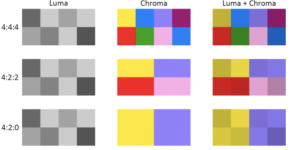
444 gives you more color samples from the image... sort of separate to the bit depth... I think 444 is always going to be better than 422 or 420 because even if you record the same number of color samples from the lower sampling frequency because you're using a higher resolution sensor, you're still skipping over areas of the image when you collect your color samples. so, one chroma value of 4K 444 remains one chrome value in 420. but 444 is averaging the color over the whole area of the photosite. 420 is just reading the color from the upper-left quadrant of that area. so you're still liable to have less color fidelity and perhaps a less smooth color variation?

Screen Shot 2021-08-23 at 9.31.50 PM.png
 
5K is 14.7M pixels and very near a perfect Bayer 4K of 17.6 MPX. Of course, there's a crop but, depending upon the setting, it can be somewhat mitigated by a wide prime.

Let's see what they reveal on the 7th. According to Canon Rumors, R5c is right around the corner too. Maybe that will have as many internal crops and codec options as with Atmos, with the overheating mitigated as well.
 
Back
Top