C100: Canon Log - does it do anything other than compress the data?

stevedocmaker

Well-known member
I've been testing the camera today and it's mostly what I expected. Sharp, detailed image, decent ergonomics (EVF could be a lot better, but at least it's useable), solid build, low noise, etc.

However, the manual makes the claim: "The Canon Log setting makes full use of the newly developed sensor to offer spectacular dynamic range." Wow, that's quite a claim. Of course, I guess you have to wonder what they're definition of "spectacular" is, but at least it implies that the range is superior with Canon Log to other settings with this camera.

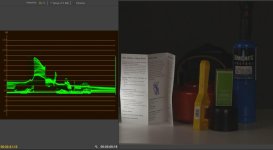
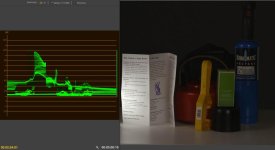
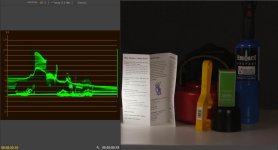
HOWEVER, all I see is a profile that compresses the data of the recorded image. When I examine via waveform a scene shot with C-LOG next to the same scene shot with Wide DR, the recordings appear to have exactly the same dynamic range. The C-LOG image LOOKS flatter, but it's just because the whole image is compressed. Apply the LUT (or adjust the levels) and the images are very similar. There is a slight difference in the gamma curves (and color matrix), and the highlights in the C-LOG clips do hold more detail, but there is no "extra" or "spectacular" range with this setting, that I can see anyway.

What's the point of this? How is compressing an 8-bit image into a 6-bit space spectacular, or even useful?

Furthermore, side-by-side, to my eye the dynamic range of the C100 (Wide DR setting) is almost identical to my 5Dii with Marvels Cine (9 or 10 stops in the real world), and the same as my FS100. The codec in the C100 (and the FS100) is of course better than the DSLR, this allowing more flexibility in grading, but I find this a bit disappointing, considering they've had three or four years to improve this.

I would really like to see a side-by-side with a C300 using C-LOG. I'm guessing from the samples I've seen that the C300 implements its log function in a different way, but perhaps Canon Log is all just smoke and mirrors. Any thoughts?

Image 1 is Wide DR, 2 is Canon Log, 3 is Canon Log with levels adjusted (LUT applied)
c100 dr test 1.jpgc100 dr test 2.jpgc100 dr test 3.jpg
 
Last edited:
I'm asking myself the same questions and try to investigate. Would be cool if someone who masters the Log workflow and benefits could speak up.

It is because of the very reasons/concerns that you raise above that for instance Technicolor CineStyle often is a very poor choice on the Canon DSLRs. Yet it is embraced with open arms by hoards of enthusiast DPs.

CineStyle was created to allow for DSLR footage to intercut with film at the intermediate stage, and had a very specific purpose. Technicolor stated on several occasions that they were surprised to see how often the profile was downloaded (since it wasn't meant to be a general purpose profile). That hasn't stopped them from going with the flow however, launching their new Technicolor Color Assist brand =)

Well, understanding must always come before application.
 
In that particular scene it would be to no advantage to use the CineLog.

But if you had a contrastier scene, it will make a difference.

If you are shooting raw then CineLog gammas make sense all the time. But with the C100, I would really only use it when Wide Dynamic Range does not give you enough range. And with very flat scenes like the gray on grey days we are having in new England these days, I would use the EOS standard, if you want a punchy look.

Cinelog is not always the best way to shoot in compressed format. You are throwing away some information that may lead to banding issues when graded. I hope this helps a little.
 
In that particular scene it would be to no advantage to use the CineLog.

But if you had a contrastier scene, it will make a difference.

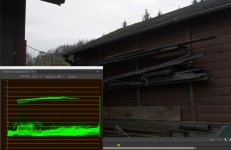
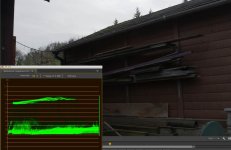
I respectfully disagree. I've exposed the scene above for highlight retention, and there is clipping in the blacks in the Wide DR setting. And this is true in both the Wide DR setting and the Log setting, and the clipping looks identical in both to me. Furthemore, if I increase the exposure in the Log setting, the highlights start getting clipped. Just for fun, I did another quick test, see for yourself (by the way, I'm sure you can appreciate the challenge of shooting with a sky backdrop on a cloudy day - something I have to deal with constantly in Seattle):

Wide DR, levels adjusted and luma curve applied to bring out detail in the sky:
log test 2-WDR.jpg

C-log, levels adjusted, no curves applied:
log test 2-clog.jpg

So the C-Log scene did require less grading, but this has to do entirely with the gamma curve and not the dynamic range, which again looks identical to me.
 
i will post some examples soon. I am just very busy right now.

I have a bunch of tests with charts lined up.
 
As a C300 owner it's my view that if you shoot in any other gamma besides LOG (unless your shooting live broadcast work) you might as well have stuck with an FS100. The whole purpose of LOG is to retain shadow and highlight information which you can massage and bring out in color correction. Otherwise in any other gamma curve you are throwing away pixels and have an 10-11 stop camera.
 
As a C300 owner it's my view that if you shoot in any other gamma besides LOG (unless your shooting live broadcast work) you might as well have stuck with an FS100. The whole purpose of LOG is to retain shadow and highlight information which you can massage and bring out in color correction. Otherwise in any other gamma curve you are throwing away pixels and have an 10-11 stop camera.

Not every client has money in the budget for color correction, or access to a post-workflow that allows time for it. C-Log and Wide DR are great, but there's nothing wrong with shooting whatever look and whatever gamma setting is right for the deliverable or project.
 
As a C300 owner it's my view that if you shoot in any other gamma besides LOG (unless your shooting live broadcast work) you might as well have stuck with an FS100. The whole purpose of LOG is to retain shadow and highlight information which you can massage and bring out in color correction. .

But it hasn't yet been determined whether there's a useful difference between Wide DR and Log on the C100. The graph I posted from Canon seems to suggest that at the high and low end they end up in the same place. Keen to see what olof has to share.
 
I sure may be wrong about this but one difference between Wide DR and LOG is that LOG looks dusty off the camera and certainly will need some grading while Wide DR looks pretty nice as is. If the DR is the same (or even close), Wide DR is what I imagine I'd be using most of the time.
 
Wide DR is what I imagine I'd be using most of the time.
Yeah my thoughts too, in fact I seem to be gravitating towards it the most. Even recording to the Ninja. It looks good and just a few teaks in post should be a great quick solution for a lot of things I shoot.
 
The wide DR is what I use pretty much all the time for now. It seems to be the best all around. I have not had time to try any fine tuning with scopes yet.

The final proof is really in the image, but scopes help you see subtle changes.

The FS700 has a measured DR of 12-13 stops, and I would say that the C100 is very close to that if not the same. And I would also say that the C100 is about the same 900+ lines of resolution. I base this on shooting some of the same scenes with both cams and comparing on a HDSDI calibrated monitor. Not very scientific but it is what it looks and grades like that is the most important.

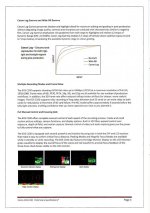
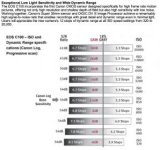
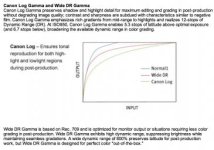
Here is what Canon says about DR and the comparison and relative emphasis in the gamma curves:
Screen Shot 2012-12-13 at 10.05.15 PM.jpgScreen Shot 2012-12-13 at 10.06.42 PM.jpg
 
Last edited:
I sure may be wrong about this but one difference between Wide DR and LOG is that LOG looks dusty off the camera and certainly will need some grading while Wide DR looks pretty nice as is. If the DR is the same (or even close), Wide DR is what I imagine I'd be using most of the time.

In the scenes I shot with the cloudy sky, the log clip required less grading, so it would seem that it does depend on how much highlight detail is needed. DR is the same in both scenes, however.

I should also note that I discovered at least a stop more DR when I used my own profile and both gammas (much better than the 5Dii which I compared my first tests with). The Wide DR and Cinema PPs in the camera were more limited.

Please post this custom profile.
 
But it hasn't yet been determined whether there's a useful difference between Wide DR and Log on the C100. The graph I posted from Canon seems to suggest that at the high and low end they end up in the same place. Keen to see what olof has to share.

What the graphic shows is that before it reaches that end point in the shadows and highlights, more information is retained within those shadows or highlights.

The FS700 has a measured DR of 12-13 stops, and I would say that the C100 is very close to that if not the same.

ADAM WILT ON THE FS100 - "It's capable of reproducing about 10 stops of dynamic range."

ADAM WILT ON THE C300 - "The camera renders crisp, clean images with 12+ stops of dynamic range(Talking about Canon Log)"

I'd trust Adam's numbers based on his personal methodology.

Couple of things on Canon Log.

1/ Yes you get a flatter waveform. Thats due to black and highlight preservation. That preservation can be adjusted in moments to pop an image. Canon Log does not compress data.

2/ Working with Canon Log can be as simple and as technical as you'd like to make it. (Same can be said of most LOG / RAW recording methods - its not something to fear).

3/ Wide DR could be useful in many situations, Im sure it may become a favourite on the C100 however, it does not yield the same DR as Canon Log. (How important is that to what you're shooting? Only you can determine that. As SM suggests you need to choose the workflow you feel is suitable for the job at hand. ) Me personally? I approach every job with the mind to utilising any and every tool at hand so, I shoot everything LOG.

4/ Regardless of weather you shoot LOG or RAW, you need to understand any given camera's DR above and below optimal exposure so you can work within those limitations and get the best results.

5/ Canon Log does not mean you can optimally shoot a 22 stop difference in light and shadow - it's going to be too far one way or another. Like anything you shoot in that uncontrolled situation, preserve what you need to.
 
ADAM WILT ON THE FS100 - "It's capable of reproducing about 10 stops of dynamic range."

ADAM WILT ON THE C300 - "The camera renders crisp, clean images with 12+ stops of dynamic range(Talking about Canon Log)"

I'd trust Adam's numbers based on his personal methodology.

To be fair, I believe Olof was looking at DR of the FS700, not the FS100.
 
ADAM WILT ON THE FS100 - "It's capable of reproducing about 10 stops of dynamic range."

ADAM WILT ON THE C300 - "The camera renders crisp, clean images with 12+ stops of dynamic range(Talking about Canon Log)"

I'd trust Adam's numbers based on his personal methodology.

I'm not sure I'd agree, Adam seems to arrive at quite a few inconsistencies (compared to others tests of DR). He rated the FS700 at 14-stops of DR, which it clearly doesn't have. Andy Shipsides' tests over at AbelCine seem to be more consistent for the most part - FS100 and FS700 at 11.5 stops, C300 at 12 stops, SLOGged F3 at 13.5 stops - all of which seems to bare itself out when you compare the images from the cameras.
 
What the graphic shows is that before it reaches that end point in the shadows and highlights, more information is retained within those shadows or highlights.

Yes. That's it.

1/ Yes you get a flatter waveform. That's due to black and highlight preservation. That preservation can be adjusted in moments to pop an image. Canon Log does not compress data.

Sure it does. How else does it get a flatter image then?

3/ Wide DR could be useful in many situations, Im sure it may become a favourite on the C100 however, it does not yield the same DR as Canon Log. (How important is that to what you're shooting? Only you can determine that. As SM suggests you need to choose the workflow you feel is suitable for the job at hand. ) Me personally? I approach every job with the mind to utilising any and every tool at hand so, I shoot everything LOG.

To each his own... I however would never shot everything in log. It's an 8bit camera!:) I would use log in situations where it would actually help me. Not
every situations needs a log gamma. Yes yes I know that C100 is using the "right" 8bits but the image is still in the end compressed to 8 little bits.


Anyway, Wide RD and C-log have probably the same DR. I mean even Canon is saying so (look at the graphs), so no point in arguing with that.
What Clog does do over Wide DR is give you more highlight detail retention (as Noel already pointed out). I'm doing a short in January and I'm going to mostly use Wide DR and if I won't need it I'll switch to cine gammas or standard gammas. Use c-log when you need it otherwise use something else. Wide DR gives us that nice highlight roll-of that we are all after.
This are all tools to be used when they're needed (as Noel already said). Limiting yourself to just one gamma is just being lazy IMHO:):)
 
Did some tests shooting into a bright sky with Canon Log. It's a good encode that saves a lot of information—and I guess we all agree there.

Sky was looking beautiful with light breaking through the clouds towards me. My foreground was buildings (I was high up on a roof) and they fell into IRE 20-25 territory with One Push auto (which kept the sky).

But since a lot of my image fell so low on the scope I needed to lift it in post (gamma). The resulting image has great detail an good tonality, but the pushed dark tones do bring added noise with them.

If you always shoot Log you'll have to do quite a bit of lifting in post. Are you all fine with this?
 
im not seeing the logic here...

steve, in your first images, you showed exactly the benefit of log, you showed a complete an utter difference in shadow retention vs wide dr. you said that you can match the log to wide dr, but that's completely backwards to the point. try matching the hightlight/shadow retention (or lackthereof) of wide dr to log. cannot be done.

it's simple: log is the SAFEST way to shoot. is it necessary ALL the time? no, but in shots with very dark and very bright parts, it has no equal. to those who say it crushes/compresses the midtones, then back it up with side by side comparisons showing this. i'll bet you a beer that family feud cannot spot the difference.

wide dr can work for MANY situations, lower contrast ones, and MAY yield less noisy tonals depending on how you grade them.

and i don't buy the whole 'its more work grading in post' argument. it takes all of 3 seconds to make a rgb curve to get a pleasing image. save yourself some presets.

andree, keep in mind when you apply a rgb/luma curve, you're bringing up those high tones. you can expose a tad more when shooting if you like, but test for yourself what curves you like to apply because if you start with too exposed of an image, when you go to bring up the top curve, you'll be more limited in how far you can push a traditional S curve. this of course is only one small part of grading and it can be done in many other ways, but since we're talking very simple shoot/grades in here, that's my take on the lower exposure with log.

cheerios,
 
Back
Top