
Navigation
Install the app
How to install the app on iOS
Follow along with the video below to see how to install our site as a web app on your home screen.
Note: This feature may not be available in some browsers.
More options
You are using an out of date browser. It may not display this or other websites correctly.
You should upgrade or use an alternative browser.
You should upgrade or use an alternative browser.
Canon 5d mark iii improved- olpf removed for higher resolution
- Thread starter PappasArts
- Start date


PappasArts
Veteran
Encoding files can make a big difference, just as this show's comparing the first and second upload.
This is comparing the two downloaded files- yesterdays & todays...

DISCLAIMER: TO THOSE THAT MIGHT THINK THAT THIS IS A COMPARISON OF NON OLPF VS OLPF
"IT IS NOT" THIS IS COMPARING TWO OF THE SAME FILE THAT WAS RE-ENCODED CORRECTLY.
That above disclaimer doesn't really apply to the regulars here- just those random ones that get confused, and run with it.
Just wanted to add it for preventive sakes.
Besides all that- Enjoy the new download, cause it show's even more how awesome the 5D Mark III can be when one of the
two OLPF's are removed from the Canon 5D Mark III. Thanks definitely goes out to James Miller for doing this.
Pappas
http://PAPPASARTS.WORDPRESS.COM
http://TWITTER.COM/PAPPASARTS
This is comparing the two downloaded files- yesterdays & todays...
DISCLAIMER: TO THOSE THAT MIGHT THINK THAT THIS IS A COMPARISON OF NON OLPF VS OLPF
"IT IS NOT" THIS IS COMPARING TWO OF THE SAME FILE THAT WAS RE-ENCODED CORRECTLY.
That above disclaimer doesn't really apply to the regulars here- just those random ones that get confused, and run with it.
Just wanted to add it for preventive sakes.
Besides all that- Enjoy the new download, cause it show's even more how awesome the 5D Mark III can be when one of the
two OLPF's are removed from the Canon 5D Mark III. Thanks definitely goes out to James Miller for doing this.
Pappas
http://PAPPASARTS.WORDPRESS.COM
http://TWITTER.COM/PAPPASARTS
Last edited:
PappasArts
Veteran
Thanks, Pappas.
Whatever was done there's clearly a drastic difference between them... which is what the three of us sawr.
I'll keep an eye out for more from James, but that put things to rest for me.
Anytime Kholi..... Yep- it put things to rest for me too. The 5D Mark III essentially takes on a look with the secondary OLPF removed like
a 4K scaled to 2K on the fly camera. Fun times.....
Pappas
http://PAPPASARTS.WORDPRESS.COM
http://TWITTER.COM/PAPPASARTS

Emanuel
Cross-Examiner
OK, watched now. Quoting Barry comes to my mind aside the big leap the absence of a 2nd filter is, and by my own words: we've already arrived to a certain point any capture device of nowadays doesn't make the moviemaker, but doesn't cut the legs either. Sometimes softer doesn't diminishes sharper if sharp enough. I am not sure we can say the same in the reverse direction as such many times, though. Because sharp can be too much at times. It is not the case so far. Hope also not for aliasing and moiré further. As Peter said, the jury is still out. Some wide angle testing @widest range would be rather welcome.Michael, you should have waited for my entry addressed to Kholi before to post it... : D
(I'd even dare to say under the risk to be taken as GH flames to fire LOL : ) no sharpness justifies the best ;-)
Emanuel
Cross-Examiner
Michael, you're missing the whole point I'm afraid to tell you. Yesterday was April 1st...Encoding files can make a big difference, just as this show's comparing the first and second upload.
This is comparing the two downloaded files- yesterdays & todays...
PappasArts
Veteran
OK, watched now. Quoting Barry comes to my mind aside the big leap the absence of a 2nd filter is, and by my own words: we've already arrived to a certain point any capture device of nowadays doesn't make the moviemaker, but doesn't cut the legs either. Sometimes softer doesn't diminishes sharper if sharp enough. I am not sure we can say the same in the reverse direction as such many times, though. Because sharp can be too much at times. It is not the case so far. Hope also not for aliasing and moiré further. As Peter said, the jury is still out. Some wide angle testing @widest range would be rather welcome.
(I'd even dare to say under the risk to be taken as GH flames to fire LOL : ) no sharpness justifies the best ;-)
I think we can safely say that this video had plenty of fine details that would have screamed aliasing if it were a major issue, as well the sparkly water shots would have rang with moire too if it was extreme. The improvements alone will out way any negatives found with this. The 5D mark III was dead on arrival in my opinion when the image quality was apparent.
It was obvious something wasn't right. 4 years of new technology over the 5D Mark II, including an improved CMOS sensor, Codecs and the new "DIGIC 5" chip that has specific technologies built for video should have been leaps and bounds above its almost 4 year old predecessor.
However maybe that’s where lies the problem, Canon had backed themselves into a corner with all the bells and whistles of technology in that camera. It was to good, if not without putting a leash on it. It's like tying a Mack truck to a Bogati to slow it down off the starting line because it's to good, to fast.
To Quote what someone said: “This is an indictment on Canon and their practices”
Pappas
http://PAPPASARTS.WORDPRESS.COM
http://TWITTER.COM/PAPPASARTS
Last edited:
Emanuel
Cross-Examiner
You know I agree with youI think we can safely say that this video had plenty of fine details that would have screamed aliasing if it were a major issue, as well the sparkly water shots would have rang with moire too if it was extreme. The improvements alone will out way any negatives found with this. The 5D mark III was dead on arrival in my opinion when the image quality was apparent.
It was obvious something wasn't right. 4 years of new technology over the 5D Mark II, including an improved CMOS sensor, Codecs and the new "DIGIC 5" chip that has specific technologies built for video should have been leaps and bound above it's almost 4 year old predecessor. However maybe that’s where lies the problem, Canon had backed themselves into a corner with all the bells and whistles of tech in that camera. It was to good, if not without putting a leash on it. It's like tying a Mack truck to a Bogati to slow it down off the starting line because it's to good.
To Quote what someone said: “This is an indictment on Canon and their practices”
Pappas
http://PAPPASARTS.WORDPRESS.COM
http://TWITTER.COM/PAPPASARTS
I should have written instead: « no sharpest justifies the best! »
And here is some food for thought (same shooter -- James Miller, but before the '5DIII hardware hack'):
HansSteinert
Well-known member
I still don't get how an AA filter for 22mp photos is making such a radically huge difference in 1080p. It's undeniably visually better than retail with sharpening tenfold, but I don't understand how.
PappasArts
Veteran
You know I agree with you
I should have written instead: « no sharpest justifies the best! »
[/SIZE]
Emanuel, I know you do.. I was writing that in general, rather than at you directly.
Pappas
http://PAPPASARTS.WORDPRESS.COM
http://TWITTER.COM/PAPPASARTS
The updated video looks really good. Only a few shots with camera motion, though. Would like to see what a pan across the pebbles looks like. The footage appears to be ALL-I and is noisy (might also be why people like it- kind of filmic): see the distance bricks and noise swirl (41s). Watching an a 46" HDTV (somewhat close, not normal for most consumers, but this is detail analysis) the frames have a coarse look, like some kind of aliasing is going on. Definite aliasing in the dark/burned out structure diagonals (24s). In the distant gray dome (1:53), the bottom has moire, but it's a very fine pattern and looks kind of like noise (not too bad). Would be interesting to see a pan of that shot to see what happens with the top of the structure. Looking forward to a resolution chart test (to compare with post-sharpened IPB).
Emanuel
Cross-Examiner
John, it is the heating... Sorry, couldn't resist. LOL The fact is: something I must say, Kholi is invariably right, your post processing doesn't convince in the same grade. Now only to me, everything has limits. You are much accurate when say there's yet much testing to check 'these' limits out.Definite aliasing in the dark/burned out structure diagonals (24s). In the distant gray dome (1:53), the bottom has moire, but it's a very fine pattern and looks kind of like noise (not too bad). Would be interesting to see a pan of that shot to see what happens with the top of the structure. Looking forward to a resolution chart test (to compare with post-sharpened IPB).
I still don't get how an AA filter for 22mp photos is making such a radically huge difference in 1080p. It's undeniably visually better than retail with sharpening tenfold, but I don't understand how.
Post sharpening resolves 850+ lines (conservatively), to get to "1000+" that's about 18% improvement. At ~850 lines, moire and aliasing are still pretty well controlled. The aliasing and moire shown so far in the NO-OLPF footage isn't bad, but there are few moving camera shots on detailed backgrounds.
A good test would be to shoot with two cameras, one with (shot with IPB) and one without the OLPF, then let me process the IPB footage in post. Show both clips and don't tell anyone which is which. That would be a single blind trial and would be a fair test.
I agree that it doesn't make complete sense that removing the 2nd OLPF would improve detail so much, especially when a still downsampled to 1920x1080 resolves 1000+ lines (with the OLPF in place). Years ago NVIDIA used to make GeForce cards that were more or less identical to much higher priced Quadros. We'd unsolder SMT resisters & move them to tell the firmware the card was a Quadro to enable, for example, high quality anti-aliased lines (not available in the GeForce).
It's possible there is still debug/validation code in the firmware which processes video frames differently when the OLPF connector has been removed. A way to test is to leave the OLPF in place and just unplug the connector.
Emanuel
Cross-Examiner
Reserved to be linked/addressed to James (Miller).The aliasing and moire shown so far in the NO-OLPF footage isn't bad, but there are few moving camera shots on detailed backgrounds.
Emanuel
Cross-Examiner
I see you speaking about numbers, lines, but not about the quality of such, though. This sample of yours, for example:Post sharpening resolves 850+ lines (conservatively), to get to "1000+" that's about 18% improvement. At ~850 lines, moire and aliasing are still pretty well controlled.
View attachment 51032
Don't you see the other is rather more pleasant?
John, it is the heating... Sorry, couldn't resist. LOL The fact is: something I must say, Kholi is invariably right, your post processing doesn't convince in the same grade. Now only to me, everything has limits. You are much accurate when say there's yet much testing to check 'these' limits out.
Heating- convection? It's there, however, ALL-I is noisy (which helps or hurts depending on your preference. Noise does hurt compression performance. I prefer to add custom noise in post).
I agree, some of the initial sharpening tests were too extreme. However, see my previous post- I'm up for a competition (single blind trial), especially with moving camera shots, moving pans with brick walls, etc.
If the mod ends up resolving 1000+ lines, etc., 850 or so can't directly compete. However, variable sharpening with custom organic grain in post might ultimately look better with camera movement and detailed content.
If Canon did ultimately lower the resolution of the 5D3 (for whatever reason), that's up to them as a business. When you buy a PC it comes with Movie Maker (or for low cost iMovie for OSX). You have to spend extra to get a pro NLE.
Same thing with cars: higher priced versions come with more options, more powerful engines, etc. People purchase the cheaper models and mod them (especially turbo cars, as they are easy to mod for more power).
It will be interesting to see what Canon has to say, especially during/after NAB.
Emanuel
Cross-Examiner
I see now. Your posts have brought a value added to these boards, thanks.Heating- convection? It's there, however, ALL-I is noisy (which helps or hurts depending on your preference. Noise does hurt compression performance. I prefer to add custom noise in post).
I agree, some of the initial sharpening tests were too extreme. However, see my previous post- I'm up for a competition (single blind trial), especially with moving camera shots, moving pans with brick walls, etc.
If the mod ends up resolving 1000+ lines, etc., 850 or so can't directly compete. However, variable sharpening with custom organic grain in post might ultimately look better with camera movement and detailed content.
If Canon did ultimately lower the resolution of the 5D3 (for whatever reason), that's up to them as a business. When you buy a PC it comes with Movie Maker (or for low cost iMovie for OSX). You have to spend extra to get a pro NLE.
Same thing with cars: higher priced versions come with more options, more powerful engines, etc. People purchase the cheaper models and mod them (especially turbo cars, as they are easy to mod for more power).
It will be interesting to see what Canon has to say, especially during/after NAB.
HansSteinert
Well-known member
The difference between 850 lines and 1080 lines is almost double. Not 18%. It's not a linear relationship due to both x and y increasing simultaneously in 16:9 ratio.
Last edited:
Cosimo Bullo
Veteran
For those who haven't gone back to look at the new, progressive version of no OLPF vid, do so. It's extraordinary. (I was wrong about the interlace thing, this did indeed fix it).
I see you speaking about numbers, lines, but not about the quality of such, though. This sample of yours, for example:
View attachment 51032
Don't you see the other is rather more pleasant?
Yes, top frame (before I modified it) is troublesome due to nasty artifacts and harsh lighting conditions. Here's another version, based on that one, where I blurred it(!) to more closely match the bottom image. Also some minor color correction to try to make it less harsh (colors aren't great but I hope the point is made):
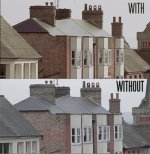
In terms of looking at both frames, I see similar perceptual sharpness (overall). There are areas in the bottom frame with more detail, however the bricks in the top image lower right look a bit sharper than the bottom frame. The fine brick detail is about the same in both frames (though some areas in the top frame have no detail at all- guessing a compression issue). The rooftops in the center and right have a bit more detail on the bottom, however the left rooftop is similar to the bottom. Lighting angles have an effect on the roof tile detail. The bricks are probably the most fair area to compare.
With a moving video image, I think it would be hard to tell which is sharper and more detailed. Thus, the challenge test request.