
Navigation
Install the app
How to install the app on iOS
Follow along with the video below to see how to install our site as a web app on your home screen.
Note: This feature may not be available in some browsers.
More options
You are using an out of date browser. It may not display this or other websites correctly.
You should upgrade or use an alternative browser.
You should upgrade or use an alternative browser.
C500: Canon 35MM T1.5 Cinema Prime $5200 ETA Dec 2013: Texas Media Systems
- Thread starter delete
- Start date
Can we keep this discussion civil and pragmatic please?Look, you're the one who wanted to know why anyone would buy cinema lenses vs still photo lenses. I told you why. You obviously think I don't know what I'm talking about - perfectly fine. I don't think you know what you're talking about. We'll live in two different worlds, and I'll continue making my living as a person that uses this stuff for every day, and you can keep trying to sell your EF adapter.
OK I am pushing new tech- only because I believe, and can prove that it has major advantages over the legacyAren't you vested in your lens set ? aren't you hyping these lenses that you own to get some premium rentals from the lens set you own? let's call spade a spade ... BTW it was a rhetorical question about the cine choice- I wasn't asking you specifically, I don't think personal posts are a proper etiquette on pro forums.... on some forums are not even allowed...
Last edited:

cowpunk52
Veteran
Can we keep this discussion civil and pragmatic please?
OK I am pushing new tech- only because I believe, and can prove that it has major advantages over the legacyAren't you vested in your lens set ? aren't you hyping these lenses that you own to get some premium rentals from the
I don't rent my lenses out except on shoots that I'm personally working on - I'm not a rental house. I use the CN-E's because they give me better and more consistent results with less fuss than the L series primes I used before them. You want to know the premium rental I get? About $25 more per lens per day. I don't push them, and I don't try to hype them. There's nothing wrong with using stills glass, I've shot entire features with stills glass. But in certain key areas, I see advantages that the CN-E's have over their L series counterparts, both in image quality and operation - and those advantages were worth the premium for me and hopefully my clients. Certainly none of them have to use the CN-E's, and they can just use only L series if they like. But most prefer the look of the CN-E's, even if they ultimately can't afford the "premium rental."
Last edited:
cowpunk52
Veteran
Here is a screenshot that is indicative of the differences I see between CN-E and L series lenses. This is taken from Jonathan Yi's comparison video, shot on the C300, & grabbed directly from the compressed Vimeo stream:
http://i.imgur.com/c8g8okh.jpg
http://i.imgur.com/c8g8okh.jpg
OKHere is a screenshot that is indicative of the differences I see between CN-E and L series lenses. This is taken from Jonathan Yi's comparison video, shot on the C300, & grabbed directly from the compressed Vimeo stream:
http://i.imgur.com/c8g8okh.jpg
I'll bite. The first obvious thing I see is that the L lens is about 1/2 to 3/4 stop faster. Look how much more detail is visible in the courtain...
They should be compared at the same exposure. That means stopping the L lens down since the cine lens won't open any more...
The DOF seems to confirm this.
It seem that the L lens is "going to 11"
I won't even mention the focus because I don't see the lens go through it..
But the closer buildings appear sharper than the distant ones... on the L lens side.
Last edited:
Wow this got personal!!!!!
Got you worked up?
Did you run out of arguments?covering for some insecurities? Education is the answer
Quit with the personal attacks. Go ahead and educate me.
The vast majority of DIs from the past 10 years have been in 2k (2048X1080 for 1.85:1). You claim every decent lens out "out-resolves" 2k/1080p resolution and apparently other factors (bokeh, distortion, contrast, flare) are irrelevant. Do you think that lens choice has been irrelevant for the past ten years or will you finally admit that your argument is totally insane?
Fwiw, the difference between the L primes and cinema primes might be small and in many respects largely irrelevant once stopped down, at least from a purely optical perspective. But your argument has been that at 2k/1080p optical difference between lenses are essentially irrelevant and that's far from true.
So go for it. Educate me. Educate all of us.
Last edited:
cowpunk52
Veteran
OK
I'll bite. The first obvious thing I see is that the L lens is about 1/2 to 3/4 stop faster. Look how much more detail is visible in the courtain...
They should be compared at the same exposure. That means stopping the L lens down since the cine lens won't open any more...
The DOF seems to confirm this.
It seem that the L lens is "going to 11"
I won't even mention the focus because I don't see the lens go through it..
But the closer buildings appear sharper than the distant ones... on the L lens side.
T1.5 on the Cinema Lens is F1.4, same as the L series prime. What you're seeing in the L series lens is more blooming and less contrast, which results in less perceived sharpness across the image. There is also slightly more chromatic aberration. Essentially, wide open, L series will give a more "milky" image compared to the CN-E's. You can chalk it up to operator error or different settings or whatever you want, but this is the same thing I see when comparing the lenses myself.
There is also the matter of the color cast on the L series, but you don't seem interested in that.
I say sample a- cine, sample b L seriesI find the discussion interesting. Here are two frames grabbed from my 1Dc in 4k mode. They are part of the frame, 100% crops:
SAMPLE A

SAMPLE B

I welcome your comments and thoughts!
EDIT: By the way... if you want to actually see them at 100%, then open the images in a new tab and click the magnifying glass to make sure you are at 100%. They get resized in the forum.
So the detail in the window curtain for the L lens you call blooming? and the lack of detail in the cine (all blacked out) you call contrast?T1.5 on the Cinema Lens is F1.4, same as the L series prime. What you're seeing in the L series lens is more blooming and less contrast, which results in less perceived sharpness across the image. There is also slightly more chromatic aberration. Essentially, wide open, L series will give a more "milky" image compared to the CN-E's. You can chalk it up to operator error or different settings or whatever you want, but this is the same thing I see when comparing the lenses myself.
There is also the matter of the color cast on the L series, but you don't seem interested in that.
OK.....
Yes I know what the f stop ant T-stop difference is. It looks like the Cine lens has been stopped down compared to the L lens
Last edited:
cowpunk52
Veteran
This is the last thing I'm going to share with you. I can't help someone that doesn't want to learn. As I said before, we'll just agree to disagree. I'm going to keep having a harder time maintaining patience with your passive aggressive posts, and everybody can make their own decision based on personal preference. I don't understand why you're so hell-bent on proving that stills glass is better than cinema glass, and I don't know why I feel the need to make you change your mind, so I'm going to stop now. Obviously you're the only person who has the opinion that you do, and I'm fine with whatever you want to think.
http://i.imgur.com/n7MSSlW.jpg
http://i.imgur.com/n7MSSlW.jpg
OK So you show one comparison with different exposure (easy to check with histogram), possibly buzzed focus, and refuse to see one posted right here.
And you realize that the expression "passive agressive " could be insulting if it wasn't, well- senseless....(sorry my personal logic pewee)
OK I'm fine with that- you're right we do live in different worlds.... At least we agree on this... Cheers.
And you realize that the expression "passive agressive " could be insulting if it wasn't, well- senseless....(sorry my personal logic pewee)
OK I'm fine with that- you're right we do live in different worlds.... At least we agree on this... Cheers.
Last edited:

indiawilds
Veteran
Still glass don't fail? My EF24-70 f2.8 L USM lens was repaired twice by Canon. Once I paid and the second time again after 11 months and since it was under warranty, I didn't need to pay. My EF 100-400 lens was also repaired once due to the zoom ring getting jammed. I only use L series lenses for filming and as a photographer have sold 24x36 inch fine art archival prints using the still glass and can understand the difference between still glass. Not all the glass are same. Each has different kind of distortions (pin-cushion, barrel), chromatic aberrations etc. Point out the lens against the sky and check for purple fringing in the high contrast areas. Do the same with Canon cine glass and you will see the difference. My 100-400 lens at 400mm is much softer than my EF 400mm f2.8 L IS USM lens. So there is a reason that I carry this 400mm f2.8 IS lens despite it being 5.3 kgs in difficult terrain.
I sincerely hope clients buy Optitek's arguments.
Unfortunately, he/she is arguing in the wrong forum. Please go and "educate" the clients rather than us. I have lost a few assignments because a complete cinema set of lenses were required. At the moment, I can't afford a set. However, that doesn't mean I will have a case of "sour grapes" and blast the clients who insist on use of cinema lenses.
Critical focus is an important aspect of the game in getting sharpness. However some folks need to understand that critical focus (avoiding buzzed focus) is not the only thing. There are lens characteristics which impact the quality. In still lenses, one will also find lot to lot variation. Some people can see the difference where as others can't. I won't blame the people who can't because there are also people who blame me because I can't find difference between a 15 usd wine and a 500 usd wine.
I sincerely wish Optikek can convince clients/producers that they are wrong in demanding cine glass and should choose still glass instead.
I talked to Canon last night about the new 35mm Cinema Prime.
ETA is still December.
Availability is going be tight for the first few months.
ETA is still December.
Availability is going be tight for the first few months.

chappelldigital
Well-known member
Here is a screenshot that is indicative of the differences I see between CN-E and L series lenses. This is taken from Jonathan Yi's comparison video, shot on the C300, & grabbed directly from the compressed Vimeo stream:
http://i.imgur.com/c8g8okh.jpg
Damn! I didn't expect that much of a difference to be honest! Amazing. And 100% end of debate at that point (if you want to debate if CN-E is better than L).
Looking forward to renting them! I've used a few CP.2's before and loved them.
Thoughts on CP.2 vs CN-E?
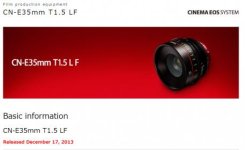
Canon's website in Japan says that the release date for the new 35mm Cinema Prime is Dec 17.
Pre-Order Online for $4950 at Texas Media Systems
Canon Financial Online Lease Application:
Canon Leasing - Texas Media Systems


Pre-Order Online for $4950 at Texas Media Systems
Canon Financial Online Lease Application:
Canon Leasing - Texas Media Systems
Canon 35mm Cinema Primes Lens Released
Canon 35mm Cinema Primes Lens Released
Confirmed that Canon USA has begun shipping us the new 35mm Canon Cinema Prime lens today.
Canon CN-E35mm T1.5 L F EF-Mount Cinema Prime Lens $4950 at Texas Media Systems
Apply Online for Canon Leasing at Texas Media Systems
Keep in mind that all Canon Cinema EOS Instant Rebates & 0% Lease Offers Expire on January 4, 2014:
Canon Cinema EOS | Programs & Promotions

Canon 35mm Cinema Primes Lens Released
Confirmed that Canon USA has begun shipping us the new 35mm Canon Cinema Prime lens today.
Canon CN-E35mm T1.5 L F EF-Mount Cinema Prime Lens $4950 at Texas Media Systems
Apply Online for Canon Leasing at Texas Media Systems
Keep in mind that all Canon Cinema EOS Instant Rebates & 0% Lease Offers Expire on January 4, 2014:
Canon Cinema EOS | Programs & Promotions