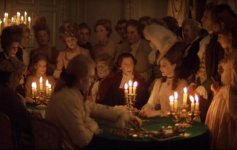
Candle light look, wb? or gels? how?

I'm getting ready to shoot something that will be an interior scene at night but will only be lit by candles.
(but I obviously want to light it with REAL lights and make it look like just candles are lighting it.)

I'm a little confused by the method to do this. I'll be using the candles in the scene but want to augment with traditional lights to make sure I have enough light for the correct exposure. My confusion come with the wb factor.
Should I white balance with both sources of illumination?
Just shoot with both and cc in post?
Gels on the light softbox?

I do NOT want to shoot with just candles for light. (but I want that look.)
 
Light it up, and stop down. Don't try to use only a very little amount of light, that will result in grainy footage. Don't try to light it so it looks to your eye like candle light. It should look very bright and nothing like candle light, until you look through the lens and stop down to f5.6, f8, whatever, if you have to.

Use flags, barn doors, or even tinfoil to make sure the light falls only on the subjects the candle light would be hitting, adn not the background.

Use Tungsten lights, or gel your lights with CTO (color temparature orange) if they are daylight balanced, then white balance after it's lit.
 
I'm still in the teach myself trial and error mode of learning so take this for what it's worth. I would try keeping the light source as close as possible to the color temperature of the candles then balancing with both sources of illumination.


Use gels on the softbox or use dimmers to keep the light warmer in order to better match the color temperature of the candle. If you have access to a flicker generator you might give that a go to replicate the flickering effect of the candle.
 
My confusion come with the wb factor. Should I white balance with both sources of illumination?

Well, we're all learning every day. I have to go back to my Student days on thinking about this one.

IIRC, which is dangerous, we'd stick to a fixed Tungsten 3200K WB, but dimming the lamps which lowers the WB - which gives the orangeyness that we associate with candle light, using half CTO to help it where necessary. This means we can gel up the background accent lights (hard shadows) with CTB to emphasise the orange in your palette and give a bit of 'night' or 'moonlight', if you're going for the full on candle-light shoot rather than a hyper-real docco feel.

Again IIRC, the big issue will be simulating the Inverse Square Law, in that candles traditionally have a huge fall-off of illumination power. We hold candles close to things (faces, props) and if it magically makes a huge pool of soft light, it looks like a theatrical effect. That means finding ways of getting small (gelled or dimmed or both) lamps close to the illuminated object.
 
Rob, candles will be practicals (probably many of them)
Candles in the Kubrick shot above were hand made triple wick, made just for him. (or so I've been told)
and while that may add a few more candle power to the lighting, <- see what I did there? pun intended. :-)
I don't think it's going to be enough to light properly.


oh for sure, its not enough by itself, but they help in addition to proper lighting.
 
I have similar shoot tomorrow. How did you resolve this. I've been advised to get a variac dimmer to simulate augment the candles. I'm for sure using my voigtlander 25mm f.95 for this.
 
As mentioned before think very carefully if you're going to light with actual candles, the sensor is much more capable near daylight. Your WB for actual candles would be <3200 for sure and there's so little blue light that the sensor will struggle with that.

My choice would be to target a WB between 3200 and 5600, but ensure there's enough light so the candles don't contribute to the actual scene lighting (because they would be super orange). Obviously scene dependent, but some blue in there would also emphasise the warmth and by balancing between 3200 and 5600 you give the option for getting blueish light too.

You could use those nets of fairy lights which give a nice glow, they're 3200 but WB to 4200 they'd become very orange and candle-like but without all the headaches.

Just test if you want to shoot in an environment that looks like candle light to your own eyes because the camera will see different

cheers
Paul
 
in the past, I've used flicker boxes to tweak the fill or dancing eyelight as well. I built a couple (see this site for a great DIY plan http://www.hauntedillinois.com/lightflicker.php) for a film a while back and they do a great job of selling the gag... and the camera's noise characteristic is SO quiet, I think you can play it all low-key. my 2 pesos.

- Dylan Sanford
vimeo.com/dylansanford
 
Sensor... I hope we're talking about the same? I'm shooting with an AF100 and a GH2. But for the candlelit scenes - only AF100. I can dial in the color temperature manually and check the monitor to see what I'm getting, I guess. The candles are practical, also for bokeh to break up a dark background, but I do plan on augmenting with soft key, the only thing I'm missing here is simulating the flicker. I don't know how I'm going to do that.
 
sorry. I read the OP. in that case, I would err on the side of more light/0 gain (dialing it back in post) with the camera set to 3200. warm up your fill with some 1/2 CTO and either build a flicker box or control fixtures by hand with variacs. or for a lo-fi solution crumble up a piece of aluminum foil, unfold it and wiggle the bounce light back towards the talent... creates an irregular bounce that work just fine.
 
Back
Top