GH4 Can someone explain the 4:2:2 output from GH4?

lifepo4

Well-known member
I was really happy about the sharpness of this camera (this scene was taken solely for evaluation of the camera), since there is only one CMOS inside this camera (versus 3MOS or 3CCD), the official specificatons says it can output 4:2:2 onto a digital recorder, but I got the impression unless you have 3CMOS or 3CCD at the prescribed resolution, you can only get 4:2:0 at 4K?
Since I don't have a 4K TV yet, I will always shoot in 4K (record to SD card), then down sample to 1080p, if I use this for green screen, presumably 4:2:0 won't be an issue because I can downgrade to 1080p at 4:2:2, am I right?
Thanks in advance for your opinion.


http://youtu.be/VCanDxumiR4
http://www.dvxuser.com/V6/showthrea...able-camera-will-match-EX3-s-resolution/page2
 
Last edited:
How do you get 4:2:0 to 4:2:2 without an external recorder? Whats your logic on how that could work?
Changing the resolution wont give you more colors.... so no, it doesn't work like that. You need an external recorder. 4k 4:2:0 converts to 1080p 4:2:0.
 
The person who validated that it can be done is David Newman, one of the three creators of Cineform codec. I think he knows what he is talking about.
 
1. The number of chips in a sensor has nothing to do with a 4:4:4 colorspace. That designation refers to the amount of compression applied to the color channels *after* capture/debayering, etc.

2. Subsampling to increase color resolution definitely does work. Proven. Colorspace will be 4:4:4. Luminance channel will have 10 bits of real data.

3. You don't need to sweat chroma keying. Shoot in 4K and it's awesome. Search YouTube for the comparison with a BMCC. Here's a piece I'm working on right now that keyed beautifully with zero effort: https://vimeo.com/105194237
 
How do you get 4:2:0 to 4:2:2 without an external recorder? Whats your logic on how that could work?
Changing the resolution wont give you more colors.... so no, it doesn't work like that.
Problem is that 4:2:0/4:2:2 have become to be seen as absolute values or quantities, and that is not true. They are *ratios*.

In each case, all they mean is twice as many luminance samples as chrominance horizontally, and for 4:2:0 that's also the case vertically. For 4:2:2 you get equal numbers of luminance/chrominance vertically. Lets put some numbers to that.

For 4k (UHD) 4:2:0 you have 3840x2160 luminance samples and 1920x1080 chrominance.

For 1080 4:2:2 you need 1920x1080 luminance samples and 960x1080 chrominance - is that agreed?

Hence it's pretty easy to see that downscaling 4k luminance will give 1080 luminance - AND you've got more than enough chrominance samples to give 960x1080, twice as many in fact. In fact if you simply downscaled the luminance and used the 4k 4:2:0 chrominance with it, that's enough to give 4:4:4 1080 HD.

The key point is that these are ratios - and you don't need to downscale the two things (lum/chrom samples) in the same proportions.

But there's more. I (too) often hear "what! only 4:2:0 4k!?", and if you're talking about a 3840x2160 Bayer sensor there's not much point in anything else.

For that sensor, you have 1920x1080 blue photosites and the same number for red - so it's unrealistic to expect the chrominance resolution to be much more than 1920x1080. In other words, what's the point of anything higher than 4:2:0 sampling? Think of it as a container. If you've got 1 litre of liquid, what's the point of putting it in a 2 litre bottle? Similar here.

I was going to post this same thing, but I couldn't have put it any better.

To the OP, greenscreening in 4K 4:2:0 is a breeze. Way more than enough color information, even for my sometimes improperly lit green screen (when I'm using it in outdoor settings for later mattes) plus the resolution gives you more than enough information to work with.
 
To put it more succinctly - 4k 4:2:0 means by definition 1920x1080 chroma samples recorded - half of 3840x2160 in each direction.

In other words, full 1080 HD resolution of chrominance. Which is why then downscaling luminance can give 4:4:4 1080 HD.

And also why it's wrong to complain about "only" 4:2:0 4k, quite apart from the chips on even quite high end cameras (F55 and the new Varicam for example) not being able to deliver much better.
 
it's wrong to complain about "only" 4:2:0 4k.

This trick is fine for delivery at 1080, but it'd be nice to have that extra color info recorded in camara at 4K...for the future.

"...the 4K format will increase the bit depth for each pixel from 8 to 10. And a new color-recording technology called BT.2020 will allow a wider gamut, compared to the existing 709 color encoding system..."

http://www.cdrinfo.com/Sections/News/Details.aspx?NewsId=41499
 
......... it'd be nice to have that extra color info recorded in camara at 4K...for the future.

"...the 4K format will increase the bit depth for each pixel from 8 to 10. And a new color-recording technology called BT.2020 will allow a wider gamut, compared to the existing 709 color encoding system..."
I think you're confusing chroma resolution with colour gamut - they're two different things. The gamut is the range of colours a system can accurately reproduce, the hue if you like. Typically, there will be colours that an RGB system will never be able to accurately reproduce, especially spectral colours - the question is how well they can be approximated to. See - http://en.wikipedia.org/wiki/Gamut.

Chroma subsampling such as 4:2:0 has no bearing on that - that ONLY refers to the RESOLUTION of the chroma signal *relative to the system luminance figure*. As said before they are ratios, not absolutes.

And as said before, if you're using a 3840x2160 Bayer filter (as even most current 4k high end cameras do) the sensor won't give any chroma detail information that 4:2:0 isn't able to record. If we were talking about 3 chip cameras with 3 3840x2160 sensors it'd be a different matter.

For most 4k cameras around today, all 4:2:2 sampling would do is either put up the bitrate for no gain, or actually REDUCE overall quality for the same bitrate, by needing heavier compression.

4:2:2/4:2:0 made a big difference in the world of standard definition and (especially) interlace, less so with HD and (especially) progressive, but is almost irrelevant with current 4K cameras. Unfortunately, salesmen like a simple message and big numbers are easier to sell - even when it's technical nonsense.
 
I think you're confusing chroma resolution with colour gamut - they're two different things.

Not really. The main point was that practical, 4K, 10 bit delivery is coming next year. It'd be nice if the cameras we had now could record 10 bit 4:2:2 internally, especially at 4K.

if you're using a 3840x2160 Bayer filter (as even most current 4k high end cameras do) the sensor won't give any chroma detail information that 4:2:0 isn't able to record

Hmmmm. So...why the 10 bit 4:2:2 output? Must come from somewhere. I would hope Panny's not just padding the signal off the sensor for a faux 4:2:2.
 
But there's more. I (too) often hear "what! only 4:2:0 4k!?", and if you're talking about a 3840x2160 Bayer sensor there's not much point in anything else.

For that sensor, you have 1920x1080 blue photosites and the same number for red - so it's unrealistic to expect the chrominance resolution to be much more than 1920x1080. In other words, what's the point of anything higher than 4:2:0 sampling? Think of it as a container. If you've got 1 litre of liquid, what's the point of putting it in a 2 litre bottle? Similar here.

For UHD on a Bayer sensor, you're definitely getting at least 1920x1080 worth of chrominance resolution, so 4:2:0 does makes sense. However, you do need to consider all the advances in debayering as well, which can now better fill in the gaps than some of the older algorithms. So, chrominance resolution is actually closer to root 2 (square root of 2) of the overall resolution, or around 2716 x 1528 (3840/sqrt(2) x 2160/sqrt(2)).

That's actually twice (2.00) the chrominance resolution of 1920x1080 (4 megapixels vs 2 megapixels, if you multiply the resolution out.)

On top of that, 4:2:0 compression isn't going to map exactly to the real resolution, which is where Nyquist comes into play, as he said that you need at least twice the resolution of the original to start (start) to accurately copy the signal of the original.

So, 4:2:2 should look substantially better.

I think you're confusing chroma resolution with colour gamut - they're two different things. The gamut is the range of colours a system can accurately reproduce, the hue if you like. Typically, there will be colours that an RGB system will never be able to accurately reproduce, especially spectral colours - the question is how well they can be approximated to. See - http://en.wikipedia.org/wiki/Gamut.

Chroma subsampling such as 4:2:0 has no bearing on that - that ONLY refers to the RESOLUTION of the chroma signal *relative to the system luminance figure*. As said before they are ratios, not absolutes.

Yes, Chroma subsampling and bit depth are different things (the Sony A7, for instance, can do 4:2:2, but only in 8 bit.) For 4:X:X, luminance, which is basically black and white, is fully recorded. Color might not be, and can instead be recorded so that it is stretched across that luminance (in 4:2:0, a 4 pixel square of different black and white information only gets one giant pixel of color.)

Bit depth is how deep those pixels buckets can be (if you will). In 8 bit, each pixel can only be 255 units deep. In 10 bit, each pixel can be 1023 pixels deep, so there's more room for variation. And it's the variation between the black and white and colored pixels that produce the final colors.

So, if more bit depth is how deep the buckets of color (and black and white) can be, a higher ratio of subsampling is how many buckets of color you get that can spread across and mix with the black and white info.
 
However, you do need to consider all the advances in debayering as well, which can now better fill in the gaps than some of the older algorithms. So, chrominance resolution is actually closer to root 2 (square root of 2) of the overall resolution, or around 2716 x 1528 (3840/sqrt(2) x 2160/sqrt(2)).
I think the sq rt 2 reference applies to general resolution on "average" pictures - not chrominance resolution as such. It becomes difficult to give precise figures since the resolution after deBayering rolls off rather than suddenly cuts out, but for luminance the generally quoted figure is up to about 75-80% of the sensor dimensions. In other words, around 2900x1620. But that's for luminance, for a monochrome image, which is the best possible case from a deBayering point of view.

Think of it this way. If the image was illuminated with pure red or blue light, then only those photosites would be illuminated. No deBayering could then possibly give an overall resolution of better than 1920x1080 - that's all the photosites of that colour there are! OK, extreme cases, and normally there will be more than a single colour, so better than that resolution. But that's overall resolution. It's still reasonable to say the *CHROMA* resolution is limited to about 1920x1080.
On top of that, 4:2:0 compression isn't going to map exactly to the real resolution, which is where Nyquist comes into play, as he said that you need at least twice the resolution of the original to start (start) to accurately copy the signal of the original.

So, 4:2:2 should look substantially better.
Ah, careful. What Nyquist actually says is that the sampling frequency should be at least twice the highest frequency to be accurately digitised. So, for audio, if that's 100Hz, you need to sample at least 200 times per second. But it's taken as read that the 100Hz is a sine wave, with positive and negative half cycles.

Spatially, the equivalent is line pairs. A white line with a corresponding black one. In the spatial case, Nyquist says we need to sample with at least twice the number of samples as line pairs.

But it's more normal to talk about resolution here not in terms of "line pairs" but in terms of "lines" and "lines per picture height". In this case, the number of lines is twice the number of line pairs. So if we spatially sample at 1920x1080 (as is the case for 4k 4:2:0 chrominance), the max we can resolve is 960x540 *line pairs* - or 1920x1080 lines.

Hence 4k 4:2:0 *should* capture pretty well all the chrominance information off a 3840x2160 Bayer chip.

Go to 4:2:2 and far from looking substantially better, then unless you increase the bitrate quite significantly, the overall compression will have to go up - and overall it will likely end up looking worse as a result.
 
You can never get actual 4:4:4 from anything lower, like 4:2:2 or 4:2:0. When a signal is chroma subsampled, data is lost, it can't be brought back. So when you go from 4k 4:2:2 to 1080p 4:4:4, you are doing the same as putting 8bit data into a 10bit space.
 
You can never get actual 4:4:4 from anything lower, like 4:2:2 or 4:2:0.
You most certainly can - if you're changing the basic luminance resolution. Please read my previous posts for the explanation how.

You are making the mistake I mentioned earlier - treating 4:2:0, 4:2:2 etc as absolutes - when in fact they are nothing of the sort, they are purely ratios. (Of the number of chroma samples to luminance.)

Look at it this way. If I have £4 in my right pocket, £1 in my left, the ratio of money will be 4:1, yes?

If I now "downsample" the amount in the right pocket to £2, but don't touch the left, the ratio becomes 4:2. In other words, the RATIO has changed although the amount of money in the left pocket hasn't.

And the principle is exactly the same with what we're talking about here. Substitute "luminance samples" for money in right pocket, and "chrominance samples" for left pocket. Downsample the luminance signal, but not the chrominance and it's obvious how the *RATIO* changes from 4:2:0 to 4:4:4.
 
Chroma sub-sampling figures are indeed ratios, however, the total color depth of a digital bitmap image (or of a digital imaging system) is absolute.

Color depth is largely misunderstood. Many mistakenly think that bit depth is color depth. Color depth is actually a much broader imaging property, with bit depth merely one factor in digital color depth. Color depth also encompasses analog imaging, where bit depth is completely uninvolved.

Another crucial factor of color depth is resolution. The higher the resolution, the greater the color depth. Another way to put it: the more RGB pixels within a given area, the greater the possible varitety of colors in that area.

We can swap lower resolution for increased bit depth. For instance, let's say we were to convert a 4K image into a 1920/1080 HD image to increase bit depth. We would first take the RGB pixels of the 4k image in groups of four adjacent pixels and merely sum the values of each respective color channels. Such summing necessarily increases the scale of values in each color channel, and, thus, we automatically have increased bit depth (per channel) in each of our new HD RGB pixels.

Of course, the same conversion principle applies to increasing the chroma sub sample ratio.

Keep in mind that we can swap lower resolution for greater bit depth (and for a richer chroma sub sample ratio), but we can NEVER increase the color depth of captured digital image (not without introducing something artificial). Such "binning" conversions are not perfect, especially with Bayer sensors, and a tiny amount of color depth information is can be lost in the process.

One caveat -- if there is banding in the original image, swapping resolution for bit depth will not make the banding disappear -- those stripes are "baked in," even with the increased bit depth. On the other hand, such banding can be "dithered out."

Basically, the relationship between color depth, bit depth and resolution in an RGB system can be expressed with this formula:
COLOR DEPTH = (BIT DEPTH x RESOLUTION)[SUP]3[/SUP]
 
I think the sq rt 2 reference applies to general resolution on "average" pictures - not chrominance resolution as such. It becomes difficult to give precise figures since the resolution after deBayering rolls off rather than suddenly cuts out, but for luminance the generally quoted figure is up to about 75-80% of the sensor dimensions. In other words, around 2900x1620. But that's for luminance, for a monochrome image, which is the best possible case from a deBayering point of view.

Think of it this way. If the image was illuminated with pure red or blue light, then only those photosites would be illuminated. No deBayering could then possibly give an overall resolution of better than 1920x1080 - that's all the photosites of that colour there are! OK, extreme cases, and normally there will be more than a single colour, so better than that resolution. But that's overall resolution. It's still reasonable to say the *CHROMA* resolution is limited to about 1920x1080.

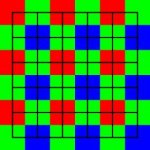
The root 2 comes from the fact that debayering takes into consideration overlapping squares. Read this here: http://www.cambridgeincolour.com/tutorials/camera-sensors.htm . The blue and red pixels are being shared. Here's a diagram, if it helps:

Bayer 21x21.jpg

What that diagram also shows is that you don't have to downsample by 2 to turn 4:2:0 into 4:4:4. By downsampling by 2 (UHD to HD), each pixel is getting one red, one blue, and 2 green pixels worth of information. But, each pixel really only needs 1/3 red, 1/3 blue, and 1/3 green to accurately map color.

Looking at the image above, each pixel is currently only geting 1/4 red, 1/4 blue, and 1/2 green. Multiply that by root 2 (1.414) and now each pixel is seeing over 1/3 of red and blue.

Why is it exactly the square root of 2? That's the distance from the middle of one pixel to another (the diagonal of the black squares above.)

If you don't believe me, David Newman of Cineform says it as well: http://www.dvinfo.net/forum/cineform-software-showcase/521594-panasonic-gh4.html .

So, a Bayer pattern 3840x2160 sensor definitely gives more than 1920x1080 worth of chrominance or color resolution.
 
Back
Top