Camera vs. Lens

Which do you feel has a more significant contribution to image quality, a camera or a lens?

If you could choose between the image of say a $2,000 camera with a $50,000 lens or a $50,000 camera with a $2,000 lens, which would you choose?

I'm asking exclusively from an image quality standpoint, so ignoring things like cinema lenses having hard stops or pro cameras having SDI, NDs, etc.
 
Camera, no question.

I'm certain I could make a vastly better looking movie with a C500 Mark II and a Canon EF 24-70mm f/2.8L lens than with a GH5 and a set of Master Primes.
 
Camera, by far. + the number of camera options and menu complexity is inversely proportional to image quality. ARRI with default settings is simple to use and produces better quality on average than the more complex cheaper cameras even after trying to tweak the complex settings for each shooting condition. On the lower end, same pattern applies to Canon vs Sony and Panasonic, though Sony’s new S Cinetone is good progress in the right direction.

Lighting correctly with correct WB and exposure should produce accurate color and skin tones. ARRI is still best here where everyone else is still struggling to get there. Pretty impressive after all these years.
 
As someone who uses cheap (under $2k and often under $500.00) still lenses 85% of the time, camera is more important, without a doubt.
A lot of cheap optics look REALLY good these days, unlike 40 years ago when most cheap lenses looked like garbage. Although to be fair, these
days you can put a cheap lens on a cheap camera like BMD PCC6K and the end result looks amazingly great for the money.
 
I'm curious about why two people have down-voted the initial post asking the question. It's a valid question, and I'm intrigued by what everyone has written so far. Why the down-vote?
 
Because if you had a $52g budget you would not allocate the split in such a dumb manner. (I didnt downvote)

--

Personally I find expensive lenses hard to justify. Yep I get that fast realignment of the focus gear with a matched set saves time on set.. but as I was told on my first feature.. 'you only have to be faster than art and makeup'

Im a huge fan of budget going to wages not kit

But a set costs $$ per minute so every wasted moment costs.. so you can draw an equation of rental fee / time saved - a big one for zooms which are indeed $$ but pretty slow (Tstop) and likely you can beat art with a prime

Cineprimes - Yes there is a look, but per $$ mainly its better spent on art or more time or upgrading from bad pizza and having a happier crew.

Anmorphics.. yes they are $$ and look cool

Its about that look per $$ equation and lenses dont return IMO when a contax or suchlike is so good for less than $1000.

Sketchy cameras on the other hand can break everything - but I cant see value in going much above C500.

For $52 Id spend $25 and keep the rest for doing my attic which will put $50 on my house - paying the whole thing!
 
Last edited:
I'm with Sam, it's a difficult question to answer because there's zero possibility of such a strange split ever happening.

For $52k today, I'd probably grab a C500ii and a set of Sigma Cine Primes (the new versions with Cooke /i lens data) and call it a day. That's an absurd amount of quality for an absurdly small amount of money. And forget low-light you can basically shoot in no-light with that combo.
 
The most important is the camera codec, although Sony's giving it a test with their baked-in FX-9. In other words, if you have Raw or a really high bit rate XAVC/ProRes, the sensors themselves are good enough.

Alexa is another long-established exception that will deliver great images with almost anything, including Zeiss photo primes - Batis, Milvus, Loxia, Otus - too
 
I think "image quality" is too broad and subjective of a term in this instence. There is a lot of fondness at the moment for "vintage" or "interesting" lenses which hamper or defeat many of the classic definitions of image quality (resolution, edge sharpness, geometric consistency, flare resistance) in favor of a stylized look. For many DP's, the baseline of a quality image is thus not necessarily one that is the most accurate, but that which one chooses for a certain project.

While there are differences between the looks of high end cameras (and certainly between high end cameras and entry-level cameras), we have moved closer to the paradigm of shooting film, where camera choice was entirely about functionality and preference on set vs the final result. One didn't opt for Panavision over Arri film cameras for the look of the footage, it was about being able to use Panavision lenses and accessories. Amongst non-Panavision cameras, the choice of Arri, Moviecam, Aaton etc was purely about comfort with the human interface of a given system i.e. viewing optics, reliability, weight and cofigurability, which would echo today's concerns about menu design, convenience features like internal ND's . The other variable was choice of film stock, which is more closely related to paradigm of which digital camera to choose, in terms of color rendition, noise/grain characteristics etc.

Ultimately there is a "laboratory" version of image quality, where one could perform a leisurely test of a given set of cameras with a given set of lenses to see which serves best. In real world practice, there are a lot of other factors in what will best serve a working style or project that will greatly affect the look of the resulting footage. As Sam points out, if there is a choice between spending money on gear vs manpower, often the latter is going to result in better looking pictures because there was more time to finesse the things in front of the lens which add up to a more quality image.
 
At this time, camera makes the bigger difference.


Cameras are the reason we choose vintage lenses to cover up the image quality. We are reacting to the cameras with our lens choices.

But as Charles said, we are getting closer to the film paradigm. I am really liking the Monstro and Gemini sensors from Red. Sony venice and varicam look great. C500ii may be the best looking Canon C yet. The BM and other budget new kids are shooting better and better iq. People are choosing cleaner ans more precise lenses as we go into the next phase. ‘1917’ is one of those best lens on the best camera with the best film makers and best budget situations. It would have mattered if they shot on Helium or Zcam. Don’t think it would have mattered if they shot on summilux or MP.

Anyway, i think we are still reacting to cameras first, and then lenses chosen because of the camera. With the exception of anamorphic lenses. So, in a sense lenses have the bigger impact on IQ, butnin today’s eco system, video cameras are still the subject of need for improvment.
 
And while, personally, i would rather spend $50K on lenses, the ROI would be stretched out so thin. A camera can infuse more cash flow into your day to day. Clients comment on cameras more than lenses.
 
I suppose it depends entirely on what you're shooting. For big budget Hollywood productions, the original question is ridiculous and would never be asked. They'd get the $50k camera AND the $50k lens and call it a day.

But for the one-person-band type of shoot, it's a very relevant question. My budget is severely limited, so I need to think long and hard about where my money goes. At this point, I'm perfectly happy with the image quality I get using Canon still lenses. I have zero reason to upgrade them. Getting a set of cinema primes would be nice from an operational standpoint, but the image quality would be roughly the same. There would be differences, but they'd be subtle, and nothing that would make me go "whoa!"

However, upgrading from my C100 to a C500 Mark II (or even a C200) would give me a dramatic improvement in image quality, using the same Canon lenses I already have. Color, dynamic range, resolution, low light ability, raw... All those things would help me get significantly better looking footage.

Interesting discussion.
 
I think "image quality" is too broad and subjective of a term in this instence. There is a lot of fondness at the moment for "vintage" or "interesting" lenses which hamper or defeat many of the classic definitions of image quality (resolution, edge sharpness, geometric consistency, flare resistance)

When I 'promote' 'vintage' stills lenses it is because I think they are good - honestly kodakchorome 64 in the late 80's made (still) images that blow the socks of any digital motion picture camera not released in the last 18 months (or so) - maybe Venice and Arri 65 are getting there.

All those bad posters, national geographic classics etc were made with thos 'vintage' lenses (I must be becoming vintage myself!)

Good copies are sharp and good enough for most motion picture uses.

Maybe they need a bit more lens shading if you want clean and flare free.

Ive tested most of my nikkors at 6k raw (nikon D600 stills) and they are good, I have a couple of donkeys that need to come to 2.8 before they sharpen up.

Clearly cine glass is better but vintage does not mean soft flare central :)
 
When I 'promote' 'vintage' stills lenses it is because I think they are good - honestly kodakchorome 64 in the late 80's made (still) images that blow the socks of any digital motion picture camera not released in the last 18 months (or so) - maybe Venice and Arri 65 are getting there.

All those bad posters, national geographic classics etc were made with thos 'vintage' lenses (I must be becoming vintage myself!)

Good copies are sharp and good enough for most motion picture uses.

Maybe they need a bit more lens shading if you want clean and flare free.

Ive tested most of my nikkors at 6k raw (nikon D600 stills) and they are good, I have a couple of donkeys that need to come to 2.8 before they sharpen up.

Clearly cine glass is better but vintage does not mean soft flare central :)

My 70s Nikon Ai's look great and are very sharp. But lousy for exteriors, the flaring is abysmal and the CA is BAD!
Call me an old geezer but I have spent my entire career trying to mitigate, reduce and eliminate what some camera
people call character, one of the worst euphemisms ever. Lens "character" = defects.

We've gone through this thing too for decades where the generation that was too young to have shot on "classic" gear
want all of the things that used to drive all of us trying to make art with those same tools crazy.

Horrific lens flaring, ultra low contrast mud lenses, hairs in the gate, gate weave, huge analog tape dropouts, mosquito noise,
it kind of reminds me of those of us who have been around long enough to have actually
been alive in the 60s, 70s, and 80s, when we see TV/Film art direction, wardrobe and hair supposedly emulating or
recreating those periods, they usually get it wrong. Because they weren't there and they only can research mass media
not "real" stuff like family snapshots, home movies, etc.

For those born after the 60s and 70s, I think that they think that everyone in the world was walking around looking like a Haight/Ashbury refugee,
wearing fringe, with tie die clothing with peace signs face painted on their mugs, when in reality, if you were there, those people were a
caricature even in the 60s and hardly anyone actually dressed like that and wore those clothes. The style becomes a caricature. It's the same with
lens "character". Nobody in the day wanted that crap in their images. So why emulate crap now? Why not move on? We have today the best made, engineered,
most consistent camera optics in history. Yet the masses have been brainwashed that they all want "character" in their lenses. Are we ever going to move beyond behaving like Lemmings?
Trends are boring the moment they become trends.

Lemmings.jpg
 
Last edited:
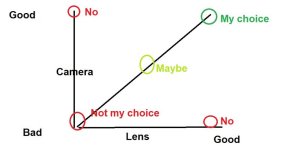
I made a diagram to solve this problem. Suppose bad lens is a pin-hole lens and bad camera is an camera obscura. A good lens/ good camera? Well I guess people have their preferred brands.

But in the end, only content matters.

cam.jpg
 
Back
Top