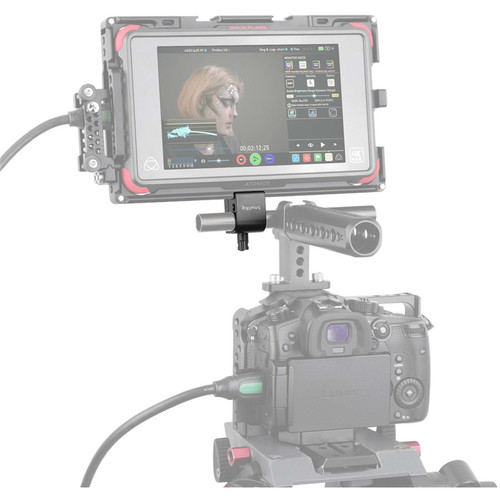
C700: C70 + Little Portkeys LEYE EVF and Misc thoughts

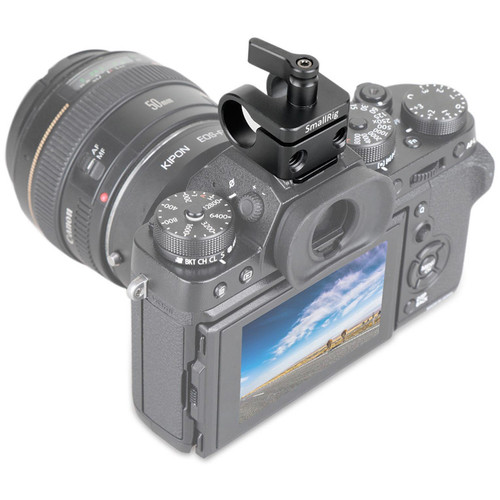
1531757752_IMG_1028338.jpg

https://www.bhphotovideo.com/c/prod...EShfc0wIuHelMkS41zZUaRJ_5SUycmKBoCtXgQAvD_BwE

+

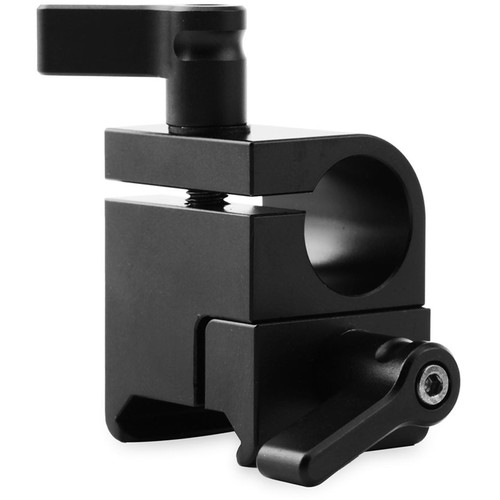
1584955432_1421794.jpg

https://www.bhphotovideo.com/c/prod...sP67lekxfPEyB3fmXZ6R6Qk-ZS1SDiBxoCOpQQAvD_BwE

+

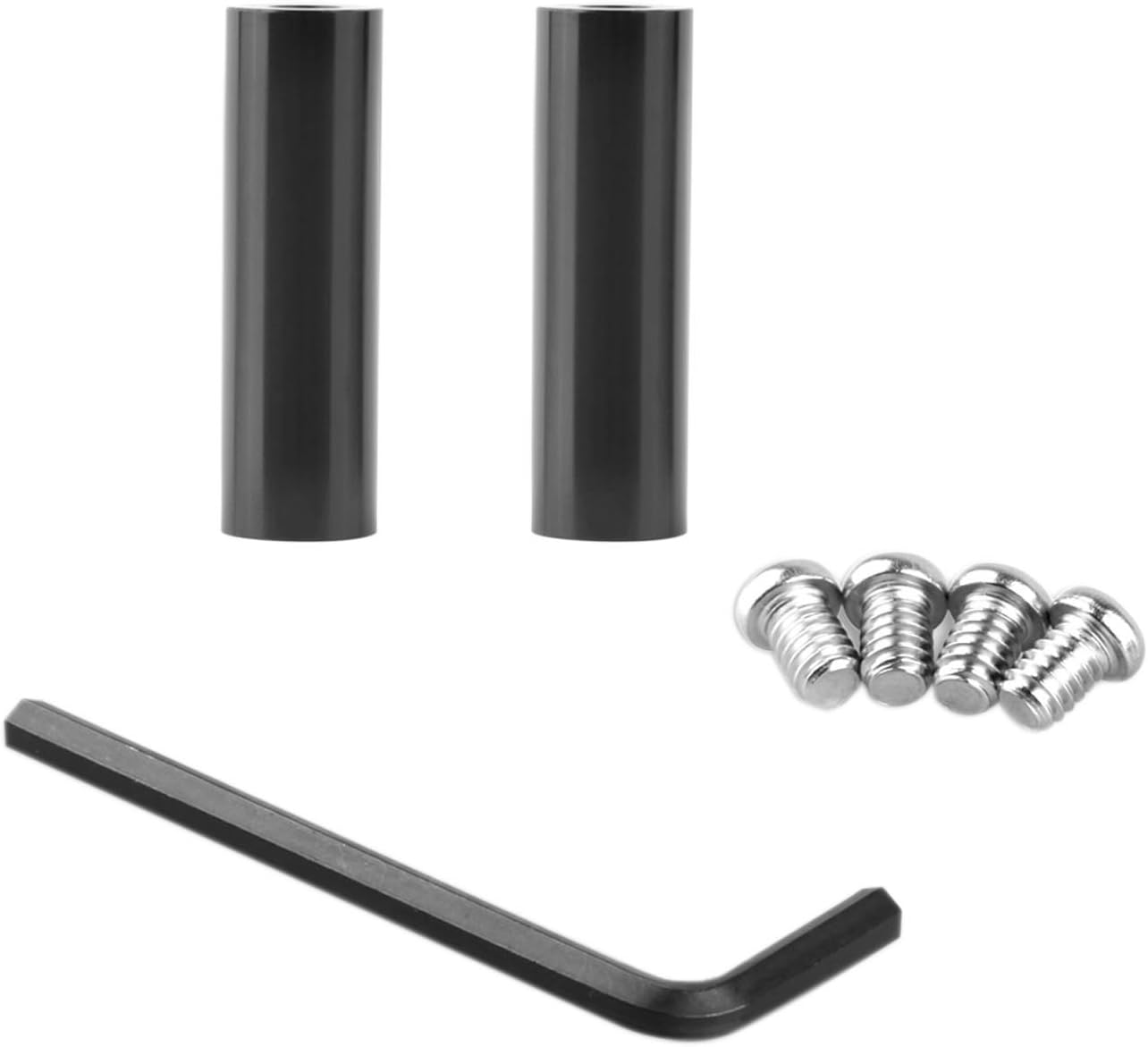
61BjDs1ugqL._AC_SL1500_.jpg

https://www.amazon.com/SMALLRIG-Rods-Threads-Clamp-Mount/dp/B00PJWZKNG

Your solution would work after leggo-ing together, but is too many parts and too many adjustments. The beauty of these simple hot shoe mounts is that the tension is just right and you really don't adjust anything after initial adjustment. This EVF is very lighweight and relatively small. The appeal for something like the C70 would be to go directly from hotshoe to tilt mechanism to nato rail. The EVF also has 1/4-20 on bottom, so the other solutions with a 1/4-20 on top like what Abe posted will also work, but they don't have any anti-slip mechanism, thus the advantage of the nato rail.

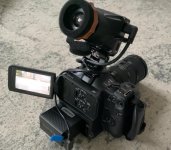
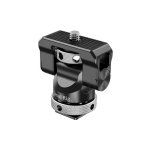
Here is how I currently have it mounted, using a smallrig part similar to the one Abe posted, but in this case it has both pan and tilt. Works fine, but nato clamp would be more secure.
138612636_10160681945592306_1139432041774516031_o.jpg
srbse2346b.jpg
 
Last edited:

I don't quite understand the logic of this design.

If you use the left side handle, then you are limited to shooting only AF. How can you manually focus with that handle in the way?

If you leave the left side handle off, then take a look at the bottom edge of that side "Z rail" (nato rail). It's got a sharp edge right where you'd need to cradle the left side for any manual focusing. I just don't get how that is supposed to be comfortable for actual shooting needs when pulling focus manually. All of that on top of the fact that the hdmi solution kills at least two of your function buttons.

So far, I'm using this cable to get the most comfortable feel for that side of the camera for my left hand, but it's hardly ideal. The rubber cover can and will be removed obviously.

138832457_10160681951262306_1346269813107922246_o.jpg
 
The portkeys EVF has a built in Nato rail on the bottom, which is why I'd like a nato mount on top of a tilting monitor mount. Your solution would work after leggo-ing together, but is too many parts and too many adjustments. The beauty of these simple hot shoe mounts is that the tension is just right and you really don't adjust anything. This EVF is very lighweight and relatively small. The appeal for something like the C70 would be to go directly from hotshoe to tilt mechanism to nato rail. The EVF also has 1/4-20 on bottom, so the other solutions with a 1/4-20 on top like what Abe posted will also work, but they don't have any anti-slip mechanism, thus the advantage of the nato rail.
The Smallrig SWAT piece I linked to is a Nato piece and will attached to the PortKeys. Looking at the PortKeys I see you actually need the parallel version of that SWAT piece which you can find here.

1533230140_IMG_1039905.jpg

https://www.bhphotovideo.com/c/product/1421796-REG/smallrig_1254_swat_nato_rail_with.html


Of course with 15mm rods it's easy to get a right angle converter so then you can use rods of different lengths if you want get the viewfinder in front of the lens for shoulder mount applications. Today I bought various Wooden Camera Nato rail pieces to make my LCD screen holder for my C300 Mark III so I can position it in various places. Right now I am using rods with my C300 Mark II but I think the Nato rails will be able to fold down smaller when not fully extending the setup. I may share that setup once I get it all setup. Rails may be a simpler solution for the C70.

Every time I think about rigging out the C70 I think, "That's what my C300 Mark III is for," and then go back to thinking just a Rode Videomic Pro on the C70 is all the C70 needs. I'm planning to get a second C300 Mark III pretty soon so the C70 won't need to be a b-cam, and can moreso be relegated to gimbal, Glidecam, or general small b-roll cam useage.

The RF to EF mount with the ring on it which you can assign to ISO also helps make the C70 a little more shoulder friendly. I don't think the .71x converter has that option, though. But say with an 18-80 which doesn't cover full frame anyway and the viewfinder positioned correctly, this camera may be somewhat usable on the shoulder.


I also ordered the viewfinder for the back of the C300 Mark III. At $11k vs $16k for the original Mark II price, you'd think the Mark III is considerably cheaper, but add in the PL mount which wasn't an option on the Mark II and the viewfinder, and it's up to $13,300. Then you also need twice the amount of batteries due to double the power draw, so add in a $400 Anton Bauer Mount with some small Anton Bauer batteries, more rigging, and you're getting closer to $16k.
 
Last edited:
The Smallrig SWAT piece I linked to is a Nato piece and will attached to the PortKeys. Looking at the PortKeys I see you actually need the parallel version of that SWAT piece which you can find here.

1533230140_IMG_1039905.jpg

https://www.bhphotovideo.com/c/product/1421796-REG/smallrig_1254_swat_nato_rail_with.html


Of course with 15mm rods it's easy to get a right angle converter so then you can use rods of different lengths if you want get the viewfinder in front of the lens for shoulder mount applications. Today I bought various Wooden Camera Nato rail pieces to make my LCD screen holder for my C300 Mark III so I can position it in various places. Right now I am using rods with my C300 Mark II but I think the Nato rails will be able to fold down smaller when not fully extending the setup. I may share that setup once I get it all setup. Rails may be a simpler solution for the C70.

Every time I think about rigging out the C70 I think, "That's what my C300 Mark III is for," and then go back to thinking just a Rode Videomic Pro on the C70 is all the C70 needs. I'm planning to get a second C300 Mark III pretty soon so the C70 won't need to be a b-cam, and can moreso be relegated to gimbal, Glidecam, or general small b-roll cam useage.

The RF to EF mount with the ring on it which you can assign to ISO also helps make the C70 a little more shoulder friendly. I don't think the .71x converter has that option, though. But say with an 18-80 which doesn't cover full frame anyway and the viewfinder positioned correctly, this camera may be somewhat usable on the shoulder.


I also ordered the viewfinder for the back of the C300 Mark III. At $11k vs $16k for the original Mark II price, you'd think the Mark III is considerably cheaper, but add in the PL mount which wasn't an option on the Mark II and the viewfinder, and it's up to $13,300. Then you also need twice the amount of batteries due to double the power draw, so add in a $400 Anton Bauer Mount with some small Anton Bauer batteries, more rigging, and you're getting closer to $16k.

I thought you were mostly in the Arri world with your Amiras, I'm surprised you are upgrading from the C300 MKIIs to the MKIIIs? Still splitting time between them?
 
I thought you were mostly in the Arri world with your Amiras, I'm surprised you are upgrading from the C300 MKIIs to the MKIIIs? Still splitting time between them?
It was a choice between getting a used Alexa Mini for around $40k kitted out or two C300 Mark IIIs, a C70, and accessories for around $40k. I've got the two Amiras. The Mini would really just be to hit the branding sweet spot as many clients like that "Alexa" name that the Amira lacks, but in terms of use and feature-set, I don't feel like the Mini actually does a lot for me that the Amira can't do. I do wonder, though, as I feel like many of my potential "clients" (in quotes) who request Alexa and don't know about the Amira are also the clients who are not technically savvy, experienced, etc., and as such, are also often not clients with good or realistic Arri budgets, compared to say clients who regularly work with Arris and as such know the capabilities of the Amira.

Yeah, still splitting time between them. I still use my C-series cameras more than my Arris because when I quote clients I give them a choice between the two and the majority of clients choose the cheaper option. Still, lately my starting rate with myself, a C300, Canon cinema lenses, tripod, lights, and basic audio is $4500 per day, so I'm making good money with them, and it gets better when they add on another camera, etc., and the Amira rate is an extra $1k at $5500 ($6500 with Ultra Primes). I recently lost a $5k job because I didn't have a C300 Mark III (client insisted on 4K 60p and kicked me off of the shoot the night before when I was already driving to it upon finding out the C300 Mark II which they had booked me with weeks previous cannot do 4K 60p (it was really unprofessional of them; they blamed me for not informing them the camera couldn't do 4K 60p when they didn't make me aware that they needed that until the night before the shoot)). So, since I use the C300s more and want the new feature-set and capabilities, it seems like the better choice for the short term than getting an Alexa Mini. I also like to have the best gear available for jobs so it seemed time to upgrade. I like to consider myself a premium option so it's important to have the best gear. The size of the Amira also makes it so it's not always the best camera for a job. The Mini is no different here because rigged out it's twice the size of a C300 and four times the size of a C70.

I'm planning to keep my three C300 Mark IIs for now. Some clients want to match up with the cameras they're using on their other shoots which for now is often Mark II, and I also sometimes double book and give the DPs who I subcontract some of my extra cameras to do the job. I may sell them if I find they don't get used much, but I imagine by the time they're fully phased out they may not have much resale value so it may make more sense to keep them long term in case I have any shoots needing a lot of cameras or get double or triple booked. I feel like they'll remain relevant for awhile as the image isn't that far off from the Mark III and most shoots don't need 4K 60p. It's not as big of a gap as the Mark I to the Mark II because the resolution capabilities at the most used frame rates (24 and 30) are the same, but even the Mark I remained relevant for years after the Mark II came out.

So, maybe I'll get an Alexa Mini later in the year. I also want to get a used set of Cooke S4 T/2 lenses. I got a five lens set of Arri Ultra Primes mid last year on a pandemic special (thanks to JPNola pointing out good Ultra Prime deals) which have been serving me well and pretty much already paid for themselves, but I think having Cookes as well would be a nicely rounded high end lens kit. It's also cool that the Mark III and C70 can do PL so I imagine I'll be able to get my Ultra Prime up-charge on the Mark III or C70 packages some which I couldn't do with my EF Mark IIs.

I'm not a huge fan of anamorphics as I see them as a specialty lens to use on rare occasions, but I've had some client requests for them so it may make sense to get some at some point. Unfortunately the Amiras don't do anamorphoic and I like to have at least two of each camera (preferably three), so getting two Minis to go with anamorphics would get pricey. That, and I'm not a huge fan of the Atlas Anamorphics because they're mid-range (not high end) and the Arri Master Anamorphics are pretty darn expensive even on the used market. I dunno, maybe I'll just pass on the anamorphic fad and let those clients hire someone else and save myself $150k of expenditures.

I bought the house last year instead of getting the Mini LF which I think was a much better choice and I guess I'm less interested in general with the Mini LF than I used to be, but I am interested in the 4K Mini when it comes out, particularly since I'm more invested in Super35 glass now. But a used Mini is going to cost half as much as a new 4K Mini, and it's unknown when the 4K Mini will be released and available. And maybe that's a part of it; I don't feel like a Mini is much of an upgrade from an Amira to get all that excited about. It's more of a side-grade to give an option for different ergonomics, marketability, and such. A 4K Mini with the new viewfinder/LCD and other improved features would be more of an upgrade, but obviously also more of a cost. It'll also be interesting to see what they do with it in terms of the new sensor, if there are image quality improvements, etc.
 
Last edited:
I don't think enough people are talking about Long-GOP. I feel like this is a godsend. So, I got two Sandisk 512 GB CFast Express, one Sony Tough 512 CFast Express (which came with the C300 Mark III I got used from a friend), and one Angelbird 2 TB CFast Express. I ALWAYS do dual record on the C300s, which means twice as many cards to check and format which is more time working on that between shoots. With the 2 TB Angelbird in there, the plan is to leave that B slot unformatted between shoots as a backup slot, as 2 TB (often in Long GOP which gives 1700 minutes (28.3 hours) of 4K 10 bit 4:2:2 footage) should last months of shooting without needing to format. Then in slot A, cycle through the 512 GB cards to give to clients to dump the footage or dump myself and format after each shoot. So, this method saves a bit of time as it's less cards to deal with after each shoot.

Now back to Long-GOP, it's like 1/3 the file size of Interframe, so now file transferring and hard drive space and all of that will take up one third of the time and one third of the hard drive space, which is savings of time and money particularly since I always backup every job I shoot even though I typically don't edit and just hand the clients the footage. I keep the footage both for potential demo reel material and as a complimentary backup for the client. But Long-GOP, I'm looking forward to that workflow.

I feel like Long-GOP has gotten a really bad rap in the last 5 years or so. I remember when Canon first gave us the Long-GOP and ALL-I option on the 5D3, they specifically said the ALL-I was at a higher data rate to make it easier to edit and maintain the same quality as Long-GOP. Some claim there is a slight improvement with ALL-I on fast-moving, detailed shots, like running water. But in most cases I believe the difference between the two is supposed to be slim to none.
 
I did a bunch of side by side tests of C300MKIII 410mbs vs C70 160mbs long gop in 23.98, 60, 120fps. I haven’t analyzed the footage yet but will post the results here when I have the comparison video done.

I do think shooting long gop on the C70 paired with the great battery life does make it a great option for long recording days.

Also, that Zacuto setup with the viewfinder and handle would make for a pretty great all day kit if you were doing a multi cam documentary shoot where you could timecode sync all the cams and leave the C70 barebones with a Canon stills lens. I’m imagining something like a huge event like the Super Bowl where you want to send out 15-20 cam ops out with no assistants and no support gear for the whole day to cover every detail of the event while keeping a low profile and maximum flexibility. I think as soon as you start adding gak to it you should probably just move up to C300mkiii instead
 
Last edited:
Can't wait for the review, Chris.

You might consider comparing the 4k to the 2k on the C70? I'm a broken record on this subject, but I don't really see a difference. Are all Canon C-cams oversampled 1080 and non-oversampled 4k? Might explain it.

This video has not processed up to 4k yet. When it does, I'd like to know if anyone can actually tell which is 4k. Both clips were put on a 4k timeline, 2k clip was scaled up, and the final render was an HQ 4K export: https://youtu.be/YHYWDzKW-Zg

Even when I punch way in to pixel peep, the noise on the 4k clip looks different, but not really sure I'd say it looks better or more detailed.
 
Can't wait for the review, Chris.

You might consider comparing the 4k to the 2k on the C70? I'm a broken record on tis subject, but I don't really see a difference. Are all Canon C-cams oversampled 1080 and non-oversampled 4k? Might explain it.

This video has not processed up to 4k yet. When it does, I'd like to know if anyone can actually tell which is 4k. Both clips were put on a 4k timeline, 2k clip was scaled up, and the final render was an HQ 4K export: https://youtu.be/YHYWDzKW-Zg

Even when I punch way in to pixel peep, the noise on the 4k clip looks different, but not really sure I'd say it looks better or more detailed.
It's also possible that 4K and 8K are not real and were just made up as a marketing scheme.
 
I do not see a difference in the example above. It would be interesting to see some side by sides on a high detail landscape shot with punch ins to 150 and 200.
 
Even when I punch way in to pixel peep, the noise on the 4k clip looks different, but not really sure I'd say it looks better or more detailed.


I don't see a difference on my 5K monitor playing full screen. I wonder if the image would still hold up if you punched in 150% on the 4K clips and what 300%? on the 2K clip to match. I punch in to 150-160% quite regularly on 4K footage in a 4K timeline as opposed to working on a 1080 timeline and reframing there, because services like YouTube tend to process footage better when uploaded in 4K as opposed to 1080p (at least it seems that way to me)
 
I'd say it's pretty difficult to tell a difference in large part because the way it was captured the images are not sharp to begin with. The image looks flat and flatness often makes images appear less sharp, of course various things like the lens used, the f-stop, the ISO, the amount of in-camera or post sharpening and noise reduction, the level of contrast and flares hitting the sensor, the compression choices when exporting the file, and then the compression that YouTube adds.
 
Just tried a test of my own in Resolve. 4k and 1080. Exported same short clip with both scaled to 200% (AKA changed the Zoom from 1 to 2 in Resolve-speak). Timeline is UHD. Exported both as UHD. Reimported and exported as single clip in UHD, all iterations DNXHR HQ. Upload to Vimeo, password: c70

The key socket is what I am primarily using to judge. It's about as different between the two clips as I'd expect when comparing 4k and 1080p at this much crop, but I'll admit that the difference does not in any way jump out when viewing everything as shot prior to crop.

https://vimeo.com/502354539

Ok, edt:

The difference is actually noticeable to me prior to crop as well, but certainly not a hit you on the head type of thing. Here is the UHD export with no crop, with the upscaled 1080 clip as the first clip and the UHD as the 2nd. The key socket, the spiral notebook, and especially noticeable on the barcode and text on the white Leica lens box in the upper right.

https://vimeo.com/502360816
pw: c70

Also, these are all shot on a vintage lens (Leica 19mm) and in a fialry low contrast situation as Eric mentioned earlier, so it's not the ultimate sharpness/detail test by any means, but there is definitely a discernable difference.

BTW, excuse the damn messy cabinet!
 
Last edited:
My shot of my idiot son eating was me just screwing around the day I got the C70. Handheld obviously, nifty-fifty RF, probably shot at f/1.8 and well above ISO 800. 60P and C-Log 3 Rec709. Both 2K and 4K were 10 bit 422.

I've never really seen a huge difference between 2K and 4K on the C-cams, not on the C300mk2, the C200 or this C70.

The 2K file is about 1/5 the file size of the 4K, it plays smoother on my beefy PC, and has the exact same color fidelity as the 4K. And it scales to 4K just fine. I think I'll be using the 2K mode rather frequently.
 
... I punch in to 150-160% quite regularly on 4K footage in a 4K timeline as opposed to working on a 1080 timeline and reframing there, because services like YouTube tend to process footage better when uploaded in 4K as opposed to 1080p (at least it seems that way to me)

Youtube uses VP9 codec for anything above 1080 ... 1440 1920 etc ... 1080 and below is AC1 and it tends to fall apart quickly.

Even when one views 1080 from a 4K upload it will stream as VP9 ... however there is a large difference with the 4K when fine detail and motion
is present.

Try viewing the following in 4K then 1080 ... right click on the video and open Stats for nerds ... both show VP9 but clearly 4K looks better on my monitor ...
not as good as the uploaded file but much closer than the 1080.

https://youtu.be/24_c3bSkiyQ
 
Just got the C70 and that new little EVF from Portkeys, the LEYE.

View attachment 142032

The EVF:

-Works pretty well

-the sweet spot in the middle of the viewfinder is pretty small. Shift your eye a bit around, and the image becomes distorted.

-obviously adds some bulk, but very little extra weight

-using a big beefy manfrotto cold shoe to ball joint. Can anyone suggest a more low profile way to add this right on that cold shoe?


Random musings on the C70:

-still really really disappointed there's no built-in EVF.

-after using the R6 for a few months, I really miss the IBIS. I guess that's the next great leap: IBIS plus internal NDs.

-SEEMS lighter than the c100, but not sure it actually is.

-Can't use clog2 in BT709 color. You must use cinema gamut. I don't always like using a profile that requires a technical LUT to transform the color to 709.

-Not sure why there's no CLOG-1. Wouldn't be hard to include for legacy uses.

-Shot a lot of test footage thinking the internal scratch mic was on, but it wasn't. Took a few minutes to figure out how to activate it.

-During the pre-release, Canon was saying you could mix and match any format and resolution on the two cards, but it seems more complicated than that. Only certain formats are available on card 2 based on what the mode on card 1 is set to.


What do you think, would it be technically possible for Canon to make a ”backside-connector” to the C500m2 EVF and add it as an EVF to the C70, ( business-wise something like the touchscreem-kit upgrade to the C300m2)? I dont know how it might work, Video from HDMI, power from usb? Possible via third party? Not possible technically at all?


PS ive been using the C70 on regular Doc shoots the last weeks, observatory and interview, replaced my C300m2. I like it, the weight, the DGO, the Slomo for special b-roll/transport but ergonomically it isnt perfect yet, would like an evf and/or a good movable monitor solution to help your neck from beeing crazy bent sometimes.... and the built in LCDs picture is fine but the tilt built is flimsy...
 
Last edited:
I doubt they'll provide a way to attach an official EVF for the C70. I'm crossing my fingers something like a C90 will just be a C70 plus EVF and SDI.
 
I doubt they'll provide a way to attach an official EVF for the C70. I'm crossing my fingers something like a C90 will just be a C70 plus EVF and SDI.


Yeah I guess you’re right, but I still hope that a third party manufacturer makes a really small EVF, just a bit larger than a mirrorless one, wouldn’t that be technically possible? Ive tried with a Zacuto Z-finder evf but the resolution ist really great of course, and it added a bit too much bulk for me.
 
Back
Top