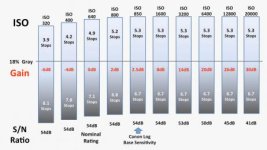
C300: C300 vs F5

Brian, digital camera sensors have their greatest dynamic range at the base ISO, which is typically ISO 100. So I'd expect that the C300 sensor would also provide the greatest dynamic range near ISO 100. I'm curious why you think using ISOs below 850 would reduce the C300 sensor's dynamic range?

C300 doesn't have ISO 100 and also because the base sensitivity of C300 is 850. The lowest ISO you can set in C300 is ISO 320.
 
Brian, digital camera sensors have their greatest dynamic range at the base ISO, which is typically ISO 100. So I'd expect that the C300 sensor would also provide the greatest dynamic range near ISO 100. I'm curious why you think using ISOs below 850 would reduce the C300 sensor's dynamic range?

Because that's the information that Canon published when they introduced the C300. Have a read: http://downloads.canon.com/CDLC/EOS_C300_Sensitometric_Characteristics_6-19-2012.pdfj

Also, this official image has circulated around the web and this forum many times since the release:
Screen Shot 2013-07-30 at 10.24.06 AM.jpg

Finally, it's not that the greatest DR is at 850, but that's where you get the greatest amount of highlight headroom, which is where digital sensors traditionally have the most trouble reaching into. Therefore, testing highlight latitude when using less than base ISO results in a flawed test.
 
digital camera sensors have their greatest dynamic range at the base ISO, which is typically ISO 100

The base ISO varies from camera to camera. My understanding is that the base ISO for the Canon C300 is 850 ISO, 1250 for the Sony F55, and 2000 for the Sony F5.
 
Also keep in mind that base sensitivity for shooting log on any camera is usually not the same as the native ASA of it's sensor.
 
Brian, digital camera sensors have their greatest dynamic range at the base ISO, which is typically ISO 100. So I'd expect that the C300 sensor would also provide the greatest dynamic range near ISO 100. I'm curious why you think using ISOs below 850 would reduce the C300 sensor's dynamic range?

C300's base ISO is 850 (in C-Log) and F5's 2000 (in S-log 2). If you go lower than base ISO, you lose DR in highlights but gain DR in shadows.
 
Do higher native ISOs make it harder to light? I usually operate at 400 ISO on interiors. I like to light and I like to open up. I can definitely see where the ability to operate in natural light without noise is valuable where you can't or don't want to light but it's a little disconcerting to think that the best ISOs on these two cameras are so high. I guess it's good they come with NDs.

... unless I'm missing something
 
According to this chart, had they used ISO 800 C300 would have gained 1 stop in highlights and lost 1-stop in shadows. That would not change the overall conclusion that C300 has 2 stops lower DR than F55.

No one is arguing that the Sony doesn't exhibit more total DR, but where those values fall is the most important thing. Using the proper base sensitivity would change the results of how the C300 performed, and put it more on par with what you can expect from the camera in relation to the F5. The F5's latitude is largely in the shadows, and it suffers from the same struggle for highlight reach that all digital cameras do.

I'll quote from Art Adams' F5 dynamic range test:

"Hypergamma 8 gives us +5/-9 from 18% grey. Those last couple of stops on the low end are gravy stops, and I define those thusly: Gravy stops: If there’s detail present, that’s gravy. One way or the other the presence of detail or lack of detail in these tones won’t affect your employment status. Paycheck stops: Detail must be present in those tones or your paycheck stops.
Technically, while there are about 9 stops of latitude between 18% gray and the noise floor, I’d only count on 7 actual 'paycheck' stops."

"This is Hypergamma 7, which will probably be my “go to” Hypergamma. We now have +5.5/-8 stops, although stop -9 is way down there. I’d count on +5.5/-7."

And finally...

"Sony speaks of these curves as “Rec 709 800″ curves, meaning they are meant to be viewed in Rec 709 and they capture 800% reflectance highlights. They also talk about SLog2 as being “Rec 709 1300″ because they claim to capture 1300% reflectance, or an additional 1/2 stop or so of highlight detail for six stops total overexposure headroom, although I’m really only seeing +5.5 stops in XAVC. That extra half stop may be available in raw."

Additionally:

"HG4 is a 109% “G33″ curve, so the highlights have been stretched by pushing what would have been middle gray in the previous curve down by nearly a stop. I see +4/-8 here, although the last two stops above the noise floor are gravy... HG2 is basically HG4 but capped at 100 IRE for broadcast. I see +4 1/3/-8 2/3 here, although the usual disclaimer applies to those bottom couple of stops. And, last but not least, HG1 is basically HG3 but capped at 100 IRE for broadcast. I see a reliable +3.75/~-8.25 here."

Of course, the C300 also shifts in latitude when using it's Norm and Cine gamma settings. But the important lesson here is to realize how much difficulty cameras have reaching above middle gray, and limiting a cameras capability in a comparison test is a little disingenuous. Of course, compare these results with the Alexa, with which it's possible to reach a full 8 stops over middle grey, and you begin to see why that camera is so special.
 
Do higher native ISOs make it harder to light? I usually operate at 400 ISO on interiors. I like to light and I like to open up. I can definitely see where the ability to operate in natural light without noise is valuable where you can't or don't want to light but it's a little disconcerting to think that the best ISOs on these two cameras are so high. I guess it's good they come with NDs.

... unless I'm missing something

If you're shooting ISO 400, you're limiting how much highlight detail you can retain, and for my money, that's a bad idea since digital cameras have such a hard time reaching into highlights anyway. But if you have total control over your contrast ratio inside, then you can mitigate the limitation - but yes, lighting might be a little more challenging depending on the situation and what you're trying to do.
 
Hold on a minute - there's a little part of me that's loading toys into my pram-mounted trebuchet at this point.

Rec 709 - I thought we're talking about the characteristics of a playback device. A Rec709 monitor has a dynamic range of x to y, of a certain linearity (or not). We, the cinematographers, can shoot 1:1 with Rec709 and get a 5-6 stop range (wriggle room). Or we can choose to shoot with super whites, super blacks, all sorts of trickery in 8 bit, 10 bit or 12 bit; video gamma, cine-gamma, hyper-gamma or C-Log and S-Log and Log-C. All of that goes through grading where we sort out what we want to see, and we present in Rec709 compliant format so we're all heading to the same... fricken'... goal.

So who do we impale on the chopping board of righteousness for suggesting that Rec709 is a standard for shooting? Why would we limit our dynamic range to fit an 800:1 monitor? We will shoot with whatever dynamic range we can get from our kit, but in the edit we will have to map those tones to a Rec709 compatible LUT.

After all, isn't one of the big 4K rah-rahs all about moving to 10 bit, moving to a wider dynamic range that the Next Generation panels can achieve?

If we shoot to Rec709, we get high contrast stuff that pleases engineers and gives the editors (my viewpoint may become slightly more obvious at this point) sod-all to work with. Allow your post-production brethren to do the best we can to shovel all your lovely rushes into Rec709's narrow porthole. Meanwhile, when Rec709 dies (like 601), we can return to your 10 bit 4:2:2 rushes and rework them for 4K - you did shoot in 10 bit, didn't you? ;)

(says he, returning to his Happy Place that goes from IRE 0 to IRE 100 and anything in between is under his control)
 
Last edited:
Back
Top