Navigation
Install the app
How to install the app on iOS
Follow along with the video below to see how to install our site as a web app on your home screen.
Note: This feature may not be available in some browsers.
More options
You are using an out of date browser. It may not display this or other websites correctly.
You should upgrade or use an alternative browser.
You should upgrade or use an alternative browser.
C300/500 price drop
- Thread starter avro
- Start date


cowpunk52
Veteran
Likely none until either pricing is announced or the cameras start rolling out. The new Sony cameras look really fantastic, but the pricing structure is a huge question mark. There's a big range between the F3 and F65 for them to fill. More than pricing, I wonder how Canon will compete in their firmware update for the C300 - to me, this is where they need to pull out all the stops in order to keep the C300 in the game without slashing the price. And I expect that they'll release an impressive update. The word that I've heard is that the C300 was designed with more capabilities than it was released with, but shipped with a firmware that was ready and tested so they could get the camera on the market.
Unsubstantiated rumors are that a firmware update will come in November, and one thing that has come through the grapevine to me as been "120 fps," but definitely take that with a grain of salt. I have to idea if it's true or not and I've only heard it from one source that I have no history with, so I've been reticent to mention it. But they are on the industry inside, so we'll see...
Unsubstantiated rumors are that a firmware update will come in November, and one thing that has come through the grapevine to me as been "120 fps," but definitely take that with a grain of salt. I have to idea if it's true or not and I've only heard it from one source that I have no history with, so I've been reticent to mention it. But they are on the industry inside, so we'll see...

Couple of things. Agree the big question mark is over Sony's pricing, they've modularised everything.
I almost invested in an F3 going back before the C300 release. The camera has a lot going for it - build quality and skin tones were the big ouchies for me so I didnt. Ive never been impressed with Sonys digital motion rendition either even in the F65 footage Ive seen to date. You would have to assume that none of these things will change. This is all from personal perspective of course, as Im sure many would disagree with those points.
EDIT TO ADD: Cant see Canon dropping prices - Canon just arent in the business of doing so.
ectobuilder
Veteran
I wonder what kind of change of pricing we will see from Canon on their new c300/500 and 1d-c..
There is lot of very positive talk about new F5 on net.
Canon would rather put the dollars into designing a response to Sony via a new product launch. They have R&D to leverage unlike RED. RED may have to resort to a price drop but I think Canon can easily design something else to go head to head with Sony.
The idea is to maintain your Average Selling Price so you can bank on reducing costs later in order to recover profits rather than killing price and therefore the consumer psychology altogether.

Paul Cronin
Well-known member
Firmware update for the C300 with more frame rates would be great. And more codec options with much higher frame rates with the C500 will keep me with Canon. I love my C300 and I just moved from Sony where I have been for the last 15 years.
Last edited:
I think Canon can easily design something else to go head to head with Sony.
The idea is to maintain your Average Selling Price so you can bank on reducing costs later in order to recover profits rather than killing price and therefore the consumer psychology altogether.
How many new cameras, in the same market, do you think they can release when they're still developing their current line? That won't happen.
And the idea of "maintaining your average selling price", is an antiquated notion, it's a fantasy in 2012.
The market, Their Market, has changed dramatically in performance and cost and the rate of change is increasing.
It's over, done, it's a new environment.
Kind of a perfect storm in the industry
The economy demands it.
Companies are releasing cameras with superior image quality at a fraction of their cost.
They either wake up or go the dinosaur route.
Sony woke up.
Red is responding to the new reality.
Canon is in a quandary right now, between a rock and a hard place - and don't think they don't know it.
What they need is some outside vision to shake up their entrenched, corporate thinking.
Firstly they need 1920 50/60p for C100/300. There must be pricedrop for c300 if Sony f5 body is $16,000. Their c500 will be reduced to at least $20,000 tommorrow if Epic will be $20,000-25,000..
and new 1d-c can not be $15,000 any more. This camera will be discontinued if not UNDER $10,000.
and new 1d-c can not be $15,000 any more. This camera will be discontinued if not UNDER $10,000.
Barry_Green
Moderator
Have you ever, ever, ever seen Canon adjust pricing on ANY professional video camera model, ever, in their history, ever? I haven't.
The XLH1, a model they couldn't give away, and that probably sold fewer than 500 units ever, was still listed at $8999 up until the day it was discontinued.
Canon still lists the GL2 (yes, the standard-def DV tape GL2) in their pro division. For $2,799. The GL2 was first introduced in 2002(!) It's ten years old, it's been vastly surpassed by many other cameras, it was destroyed by the DVX100, and yet ten years later, it's selling for the same price as when it was introduced. I found on DVInfo a report from a guy who ordered one from Zotz Digital at a discounted price of $2600. Ten years later, woefully outdated and long past its sell-by date, the GL2 is still selling for the same MSRP as when it was introduced.
The moral of the story? Canon doesn't "do" price drops.
Will the price of the C500 change, even one nickel, even if the Epic drops to $15,000? Don't count on it. I would bet the price of the C500 will be exactly the same one year from now, as it is today, regardless of what Sony or Red do. It's just how the company works, and how they've always worked.

John Andersson
Well-known member
That might be true for their videocameras but Canon DSLR cameras get cheaper over time. Isn't the C-line also EOS?
Barry_Green
Moderator
I don't concern myself with DSLRs, I don't know what they may or may not do over time, they're consumer commodity items. But I've been watching pro video for the last decade, and Canon has been profoundly consistent. So consistent, in fact, that I made a prediction in 2010, well before the AF100 was even released, that we wouldn't see an AF100 competitor from them in 2010, or in 2011, or in 2012. And here we are, tomorrow is November of 2012, and still no competitor. The C100 is sort of close, but it's twice the price, so you can't really call that a competitor, but even if you did, you still would have to admit I came really, really close with my prediction!
I find Canon to be the most predictable of the "big 4" (JVC, Canon, Sony, Panasonic). And I would be very confident in predicting that they're not going to drop the MSRP of the C300 or C500, most definitely they won't drop it a penny until Jan. 1 2014 at the very earliest. They are doing a little rebate right now, that's pretty much the extent of the price drop you can expect from them.
But hey, we'll see...
Have you ever, ever, ever seen Canon adjust pricing on ANY professional video camera model, ever, in their history, ever? I haven't.
The XLH1, a model they couldn't give away, and that probably sold fewer than 500 units ever, was still listed at $8999 up until the day it was discontinued.
Canon still lists the GL2 (yes, the standard-def DV tape GL2) in their pro division. For $2,799. The GL2 was first introduced in 2002(!) It's ten years old, it's been vastly surpassed by many other cameras, it was destroyed by the DVX100, and yet ten years later, it's selling for the same price as when it was introduced. I found on DVInfo a report from a guy who ordered one from Zotz Digital at a discounted price of $2600. Ten years later, woefully outdated and long past its sell-by date, the GL2 is still selling for the same MSRP as when it was introduced.
The moral of the story? Canon doesn't "do" price drops.
Will the price of the C500 change, even one nickel, even if the Epic drops to $15,000? Don't count on it. I would bet the price of the C500 will be exactly the same one year from now, as it is today, regardless of what Sony or Red do. It's just how the company works, and how they've always worked.
If they do not change they will sell not even HALF of what they should...and do not forger Panasonic entering this now very competitive market with their CINE MODULAR camera soon. Who cares now about what Canon will do, it is buyers market now.
Barry_Green
Moderator
Probably true.If they do not change they will sell not even HALF of what they should
But that's never stopped them before...
I don't concern myself with DSLRs, I don't know what they may or may not do over time, they're consumer commodity items. But I've been watching pro video for the last decade,
DSLRs have greatly impacted the pro market for 4 years now - whether you concern yourself with them or not.
We've used them on national TV work and high end film work for the Olympics and major orgs and corps - they've obviously been used repeatedly in features.
What took place over the last decade in pro video has little to do with what will happen now and over the next half decade.
It is a different reality with many blurred lines going forward.
The last decade is history as will be Canon's market share if you're right, because the eos/C line won't be competitive with anyone - from Panasonic to BMC - a year from now.
Premium prices for limited functionality simply won't work going forward.
It's not a sustainable business model for any company let alone one with shrinking income in a sour economy.

Liam Hall
Veteran
DSLRs have greatly impacted the pro market for 4 years now - whether you concern yourself with them or not.
We've used them on national TV work and high end film work for the Olympics and major orgs and corps - they've obviously been used repeatedly in features.
What took place over the last decade in pro video has little to do with what will happen now and over the next half decade.
It is a different reality with many blurred lines going forward.
The last decade is history as will be Canon's market share if you're right, because the eos/C line won't be competitive with anyone - from Panasonic to BMC - a year from now.
Premium prices for limited functionality simply won't work going forward.
It's not a sustainable business model for any company let alone one with shrinking income in a sour economy.
Completely agree.
Barry_Green
Moderator
Again, perhaps so -- but that doesn't mean the existing companies will suddenly lurch to a new business model. Again, it took Canon from 2008, with the introduction of the 5D, until 2012 or nigh unto 2013 to come out with a (relatively) affordable pro version of their existing DSLR.DSLRs have greatly impacted the pro market for 4 years now - whether you concern yourself with them or not.
We've used them on national TV work and high end film work for the Olympics and major orgs and corps - they've obviously been used repeatedly in features.
What took place over the last decade in pro video has little to do with what will happen now and over the next half decade.
Just because we "want" things to happen overnight, and we "expect" price drops, doesn't mean those things will happen!
Well, again, people said that when Red announced the Scarlet (also in 2008) that Panasonic, Sony, and Canon were all out of business effective immediately. That didn't happen either. I suspect Panasonic, Sony, Canon, BlackMagic and Red will all be in business a year from now. And Canon will sell very few of their models, comparatively, just like their HDV pro line never sold in a tenth the quantities of the HVX or Z1U or EX1. Apparently they're comfortable with the overpriced niche, as they've been occupying it for many many years.The last decade is history as will be Canon's market share if you're right, because the eos/C line won't be competitive with anyone - from Panasonic to BMC - a year from now.
I would agree, but -- look, frankly, the DSLRs were horrible to shoot on, had extremely limited functionality and tons of problems, and they still became very popular. The C300 and C500 don't really have any problems at all, they're just expensive and don't have quite as many features as the competition. And Canon doesn't give a flying hoot about selling those to individuals, they're focused on Hollywood. If Hollywood has bought into the "Canon" name, they'll continue to buy into C300's and C500's, as long as they do the job.Premium prices for limited functionality simply won't work going forward.
It's not a sustainable business model for any company let alone one with shrinking income in a sour economy.
But we'll see. I don't think Hollywood is making their decisions based on what Sony does next, I haven't seen Sony be that major of a player in Hollywood since the original F900. I think (for better or worse) Red's reaction to the F5/F55 will hold more impact on Canon's future, than Sony's F5/F55. On the other hand, I expect the F5/F55 to be adopted by individual owner/ops more rapidly than C300/C500's now.
The F900 had higher specs, and was known as "the" go-to cinema camera for years. But the "lowly" VariCam sold 10x as many, because owner-ops could afford an entire studio. Canon may retain its title as the "hollywood" camera, that won't prevent Sony from selling tons of F5's and F55's to owner-ops.
But, again, we'll see.
Barry_Green
Moderator
Total speculation, but I think there's zero chance of there being an update like that for the C300. The recording system it uses doesn't have provision for 60p, and it's based on the Digic DV III chip which, if I'm not mistaken, doesn't do 60p either. I don't think the hardware is there to provide 1080/60p. And if the hardware's not there, there's nothing a firmware update can do for it.
But again, I'm speculating, I don't know this for an absolute fact.
But again, I'm speculating, I don't know this for an absolute fact.
John Andersson
Well-known member
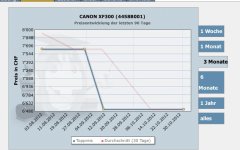
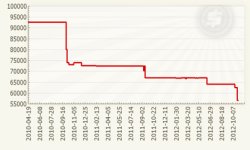
This is the price graph (second one) here in Sweden and even thou it's just a slight curve downwards the C300 is cheaper today. The first graph shows price for the XF305. It also has a curve going down.

Have you ever, ever, ever seen Canon adjust pricing on ANY professional video camera model, ever, in their history, ever? I haven't.
The XLH1, a model they couldn't give away, and that probably sold fewer than 500 units ever, was still listed at $8999 up until the day it was discontinued.
Canon still lists the GL2 (yes, the standard-def DV tape GL2) in their pro division. For $2,799. The GL2 was first introduced in 2002(!) It's ten years old, it's been vastly surpassed by many other cameras, it was destroyed by the DVX100, and yet ten years later, it's selling for the same price as when it was introduced. I found on DVInfo a report from a guy who ordered one from Zotz Digital at a discounted price of $2600. Ten years later, woefully outdated and long past its sell-by date, the GL2 is still selling for the same MSRP as when it was introduced.
The moral of the story? Canon doesn't "do" price drops.
Will the price of the C500 change, even one nickel, even if the Epic drops to $15,000? Don't count on it. I would bet the price of the C500 will be exactly the same one year from now, as it is today, regardless of what Sony or Red do. It's just how the company works, and how they've always worked.
CANON XF 300 was 6799$ CANON List Price now 5995$ @ B&H and in switzerland avalanche price drop: