Blackmagic Raises Price of Many Items

It's not. It's a constant. And inflation is a monetary phenomenon.

in normal times (ie 2-3% inflation), there's only so much a retailer can raise prices without driving the customer away. but in a time of elevated inflation, the customer knows there will be unusual price increases, they just don't know how much. every retailer can carefully raise them as much as possible based on their studies. the consumer blames inflation and doesn't balk. there's no downward price pressure, and the cumulative effect of so many retailers following suit is extra inflation. psychology

but if consumers cut back, as per Amazon's soft holiday shopping predictions, then you would expect to see some retailers start to relent with the price increases in a bid to boost sales volume. thus far, shoppers have mostly swallowed the price increases, so there's been no need
 
Last edited:
Inflation is when the demand for goods and services is more than the supply. When you increase the supply of money through monetary policies the purchasing power of the dollar is diluted. The dollar doesn't buy as much, doesn't buy as many gallons of fuel, food, everything. Retailers don't cause inflation.
 
Inflation is when the demand for goods and services is more than the supply. When you increase the supply of money through monetary policies the purchasing power of the dollar is diluted. The dollar doesn't buy as much, doesn't buy as many gallons of fuel, food, everything. Retailers don't cause inflation.
Sorry, Tom, but when it comes to economics, Robert Reich knows more than you do. Maybe you missed the part where a dozen CEOs bragged about continually increasing prices because consumers will have no choice but to accept it. Or maybe you missed the part where the CEOs of drug companies and oil and gas executives were dragged in before congress where they admitted to price gouging while rewarding themselves with outrageous bonuses. Even as the cost of a barrel of oil drops, the price at the pump barely changes. That’s not supply/demand, that’s price gouging. The excess profits of these and other sectors of the economy account for more than 50% of inflation and we need to tax the hell out of those businesses.
 
Last edited:
Sorry, Tom, but when it comes to economics, Robert Reich knows more than you do. Maybe you missed the part where a dozen CEOs bragged about continually increasing prices because consumers will have no choice but to accept it. Or maybe you missed the part where the CEOs of drug companies and oil and gas executives were dragged in before congress where they admitted to price gouging while rewarding themselves with outrageous bonuses. Even as the cost of a barrel of oil drops, the price at the pump barely changes. That’s not supply/demand, that’s price gouging. The excess profits of these and other sectors of the economy account for more than 50% of inflation and we need to tax the hell out of those businesses.

Sorry Jon you are just spouting neo-Marxist class envy, not economics.
 
Sorry Jon you are just spouting neo-Marxist class envy, not economics.

Wong, Tom, it's you who are spouting complete and utter nonsense. I have stated facts, supported by evidence, along with the very words and actions of the greedy, power hungry CEOs themselves. I've watched the CEOs of drug companies in Senate hearings admitting how they dramatically increased the costs of life saving medications for no other reason than to increase their already obscene profits. And they have all of Congress in their pocket, which is why the USA is the only developed country that can't negotiate drug prices. Not sure where you get the envy bit, that's bonkers. I don't envy these disgusting corporate criminals at all.
 
Wong, Tom, it's you who are spouting complete and utter nonsense. I have stated facts, supported by evidence, along with the very words and actions of the greedy, power hungry CEOs themselves. I've watched the CEOs of drug companies in Senate hearings admitting how they dramatically increased the costs of life saving medications for no other reason than to increase their already obscene profits. And they have all of Congress in their pocket, which is why the USA is the only developed country that can't negotiate drug prices. Not sure where you get the envy bit, that's bonkers. I don't envy these disgusting corporate criminals at all.

If you don't like the companies don't buy their kit.
We don't need rants about economics.
 
in normal times (ie 2-3% inflation), there's only so much a retailer can raise prices without driving the customer away. but in a time of elevated inflation, the customer knows there will be unusual price increases, they just don't know how much. every retailer can carefully raise them as much as possible based on their studies. the consumer blames inflation and doesn't balk. there's no downward price pressure, and the cumulative effect of so many retailers following suit is extra inflation. psychology

but if consumers cut back, as per Amazon's soft holiday shopping predictions, then you would expect to see some retailers start to relent with the price increases in a bid to boost sales volume. thus far, shoppers have mostly swallowed the price increases, so there's been no need

That is basically correct. The human nature is a constant and, if a money pool shrinks, a recession generally follows, prices drop, unemployment ensues.

I was around during the early 80's Volcker-Reagan recession --- 20% prime rate, 10% unemployment, S&L crisis. Raising prices or salaries were a death knell for a business.

The catch is that the preceding inflation of the 70's under both Burns and Volcker (Nixon, Ford, Carter) was an illusion of prosperity. They were all Keynesians then.

https://en.wikipedia.org/wiki/We_are_all_Keynesians_now

PS. Herb Stein, Ben's father and Nixon's top economic adviser, was indeed a Keynesian.
 
If you don't like the companies don't buy their kit.
We don't need rants about economics.

It's got nothing whatsoever to do with liking a company's products or buying or not buying their products.
To a great extent, it's about how readily all the websites devoted to filmmaking appear to be so eager to make it sound
like the electronics giants are trying so hard to contain prices.
I'm afraid it's not up to you whether or not I share my thoughts here, either.

Fortunatley for you I am not going to share my thoughts about you.
You clearly have no odea what is going on in the electronics world.
 
Wong, Tom, it's you who are spouting complete and utter nonsense. I have stated facts, supported by evidence, along with the very words and actions of the greedy, power hungry CEOs themselves. I've watched the CEOs of drug companies in Senate hearings admitting how they dramatically increased the costs of life saving medications for no other reason than to increase their already obscene profits. And they have all of Congress in their pocket, which is why the USA is the only developed country that can't negotiate drug prices. Not sure where you get the envy bit, that's bonkers. I don't envy these disgusting corporate criminals at all.

He's not wrong, I agree with Tom that your rant is nothing but neo-Marxist class envy. As JAMedia suggested, if you don't like the business practices of a company, don't buy their products, don't invest in their stock, and don't go to work for them. Beyond that, you have no standing and your opinion doesn't matter. What makes you the arbiter of good and evil?
 
He's not wrong, I agree with Tom that your rant is nothing but neo-Marxist class envy. As JAMedia suggested, if you don't like the business practices of a company, don't buy their products, don't invest in their stock, and don't go to work for them. Beyond that, you have no standing and your opinion doesn't matter. What makes you the arbiter of good and evil?

Interesting how you quote a statement with facts and rather than refuting them (because you can't!), you just mutter stuff about me not being an arbiter of good and evil, repeating crap about me being envious of greedy CEOs and saying that my opinion doesn't matter. Bravo!
 
What facts do I have to quote? It is your opinions that I take issue with. Even if one of the CEO's you hate came right out and said "I am an evil corporate bastard who will stop at nothing to increase profits", I would say that is his/her right to do so within the limits of the law. If you don't like it, too bad. Take your business, investment portfolio, and employment elsewhere. Other than those three things, your opinion matters not. You are not the arbiter of what is wrong or right.

What if someone else says YOU make too much money and that you overcharge YOUR clients. Are you going to agree with them? Why not?
 
Somewhere it was said here about increasing the money supply producing inflation.

Economists typically link inflation to low unemployment, seeing employers competing for workers by driving up wages as the usual instigator.

In this particular case, I think the main instigator was a supply shortage brought on by pandemic disruptions. Suddenly (and to this day) there wasn't as much of many products as there had been before, thus altering the supply/demand ratio.

There's more than one way for your cat to get skinned. It's not Marxist to analyze the dynamics of price-setting or the sales/purchases strategies of retailers and consumers.

There is no magic price where anyone is morally bound to sell anything. Personally, I'm just looking for my dollar to go as far as it can. Do you ever ask someone what the price of a good or service is and then respond, "that's too much," because that's all we're talking about here. Imagine you never ever responded that way but just paid them and said, "Well, that's inflation."
 
I can't remember if I've brought this up before or not. I read an article a while back that said part of the skyrocketing real estate prices and inflation problem were because of millennials. They went "without" for so long, and then they finally hit a point in their lives where they had some money and were tired of doing without, that when they wanted something that they would buy it, no matter the cost(i.e: bidding wars that drove $250K houses to $450K, etc).
 
Millennial here. Living in UK so USA may be different but here (anecdotal, I know) people I know went without because they could not afford and there has been absolutely no bidding wars among millennials because that moves houses into "cannot afford" places anymore.

In the UK the government temporarily took away a pretty hefty tax that you have to pay when you buy a house (unless it is the first house you ever buy) and that caused the prices to raise ridiculously.

In Spain (where I am originally from and I am sure it is similar elsewhere) companies like Blackrock and people who can afford it, buy at ridiculous prices (likely these are the ones that go into bidding wars) because renting is such a great business be it in Air BnB style or to more stable renters.

Finally, to hint (anecdotally again) at how messed up the rental market is. My partner and I have a mortgage, she pays slightly above 33% of her income (from a poor paying job in a fancy art institution) and I am currently unemployed, but was paying slightly below 25% of my income (from a teacher job in central London). If we were renting a place like ours, she'd be paying over 50% and I would have been paying about 33%.

An old boss of mine owned 7 flats in the UK, 5 in London, 2 in Bristol. He once boasted (after I complained about how much money I was spending in rent) that he paid 400 pounds a month mortgage on a flat he was renting for 1600.

My conclusion, in my limited but significant experience, it is not millennials (unless they are really well off) that are causing inflation in real estate (in London and Spain, and likely elsewhere from what I gather) but companies and people who are well off and can put in a decent initial payment and then rent the property, having the renters pay the mortgage while they pocket the surplus which can be a lot. For us, if we rented, it would be about 20% (taxes eat a lot) of what we would charge to rent our place, but for my old boss who bought ages ago, it was about 50%.

You bring up something interesting. I saw a story months ago on the local news here, where some HoA’s were stepping in and enacting rules like houses must be actually lived in by the buyer for, sometimes, multiple years, before it could be rented out, to try to prevent these big cash rich companies from coming into neighborhoods and buying up the houses just to turn them into rentals.
 
=
Run&Gun;n5696258 said:
I can't remember if I've brought this up before or not. I read an article a while back that said part of the skyrocketing real estate prices and inflation problem were because of millennials. They went "without" for so long, and then they finally hit a point in their lives where they had some money and were tired of doing without, that when they wanted something that they would buy it, no matter the cost(i.e: bidding wars that drove $250K houses to $450K, etc).

You've earned honorary boomer status :)
wAAACH5BAEKAAAALAAAAAABAAEAAAICRAEAOw==
​

I think there's some truth to that in that a large bulk of millennials started forming families and households simultaneously, suddenly increasing demand for houses. (My wife and I are among them, but I wish i had been ready a couple years earlier. We could have saved mega bucks.)

But the reality is that you have to consider the cost of buying a new home. That cost has skyrocketed due to parts shortages. At one point, lumber was way up. (I think it came down now?) Every contractor and housing inspector I spoke to before buying a house, when I asked them how much something cost to replace, they would ask me, "Do you want current prices or pre-pandemic prices?" Because the cost of everything has gone up so much and they don't know if it will come back down.

Everyone, myself included, who looks at the crazy prices of used houses then considers building a new one, but those prices are even crazier. And, as far as I know, it's not due to bidding wars. So, the price of used houses rises in relation to the price of new houses.

The housing supply went from about 4 months in 2020 to about 2 months in 2022 when I bought.

Rent went through the roof, making it more palatable to pay more for a house and get off the rental market.

I think that millennials participated in bidding wars but that it wasn't necessarily irrational. I'm sure glad I got in at 4% APR. There were 13 bidders for our house.

But thanks for implying that we're financially illiterate rubes! :)

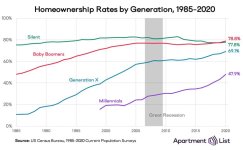
Half of millennials bought in before the craziness, which probably constitutes about 2/3 of all millennials who will ever own a home:

Click image for larger version  Name:	Home-Ownership-Rates-By-Generation-Apartment-List.jpg Views:	0 Size:	69.1 KB ID:	5696312
 
Last edited:
Half of millennials bought in before the craziness, which probably constitutes about 2/3 of all millennials who will ever own a home:

In the UK I am fortunate I had fully paid for my house by my mid-50s and from that point I don't owe any one anything bar the next utilities bill (gas, electric and phone)
I have two sons, both milennials. One owns his house (for all the wrong reasons but it turned out OK) and the other is never likely to.
Things are getting steadily worse for first time buyers for most.
 
You bring up something interesting. I saw a story months ago on the local news here, where some HoA’s were stepping in and enacting rules like houses must be actually lived in by the buyer for, sometimes, multiple years, before it could be rented out, to try to prevent these big cash rich companies from coming into neighborhoods and buying up the houses just to turn them into rentals.

We have that in our condo building. Or had. Two years of ownership before renting.
 
Back
Top