Red went for the high end market, which has fewer units sold by definition. But, even there, ARRI and Sony have had the same cameras - albeit with various upgrades - for six years now. And Canon is marching to its own drumbeat anyway.That's what they said about RED too.

Navigation
Install the app
How to install the app on iOS
Follow along with the video below to see how to install our site as a web app on your home screen.
Note: This feature may not be available in some browsers.
More options
You are using an out of date browser. It may not display this or other websites correctly.
You should upgrade or use an alternative browser.
You should upgrade or use an alternative browser.
Blackmagic press conference on Thursday, March 2nd, 12.00pm PST
- Thread starter Cary Knoop
- Start date
steve phillipps
Veteran
I agree with NorBro here, when the RED One was released it was absolutely a budget alternative, crazy cheap compared to the alternatives (probably Sony F35 at $170,000 was its closest competitor?). You have to remember that all professional camera kit used to be very much more expensive than it is now - right from Super 16 through Beta SP, Digibeta, HDCam, the cameras tended to hover around the £50,000 mark on release, stabilising to around £35,000 after a couple of years. Things have really changed now, and a £20,000 camera is seen as seriously expensive!
Steve
Steve

NorBro
Major Contributor
What was Red One? $17,000 naked? A shooting package was around $30,000? And that was a decade ago. It's not the entry level market. BMD is aiming at a much lower niche with URSA, Mini, Mini 4.6, Mini Pro, especially when looking at a complete package.
In my opinion, the lower niche is now the normal niche because 99% of independent shooters will never buy another camera above $10,000 again.
Yes. That's how the market has shifted downward in terms of the price and upward in terms of the price-for-quality ratio within the decade. Presuming the QC holds up, Mini Pro might begin to edge into medium budget productions and reign among the independents.In my opinion, the lower niche is now the normal niche because 99% of independent shooters will never buy another camera above $10,000 again.
One also has to look at the rapidly falling prices of the LED's. At some point in the near future, even a no/low budget set would be able to shoot outdoors at night.
steve phillipps
Veteran
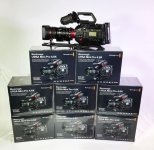
Got a few Blackmagic URSA Mini Pro cameras in yesterday.
Stop by to demo.
BLACKMAGIC DESIGN URSA MINI PRO 4.6K DIGITAL CINEMA CAMERA - CINEURSAMUPRO46K $5995
BLACKMAGIC URSA MINI PRO W/ CANON COMPACT-SERVO 18-80MM $11,694.05
View attachment 121855

Fair play to them that they have shipped immediately. That is certainly one step in the right direction. Camera does look like an excellent design and spec too.
Steve
alaskacameradude
Veteran
Wish they had made it in E mount as well as EF and PL, but I'm not sure you could cram a filter wheel behind an E/X/mft mount and still have all of those lenses work properly.
Well, the FS700 managed to cram a filter wheel behind an Emount and so did the FS7.
To a lesser (or greater) extent the FS5 and FS7 II but they are both using the really cool
electronic variable ND.

Run&Gun
Veteran
What was Red One? $17,000 naked? A shooting package was around $30,000? And that was a decade ago. It's not the entry level market. BMD is aiming at a much lower niche with URSA, Mini, Mini 4.6, Mini Pro, especially when looking at a complete package.
I agree with NorBro here, when the RED One was released it was absolutely a budget alternative, crazy cheap compared to the alternatives (probably Sony F35 at $170,000 was its closest competitor?). You have to remember that all professional camera kit used to be very much more expensive than it is now - right from Super 16 through Beta SP, Digibeta, HDCam, the cameras tended to hover around the £50,000 mark on release, stabilising to around £35,000 after a couple of years. Things have really changed now, and a £20,000 camera is seen as seriously expensive!
Steve
A decade ago $30K ready to shoot was the entry level market/cheap. I paid ~$45K for my tape VariCam in 2006 and the F900 was still ~$100K. Those prices were just body & VF and just body, respectively. And we're also talking about 2/3" 720P and 1080PsF/i. Not that there is anything wrong with 3-chip, 2/3" HD ENG cameras. They still have some advantages over a lot of s35 camera offerings.
Hell, I remember when the C300 came out. I bought one in 2013 for $15K. So many of us snatched those up with cash without any real hesitation while thinking, "Man, this thing is almost disposable cheap, why in the world wouldn't I buy one?". That was only four years ago, now $15K-$20K is considered high-end/out of reach/rental market.
That is something to keep in mind to contrast where we are from where we were.
But there was also Canon XL2, going for just over $5,000 in 2004, then XL H1 was about $6,000 in 2006 or so. Then HVX 200 was $3,200 in 2006. Et cetera, et cetera.A decade ago $30K ready to shoot was the entry level market/cheap...
Obviously, the big productions used Sony and ARRI (what was it, D20/D21 then?) and Dalsa/Thompson and so on but one could still do HD on a budget.
steve phillipps
Veteran
But there was also Canon XL2, going for just over $5,000 in 2004, then XL H1 was about $6,000 in 2006 or so. Then HVX 200 was $3,200 in 2006. Et cetera, et cetera.
Obviously, the big productions used Sony and ARRI (what was it, D20/D21 then?) and Dalsa/Thompson and so on but one could still do HD on a budget.
I think the difference there though is that those cheap alternatives were so very far below the technical quality of the expensive cameras...that's not the case today at all.
Steve

Samuel H
Major Contributor
That's the thing: as time goes by, the best cameras improve, but the cheap cameras improve much faster and continuously catch up. They may never get there, but the gap gets smaller and smaller, and more and more productions start to compromise and go for the cheap stuff (cheap as in FS7 or Ursa Mini, the market for the GH4 or a6500 is a different one, I think).
steve phillipps
Veteran
That's the thing: as time goes by, the best cameras improve, but the cheap cameras improve much faster and continuously catch up. They may never get there, but the gap gets smaller and smaller, and more and more productions start to compromise and go for the cheap stuff (cheap as in FS7 or Ursa Mini, the market for the GH4 or a6500 is a different one, I think).
...and just as importantly, it becomes harder to justify paying big money for the top-end kit...which inevitably drives down the top-end prices due to lack of demand.
Steve
I was looking at the 2006 time frame, since it was used as a reference in a previous post.Since we are at dvxuser, maybe someone should mention the DVX100. What was that, $3500 at launch?
XL2 was a 720p camera at the time when not many people even had an HD set. The footage could then be upscaled to 1080p via hardware, had there been a need for it. The footage looks soft by the current standards but then YouTube was only doing 240p then in H264/MPEG4 (144p equivalent in VP9) and any sort of a movement on the screen immediately led to gaudy pixelation. I remember seeing some David Gilmour clip streamed on YouTube at 720p around 2009 and being amazed at how good it looked on a PC screen.I think the difference there though is that those cheap alternatives were so very far below the technical quality of the expensive cameras...that's not the case today at all.
Steve
PS. I bought a 27" 480p ("improved definition", where the "i" became the "p") tube TV back in 2006 to watch the 4:3 cable broadcasts and it served me well for a full decade. A $269 Advent.
steve phillipps
Veteran
XL2 was a 720p camera at the time when not many people even had an HD set. The footage could then be upscaled to 1080p via hardware, had there been a need for it. The footage looks soft by the current standards but then YouTube was only doing 240p then in H264/MPEG4 (144p equivalent in VP9) and any sort of a movement on the screen immediately led to gaudy pixelation. I remember seeing some David Gilmour clip streamed on YouTube at 720p around 2009 and being amazed at how good it looked on a PC screen.
.
I thought the Canon XL2 was standard def interlaced, not HD. The thing with those cheaper cameras was that they tended to look decent plugged straight into a tv, but once they'd gone through the broadcast chain they looked terrible.
Steve
steve phillipps
Veteran
I remember doing a programme on Digibeta just after the Sony Z1 had come out - so this was a brand new, full HD camera which was used as a B camera to the standard def (and quite old by then) Digibeta...and on broadcast the Z1 looked AWFUL!
Steve
Steve