Samuel's post you responded to said BMMCC.
That's the Blackmagic Micro Cinema Camera. S16.
Your link is to the URSA Mini, which is S35.
My mistake, thanks for clarifying


Follow along with the video below to see how to install our site as a web app on your home screen.
Note: This feature may not be available in some browsers.
Samuel's post you responded to said BMMCC.
That's the Blackmagic Micro Cinema Camera. S16.
Your link is to the URSA Mini, which is S35.
In "consumer", an internal SSD may become the sole provider of the high resolution/high bit rate images, with the removable media used mostly as a backup. In high end cameras, it will become the backup.
As to the offload time, Thunderbolt 3 does 5 GB/s and most pro operators shoot less than 1 TB/day, so it's a 2-3 min offload under most situations. Not really much of a tie up.
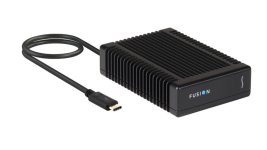

This would be amazing, but I have a feeling it will take a few years before anything remotely like this actually shows up in DSLRs or mirrorless cameras. Here's crossing my fingers for the GH5!Removable, commodity, solid-state cards (for example, today's SDXC cards) will always be best. It's just a matter of them getting fast enough. They already are fast enough for ProRes at 2K, which is a fabulous format. But just when the cards got there, the industry moved the line to 4K, and, much to my surprise, even pros fell for it --- maybe because their less-technical clients blindly demand it. But I still hold, and will hold forever, that 2K is enough for most situations.
Anyway, that's not why I posted, to start another 2K-vs-4K debate. I came here to say that removable, commodity cards, like SDXC, are ideal. But second best would be an external solid-state drive. Thunderbolt 3 (same jack as the recent USB Type C) came out, and here's an external, Thunderbolt 3, solid-state drive that gets 2,100 megabytes per second. That's 16.8 gigabits per second. By comparison, that's 700 times the bandwidth of AVCHD, 168 times the bandwidth of the GH4 in 4K, over 70 times the bandwidth of Prores 2K, 12 times the bandwidth of Prores 4444 XQ 4K, and about 8 times the bandwidth of 10-bit 4K raw. I don't know how much this drive is, since it was just announced, but it their old, Thunderbolt-2 drives are $2/GB.
The jack is about the size of the Micro USB jack, on a smartphone for instance. It is reversible, so no more fumbling around. And it provides power (up to 100 watts, as needed), so no need to run a separate power cable, no matter how power-hungry the external device. A videocamera or DSLR could fit three or four or five of these little jacks on their bodies, and they could be used for this external drive or, like, an XLR adapter (if someone would please design a USB-Type-C-powered XLR adapter) or an external monitor or whatever.
View attachment 111862
And this drive, like I said, goes up to 16.8 Gbps. But that's a limitation of the flash media within the box. The jack itself supports 40 Gbps. It's an amazing jack and hope soon becomes standard and pervasive across . . . everything!
No. It's not. Or any laptop would be run off flash cards.This is a terrible idea...
And, with everything moving to 6K/8K - first 8K sensor shipments have commenced for NHK - a pro tier camera will need that bandwidth and the typical removable media may or may not be up to snuff for a while. The SSD's - whether internal or external - are.... second best would be an external solid-state drive. Thunderbolt 3 (same jack as the recent USB Type C) came out, and here's an external, Thunderbolt 3, solid-state drive that gets 2,100 megabytes per second. That's 16.8 gigabits per second. By comparison, that's 700 times the bandwidth of AVCHD, 168 times the bandwidth of the GH4 in 4K, over 70 times the bandwidth of Prores 2K, 12 times the bandwidth of Prores 4444 XQ 4K, and about 8 times the bandwidth of 10-bit 4K raw...

We have 1 left from the first shipment......
http://www.evsonline.com/blackmagic-design-ursa-mini-4-6k-digital-cinema-camera-ef-mount.html
Jim Martin
EVSonline.com

We have 1 left from the first shipment......
http://www.evsonline.com/blackmagic-design-ursa-mini-4-6k-digital-cinema-camera-ef-mount.html
Jim Martin
EVSonline.com

The new V90 SDXC card standard is rated for 8K video and I use 2000x Lexar SDXC UHS-II cards in my Samsung NX1 that has UHS-II support . My new Sony a6300 shoots 4K UHD XAVC-S at 100Mbit using low cost Transcend UHS-1 U3 SDXC cards without any problems so even if the GH5 has 6K todays UHS-II 2000x SDXC cards would be more than fast enough.This would be amazing, but I have a feeling it will take a few years before anything remotely like this actually shows up in DSLRs or mirrorless cameras. Here's crossing my fingers for the GH5!