Biax color quality Diva vs Flo light vs Cool light?

Lenilenapi

Carbonite Member
has anyone compared the color quality of the tungstun and daylight Biax bulbs from Kino-flo (Diva) vs the Cool Lights or the Flo Lights?
 
I haven't done head-to-head but have often read the quality is the same, same factories, etc.

I can tell you that every 55w biax light I've bought has had the same characteristics and tests out the same. Usually they can still use 1/4 - 1/2 minus green (I test by shooting a RAW still of a grey card and eyedroppering the resulting color, and testing that against a RAW still shot in actual sunlight). Many people feel kino-branded bulbs still need minus green.

If you're that concerned about color accuracy, it's a good idea to test everything you've got - I have 85 and 100 watt huge spiral/tubes, 55 biax, 40 watt spirals, HIDs, etc - if you're mixing daylight scources, take a couple hours one day and test them comparatively. You'll be surprised how different they are and what gel combos it takes to get to pure RGB. Some of the big spiral-style (not really spiral glass but tubular glass with ballast-in-the-base) that I have are actually kind of yellow; the Alzo HID stuff is very natural, 55w biax a tad green, etc.

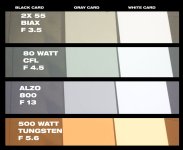
My process: set your camera to daylight white balance & shoot a gray card under each light; use your histogram to get matching exposures of each;

Open the files in camera raw with the same white balance as shot and keep all the setting nuetral;

Eyedropper the grays and look for even RGB values; the differences between red, green and blue will give you a good idea of color skew.

Don't imagine that's a scientific as a color meter - it was the only thing I could think of using gear I own.

Here's some test results of a black/white/gray card:

light-test.jpg
 
I have used a minolta Color meter to tell me what correction to put on LED's to get them to match daylight or tungstun and the meter was pretty much orthless. it always overcorrected . I found it better to just put a tungstun light up against a florescent and gel until it looked like a match - likewise for daylight. Friends old me they had the same experince with a color meter.

I've seen CRI's for those brands that vary from 85 to 95 so I wondered if they really are different./ With Diva's I more often have found them to be magenta, and needing 1/8 - 1/4 Green.
 
Your experience with the color meter was probably partly because they're not really meant to read sources like that. They're much more accurate with full spectrum sources.

I agree about the biax tubes though, 1/8 plus green seems to get tungsten ones much closer to real tungsten. For daylight tubes I'll often use 1/4 straw, this negates the magenta and warms them up to where I want them at the same time.
 
I ran a Coollight next to a Kino Diva and found the Coolight with Coollight daylight tubes to be a bit more noticeably green. But when running the Coollight with Kino tubes, it was pretty close. Never tested the tungsten tubes.
 
I ran a Coollight next to a Kino Diva and found the Coolight with Coollight daylight tubes to be a bit more noticeably green. But when running the Coollight with Kino tubes, it was pretty close. Never tested the tungsten tubes.

I've read this before, so your experience isn't unknown. I've also read that it doesn't matter so much for video but will show up more on actual film. Whether or not this is true probably depends on how the camera performs a white balance, and whether or not the camera's operator follows good practice in making said white balance. White balance being something that you can't do with actual film might account for why the green content is considered more critical when capturing to actual film.

The reason seems to be the tradeoff between controlling the green vs. total light output. IOW, if you're willing to live with a little more green, you get more total lumens. Why the companies involved make these tradeoffs makes sense when you look at their markets. Kinoflo is aimed squarely at Hollywood which until the last couple of years was heavily into actual film capture. Cool Lights is aimed squarely at the video market. You do the math.
 
Coolights does say on their website that they traded color purity for more output. But if you need to add gel to offset the color what have you gained?
I can get a Flo-light at a very good price locally and so am actually more interested in those bulbs. I tested them against tungstun & tungstun w/ 201 CTB on it the other day and it looked pretty good, but I didn't have a camera which would have been more sensitive to green.
 
I did a test between probably 6 different manufactures BIAX 55w tubes a couple of years back including those specified for film/TV use. The results were shocking. Very few were actually the color temp indicated.
 
Bruce, that's exactly what I have said on this subject in the past. As far as I know, 99% of our customers are using our products with digital mediums. Actual entities using film is such a small, entrenched market its not even worth trying to pursue marketing to them.

Lenilenapi, we have many customers that have adequate white balance functions on their camera and do not use any minus green at all. Thus that is a gain for them.

David, why don't you tell us who the 6 were, and what method you used to determine this "shocking" result.
 
I'll pull out my case with the original Biax test tubes when I get a chance. I marked the color temp of each brand on the base. Readings were taken with my Chroma Meter CL-200A. From memory the GE Cinema was off by 450K, but I'd have to double check when I can.
 
Back
Top