Best CFL Bulbs

DevonH

Well-known member
I have a couple of the cheapo "e-photo" 5-Bulb CFL softboxes off of amazon collecting dust and cobwebs in the attic, and figure I might as well put them to use (they're a pain to transport).

I'm looking for some nice CFL bulbs to toss in them, and would like some pointers to some that have a good CRI.

Thanks!
 
I've had great results with using these bulbs from Alzo as catch lights and fills. They have up to 85W, 300W equivalent to incandescent. Make sure they will fit because the high-power ones are HUGE.

I'll keep this one in mind. They at least list their CRI on most, which seems to be about 90-92. They also list the lumen output, which one could sort of 'calculate' what the actual footcandles delivered are... sort of, by guessing what the beam spread may be for a fixture+reflector.

So for a fixture+reflector that has 60 deg angle, at 15 feet, one would have about 30 fc... get 4 bulbs, one would then have about 120 fc. Which gives the magic values of f/2.8 @ 1/50 with ISO 100...

One of these days I'm going to get around to actually testing some of these formulas with real DIY equipment...
 
There's so many freaking bulbs out there calling themselves "daylight"... even biax bulbs in kino knockoffs.

The best thing to do is test whatever you have. I just set a DSLR for raw/daylight, and shoot stills of my gray, black and white cards together. Eyedropper them in photoshop and check the values. watch for even values within a few percent of each other.

I tend to watch the CMYK values (info pallet) since it approximates what you may need gel-wise. If something is reading, say, 60c 60y 40m 10k, you know a little minus green will be a big help.

Then try some grades of minus green, reshoot it and see what you have. Make a note on the lamp's packaging. This is really very quick to do.

Thanks. I was looking for a way to do that. Great Idea.
 
Thanks. I was looking for a way to do that. Great Idea.

Because I can't afford a fancy/expensive GretagMcBeth chart, I'm using an old Kodak... remember that ancient and venerable company... photoguide that has a grey card, grey scale chips, and a set of color bars. Since I'm not really looking for NIST traceability, just to get a better feeling on how the spectrum affects the in camera rendition of colors, I don't have a problem with using this old chart.

However, at the moment, I'm looking at the 'problem' of shooting for high values, then using curves to 'boost' levels in the shadows, and how much boost I can tolerate... Perhaps other couldn't tolerate such... but then I do have some sort of 'goals'... one is what is needed to 'look good to me' on the Internet, may not require precision that a bigscreen theater presentation requires... face it... other than 'fests' many will never see their works other than on Internet, or at most 'big' screen in the home theater environment.

That's not to say shoot crap... just shoot for the target that one will most likely make at this time... and develop processes/skills that would allow one to move up.

Of course, in the areas of cars... I'd go for a pickemup truck, vs. a Ferrari... I wouldn't know what to do with such a car... and definitely there's no room for a bunch of gear...
 
Because I can't afford a fancy/expensive GretagMcBeth chart, I'm using an old Kodak... remember that ancient and venerable company... photoguide that has a grey card, grey scale chips, and a set of color bars. Since I'm not really looking for NIST traceability, just to get a better feeling on how the spectrum affects the in camera rendition of colors, I don't have a problem with using this old chart.


Of course, in the areas of cars... I'd go for a pickemup truck, vs. a Ferrari... I wouldn't know what to do with such a car... and definitely there's no room for a bunch of gear...


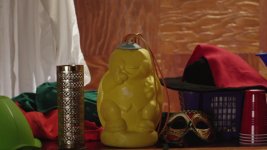
Ha, Ha, Ha!!! I know how you feel. Those color test charts are very expensive, IMHO. So, for a recent lens comparison, for sharpness and color consistency, I just used some found objects from around the house. Like so:

Lens test still JPEG.jpg

Hey, it worked for my needs. I also can report, from a bottom feeder/guerrilla film point of view, different shoots taken with my set of Nikkor primes and Vivitar Series 1 zooms will cut together within a scene with no problem as far as color or sharpness is concerned. What ever it takes.

I have the same concern with the CFLs as the OP, and I like the Michael Carter's ideas about finding the right combo of filtration to try and match the bulbs to daylight. I don't care for custom white balance in camera and I have been frustrated with the green spike in low CRI CFLs. As far as the lower K CFL bulbs, I think they are useless for video or film use, IMHO and would rather stick with quartz halogens or regular incandescent bulbs.
 
Ha, Ha, Ha!!! I know how you feel. Those color test charts are very expensive, IMHO. So, for a recent lens comparison, for sharpness and color consistency, I just used some found objects from around the house.

I got a set of small plastic gray, white and black cards for less then $30; using a grey card and eyedropper-ing will give you a pretty precise idea of what each lamp/instrument is doing, within a few percentage points. To be very precise with a range of lamps, you need to use spot metering on the gray and check the histogram when shooting - try to get each shot very close exposure-wise.

For extra credit, stick a post-it in the shot with the lamp or fixture listed; cut them all into one file where the grays line up - you will be very surprised at the color variance you'll see in grays of the same exposure density. It is an eye opener to say the least, and if you've ever fought to grade a shot, you'll quickly see why.

Going that route will give you a very very good idea of where your lights fall in color rendering; though doing the "household objects" shot is a good way to test relative color rendering of lenses (and of very very big importance, to setup profiles in multiple cameras, say matching your video cam to your DSLR). Not just for color balance, but for contrast, saturation, and rendering of blacks and highlights.

In the "household objects" test - I would really want to get a human face in there...
 
Back
Top