
Barry_Green
Moderator
So, I just got in my FoXi, from dvshop.ca. Love those guys. Great price, shipped through Express Mail, for free. Even included a copy of The HVX BootCamp DVD (er, thanks, I do have a few of those, but ... hey, it was free!)
Was looking for a focus controller for the AF100 to handle remote focus on the Lumix lenses. Not at all willing to go for the super-cheapo rubber-tire type of indie follow focuses, and I'd wanted a FoXi ever since Evin Grant reviewed it for DVXUser here, but couldn't justify it. But, seeing as I now have three of the Lumix lenses, and just ordered two more, I figured it was about time. Placed my order with dvshop.ca, and a couple of days later, it arrived.
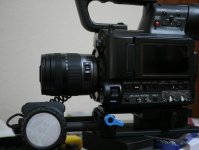
First reaction is, like Evin's reaction: this thing is slick, and nice, and I love it. It clamps on the rails just like a regular follow focus would, you mark its white ring just like you would with a regular follow focus, but there are two key differences between it and a regular follow focus:
1) It's an electronic remote control, so you could use it to control focus on a jib arm, a crane, a steadicam, wherever you are.
2) It's repeatable. The Lumix lens focus rings are not repeatable, but the FoXi sends specific voltage at whatever position its ring is set, and the lens will move to that position.
Seemed like a perfect match.
In reality, eh, not so much. It's not bad, in fact the FoXi is fine, but... well, the level of precision I have come to know and love from a follow focus, is just not really there with the combination of the FoXi and the Lumix lenses (and I assume it's the lens's fault, as the lens isn't really designed for this job). When you mark focus on the ring, you can exactly hit that focus point each and every time... as long as you approach it from the same direction! Turn the ring left, stop at the mark, it'll show 7.00 feet (assuming you marked it for 7.00 feet). Go too far (meaning, turn the ring too far left past the mark) and try to turn the ring to the right to back up to the mark, and the focus will show 7.30 feet. Even when you've moved the follow focus to exactly the same position. It's close, but not absolutely perfect.
Secondly, the positioning isn't exact at the instant you finish the move. The FoXi is telling the focus motor in the lens what position to go to, but the lens's focus motor might take its sweet time getting there. On the 14-140 it seems more responsive than on the 20mm. On the 20mm, it takes forever... if you slam from minimum to maximum focus distance, it might take the lens two to three seconds to complete moving its motor all the way to infinity. That's not the FoXi's fault, it's the speed of the 20mm lens... if you remove the FoXi from the equation and put the 20mm at minimum focus and then hold down the AF100's "infinity" button, it'll take the lens almost three seconds to finally settle on infinity. And trying to turn the 20mm's lens from minimum to infinity takes forever, so ... it's not bad, it's not worse than using the lens bare, it's ... just not what I wished. I wanted it to be magical and cinematic, and instead it's what it is... an electronic control instructing a still-camera lens to move its focus motor.
However, trying with the 7-14 lens, I can spin that focus ring in one turn from min to max and it takes the lens about 1/2 second to catch up. When using the FoXi, the lens takes about 1.7 seconds to make the journey, so ... yeah, the FoXi is part of the issue too.
Iris is much the same story -- all the Lumix lenses have really slow iris response. Slamming iris from wide-open to closed with the FoXi takes about 3 seconds for the lens to catch up -- but the performance is the same with or without the FoXi; just manually turning the iris to "closed" and then putting the cam on auto-iris in a dark room, it takes about three seconds for it to open its lens all the way, so ... that's just how the lenses work.
On the 14-140, it can go from minimum to maximum in about 1.5 seconds. Holding down the "infinity" button, the lens alone can do it in about 1/4 second. But, rotating the ring, the best I can do is about 1 second, so the FoXi's 1.5 seconds isn't bad at all. In terms of iris, it's just as fast as the auto-iris system.
For a neutral control in my experiments, I put the FoXi on my HMC150, and it performed about the same. The thing about it hitting slightly different marks depending on which direction you're coming from, happened on the HMC150 too. It's ever so slightly off, and on the HMC150 it doesn't matter, you'll never see the difference in focus between 10 feet and 10.5 feet, even with the iris wide open, and the FoXi was made for the 1/3" and 1/4" cameras so that little tiny bit of imprecision is totally acceptable there. But not quite as welcome on the AF100, where a half a foot can indeed show a difference in focus when your DOF might only be a foot to begin with! And the HMC150 took a little time to traverse its focus range and showed about the same iris response, so ... it's just what's to be expected when working with electronic lenses, I guess.
So, am I disappointed? Only in that it didn't meet my lofty expectations, but that's my own fault for getting my expectations too high. These are still-camera lenses, not cinema primes! I am still glad I got it, because whether it's 100% precise or not, it's still 99% precise, and that's far better than I can get with the Lumix lens focus rings! And whether it's 100% repeatable or not, it's still 99% repeatable, and the Lumix lenses aren't repeatable at all. And it's a remote that can be used on a jib or steadicam or tripod by the operator or an AC, which you're not gonna want to do with the bare lens. And, because it works with the camera's own protocol, it should also work with the Birger adapter too.
And, it works with my HMC150 and HMC40, so that's a bonus.
But, yeah, it's not like using the SG Pro CineFocus on dedicated cinema lenses like the Zeiss Compact Primes we used on "A Verse Before Dying". If someone's trying to build a cinema kit, I wouldn't recommend that they go out and buy Lumix lenses and a FoXi to get the cinema feel. Instead, get the SG Pro follow focus and get some Zeiss ZF's cine-modded by Duclos; that'll give you 100% of the cinema-lens experience for a lot less than actual cinema lenses.
Years ago I had a VariZoom PZFI on my HVX200. Is the FoXi better than that? Much. The VariZoom is a lot less expensive and also provides for record start/stop (and zoom control if used with an HMC or DVX or HVX or HPX170) but as for focus control, the FoXi looks and feels like a real cinema follow focus.
FoXi remote, for use with the AF100: 7/10.
FoXi remote, for use with the HMC150/80/40, HVX/DVX/HPX170: 9/10.
Was looking for a focus controller for the AF100 to handle remote focus on the Lumix lenses. Not at all willing to go for the super-cheapo rubber-tire type of indie follow focuses, and I'd wanted a FoXi ever since Evin Grant reviewed it for DVXUser here, but couldn't justify it. But, seeing as I now have three of the Lumix lenses, and just ordered two more, I figured it was about time. Placed my order with dvshop.ca, and a couple of days later, it arrived.
First reaction is, like Evin's reaction: this thing is slick, and nice, and I love it. It clamps on the rails just like a regular follow focus would, you mark its white ring just like you would with a regular follow focus, but there are two key differences between it and a regular follow focus:
1) It's an electronic remote control, so you could use it to control focus on a jib arm, a crane, a steadicam, wherever you are.
2) It's repeatable. The Lumix lens focus rings are not repeatable, but the FoXi sends specific voltage at whatever position its ring is set, and the lens will move to that position.
Seemed like a perfect match.
In reality, eh, not so much. It's not bad, in fact the FoXi is fine, but... well, the level of precision I have come to know and love from a follow focus, is just not really there with the combination of the FoXi and the Lumix lenses (and I assume it's the lens's fault, as the lens isn't really designed for this job). When you mark focus on the ring, you can exactly hit that focus point each and every time... as long as you approach it from the same direction! Turn the ring left, stop at the mark, it'll show 7.00 feet (assuming you marked it for 7.00 feet). Go too far (meaning, turn the ring too far left past the mark) and try to turn the ring to the right to back up to the mark, and the focus will show 7.30 feet. Even when you've moved the follow focus to exactly the same position. It's close, but not absolutely perfect.
Secondly, the positioning isn't exact at the instant you finish the move. The FoXi is telling the focus motor in the lens what position to go to, but the lens's focus motor might take its sweet time getting there. On the 14-140 it seems more responsive than on the 20mm. On the 20mm, it takes forever... if you slam from minimum to maximum focus distance, it might take the lens two to three seconds to complete moving its motor all the way to infinity. That's not the FoXi's fault, it's the speed of the 20mm lens... if you remove the FoXi from the equation and put the 20mm at minimum focus and then hold down the AF100's "infinity" button, it'll take the lens almost three seconds to finally settle on infinity. And trying to turn the 20mm's lens from minimum to infinity takes forever, so ... it's not bad, it's not worse than using the lens bare, it's ... just not what I wished. I wanted it to be magical and cinematic, and instead it's what it is... an electronic control instructing a still-camera lens to move its focus motor.
However, trying with the 7-14 lens, I can spin that focus ring in one turn from min to max and it takes the lens about 1/2 second to catch up. When using the FoXi, the lens takes about 1.7 seconds to make the journey, so ... yeah, the FoXi is part of the issue too.
Iris is much the same story -- all the Lumix lenses have really slow iris response. Slamming iris from wide-open to closed with the FoXi takes about 3 seconds for the lens to catch up -- but the performance is the same with or without the FoXi; just manually turning the iris to "closed" and then putting the cam on auto-iris in a dark room, it takes about three seconds for it to open its lens all the way, so ... that's just how the lenses work.
On the 14-140, it can go from minimum to maximum in about 1.5 seconds. Holding down the "infinity" button, the lens alone can do it in about 1/4 second. But, rotating the ring, the best I can do is about 1 second, so the FoXi's 1.5 seconds isn't bad at all. In terms of iris, it's just as fast as the auto-iris system.
For a neutral control in my experiments, I put the FoXi on my HMC150, and it performed about the same. The thing about it hitting slightly different marks depending on which direction you're coming from, happened on the HMC150 too. It's ever so slightly off, and on the HMC150 it doesn't matter, you'll never see the difference in focus between 10 feet and 10.5 feet, even with the iris wide open, and the FoXi was made for the 1/3" and 1/4" cameras so that little tiny bit of imprecision is totally acceptable there. But not quite as welcome on the AF100, where a half a foot can indeed show a difference in focus when your DOF might only be a foot to begin with! And the HMC150 took a little time to traverse its focus range and showed about the same iris response, so ... it's just what's to be expected when working with electronic lenses, I guess.
So, am I disappointed? Only in that it didn't meet my lofty expectations, but that's my own fault for getting my expectations too high. These are still-camera lenses, not cinema primes! I am still glad I got it, because whether it's 100% precise or not, it's still 99% precise, and that's far better than I can get with the Lumix lens focus rings! And whether it's 100% repeatable or not, it's still 99% repeatable, and the Lumix lenses aren't repeatable at all. And it's a remote that can be used on a jib or steadicam or tripod by the operator or an AC, which you're not gonna want to do with the bare lens. And, because it works with the camera's own protocol, it should also work with the Birger adapter too.
And, it works with my HMC150 and HMC40, so that's a bonus.
But, yeah, it's not like using the SG Pro CineFocus on dedicated cinema lenses like the Zeiss Compact Primes we used on "A Verse Before Dying". If someone's trying to build a cinema kit, I wouldn't recommend that they go out and buy Lumix lenses and a FoXi to get the cinema feel. Instead, get the SG Pro follow focus and get some Zeiss ZF's cine-modded by Duclos; that'll give you 100% of the cinema-lens experience for a lot less than actual cinema lenses.
Years ago I had a VariZoom PZFI on my HVX200. Is the FoXi better than that? Much. The VariZoom is a lot less expensive and also provides for record start/stop (and zoom control if used with an HMC or DVX or HVX or HPX170) but as for focus control, the FoXi looks and feels like a real cinema follow focus.
FoXi remote, for use with the AF100: 7/10.
FoXi remote, for use with the HMC150/80/40, HVX/DVX/HPX170: 9/10.


