OTHER: As promised

charliemcdanger

Well-known member
I threatened in a recent thread to hit you guys with a wedding video, which I think we can all agree is the worst sort of video. Well good news--the wait is over!

If your reaction is "hey, this just looks some chump walking around a wedding with his DSLR," that's because it is in fact just some...well anyway if you don't like it, close your eyes and enjoy a lovely rendition of Canon in D--and no that isn't a camera. Without further ado...

https://youtu.be/hrHttEmzF4g
 
Very quickly, just a couple of points, as I'm running out the door... It told a story - that's a definite +... rather than seeming random, which is what happens all too often with wedding videos. You chose your moments well. Didn't call attention to itself (i.e. the videographer) another big +... because again, too often in wedding videos it seems like it's more about showing off the videographer rather than the subject. Now for the minus - what in the heck is going on with the focus? It's bad. Bad. Did I say bad? Bad. Often the camera is fighting to acquire focus. It's constant, often right after the cut - see going from 0:8 to 0:10, there's a full second before it snaps into focus. Or, focus is on the wrong subject (officiant, instead of the bride & groom etc.). Imagine the client reviewing - if it's this bad on a small screen, it worse on a big TV - and the couple or their family and friends wants to relive the memories, only they can't because it's out of focus. The usual idea is to shoot a lot, and when editing throw out all the out of focus stuff, or where the camera is hunting; sometimes that's not an option when a critical moment arrives, but that's why you shoot a lot and keep it mostly running. Your angles and framing are mostly good - you avoid the horror of shooting from above, which is depressingly common.

I also liked the color palette, unpretentious and understated - many wedding videos go for massive saturation - so good on ya. It helps that the people here are very good looking :) - but overall, this is a nice video (just work on better focus). I'd hire you! Oh wait, I'm already married.
 
OldCorpse, thanks for the comments. On the focus: you're right, and it's interesting because it was purposeful, if an aesthetic mistake. For some reason I enjoy the kinetic element and the reveal of the moment of finding focus. For the same reason I tend to include the jostle or whip pan to arrive at the intended framing. Probably I fell too in love with the Wonder Years intro as a kid. In any case, feedback from my non-film friends supports your notion that this aesthetic may suck. What I see as intimacy and a lack of contrivance instead comes off as bush-league.

(EDIT: fwiw the hunting is me on a manual lens, and yes I need to either up my skill or up my camera body for decent AF. My Canon-in-7D is starting to feel classical.)

I was expecting you'd hammer it on other spots, so your general tranquility is a relief. And yes, good-looking people make the job waaay easier.
 
Last edited:
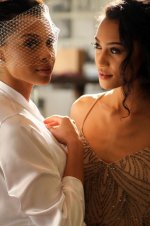
Seriously, it's hard to tell who is the mother and who is the daughter. If you told me they were sisters, I wouldn't bat an eye. As to hammering you on other things - all creative work has to be evaluated from the intended audience point of view. This is a wedding video. There is no sense in picking on this or that technical or artistic choice if it doesn't impact the intended audience. The focus thing did - and so I hammered on that. I hear you about the kinetic aspect, but if that was your goal in doing it through focus (rather than movement), then the traditional way to do it is to rack focus, not hunt for it - it's also a question of timing, and milliseconds make a difference... your unfocus after a cut was simply way too long - cut that effect much shorter, and I think you'll get the effect and not alienate the audience.

I saw a documentary about autistic people. Obviously people are on a spectrum - from very slight (many normally functioning Aspergers people - same diagnosis as autism, different severity) to severe. There was one fascinating sequence, where they mapped where the pupils of people focus in a picture, both for autistic/Aspergers and "normal" people. The difference was fascinating - the autistic people focused much less time, or not at all, on what "normal" people did, the central or key aspect of the picture, especially if there was some emotion attached to it - so for example there was a picture of an elephant in Africa with some trees in the far background - the "normal" people of course focused on the elephant 95% of the time, while the autistic/Aspergers attention/focus was flipped - 95% on everything other than the elephant, the background etc. In other words, autistic/Aspergers can't/don't pick out what is important or the "big picture", instead getting lost in peripheral and less important.

This is what I often think of when I see how some folks here and in various technical settings discuss films - they focus on stuff that the audience doesn't care about. Now - this is super important as a distinction - obviously, if you are discussing a piece of gear, or a very specific aspect of the film because you're a DP, or sound person, or set or costume designer, or whatever, then it is totally understandable and right and expected that you'll focus on those aspects. But I'm talking about something really different - I'm talking about someone, or even the same pro (DP, sound person etc.), who is evaluating the whole film, as an audience member, the whole artistic impact, and if now this person is unable to do so, but keeps focusing on peripheral stuff, they simply cannot see the big picture. That's what I see often on such boards - folks who discuss a film, the artistic impact, and have little or nothing to say about the story, the audience involvement, the technical choices insofar as they impact the artistic effect on the audience, but instead focus on irrelevant - to the audience - aspects of production. That's the tell. It's not about technical issues - a DP might observe how the light makes the scene seem more menacing, that's totally legit, but if he were to point to some aspect of lighting that has no impact on the audience (because it does not affect the scene - not even subliminally), then s/he is being Aspie about it. The technical crafts often attract people who have those tendencies, although, obviously not all, which is why I think you find f.ex. fewer DPs who transition successfully to being a director, than "bigger picture" folks like writers, editors or actors, because directing is a "bigger picture" type activity.

So the ultimate criterion is always - what is the overall impact on the intended audience? Even what may in one context be a clear mistake, would not be in a different context with a different intended audience. For example, if I were to hammer you on the fact that one can see you in the mirror as you're bent over the slider, that would be a pretty stupid criticism in a wedding video, although completely legitimate criticism in a feature film. Because in a feature film, you as the filmmaker are not part of the story and showing you would destroy the suspension of disbelief, whereas in a wedding video, the videographer is a small part of the story the client might say in recounting the wedding "yeah, we had a really cool videographer", it's part of the story, whereas it's not part of the car chase story that we can see the film crew in a reflection. Of course, you are a small part of the story, so you can't put yourself front and center as some tend to do - no client is going to talk mostly about the videographer in their wedding (and why I complimented you on not making this video all about yourself - you got it just right).
 
Your observation recalls a thought that occurred to me a couple weeks ago. If you imagined this site as a comedy forum, you'd have a guy post a video of his standup set, and then the gallery would set to work picking apart his wardrobe, his haircut, his mic technique--everything but whether the jokes were funny or not.* You more eloquently address the point.

Another interesting note on the sorts of people drawn to the technical side of filmmaking: not only is it Aspie, it's remarkably male. Go to the analytics on alexa.com for sites like DVXuser, NoFilmSchool, etc, and look at the male/female split. If you haven't seen the numbers already, these sites are more male-leaning than any you might think of (utterly trouncing pornography and sports, for example). Hollywood's great conspiracy against hiring women may have some root in self-selection, it would seem.

*(This is not to say I don't love the technical experts here. I do!)
 
Last edited:
Yeah, no question, I appreciate all the technical info, absolutely - it's just that some guys can't ever change gears or turn it off :). Good observation on the male/female split. I've pondered the chicken/eggness of it all, nature/nurture etc. I suspect there is something inherent in males drilling into mechanical stuff way more, just a gut feel, no proof of course; I could be wrong. I have known a couple of women DPs, so it's not 100%, maybe there is the aspect of conditioning, upbringing or social expectations, but anyway, I'm gonna drop this line of inquiry, as it may stray into controversial stuff like politics etc., which is against the TOS.

Personally I approach gear in a pretty utilitarian way - what can it do for me to help me accomplish my goals, and I don't have much interest in discussing beyond that point. Same with technical aspects of filmmaking. If it doesn't make any difference to the scene or impact on the viewer, even subliminal, then I really don't care about crushed blacks or whatever. But whatever floats your boat, everyone needs to have something to be passionate about.
 
Back
Top