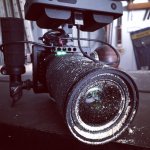
Are the Zeiss Otus primes TOO good?

You might be right. It's all so subjective.

I can only personally speak to my limited experience with the specific lenses I've used. But that experience is also tainted by opinions, aesthetics and such. I enjoy using clean and sharp modern glass, but for some reason, not for drama as much.

But Charles, what elements do you expect would make the results surprising? Do you think that lighting and production design gets mistaken for lens characteristics?
 
Honestly, I think that pre-conceived notions play a big part in things that are subjective. I'll refer again to wine tasting, there are many documented instances of wine connoissuers picking cheaper offerings that they had previously shunned (the "Judgement of Paris" is the famous example). I feel like there is a certain amount of quantifiable reality but a lot of the Emperor's New Clothes going on in this arena.

And that's just an apples to apples comparison. We have so many capabilities in post at our disposal, it's splitting hairs to claim a certain lens as being cold while another is warm if it's an overall cast that can be dialed out instantly in post, or even via white balance on the camera.

I don't want to specifically second-guess anyone's impressions, but I've just seen too many instances where subjective is confused with objective, where hype overtakes reality. I've seen it within myself.
 
I guess Sharegrid did a lens comparison a few months back. Not a blind test, but a start.

I'd love to get together with some folks and shoot a 30 second drama scene, each take with the equivalent of a different lens. This way it's not just a girls sitting, lit in an interview style.

I'd be open to that, and would volunteer a set of Cooke Speed Panchros to the test...but would be limited to the East Coast, unfortunately.
 
And in audio, the exact same debate has been going on since (at least) the 1940s. They even use your own terminology of "character" when they talk about vintage Neumann U47s (what Sinatra used at Capitol records) vs. "clinical" for modern mics. They wax poetic about the old Neumann M50s as the pinacle of tube microphones, but conveniently forget that Decca replaced the tubes with FETs for their all of their fabled classical recordings in the 1960s.

Well, there was some reasons to that, then also all preamps were tube preamps, so having both a tube preamp and a tube mic can get too much, couple a tube preamp with a FET microphone and you strike a beautiful balance... in the same way ribbon mics were replaced by condenser microphones due to the inherent high frequency loss of recording to tape. With none of that frequency loss in moderna digital recordings, ribbon mics have regained popularity because of their smooth high frequency response.
The same might be said for lenses... now that cameras can resolve so much detail at so high resolution, maybe there is a need to tone it down (sometimes).

That's one of the arguments, yes. There are others.

And one of the things that driving the (small) ribbon revival is the new generations of full spectrum ribbons like the Samars and Mesanovic. Nice sounding mics, but sufficiently fragile and heavy that I'm not thinking it's worth it to carry them on location.

But to optical lenses, you seem to like the older vintage stock, and I'm perfectly happy if you do. It's a choice you get to make. But I like just about everything about the newer designs and coatings. And that's a choice I get to make. So... we're in opposition. Vive la difference.
 
I have a set of nice 1970s Nikon still lenses that, on my camera, look quite different than my Canon EOS lenses. I like the look of the Nikons sometimes but then shooting outdoors, in bright, contrasty backlighting, the flaring on the Nikons is really bad and the CA is amazingly bad. So for interiors like interviews, the Nikons look very nice. But for exteriors, the Nikons get put away and the EOS lenses are what is on the camera. A lot of progress was made on lens coatings since the 1970s.
 
I have a set of nice 1970s Nikon still lenses that, on my camera, look quite different than my Canon EOS lenses. I like the look of the Nikons sometimes but then shooting outdoors, in bright, contrasty backlighting, the flaring on the Nikons is really bad and the CA is amazingly bad. So for interiors like interviews, the Nikons look very nice. But for exteriors, the Nikons get put away and the EOS lenses are what is on the camera. A lot of progress was made on lens coatings since the 1970s.


Speaking of lens coatings...

I was on a film set where they were using Panavision anamorphic primes. I think they were G-series, but makes no difference. Anyway, one of the AC's was cleaning the front element in what to me seemed a very vigorous manner. And using a cotton rag. I asked him if there was a concern about cleaning marks on the front element from all the times that a rental lens like that is cleaned while working. And I asked him if the front element ever has to be replaced from wear and tear. The AC - a guy who is highly experienced and with a long credit list - chuckled a bit at that and said that the coatings on a lens like that are so durable that cleaning marks like you might get on a Canon EF lens are not a concern. He said it is difficult to scratch a lens of that quality. I don't know how much truth there is to that. But I do know the lenses I see used on big productions never have any type of UV / protective filter on them unless they are doing some sort of stunt where they know there will be projectile. And then they use an optical flat in a matte box.

Which, brings me back to the Otus. Do you spend $5k on a high precision lens made from the finest materials and then put a $150 piece of glass in front of the optics? Do you spend $5k on a lens and NOT have any protective glass on the front?

I don't use protective filters on any of my lenses. I'd rather take a chance on the front element suffering damage than introduce all the issues that can result from using a protective filter on the front. I recall from my sports shooting days that a clear protective filter on the front of a lens introduced horrible flaring and streaking when under stadium lights, in part because of their huge size- 127mm. These were not cheap, low quality filters either. They cost something like $500 a piece. Yet they still made a mess of things when shooting into lights. I'd remove those filters as soon as I got on the camera.

Who here uses a protective filter and who runs naked?
 
So, here's an 8K clip recorded on Red Helium. Unfortunately, the subject of the 8K resolution is mostly Matt Granger.


Take applicable precautions.
 
Who here uses a protective filter and who runs naked?

Back in the day I used UV filters all the time 'a transparent lens cap' (only amater snappers would have lenses not ready to shoot!) , but when backlight became fashionable it caused problems.

Now I go naked apart from on my EX1 which would be a royal pain if I did the front element especially as the deep DOF brings crud into focus.

Id like to protect lenses like my 14/2.8 50-300 and 400 2.8 but it is not practical.

Basically cheap replaceable lenses is part of the strategy. Dinging a $150 50nikkor is not a major crisis.

I also think coatings have changed..
My nikkors manuals dont seem to be scratched after years of misuse, but then the AF20mm came out in 1995 or so and we pinged the back element of three in a very short time much to my annoyance-it was like the coating was different stuff. My Stigma 80-200 similarly seems to have a fragile coating and is now out of service.
 
Last edited:
Who here uses a protective filter and who runs naked?

This thread from years ago touches on it.

It's funny how off the back of the DSLR resolution, before I made my own decisions, I bought a few UV filters because I read that it was the right thing to do. Today, those same blog authors hold much less weight when it comes to making decisions. They're probably partly responsible for the vintage lens trend. I really enjoy using select nikkor AI-S lenses for their tiny size and smooth focus. But this is mostly for personal projects where the choice is only mine...

As far as UV filters, I look after my lenses and clean them properly etc. so I'm not very concerned. Probably should have stuck something in front for this one though:

sawdust.jpg
 
I'm with you JP, I stopped putting anything but an ND or variable ND on the front of my lenses decades ago. I did tests with just shooting stills and almost all filtration degrades the image significantly. I use a variable ND for my 80D because it doesn't have internal NDs but other than that, I go with the lens alone. Yes, we run the risk of a damaged front element and if I know the lens will be exposed to the elements and am near salt water, mud or spray, then I will put on a UV filter or something but generally, anything you put in front of the front element is going to cause reflections and loss of sharpness.
 
The coatings have not changed too much, except for a few of the new "nano" coatings. They have been for decades a simple metal film deposited on the glass (typically sputter coated). As time went by you got two or three different metals in different layers (multicoating). These were fairly durable until the newer way of depositing which is a chemical solvent (solgel) which can be extremely fragile if it isn't cooked correctly.

These so called nano coatings are a widely variable process with some going the way of a moth's eye. Tiny little grooves that prevent light from scattering and reflecting, but from what I've read, these moth's eye type of AR (anti reflective) are extremely fragile but are also extremely efficient and very expensive to produce.
 
Who here uses a protective filter and who runs naked?

My ENG lenses(worth ~$30K/each?): Schneider super-duper multi-coated clear filters. I'll pull them if I need to because of dirt/reflections, etc. while shooting scenics, but usually on 99% of the time. I've spent most of my career at the racetrack and there is NO WAY IN HELL I was risking pitting/scratching a front element. I had one of my W/A's saved by a sacrificial filter several years ago. A guy was either welding or cutting with a torch, I can't remember, and I was a reasonable distance away I felt during the shot. During the next shot I saw "dirt" on the filter so I went to clean it, only it didn't come off. Sparks had pitted the filter. Pulled it, grabbed an old one(the one that got pitted was brand new and I had just put it on that morning. Threw away $300-$500 Schneider filter, stopped for a minute, called my sales rep and had another one over nighted) and continued the shoot. Otherwise, I would have been done and the lens would have been gone for possibly weeks for repair.

My still lenses: No filters. I'm usually not using them in high-risk environments. From what I've been told many times, the front elements on most still lenses are cheap and easy to replace(not yourself, obviously). And my still lenses, even though most are L, are still cheap compared to video and cine lenses, so I don't feel as strong of a need to protect them. And more crap on the filter is gonna show up in a still image than a video image, more than likely.

My Cine lenses: CN-E Primes(~$5K/ea): No filters. They are 99.9% of the time only used in low-risk interview situations.
Cine-Servo 17-120(~$32K): Schneider uncoated optical flat. When I do use it on interviews I have a MB on for extra light control, so the filter is "automatically" pulled, because it's mounted on the lens hood that comes off.
 
Last edited:
Back
Top