

mainstreetprod
Veteran
Analysis of a microbudget movie (or, "How we made a low budget feature and actually paid the principal cast and crew")
This post is all about the advantages, disadvantages, and compromises that happen in a micro budget movie. How they affect (or do not affect) the final product. Almost exactly 1 year from concept to completion (Jan 2012 to Dec. 2012) . Enjoy.
I'm sitting here duplicating DVD's for the premiere of "Flowers for Fannie" and thought it might be a good time to reflect on how the entire project was done for the cost of a good used car.
A little background on me that should help you understand where I'm at as a filmmaker (just scroll down to "The Script" if you're in a hurry) : I'm 55 with an interest in film and video going back to high school days. I enjoyed shooting and editing projects for school using a Super 8 camera. One was done for a vocational class that helped students get a job. I shot a film that showed students at work at their respective jobs, originally accompanied by the tunes of Bachman Turner Overdrive, "Takin' Care of Business"! The camera required a tremendous amount of light as you will see. Outside stuff, starting around :35, looks better.
In college I leaned toward broadcasting (not realizing I had a face for radio and a non broadcasting voice). I tried out for the college TV news desk but didn't make the cut. I realized I was more of a tech guy and started working toward that goal. I produced some projects for classes and got offered an internship in the media dept, but turned it down.
The college offered one filmmaking course and of course I took it. The result was the 70's version of what every 20 year old kid wants to produce, horror. "Dorm Stalker" was a campy 16mm feast of vampires and coeds (someday I need to dig up the reel and transfer it to digital). The lighting was basically a car headlight mounted on the camera. That's the equipment we were issued, so that's what we used. I also worked a lot with 3/4 Umatic equipment.
I went into an entirely unrelated field, but was interested in prosumer video equipment from day one. I remember finding out through a video magazine that a new VHS VCR and color camera combination was coming out , the camera tethered to the VCR by a cord (camcorders did not exist yet). I decided I must own it. It became available at a Mobile AL dealer on the coldest day the FL panhandle has ever experienced. How bad could it be- this is sunny Florida right? I decided to make the 50 mile trip regardless. About halfway through I hit the first bridge, skidded a couple hundred feet on black ice, made it to the end and hit the grass median, nearly running over a road worker who was determining if the bridge needed salt. I think I helped him make his decision.
Undeterred, I recovered and got back on the road to Mobile, which is bordered by a 3 mile long interstate bridge. Cars and Semis were all sideways, no law enforcement, traffic proceeding at 5mph. Made it to the end of the bridge and finally gave up and turned around. All of this underscores a lifelong dedication to owning the latest tech gear FIRST. I later owned the first camcorder, the first Super VHS camcorder, A Toshiba 3 chip ENG cam, the 3 chip Sony Hi 8 VX-3, Sony VX1000 3 chip DV, the HVX200, and the AF100. In the late 20th century I put together a Windows realtime Matrox based editing system and became the "internet guru" for that system, helping owners get it up and running . Around 2006 I went Mac/FCP and never looked back.
While progressing through the prosumer video cameras I mainly shot commercials for the business I owned. About the time I got the Mac I decided to finally get serious about video work . After a ton of research I decided on the fresh to the market HVX200 and have never regretted it, in fact, still own it and use it on most jobs. I moved from FL to the Nashville TN area where opportunity abounded in comparison. To get better with the camera I started shooting stock footage. I shot thousands of clips of small towns, landscapes, nature and people. I uploaded them to microstock sites and gained a small but somewhat stable source of income.
In late '06 we shot a faith based indy comedy feature, "Class of '91". I look back at it and laugh at some of the mistakes we made (my wife wrote and directed while I shot and edited it). By some fluke we got distribution to Christian bookstores around the country and sold it to a satellite network. To get an idea how I was doing, I submitted it to Micro Filmmaker Magazine's critique service. For a first attempt I thought we did pretty good with some expected weakness here and there. The problems they pointed out were a big help in preparing for our next attempt, "Flowers for Fannie"
THE SCRIPT
My wife had written a script about a reclusive little old lady (Fannie) who lives in a small town and is obsessed with dying. She is befriended by a young woman (Louise) who decides to "adopt" the older woman and is not bothered by her crankiness. The cast of characters includes her handyman, maid, lawyer, a nephew after her money and a distantly related redneck family hoping to inherit money to buy a new septic tank (the movie is a drama, but includes quite a few comical scenes).
In spring 2012 we launched the project. Our goal from day one was to do the best movie we could on the least amount of money. I'll let you be the judge of whether we accomplished that (we'll later be streaming the movie for free for one day) . My goal here is to present information that is not often presented, in order to help filmmakers who haven't done this yet. I'm going to outline exactly how this was done and how much ( or how little) money, was spent doing it.
PREP WORK
My wife has the gift of organization and she put it to good use. She put together shot lists for the entire movie and a shooting schedule that took place over several months (I realize this isn't how it's usually done but it works for us). Just as with our last movie, we decided that principal cast and all crew would be paid. Impossible for a few thousand bucks? As it turned out, not impossible at all.
CASTING
We live in a small town that has a thriving live theatre scene and already knew some local actors. We also knew some from the previous movie and considered them for parts. And, we advertised on Craigslist for specific key parts and extras and quickly got a number of resumes from Nashville area actors. Offering to pay key actors got us better looking resumes than deferrred or no pay would have, even though the pay we were offering was minimal (a rate similar to low budget SAG). We narrowed the list down and scheduled auditions, using a room at our church.
There was no audition for the part of "Fannie". A woman at our church struck us as being a lot like the character, less the crankiness, so we simply asked her if she was interested and she was. Since she, some of the key cast and most of the extras had primarily theatre acting experience, we decided to hold two all day workshops in "Acting for Film". My wife led them in exercises designed to help them know their characters and learn the craft. Some excerpts from these workshops can be seen here (a funny moment near the end of this clip)
<font size="3"><br>
CREW
To keep costs down we decided the crew would generally consist of simply a boom person and a gaffer. I and the gaffer would light the set and I would do the camerawork. The boom op would monitor on headphones while I kept an eye on the levels. This of course is a compromise but thanks to the ALC on the AF100, which only prevents spikes and doesn't "pump" the volume up and down, it worked quite well.
My principal crew consisted of Chuck, Scott and Jesse. A little background will help you see why we picked who we did.
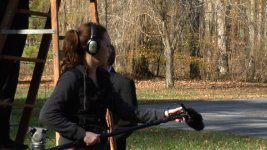
Chuck
Chuck is a young married guy who works janitorial by night and lives and breaths filmmaking by day. His dream is to have a fully equipped grip truck and he is well on the way, having acquired the truck and most of the lighting, including some massive HMI's. Chuck has plenty of gaffer and grip experience and therefore has a working knowledge of lighting in general. He was my right hand man in getting scenes properly lit at the lightning pace we worked at.
Scott
Scott is another young, just married guy with an unusual background- he's a former Abercrombie and Fitch model who originally auditioned for the role of "Trevor", love interest for Louise (who befriends Fannie). He came close, but another actor was ideal. Since he also had a strong technical background in all aspects of video production, we decided to use him as crew and schedule him when Chuck was unavailable. We soon realized he had directing ability and decided to use him as AD on some key scenes he wasn't gripping on. He turned out to be a huge asset to the overall production, willing to help out in any way.
Jesse
Jesse is a young lady fresh out of college with an audio engineering degree and some experience as a boom op. What really impressed us was a video clip she sent with her resume of the animated movie "Despicable Me". As a year long class project she had completed re recorded and rebuilt the sound track using student's voices and re constructed Foley. I was blown away by the audio quality and how much it sounded like the original. She was able to supply me with a sample of something she had run boom for and as soon as I heard it, I knew we had our boom op/ post engineer.
THE EQUIPMENT
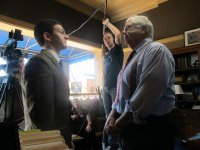
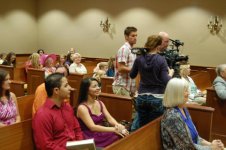
Here's the part you probably scrolled down to, what gear we used to shoot the movie (I already owned most of it from the last project) A quick listing:
Panasonic AF100 (most scenes)
Panasonic HVX200 (a couple of scenes)
"Zaza" type DIY slider
Glidecam Cam Crane 200
Cool lights CDM 75 and 150 fresnels
Several soft boxes with various high CRI daylight balanced bulbs
Scrims, blackwrap, reflector, etc.
AT 4053a mic for dialogue indoors
AT 4073 shotgun for dialogue outdoors
Oktava MC012 as a second indoor mic
Soundstage fixed boom stand (extends 7 feet vertically and horizontally)
Two Sennheiser G2 wireless with Countryman B3 lavs
Ktek aluminum boom pole with internal cable, KSSM shockmount
LIGHTING
Having the advantage of the main location (Fannie's 1898 Victorian home) also being my home, I was often able to set up lighting the day before. I mounted light mounts to the top of the door frames in several rooms, enabling light placement without floor stands. I did lighting tests using the family as stand ins. This made the next day a lot easier, just flipping the lights on and making some quick adjustments. Naturally the lights were not always in the right place so lights would then be put on stands and moved around.
The home has a lot of windows and since all my lighting is daylight balanced, no correcting gels were required. In each lighting scheme I considered the incoming window light as key or fill, depending on the situation. We avoided shots into windows whenever possible. WIth many of the scenes taking place in the kitchen and windows being in every shot, we went with a dark gel on those that stayed on the whole production.
SOUND
I deliberated a long time about using a mixer instead of plugging straight into the camera but in the end went the direct route. I didn't regret the decision- I was very happy with the final product. One factor in the decision was that the end product would never be shown on the "big screen" in a theater and never be heard through a professional sound system. It is direct to DVD and (because of the nature of the particular faith based audience for our film) 90% of the time will be heard on two 3" TV speakers. Hearing it like that, no one could possibly hear the difference that using a preamp/mixer or separate recording would have made.
Mics
The primary indoor dialogue mic, the AT 4053A, is an unusually sensitve mic. The outdoor mic, the 4073, is even hotter. Bottom line is that with the preamps in the AF100, which are pretty good for internal camera preamps, the level control seldom needed to be turned up past 50%. That made preamp noise a non issue.
Handling noise
This can often be an issue, especially with boom ops who don't have years of experience. My solution was two fold: To get the best shockmount I could afford (the KTEK KSSM with soft bands) and to engage the low cut switch on both mics. This made handling noise and wind noise a non issue during most of the filming. The downside was that dialogue doesn't quite have that "Hollywood" bottom end. But the dialogue is crystal clear and that is what counts for me. And the bass can be boosted a bit in post anyway.
Fixed boom stand
For some scenes we used a large, fixed microphone stand to mic the actors. We used this in cases where an actor was seated and not moving his head much, or when we had one boom op and two actors on opposite sides of the room. Sometimes we fixed two mics to it for two actors near each other, but a bit too far apart for one mic. I loved using the fixed stand because it allowed me to put the mic exactly where I wanted it. Naturally it could not be used in scenes with much movement or head turns, but in general it worked well and saved us on payroll for short shooting days when a boom op was sometimes not needed.
Wireless mics
We used the two Sennheiser wireless when we had a walking talking scene outdoors that would be difficult to boom. The bodypack was of course hidden and the lav was also concealed. Having a female boom op was a real asset when it came to hiding the lav in the clothing of the actresses!
We did not use the lavs much indoors. A lavalier pointing at the ceiling, with its high reflective rate, doesn't always work well. We used them indoors only in a pinch. One of the receivers was having some reception issues and that caused a lot of bad takes. I finally got it under control by switching frequencies and using fresh batteries daily even when the old ones registered OK on the meter. Overall I was impressed by the G2's and I bet the G'3s are even nicer to work with.
Background noise
Noise was not an issue on most of the indoor shoots. My home's HVAC system is buried deep in the basement and is not heard much upstairs. We usually turned it off anyway. In the kitchen we were obsessive about turning off the fridge. Outside was another story. We had little control of outside noise and it was often a problem. One example is the constant locust sounds . Tennessee is sometimes invaded by a variety called a "Cicada" and they hang around for weeks making a LOUD cricket or tree frog like sound. In this case they were around for the first 4 weeks of shooting. We decided to make them a part of the local "ambience" and got plenty of ambient sound of them for future use. In the end they only ended up being an issue in one scene, and post noise reduction made them tolerable.
Lawn mowers and motorcycles were another story. We shot outside mainly on Saturdays and with it being a residential neighborhood, the mower engines cranked up for miles around. We dealt with this the best we could, by waiting until the noise stopped or sometimes actually asking the neighbor to take a break. We also dealt with noise "downtown" in our small city when biker parades and noisy four wheel drive trucks happened by. Fortunately they moved on quickly and we could continue. Having hyper mics close in on the subject was a big asset in dealing with external noise.
Audio Post
Several weeks and about 70 hours were spent on audio post. Primary work needed was noise reduction (noisy bugs and lawn mowers), crossfades between clips, light compression and EQ and normalizing the dialogue throughout the movie. One area that was hard to fix was a scene shot on a flowing stream. We mic'ed on actor from below and the other from above, consequently the water noise is much louder on the one mic'ed from above. The ambient water noise had to be cranked up a bit to help conceal it. Live and learn.
BUDGET
I'm sure a lot of you are tuned in because you wonder how someone could possibly make a feature movie for very little and still manage to pay the principal cast and crew. Part of it was because we refused to participate in the industry standard "day rate". Many of our days were 3 hours or 6 hours so it didn't work for us. Instead we elected to simply pay our actors and crew by the hour, just like any other job.
Who got paid?
Obviously with this kind of budget we couldn't pay everyone so we drew the line of pay/ no pay with actors who put in more than one days work getting paid. The pay rate was of course low, similar to SAG low budget. Actors who came in for a hour or a few hours for a bit part were unpaid, as were all extras (except that they all get a copy of the DVD). The result was about 8 actors getting a paycheck, with about 5 of them getting substantial checks. All the crew were paid for their time hourly, with the exception of one nearby filmmaker who kindly volunteered his time for the learning experience and screen credit.
Paying the actors and crew resulted in people showing up on time and working hard . I can't imagine getting the kind of dedication we had on set with deferred pay.
How we fed the multitudes
Somehow we managed to feed the cast and crew over several months of shooting, 2-3 days a week for a couple hundred bucks. Part of the reason is that my wife is a good cook and decided to not only direct, but also feed everyone. I was very much against this but it actually worked out well. The night before, she would make a meal and put it in slow cookers. Next day at noon, we stopped shooting and she served the meal to the cast and crew. Some of the meals served were taco salad (meat in the slow cooker), chili, spaghetti and meatballs, barbecue pork sandwiches, and chicken and dumplings. No one was ever served pizza. We started late enough that no one expected breakfast (though we always had some snacks and drinks available),and we usually wrapped before dinnertime - so just one meal per day. SInce everything was cooked from scratch, we only had minimal grocery store receipts rather than catering or restaurant bills. The goodwill generated by feeding homecooked meals to the actors and crew was off the charts.
Shooting days: 30 (over a 3 month period)
Locations
As I mentioned, our house served as Fannie's house, the primary location. We shot in the kitchen, basement, library, parlor, dining room, living room, master bedroom and foyer and around the yard. Upstairs rooms served as rooms in Louise's house. A smaller neighbor's house next door was used for exterior shots of that house and for the kitchen.
A friend in the insurance business let us use his office on Saturdays as the lawer's office. An opening shot was done at a local florist and the local museum let us use an area for a museum scene. Our church let us use a small chapel to shoot a church service and a funeral home allowed us to shoot in a sales room full of caskets. We did not have to pay for any of the locations.
Another church allowed us to use their private cemetery for the many scenes with Fannie at the gravesite of her deceased husband. We also shot a scene there where a couple driving an SUV lets their GPS guide them into the cemetery and they "run over" Fannie.
Shooting with the AF100
I've posted all along about this aspect of the production. While I wouldn't describe the AF as exactly a joy to use, in retrospect I'm glad I chose it. I got some images that truly astounded me, color and resolution wise. I got others that underwhelmed me, and which I got didn't always correlate with the amount of effort I put in.
During the pre production phase I put together a kit I thought would give me the look I wanted. I started with the AF body, the 14-140 lens and the 20mm F 1.7 pancake. Then I got an inexpensive Rainbow imaging adaptor (with aperture control) for Nikkor lenses and started looking for primes. Eventually I settled on the 35mm F1.8 (a current Nikon model) and a 50mm F 1.8 (older with no AF, which really doesn't matter when the camera can't control it anyway). I really enjoyed using both of these lenses compared to the Leicas. It was easy to "snap" them into focus compared to the Panny electronic focus ring. And both gave the shallow focus look I wanted for certain shots, nearly impossible with the 14-140 and tough with the pancake.
Focusing was an issue during the whole duration of the movie. As you saw by my bio above, I'm not exactly an experienced "DP" so I needed all the help I could get and decided to buy a 7" monitor (Ruige) with zoom focus assist. While it really helped focusing, there were still shots that looked fine on set and later were noticeably soft on a 20" monitor. Usually the source of the problem was the uncertain focusing of the electronic lenses (combined with my tired old eyes). I really missed the old HVX LCD with it's focus assist combined with being able to actually ZOOM IN to focus. I did try the read peaking when I first got the AF but when it caused me to blow the focus on an important shot on another project, I got gun shy about depending on it. Peaking depends too much on having a well defined highlight to focus on, which you don't always have.
That being said, on the many scenes where I was able to nail the focus perfectly, the AF100 was really worth it's salt. It's the first video camera I've had where I can look at one of those still frames blown up on a large monitor and not see compression or pixellation. Fast moving images, of course, are another thing. But in a story like "Flowers for Fannie", fast moving images are not a big concern!
Setting the camera up was pretty easy. With the limited ability of the codec to handle color grading, I decided to try to get the look I wanted in camera. I ended up with a scene file listed here on DVX and on Ablecine called "Alex".
Name: Alex 1
Detail Level: +2
V Detail Level: 0
Detail Coring: -2
Chroma Level: -3
DRS: Off
Gamma: B.Press
Knee: Mid
Matrix: Norm2
Skin Tone Dtl: Off
I used it through most of the movie and was quite happy with the end result. Grading consisted mainly of correcting white balance issues and adding a bit of contrast. The extra contrast was mainly needed to compensate for some contrast lost in the transition to an MPEG 2 file for the DVD. The HD footage looks pretty good right out of the camera, to me.
Another issue that reared it's ugly head was exposure. Using the AF after 5 years of shooting with the HVX, I quickly found it is not as forgiving when trying to expose properly. FIrst thing I did was get a circular polarizer, which I've found helps me with sky exposure on any camera, if the time of day is right. Still relying on the tried and true zebras (set at 70/95) I found like many others have found that just a bit of underexposure can save a lot of grief later. Bumping the brightness in post is no big deal, but the opposite, overexposing and trying to deal with that in post, is no picnic. I did run into some impossible situations, like shooting inside toward bright sunlight coming through a door and windows, no time or enough materials to gel them, trying to compensate by throwing all the light I had on the actors and not succeeding. Fortunately there were not many situations like this and the majority of the time I had more control. Over time I got a handle on exposing with the AF100 and don't consider it to be all that difficult once you get the hang of it.
The HVX200 is more of a camera that anyone with a bit of experience can pick up and make nice pictures (I still have an HVX and used it to shoot the steadicam shot in the movie) The AF is a camera that requires a lot more of it's operator, but pays it back in image quality in the end. I don't regret using it a bit and only sold it because by the time I start another feature in a year or two, it will be depreciated to nothing.
Editing
I don't know if anyone else does this, but after each day of shooting, I went home, uploaded the footage and rough edited that day's scenes. I immediately knew if everything was cutting together OK and if make up shoots would be needed. When we were done shooting, I spent 3 more months doing the final edit and color correction. I made version after version of the movie until I felt it was as good as it could be with the footage I had available.
I edited in Final Cut Pro 7. I know Final Cut X is the latest thing, but with a 3 year old Mac that wouldn't take X without an upgrade and no inclination to learn different editing software in the middle of a major project, I elected to stick with 7 for this one. As usual, I dealt with weekly crashes and other infuriating issues that I thought would be gone forever when I switched from Windows to Mac. All that changed is they went from daily to weekly. Hard drives consist of a 1TB Raid as the scratch disk, set up as a Raid 1 for backup purposes. Two more 750 gig HD's were used for miscellaneous files and backup. ALL the SD cards I used in the AF were kept as footage backups rather than re recorded. I considered this a small price to pay for the peace of mind. Over 150 gigs of footage was shot including what I shot on the HVX200. The project ended up nearly completely filling the 2.5 TB of storage.
I ingested the footage by using FCP Log and Transfer, transcoding to Pro Res 422.The footage really held up well using this process. Trailers, screeners and other material for streaming were rendered out at MP4 files, H264 usually at 6000mbs. Audio was converted to AAC at 44,100 for Youtube.
Making the DVD was an adventure in itself. When the movie was basically complete on the timeline, I rendered it out as a non self contained Quicktime file (much smaller file size). I also created a self contained file and put it on another drive for backup. I dropped the smaller file on its own timeline and sent it to Compressor to make an MPEG 2 file for the DVD. Then I either made a DVD using the FCP "Share" function, or dropped the file in DVDSP and made one. Checking the movie for quality, all was fine until I got to a scene near the end with a lot of moving leaves. The shimmering and pixellation was unacceptable, and this happened again and again using this workflow regardless of what I tried. Finally I gave up and made one using IDVD, and it looked just fine. I still had a lot of fine tuning to do so did not try to make a DVD for awhile. Later, I tried Compressor and DVDSP again for the final DVD, and it worked great. When I finally had a "perfect" DVD, I quickly cloned it and started making duplicates, using a 4 at a time duplicator. We need about 200 DVD's for our movie premiere coming up January 12 (about 100 to give to the actors and 100 to hopefully sell) and we missed the deadline for having them replicated in time , so we are doing it the hard way. Printing the discs one at a time on an inkjet printer is tedious but works, and the family is pitching in on assembling the DVD cases and inserts. We'll still have 1000 replicated to sell, just not in time for the premiere.
Marketing and distribution: In any project we assume it won't be distributed and figure out how we will market it without a distributor. Last project fortunately did get distribution and ended up in Lifeway, Family Christian and independent bookstores nationwide. In addition it was sold (3 years ago) to a streaming network with 80% differed payment. Bottom line is that even with distribution we have yet to break even.
This time we are being a lot more careful. We've come up with a marketing plan outside of traditional distribution. Included are a Facebook campaign (which includes paid ads) and a long term banner ad on Christian Film Database. Amazon and VOD are also possibilities.In addition, I've found Ebay to provide a steady source of sales when product is priced at about 50% of retail.


Local newspaper article about the premiere: http://www.tennessean.com/viewart/20130116/ROBERTSON01/301160084/Local-actors-walk-red-carpet
UPDATE: Now have the 1000 replicated discs and the "World Premiere" is history. Sold over 100 at the premiere and to locals interested in the movie. Sales now coming in from an advertisement we placed on Christian Film Database.com. Two distribution offers in hand, decision pending.
This post is all about the advantages, disadvantages, and compromises that happen in a micro budget movie. How they affect (or do not affect) the final product. Almost exactly 1 year from concept to completion (Jan 2012 to Dec. 2012) . Enjoy.
I'm sitting here duplicating DVD's for the premiere of "Flowers for Fannie" and thought it might be a good time to reflect on how the entire project was done for the cost of a good used car.
A little background on me that should help you understand where I'm at as a filmmaker (just scroll down to "The Script" if you're in a hurry) : I'm 55 with an interest in film and video going back to high school days. I enjoyed shooting and editing projects for school using a Super 8 camera. One was done for a vocational class that helped students get a job. I shot a film that showed students at work at their respective jobs, originally accompanied by the tunes of Bachman Turner Overdrive, "Takin' Care of Business"! The camera required a tremendous amount of light as you will see. Outside stuff, starting around :35, looks better.
In college I leaned toward broadcasting (not realizing I had a face for radio and a non broadcasting voice). I tried out for the college TV news desk but didn't make the cut. I realized I was more of a tech guy and started working toward that goal. I produced some projects for classes and got offered an internship in the media dept, but turned it down.
The college offered one filmmaking course and of course I took it. The result was the 70's version of what every 20 year old kid wants to produce, horror. "Dorm Stalker" was a campy 16mm feast of vampires and coeds (someday I need to dig up the reel and transfer it to digital). The lighting was basically a car headlight mounted on the camera. That's the equipment we were issued, so that's what we used. I also worked a lot with 3/4 Umatic equipment.
I went into an entirely unrelated field, but was interested in prosumer video equipment from day one. I remember finding out through a video magazine that a new VHS VCR and color camera combination was coming out , the camera tethered to the VCR by a cord (camcorders did not exist yet). I decided I must own it. It became available at a Mobile AL dealer on the coldest day the FL panhandle has ever experienced. How bad could it be- this is sunny Florida right? I decided to make the 50 mile trip regardless. About halfway through I hit the first bridge, skidded a couple hundred feet on black ice, made it to the end and hit the grass median, nearly running over a road worker who was determining if the bridge needed salt. I think I helped him make his decision.
Undeterred, I recovered and got back on the road to Mobile, which is bordered by a 3 mile long interstate bridge. Cars and Semis were all sideways, no law enforcement, traffic proceeding at 5mph. Made it to the end of the bridge and finally gave up and turned around. All of this underscores a lifelong dedication to owning the latest tech gear FIRST. I later owned the first camcorder, the first Super VHS camcorder, A Toshiba 3 chip ENG cam, the 3 chip Sony Hi 8 VX-3, Sony VX1000 3 chip DV, the HVX200, and the AF100. In the late 20th century I put together a Windows realtime Matrox based editing system and became the "internet guru" for that system, helping owners get it up and running . Around 2006 I went Mac/FCP and never looked back.
While progressing through the prosumer video cameras I mainly shot commercials for the business I owned. About the time I got the Mac I decided to finally get serious about video work . After a ton of research I decided on the fresh to the market HVX200 and have never regretted it, in fact, still own it and use it on most jobs. I moved from FL to the Nashville TN area where opportunity abounded in comparison. To get better with the camera I started shooting stock footage. I shot thousands of clips of small towns, landscapes, nature and people. I uploaded them to microstock sites and gained a small but somewhat stable source of income.
In late '06 we shot a faith based indy comedy feature, "Class of '91". I look back at it and laugh at some of the mistakes we made (my wife wrote and directed while I shot and edited it). By some fluke we got distribution to Christian bookstores around the country and sold it to a satellite network. To get an idea how I was doing, I submitted it to Micro Filmmaker Magazine's critique service. For a first attempt I thought we did pretty good with some expected weakness here and there. The problems they pointed out were a big help in preparing for our next attempt, "Flowers for Fannie"
THE SCRIPT
My wife had written a script about a reclusive little old lady (Fannie) who lives in a small town and is obsessed with dying. She is befriended by a young woman (Louise) who decides to "adopt" the older woman and is not bothered by her crankiness. The cast of characters includes her handyman, maid, lawyer, a nephew after her money and a distantly related redneck family hoping to inherit money to buy a new septic tank (the movie is a drama, but includes quite a few comical scenes).
In spring 2012 we launched the project. Our goal from day one was to do the best movie we could on the least amount of money. I'll let you be the judge of whether we accomplished that (we'll later be streaming the movie for free for one day) . My goal here is to present information that is not often presented, in order to help filmmakers who haven't done this yet. I'm going to outline exactly how this was done and how much ( or how little) money, was spent doing it.
PREP WORK
My wife has the gift of organization and she put it to good use. She put together shot lists for the entire movie and a shooting schedule that took place over several months (I realize this isn't how it's usually done but it works for us). Just as with our last movie, we decided that principal cast and all crew would be paid. Impossible for a few thousand bucks? As it turned out, not impossible at all.
CASTING
We live in a small town that has a thriving live theatre scene and already knew some local actors. We also knew some from the previous movie and considered them for parts. And, we advertised on Craigslist for specific key parts and extras and quickly got a number of resumes from Nashville area actors. Offering to pay key actors got us better looking resumes than deferrred or no pay would have, even though the pay we were offering was minimal (a rate similar to low budget SAG). We narrowed the list down and scheduled auditions, using a room at our church.
There was no audition for the part of "Fannie". A woman at our church struck us as being a lot like the character, less the crankiness, so we simply asked her if she was interested and she was. Since she, some of the key cast and most of the extras had primarily theatre acting experience, we decided to hold two all day workshops in "Acting for Film". My wife led them in exercises designed to help them know their characters and learn the craft. Some excerpts from these workshops can be seen here (a funny moment near the end of this clip)
<font size="3"><br>
CREW
To keep costs down we decided the crew would generally consist of simply a boom person and a gaffer. I and the gaffer would light the set and I would do the camerawork. The boom op would monitor on headphones while I kept an eye on the levels. This of course is a compromise but thanks to the ALC on the AF100, which only prevents spikes and doesn't "pump" the volume up and down, it worked quite well.
My principal crew consisted of Chuck, Scott and Jesse. A little background will help you see why we picked who we did.
Chuck
Chuck is a young married guy who works janitorial by night and lives and breaths filmmaking by day. His dream is to have a fully equipped grip truck and he is well on the way, having acquired the truck and most of the lighting, including some massive HMI's. Chuck has plenty of gaffer and grip experience and therefore has a working knowledge of lighting in general. He was my right hand man in getting scenes properly lit at the lightning pace we worked at.
Scott
Scott is another young, just married guy with an unusual background- he's a former Abercrombie and Fitch model who originally auditioned for the role of "Trevor", love interest for Louise (who befriends Fannie). He came close, but another actor was ideal. Since he also had a strong technical background in all aspects of video production, we decided to use him as crew and schedule him when Chuck was unavailable. We soon realized he had directing ability and decided to use him as AD on some key scenes he wasn't gripping on. He turned out to be a huge asset to the overall production, willing to help out in any way.
Jesse
Jesse is a young lady fresh out of college with an audio engineering degree and some experience as a boom op. What really impressed us was a video clip she sent with her resume of the animated movie "Despicable Me". As a year long class project she had completed re recorded and rebuilt the sound track using student's voices and re constructed Foley. I was blown away by the audio quality and how much it sounded like the original. She was able to supply me with a sample of something she had run boom for and as soon as I heard it, I knew we had our boom op/ post engineer.
THE EQUIPMENT
Here's the part you probably scrolled down to, what gear we used to shoot the movie (I already owned most of it from the last project) A quick listing:
Panasonic AF100 (most scenes)
Panasonic HVX200 (a couple of scenes)
"Zaza" type DIY slider
Glidecam Cam Crane 200
Cool lights CDM 75 and 150 fresnels
Several soft boxes with various high CRI daylight balanced bulbs
Scrims, blackwrap, reflector, etc.
AT 4053a mic for dialogue indoors
AT 4073 shotgun for dialogue outdoors
Oktava MC012 as a second indoor mic
Soundstage fixed boom stand (extends 7 feet vertically and horizontally)
Two Sennheiser G2 wireless with Countryman B3 lavs
Ktek aluminum boom pole with internal cable, KSSM shockmount
LIGHTING
Having the advantage of the main location (Fannie's 1898 Victorian home) also being my home, I was often able to set up lighting the day before. I mounted light mounts to the top of the door frames in several rooms, enabling light placement without floor stands. I did lighting tests using the family as stand ins. This made the next day a lot easier, just flipping the lights on and making some quick adjustments. Naturally the lights were not always in the right place so lights would then be put on stands and moved around.
The home has a lot of windows and since all my lighting is daylight balanced, no correcting gels were required. In each lighting scheme I considered the incoming window light as key or fill, depending on the situation. We avoided shots into windows whenever possible. WIth many of the scenes taking place in the kitchen and windows being in every shot, we went with a dark gel on those that stayed on the whole production.
SOUND
I deliberated a long time about using a mixer instead of plugging straight into the camera but in the end went the direct route. I didn't regret the decision- I was very happy with the final product. One factor in the decision was that the end product would never be shown on the "big screen" in a theater and never be heard through a professional sound system. It is direct to DVD and (because of the nature of the particular faith based audience for our film) 90% of the time will be heard on two 3" TV speakers. Hearing it like that, no one could possibly hear the difference that using a preamp/mixer or separate recording would have made.
Mics
The primary indoor dialogue mic, the AT 4053A, is an unusually sensitve mic. The outdoor mic, the 4073, is even hotter. Bottom line is that with the preamps in the AF100, which are pretty good for internal camera preamps, the level control seldom needed to be turned up past 50%. That made preamp noise a non issue.
Handling noise
This can often be an issue, especially with boom ops who don't have years of experience. My solution was two fold: To get the best shockmount I could afford (the KTEK KSSM with soft bands) and to engage the low cut switch on both mics. This made handling noise and wind noise a non issue during most of the filming. The downside was that dialogue doesn't quite have that "Hollywood" bottom end. But the dialogue is crystal clear and that is what counts for me. And the bass can be boosted a bit in post anyway.
Fixed boom stand
For some scenes we used a large, fixed microphone stand to mic the actors. We used this in cases where an actor was seated and not moving his head much, or when we had one boom op and two actors on opposite sides of the room. Sometimes we fixed two mics to it for two actors near each other, but a bit too far apart for one mic. I loved using the fixed stand because it allowed me to put the mic exactly where I wanted it. Naturally it could not be used in scenes with much movement or head turns, but in general it worked well and saved us on payroll for short shooting days when a boom op was sometimes not needed.
Wireless mics
We used the two Sennheiser wireless when we had a walking talking scene outdoors that would be difficult to boom. The bodypack was of course hidden and the lav was also concealed. Having a female boom op was a real asset when it came to hiding the lav in the clothing of the actresses!
We did not use the lavs much indoors. A lavalier pointing at the ceiling, with its high reflective rate, doesn't always work well. We used them indoors only in a pinch. One of the receivers was having some reception issues and that caused a lot of bad takes. I finally got it under control by switching frequencies and using fresh batteries daily even when the old ones registered OK on the meter. Overall I was impressed by the G2's and I bet the G'3s are even nicer to work with.
Background noise
Noise was not an issue on most of the indoor shoots. My home's HVAC system is buried deep in the basement and is not heard much upstairs. We usually turned it off anyway. In the kitchen we were obsessive about turning off the fridge. Outside was another story. We had little control of outside noise and it was often a problem. One example is the constant locust sounds . Tennessee is sometimes invaded by a variety called a "Cicada" and they hang around for weeks making a LOUD cricket or tree frog like sound. In this case they were around for the first 4 weeks of shooting. We decided to make them a part of the local "ambience" and got plenty of ambient sound of them for future use. In the end they only ended up being an issue in one scene, and post noise reduction made them tolerable.
Lawn mowers and motorcycles were another story. We shot outside mainly on Saturdays and with it being a residential neighborhood, the mower engines cranked up for miles around. We dealt with this the best we could, by waiting until the noise stopped or sometimes actually asking the neighbor to take a break. We also dealt with noise "downtown" in our small city when biker parades and noisy four wheel drive trucks happened by. Fortunately they moved on quickly and we could continue. Having hyper mics close in on the subject was a big asset in dealing with external noise.
Audio Post
Several weeks and about 70 hours were spent on audio post. Primary work needed was noise reduction (noisy bugs and lawn mowers), crossfades between clips, light compression and EQ and normalizing the dialogue throughout the movie. One area that was hard to fix was a scene shot on a flowing stream. We mic'ed on actor from below and the other from above, consequently the water noise is much louder on the one mic'ed from above. The ambient water noise had to be cranked up a bit to help conceal it. Live and learn.
BUDGET
I'm sure a lot of you are tuned in because you wonder how someone could possibly make a feature movie for very little and still manage to pay the principal cast and crew. Part of it was because we refused to participate in the industry standard "day rate". Many of our days were 3 hours or 6 hours so it didn't work for us. Instead we elected to simply pay our actors and crew by the hour, just like any other job.
Who got paid?
Obviously with this kind of budget we couldn't pay everyone so we drew the line of pay/ no pay with actors who put in more than one days work getting paid. The pay rate was of course low, similar to SAG low budget. Actors who came in for a hour or a few hours for a bit part were unpaid, as were all extras (except that they all get a copy of the DVD). The result was about 8 actors getting a paycheck, with about 5 of them getting substantial checks. All the crew were paid for their time hourly, with the exception of one nearby filmmaker who kindly volunteered his time for the learning experience and screen credit.
Paying the actors and crew resulted in people showing up on time and working hard . I can't imagine getting the kind of dedication we had on set with deferred pay.
How we fed the multitudes
Somehow we managed to feed the cast and crew over several months of shooting, 2-3 days a week for a couple hundred bucks. Part of the reason is that my wife is a good cook and decided to not only direct, but also feed everyone. I was very much against this but it actually worked out well. The night before, she would make a meal and put it in slow cookers. Next day at noon, we stopped shooting and she served the meal to the cast and crew. Some of the meals served were taco salad (meat in the slow cooker), chili, spaghetti and meatballs, barbecue pork sandwiches, and chicken and dumplings. No one was ever served pizza. We started late enough that no one expected breakfast (though we always had some snacks and drinks available),and we usually wrapped before dinnertime - so just one meal per day. SInce everything was cooked from scratch, we only had minimal grocery store receipts rather than catering or restaurant bills. The goodwill generated by feeding homecooked meals to the actors and crew was off the charts.
Shooting days: 30 (over a 3 month period)
Locations
As I mentioned, our house served as Fannie's house, the primary location. We shot in the kitchen, basement, library, parlor, dining room, living room, master bedroom and foyer and around the yard. Upstairs rooms served as rooms in Louise's house. A smaller neighbor's house next door was used for exterior shots of that house and for the kitchen.
A friend in the insurance business let us use his office on Saturdays as the lawer's office. An opening shot was done at a local florist and the local museum let us use an area for a museum scene. Our church let us use a small chapel to shoot a church service and a funeral home allowed us to shoot in a sales room full of caskets. We did not have to pay for any of the locations.
Another church allowed us to use their private cemetery for the many scenes with Fannie at the gravesite of her deceased husband. We also shot a scene there where a couple driving an SUV lets their GPS guide them into the cemetery and they "run over" Fannie.
Shooting with the AF100
I've posted all along about this aspect of the production. While I wouldn't describe the AF as exactly a joy to use, in retrospect I'm glad I chose it. I got some images that truly astounded me, color and resolution wise. I got others that underwhelmed me, and which I got didn't always correlate with the amount of effort I put in.
During the pre production phase I put together a kit I thought would give me the look I wanted. I started with the AF body, the 14-140 lens and the 20mm F 1.7 pancake. Then I got an inexpensive Rainbow imaging adaptor (with aperture control) for Nikkor lenses and started looking for primes. Eventually I settled on the 35mm F1.8 (a current Nikon model) and a 50mm F 1.8 (older with no AF, which really doesn't matter when the camera can't control it anyway). I really enjoyed using both of these lenses compared to the Leicas. It was easy to "snap" them into focus compared to the Panny electronic focus ring. And both gave the shallow focus look I wanted for certain shots, nearly impossible with the 14-140 and tough with the pancake.
Focusing was an issue during the whole duration of the movie. As you saw by my bio above, I'm not exactly an experienced "DP" so I needed all the help I could get and decided to buy a 7" monitor (Ruige) with zoom focus assist. While it really helped focusing, there were still shots that looked fine on set and later were noticeably soft on a 20" monitor. Usually the source of the problem was the uncertain focusing of the electronic lenses (combined with my tired old eyes). I really missed the old HVX LCD with it's focus assist combined with being able to actually ZOOM IN to focus. I did try the read peaking when I first got the AF but when it caused me to blow the focus on an important shot on another project, I got gun shy about depending on it. Peaking depends too much on having a well defined highlight to focus on, which you don't always have.
That being said, on the many scenes where I was able to nail the focus perfectly, the AF100 was really worth it's salt. It's the first video camera I've had where I can look at one of those still frames blown up on a large monitor and not see compression or pixellation. Fast moving images, of course, are another thing. But in a story like "Flowers for Fannie", fast moving images are not a big concern!
Setting the camera up was pretty easy. With the limited ability of the codec to handle color grading, I decided to try to get the look I wanted in camera. I ended up with a scene file listed here on DVX and on Ablecine called "Alex".
Name: Alex 1
Detail Level: +2
V Detail Level: 0
Detail Coring: -2
Chroma Level: -3
DRS: Off
Gamma: B.Press
Knee: Mid
Matrix: Norm2
Skin Tone Dtl: Off
I used it through most of the movie and was quite happy with the end result. Grading consisted mainly of correcting white balance issues and adding a bit of contrast. The extra contrast was mainly needed to compensate for some contrast lost in the transition to an MPEG 2 file for the DVD. The HD footage looks pretty good right out of the camera, to me.
Another issue that reared it's ugly head was exposure. Using the AF after 5 years of shooting with the HVX, I quickly found it is not as forgiving when trying to expose properly. FIrst thing I did was get a circular polarizer, which I've found helps me with sky exposure on any camera, if the time of day is right. Still relying on the tried and true zebras (set at 70/95) I found like many others have found that just a bit of underexposure can save a lot of grief later. Bumping the brightness in post is no big deal, but the opposite, overexposing and trying to deal with that in post, is no picnic. I did run into some impossible situations, like shooting inside toward bright sunlight coming through a door and windows, no time or enough materials to gel them, trying to compensate by throwing all the light I had on the actors and not succeeding. Fortunately there were not many situations like this and the majority of the time I had more control. Over time I got a handle on exposing with the AF100 and don't consider it to be all that difficult once you get the hang of it.
The HVX200 is more of a camera that anyone with a bit of experience can pick up and make nice pictures (I still have an HVX and used it to shoot the steadicam shot in the movie) The AF is a camera that requires a lot more of it's operator, but pays it back in image quality in the end. I don't regret using it a bit and only sold it because by the time I start another feature in a year or two, it will be depreciated to nothing.
Editing
I don't know if anyone else does this, but after each day of shooting, I went home, uploaded the footage and rough edited that day's scenes. I immediately knew if everything was cutting together OK and if make up shoots would be needed. When we were done shooting, I spent 3 more months doing the final edit and color correction. I made version after version of the movie until I felt it was as good as it could be with the footage I had available.
I edited in Final Cut Pro 7. I know Final Cut X is the latest thing, but with a 3 year old Mac that wouldn't take X without an upgrade and no inclination to learn different editing software in the middle of a major project, I elected to stick with 7 for this one. As usual, I dealt with weekly crashes and other infuriating issues that I thought would be gone forever when I switched from Windows to Mac. All that changed is they went from daily to weekly. Hard drives consist of a 1TB Raid as the scratch disk, set up as a Raid 1 for backup purposes. Two more 750 gig HD's were used for miscellaneous files and backup. ALL the SD cards I used in the AF were kept as footage backups rather than re recorded. I considered this a small price to pay for the peace of mind. Over 150 gigs of footage was shot including what I shot on the HVX200. The project ended up nearly completely filling the 2.5 TB of storage.
I ingested the footage by using FCP Log and Transfer, transcoding to Pro Res 422.The footage really held up well using this process. Trailers, screeners and other material for streaming were rendered out at MP4 files, H264 usually at 6000mbs. Audio was converted to AAC at 44,100 for Youtube.
Making the DVD was an adventure in itself. When the movie was basically complete on the timeline, I rendered it out as a non self contained Quicktime file (much smaller file size). I also created a self contained file and put it on another drive for backup. I dropped the smaller file on its own timeline and sent it to Compressor to make an MPEG 2 file for the DVD. Then I either made a DVD using the FCP "Share" function, or dropped the file in DVDSP and made one. Checking the movie for quality, all was fine until I got to a scene near the end with a lot of moving leaves. The shimmering and pixellation was unacceptable, and this happened again and again using this workflow regardless of what I tried. Finally I gave up and made one using IDVD, and it looked just fine. I still had a lot of fine tuning to do so did not try to make a DVD for awhile. Later, I tried Compressor and DVDSP again for the final DVD, and it worked great. When I finally had a "perfect" DVD, I quickly cloned it and started making duplicates, using a 4 at a time duplicator. We need about 200 DVD's for our movie premiere coming up January 12 (about 100 to give to the actors and 100 to hopefully sell) and we missed the deadline for having them replicated in time , so we are doing it the hard way. Printing the discs one at a time on an inkjet printer is tedious but works, and the family is pitching in on assembling the DVD cases and inserts. We'll still have 1000 replicated to sell, just not in time for the premiere.
Marketing and distribution: In any project we assume it won't be distributed and figure out how we will market it without a distributor. Last project fortunately did get distribution and ended up in Lifeway, Family Christian and independent bookstores nationwide. In addition it was sold (3 years ago) to a streaming network with 80% differed payment. Bottom line is that even with distribution we have yet to break even.
This time we are being a lot more careful. We've come up with a marketing plan outside of traditional distribution. Included are a Facebook campaign (which includes paid ads) and a long term banner ad on Christian Film Database. Amazon and VOD are also possibilities.In addition, I've found Ebay to provide a steady source of sales when product is priced at about 50% of retail.
Local newspaper article about the premiere: http://www.tennessean.com/viewart/20130116/ROBERTSON01/301160084/Local-actors-walk-red-carpet
UPDATE: Now have the 1000 replicated discs and the "World Premiere" is history. Sold over 100 at the premiere and to locals interested in the movie. Sales now coming in from an advertisement we placed on Christian Film Database.com. Two distribution offers in hand, decision pending.
Last edited:

