Am I the Only One Jonesing for a High Quality Video Nikon DX Camera?

Video on DSLRs will always be a secondary function that will come with the limitations that inherits.

My vision is a DSLR that can simply shoot 25FPS, which considering they can do 12FPS (while flapping the mirror) at 20mp should not be 'that hard' in the 6-8mp region im mirror locked mode

Add a semi mirror and get DSLR standard AF too!

8mp stills not good enough? - well my 11mp D3 is a client pleaser good for 90% of stills jobs

If you had an 11mp FF camera with an 6-8mp high speed mirror lock crop mode it seems you would be good for both stills and motion.

Sure I think it would need a recording box kinda Pix240 size to provide XLR,TC and hold large media (maybe SSD) for anything but the shortest clips

That camera would be (beyond) alexa standard, and limited only by framerate compared to the epic

S
 
I would say the FF camera gives you more options for DOF. You can use f4 lenses which are a lot cheaper and you are not always shooting at the extreme a lens offers which means better detail.

I really don't know if this is true. What you're saying is that it is easier to design and cheaper to make an FF lens than an S35 lens for a given field of view and DoF.
 
Actually, I was saying that as sensor size goes up, the need to more extreme aperatures goes down for video use. So using a FF camera can allow one to purchase lighter & more affordable f4 lenses (zooms) compared to the f2.8 versions. The Canon 70-200 f4 IS is almost half the price of the f2.8 IS lens.
 
...But I see so many people shooting FF video with their lenses close to wide open and the DOF is way too shallow.

FF at f/5.6 is the same as m4/3 at f/2.8, which is a pretty common F-stop for many GH2 shooters.

Is the difference in DOF between FF and a GH2 really 2 stops? I would've thought it's more like 1 1/2 or thereabouts, considering that the GH2's sensor is a bit oversized.
 
Well, I guess I am not doing a direct comparison which is my fault as Canon for example does not make APS-C "L" lenses. So it is hard to compare between sensor sizes. I do not know about Manufacturing cost and ease of design for lenses & different sensor sizes.
 
Thank you for sharing how you've gotten the D5100 to work. If I understand correctly, you lock the shutter speed and adjust the aperture as needed. But as you adjust the aperture, the camera can change the ISO according to what it feels the correct exposure should be... and it ususally does a good job of this. But if you want to alter the exposure the camera has chosen, you can use the Exposure Compensation button to increase or decrease the exposuse which in turn increases or decreases the ISO.

So two ?'s. Does the camera display the chosen ISO (and does it display the adjusted ISO if you've used the Exposure Compensation button)? And how fine are changes with the Exposure Compensation button, e.g. one stop increments?
With Nikon cameras, you don't actually "lock" the shutter speed - it's more flexible than that. In the ISO Sensitivity Settings, with Auto-ISO on, you can preset your preferred shutter speed in the Minimum Shutter Speed setting. You should also set the minimum ISO in the ISO Sensitivity settting (e.g. 100), and the max ISO in the Maximum Sensitivity setting.

Before you enter Live View in Aperture Priority mode, you must select your aperture in advance. Once in Live View, the camera will adjust the ISO in 1/3-stop increments to comply with your current Exposure Compensation setting. However, if the proper exposure falls outside the min-max ISO range you've preset, the camera will start adjusting the shutter speed as well, to maintain correct exposure. In those cases, you can use Exposure Compensation to bring the shutter speed back to where you set it.

Once you're satisfied with the exposure settings, press the AE-lock button to keep them fixed during your video take. You can then hit the video record button, and the camera will use your locked settings.

Oh, and one more, how would you compare the image from the 5100 to what you're getting from your GH's?
With Flow Motion v2, the hacked GH2 uses a short GOP at a much higher bitrate than the D5100. That gives the GH2 an advantage when shooting scenes with rapidly moving objects. There's no other DSLR I know of that handles these scenes as well as the GH2.

The GH2's usable ISO range, however, is limited to ISO 160-1600, and its dynamic range falls short of the D5100's by one-stop. That makes the D5100 a much better choice for low-light scenes that require high ISO settings. In practice, the D5100 can produce usable video as high as ISO 6400, and its broad ISO range is what makes using it in Auto-ISO mode a viable option.
 
My vision is a DSLR that can simply shoot 25FPS, which considering they can do 12FPS (while flapping the mirror) at 20mp should not be 'that hard' in the 6-8mp region im mirror locked mode

Add a semi mirror and get DSLR standard AF too!

8mp stills not good enough? - well my 11mp D3 is a client pleaser good for 90% of stills jobs

If you had an 11mp FF camera with an 6-8mp high speed mirror lock crop mode it seems you would be good for both stills and motion.

Sure I think it would need a recording box kinda Pix240 size to provide XLR,TC and hold large media (maybe SSD) for anything but the shortest clips

That camera would be (beyond) alexa standard, and limited only by framerate compared to the epic

S

I wish you were head of Nikon...
 
Is the difference in DOF between FF and a GH2 really 2 stops? I would've thought it's more like 1 1/2 or thereabouts, considering that the GH2's sensor is a bit oversized.

If the crop factor is 2x, then the difference in DoF is 2 stops. If you want to take oversize into consideration: crop factor is 1.9x, the difference in DoF is 1.9 stops. Not really that much difference...

http://www.similaar.com/foto/doftest/doftest.html
 
At the 3k price point, isnt the Blackmagic Camera the "DSLR that nailed it?" It isn't a full DX sensor size, but the visuals are really impressive.
 
I would have to agree to a point. If the BMC had a larger sensor and 60p I would say game over. In my view, the BMC is not that far away from a 2/3" video camera in sensor size which throws still lenses way off of their intended range. I do not know how much an APS-C or FF BMC would cost but I would guess closer to other cameras on the market - C100 etc...
 
the BMC is not that far away from a 2/3" video camera in sensor size which throws still lenses way off of their intended range

I would agree for 35mm Full Frame still photo lenses, but then these lenses were never intended for video in the first place...

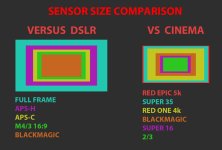
sensor_size.jpg
 
Last edited:
What I rarely see acknowledged in discussions of Full-Frame cameras' DOF is the counterbalancing drawback. In low-light conditions where you need to open up the aperture to f2.0 and wider, an FF sensor produces such a narrow DOF that it's often impractical. With AF-C and MFT cameras, I can go down to f1.4 at moderate ISO settings and have both low noise and adequately deep DOF. Full Frame has a wonderful look of its own, but it's one that works better with narrow apertures on a camera optimized for high-ISO dynamic range.
 
well, even film movies aren't/weren't "full frame" 35mm so yes, you would end up with even less DOF at any given aperture. I would think it is markedly better than 2/3" though admittedly not as good as APS-C. The lack of 60p is a good point, but is it "needed" or is it "nice to have?" On the bright side, 60p is probably coming soon. I do not know that a larger sensor is as easy.


Still, the video I saw on Vimeo comparing it to a 5D Mark 3 looked really, really good. (http://vimeo.com/49875510 on the very very off chance you haven't seen it already).
 
What I rarely see acknowledged in discussions of Full-Frame cameras' DOF is the counterbalancing drawback. In low-light conditions where you need to open up the aperture to f2.0 and wider, an FF sensor produces such a narrow DOF that it's often impractical. With AF-C and MFT cameras, I can go down to f1.4 at moderate ISO settings and have both low noise and adequately deep DOF. Full Frame has a wonderful look of its own, but it's one that works better with narrow apertures on a camera optimized for high-ISO dynamic range.

You are correct but I think we did touch upon this earlier in this thread. Sure you can go to f1.4 on a 4/3rds or APS-C sensor but lenses fall apart when you go to that aperature. FF allows you to stay in the sweet spot of lenses and still get acceptable subject separation. Yes you need good noise characterisitcs for ISO adjustment to make up for the smaller aperature, but the MKIII & D800 seem quite up to the task. But in the end, I would be happy with anyhting form 4/3rds on up in size.
 
Sure you can go to f1.4 on a 4/3rds or APS-C sensor but lenses fall apart when you go to that aperature.

Some of the high end Olympus and Panasonic m4/3 lenses deliver close to maximum performance when wide-open, so nothing falls apart when using these lenses at full aperture.
 
^ They're not f/1.4 lenses AFAIK. Not falling apart at f/2.8 or f/4 is, well, not that impressive. In any case, I think all of this debate is deeply subjective: I want a full frame camera because I built a lens set thinking about fullframe, and I won't be able to use it to its full potential if my camera is APS-C or m43. If I had built my lens set around the GH2, I'd probably be madly in love with the BMC. But as things stand, my widest "awesome lens" is a 35mm, and at 24mm and 19mm I'm already making compromises. Even more: I'm in no hury, so I can patiently wait for my "dream camera" to come out (not an option for everybody, either).
 
Not falling apart at f/2.8 or f/4 is, well, not that impressive

No, but they are f/1.8 and f/2.0. These lenses generally out perform their Full Frame counter-parts at the same F-Stop.

I don't know of any non-telephoto lens that is faster than f/1.8 and still sharp from the center to the edge of the imaging area.
 
Back
Top