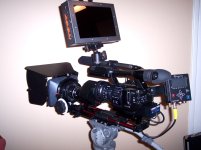
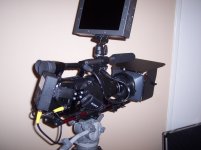
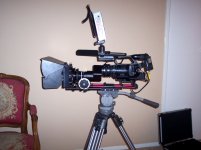
Well, I've noticed that on shots that I've got spot on, on set, there's bugger all difference quality-wise between Canon dSLR footage and HVX200 footage. Obviously there's lots of differences, depth of field, aliasing, etc. but the overall perceived effect is pretty good from each.
The difference comes when I've cocked up on set. Shooting micro budget with limited crew, this is all too easy to do... and our "safe" fall back is to err on the side of underexposure, and to white balance using the camera's built in 5600K setting (so at least white balance has a consistent starting point to grade from).
My experience then is that the HVX200 footage, captured in DVCProHD, is a lot more forgiving in the grade if i need to pull everything up by a stop and correct a colour cast which was not spotted on set. The Canon footage falls apart rather more quickly. This makes sense- the Canon footage is more heavily compressed, it has thrown away more of the supposedly non-visually important information which is what one is trying to get back in the grade by boosting everything to compensate for a stop of underexposure.
Ironically, if you are a big budget operation you've probably got a better chance of capturing the right 8 bits of information from the cameras on set than a micro budget operation like us. We're more likely to be shooting something a bit more contrasty than we can really cope with but not have enough lighting with us to compensate properly, for example. So ironically the big boys can probably happily chug along with these heavy perceptual compression codecs and concentrate on getting it right on set.
I'm definitely interested in the external recorders because I suspect they'll give me a bit of an insurance policy against shooting day cock-ups. So rather than a perceived increase in quality, for me the use of external recorders would be there to cover my backside in case I've underexposed by a stop or curse and realise that I really needed to balance minus green on a particular scene.
I'm going to play with my AF100 to breaking point when it arrives, and see how badly wrong I can get it and still rescue the skin tones (which is the primary think I care about) in the grade. If it gives me the sort of latitude that the DVCProHD footage did, I'll be very happy (and a bit surprised). What I suspect may happen is that the footage will be fine, but will fall apart rather quickly if you get out of the butter zone... and that's probably where an external recorder would really come into its own. If the Ninja works as promised, for the price it is almost worth having just as a hardware converter and instant backup device so that even if I get a dead card I'll have a backup on SDD or hard drive, already in ProRes to feed straight into my FCP editing chain without log and transfer. That it might stand up better in the grade is an added bonus.
Cheers, Hywel