7D = Super 35mm Sensor?

alex1

Well-known member
I know this has been discussed before, but I have not found a good answer.

I have heard that cropped sensors like the 7D are very close in size to the Super 35mm sensor, so does that mean the 7D looks more like "film" than the FF DSLR cameras?

Has anyone here done their own tests and noticed a difference?

Or, what also has an impact that makes a video shot on a DSLR look more cinematic? 24p, dof, anamorphic lenses, post grading, lighting, any other tricks you would recommend?

Any feedback is welcome.
 
To answer your first question, it is true the sensor size resembles s35mm film, that includes the depth compression of the image, however it is not true that the 7D looks more like film(?) than a FF DSLR. The almost vista-vision sensor of a FF sensor can resemble s65mm film, which can be equally "filmic/cinematic" as s35mm.

For tricks to make your DSLR camera give the images of the moviemaking machine you want it to be it comes down to extremely many factors. However, do know that although the DSLR revolution ain't hot anymore your DSLR camera still is a beast of a camera. If you gave it the same treatment as you would with any camera shooting for a feature film, from production to post, it can look really great. The first tricks I can come to think of is:

- Don't shoot below 2/2.8, most lenses starts to struggle once you go below there and that will bring out the worst of it, especially for fine details and bokeh!
- Do not rely on available light in challenging situations. Just because your camera is a lowlight beast does not mean your lowlight scenes will be miraculously good. Add and remove lights to get the look you're after and use ISOs below 800 (APS-C).
- Treat it like any cinematographer would treat his Arri/Panavision 35mm/high end digital camera. It still needs great composition, movement, light and colors. Not like anyone credits the set designers.. :(
- Control the latitude! It is true one of the pitfalls with DSLRs compared to higher end cameras is the dynamic range, luckily it can be helped by adding fill lights, gels and exposing precisely.
 
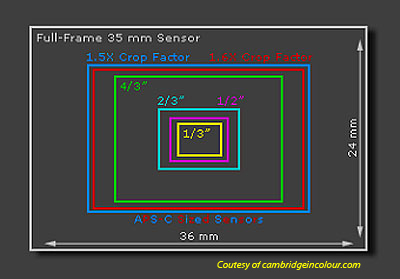
s35 is around 24mm wide
The sensor in the RED ONE was 24.4mm wide
The sensor in the RED EPIC is bigger: it is 27.7mm wide
The RED DRAGON will be even bigger, the number that floats around is 30.7mm

Against that...
BMC is 15.8mm wide
m43 is 17.3mm wide
Canon APS-C is 22.3mm wide
Sony/Nikon/Pentax APS-C is 23.4mm wide
Full frame is 36mm wide
 
Everything is "crop" from actual full 35mm frame, which traditionally was never really possible to shoot because of the perforated edges needed for the film camera cogs to roll the film through.

Hence Super 35mm and also Academy Frame. Yes, APS-C is pretty close to s35.

sensor-size.jpg


DSLR-Sensor-Sizes.jpg


sensor_table.gif
 
Last edited:
To answer your first question, it is true the sensor size resembles s35mm film, that includes the depth compression of the image, however it is not true that the 7D looks more like film(?) than a FF DSLR. The almost vista-vision sensor of a FF sensor can resemble s65mm film, which can be equally "filmic/cinematic" as s35mm.

For tricks to make your DSLR camera give the images of the moviemaking machine you want it to be it comes down to extremely many factors. However, do know that although the DSLR revolution ain't hot anymore your DSLR camera still is a beast of a camera. If you gave it the same treatment as you would with any camera shooting for a feature film, from production to post, it can look really great. The first tricks I can come to think of is:

- Don't shoot below 2/2.8, most lenses starts to struggle once you go below there and that will bring out the worst of it, especially for fine details and bokeh!
- Do not rely on available light in challenging situations. Just because your camera is a lowlight beast does not mean your lowlight scenes will be miraculously good. Add and remove lights to get the look you're after and use ISOs below 800 (APS-C).
- Treat it like any cinematographer would treat his Arri/Panavision 35mm/high end digital camera. It still needs great composition, movement, light and colors. Not like anyone credits the set designers.. :(
- Control the latitude! It is true one of the pitfalls with DSLRs compared to higher end cameras is the dynamic range, luckily it can be helped by adding fill lights, gels and exposing precisely.

+ 100000000000
 
u often need to stop down a lens to give enough depth fo field for an actor to move comfortably without on eye drifting out of focus ... right?

given that, and your knowledge of full frame fov vs dof

it means you need to stop down more to do the same on a full frame sensor, hence s35 (and now aps-c) are great optimum's
 
Arri/Panavision 35mm

Thank you for listing Arri first. I've always been an Arriflex fan. Panavision copied their Academy Award winning shutter. As did everyone else. This technology employs a rotating mirror that allows a continuous motor to operate the camera while providing parallax-free reflex viewing to the operator, and the ability to focus the image by eye through the viewfinder. OK, back to the thread - sorry for my rant. But Panavision always gets the glory!
 
It's what you shoot and how you shoot it more than what you shoot with. I've seen alot of "movies" shot with 7D that look like video, and then there are some that you can't tell from film. Same camera, different people. What you do in post can affect this also.

IF you lit correctly the tool http://www.filmconvert.com/ is really good at nailing the palettes of film stocks. if your stuff isn't lit well nothing will matter. To me the key to the film look is the lighting. This goes for outdoors too. I always shoot with reflectors and ND filters when outdoors. A good grip and good cinematographer will let the 7D look like film.
 
Last edited:
Back
Top