Doug_EX
Well-known member
Oh sorry, I had a 70-200 F4 non IS I bought for $400 used. My IS version I paid $800 for.
Makes more sense!


Follow along with the video below to see how to install our site as a web app on your home screen.
Note: This feature may not be available in some browsers.
Oh sorry, I had a 70-200 F4 non IS I bought for $400 used. My IS version I paid $800 for.


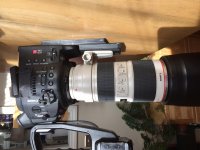
is there a "cheap" setup that will allow you to use the longer/heavier lenses without a lot of fuss? ideally youd be able to switch from something like the 24-105 to the 70-200 2.8 without taking the cam off tripod but without worrying about the lens's weight eventually deforming the lens mount on the cam body.
what can you do that doesnt involve zacuto plates and rails? im thinking of a c100 here by the way.

ned-
care to share an example of what you are seeing?
thanks in advance.
be well.
rob
smalltalk.productions

Yeah, I'd think the 70-200 f/4 non-IS is fine as an interview lens. I've often heard it is sharper than the 70-200 f/2.8 IS II. For sit down interviews you don't want IS anyway. I typically film my tight shot for interviews with a Nikon 80-200 f/2.8 ($350, optically it's great) at f/4-f/5.6 at ISO 320-850, shutter at 1/48. Now that I have the Canon 70-200 f/2.8 IS II, I'll still use the same settings. I avoid f/2.8 for sit down interviews because f/4-f/5.6 is sharper, the deeper depth of field keeps the person in focus easier if they move back and forth, I actually like to have a person's whole head in focus (such as their ears), not just their eyes, and often I want (the viewer) to have an idea of what the background is, as opposed to the background being a blob of out of focus mush.Thanks guys I will just st be using it for interviews do you think the f4 non is be ok? Or is it worth saving for the non is 2.8??
Thanks
How does a 3.28 lb lens make any difference in terms of being "so heavy" on a tripod that is rated to handle up to 55 lbs?BTW, I have a Sachtler 20. It's insured replacement value is $9K with the graphite legs. Yes, it's heavy but I'm not white collar.
P.S. I have a long plate since I often have a 15" heavy teleprompter on my head, but this 70-200 is so heavy it's very touchy for reframing, I have to push/pull harder on my handle.
Yeah, I'd think the 70-200 f/4 non-IS is fine as a sit down interview lens. I've often heard it is sharper than the 70-200 f/2.8 IS II. For sit down interviews you don't want IS anyway. I typically film my tight shot for interviews with a Nikon 80-200 f/2.8 ($350, optically it's great) at f/4-f/5.6 at ISO 320-850, shutter at 1/48. Now that I have the Canon 70-200 f/2.8 IS II, I'll still use the same settings. I avoid f/2.8 for sit down interviews because f/4-f/5.6 is sharper, the deeper depth of field keeps the person in focus easier if they move back and forth, I actually like to have a person's whole head in focus (such as their ears), not just their eyes, and often I want (the viewer) to have an idea of what the background is, as opposed to the background being a blob of out of focus mush.Thanks guys I will just st be using it for interviews do you think the f4 non is be ok? Or is it worth saving for the non is 2.8??
Thanks
Well if you're doing a sit down interview then I'd sure hope you'd have sufficient light to film at f/4. Even a $50 Home Depot light setup could get you to f/4 at ISO 320-850. I suppose if you're using some of the lower powered first generation LED lights for your key and fill then you may be under-lit, or with a couple Lowel Pro 250s. For my key lights I first used Home Depot lights, then an Arri 650 through diffusion, then a Lowel Rifa 1K, and now I use a Litepanel Astra for my key. Plenty of light.F/4 indoors is always going to be a disappointment IMO, unless you're just really, really well lit.
How does a 3.28 lb lens make any difference in terms of being "so heavy" on a tripod that is rated to handle up to 55 lbs?BTW, I have a Sachtler 20. It's insured replacement value is $9K with the graphite legs. Yes, it's heavy but I'm not white collar.
P.S. I have a long plate since I often have a 15" heavy teleprompter on my head, but this 70-200 is so heavy it's very touchy for reframing, I have to push/pull harder on my handle.

I got a used 70-200 F/4 IS for $175! A corporate photo studio was auctioning off all their stuff and I won the bid. A fine piece of glass too. Even the old non IS 70-200 F4 is a great lens.400$ for the 70-200 F4 IS...wow! That is a deal!
Double WOW!I got a used 70-200 F/4 IS for $175! A corporate photo studio was auctioning off all their stuff and I won the bid. A fine piece of glass too. Even the old non IS 70-200 F4 is a great lens.
Isn't there pretty much an ideal equilibrium where the balance is perfect? So assuming a head can handle the weight, is a good head, and is balanced properly, it should be able to be adjusted well without locking it, I'd think.It"s touchy, depending where I set the balance.


The OConnor 1030 is its primary competition, I'd say. I used the OConnor with the Arri Alexa once and I feel the starts and stops were more buttery smooth than the Sachtler 20. I read in one place that the 1030 isn't as good at handling lighter camera loads (such as C-series cameras) as the Sachtler 20 is, though.there's nothing like a Sachtler 20.


How does a 3.28 lb lens make any difference in terms of being "so heavy" on a tripod that is rated to handle up to 55 lbs?