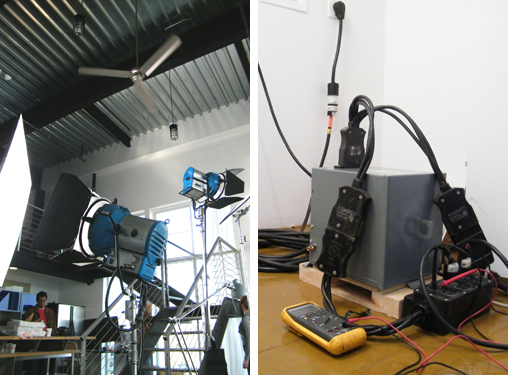
60 amp Bates plug?

You can use a 60 amp dryer outlet to power a 5K, so just buy a dryer outlet plug, use that instead of the Bates plug, and go to town.

As for the dryer outlet issues, yes there are many different types of plugs so when you do a tech scout of the location take a picture of the outlet (if one is there) and show up on the shoot day(s) with the right plug on the end of your cable.

It would also make a lot of sense to actually just make a short "dryer plug to 60 amp Bates" cable and use regular 60 amp extension cables to reach the head.


Chris will accuse me of hijacking this thread to market my “Amazing Transformer Machine” under the guise of education, but these posts of his are so misleading that they are dangerous. Yes, you can plug a 5k into a 60 amp dryer outlet, but unless you use a 240V 5k bulb (which Chris fails to mention) and the head is specifically designed to operate at 240V (which Chris fails to mention) you have an electrical hazard. If some kid took his suggestion to “just buy a dryer outlet plug, use that instead of the Bates plug, and go to town” without replacing the 120V bulb with a 240V bulb, that 120V bulb would blow like a fire cracker - probably taking the lens with it and possibly someone’s eye.

Even if the kid did swap the bulb for a 240V bulb, but the light was not specifically designed to operate at 240V with a double throw switch (switches both hot and neutral simultaneously), you would have an electrical hazard. If you were to feed a light without a double throw switch 240V you would have a light that is energized even when the switch is in the off position.

I know Chris thinks my “verbiage” is tedious, and only an excuse to market my “Amazing Transformer Machine” under the guise of education, but if he just read some of those posts, instead of criticizing them, he might not make such irresponsible statements as these. I find again and again that because of the brevity of the posts like his, online forums like this are filled with a lot of misinformation (case in point.) Since a little knowledge can be a dangerous thing when it comes to handling electricity (case in point), he leaves me no choice but to respond at length, and it is not for marketing purposes as Chris would have you think, but for your own edification.

If you look closely at the table of Nema configurations that Ryan had the good sense to post, you will see that the reason that there are so many different dryer/range plugs is because there are dryer/range plug outlets derived from single phase power (240V), three phase power (208V), as well as those derived from 408 three phase power (277V.) For this reason it is not as simple as taking a picture of the receptacle on the tech scout and “show up on the shoot day(s) with the right plug on the end of your cable.” You actually have to meter the receptacle to see if you have 208V, 240V, or 277V across the two hot legs of the receptacle. If you in fact have 240V you can use the receptacle to power a 5k head designed for 240V operation with a 240V bulb.

Chris also suggests that you can split a 240V range circuit and use one leg of it to power a 5k:

Use the range/oven socket instead and you're good. Those are usually 2-120 volt 50 amp legs...

Since electricity can be dangerous if mishandled, I think it is important to make absolutely clear why you have to be really careful when splitting 240V circuits as he suggests.

But, first we need a basic understanding of 240V circuits. There are a number 240 volt wall outlets in a typical house, office, or industrial plant that you can safely and legally use to power a 5k and even HMIs as large as a 6k. The most common are air conditioner outlets, dryer outlets, range outlets, outlets for large copy machines in offices, and the outlets for motorized equipment and compressors in industrial plants.

If you look at the breaker of these circuits on the building service panel you will notice that they use two pole breakers - either 30A or 50A. Each pole of the breaker is in a sense an independent 30A or 50A 120 volt circuit. That is, if you measure the voltage from each pole of the breaker to ground it will be 120 volts, and if you measure the voltage between the two poles of the breaker you will notice that it is 240 volts. The 120 volts of the two poles adds up to 240V because the 120V circuits are on opposing legs (and are therefore additive) of either a single phase electrical service of a house, or a single phase secondary step down transformer of a office or industrial plant. In residential settings, this is how higher voltages are supplied to household appliances like Dryers, Electric Ranges, Air Conditioners, Motors, etc. that require more power than can be reasonably supplied by a single 120V circuit. Many of these household and industrial 240V receptacles use a three wire system (no neutral) because they are designed to power single phase motors or heating elements that draw a perfectly balanced load and return no current because the single phase service legs are 180 degrees out of phase and cancel each other out.

Where a state of the art Power Factor Corrected (PFC) Electronic HMI ballast draws only 25 Amps on each leg of a single phase 240V circuit, its' load is well within the capacity of these common 240V circuits. In our rental inventory we keep an assortment of adapters because as Ryan pointed out all of these 240V wall receptacles use a different pin configuration. As Ryan also pointed out, you can power 5ks and even 4k HMIs with 120V magnetic ballasts from these 240V circuits by using a 240v-to-120v step down transformer. A 240v-to-120v step down transformer will convert the 240 volts supplied by these industrial and household receptacles back to 120 volts in a single circuit, that is the sum of the two single phase legs of 30/50 amps each, and is capable of powering bigger lights. It can also be used to power multiple 120V luminaries off of 240 Volt circuits because a transformer automatically splits the load of whatever you plug into it evenly over the two legs of the 240V circuit so there is no neutral return.

Some gaffers will advocate, like Chris, the use of a "Splitter Box" on 240V outlets. A "Splitter Box" is a special distro panel that you can make up that is wired to split out the two 120V circuits that make up the 240V outlet. If the 240V outlet is a 4-wire 50A/240V Range plug (the receptacle has four slots: one for ground, one for neutral, and two for hot), you could use a splitter box to power a 5k if it is wired correctly. But, you have to be really careful when splitting 240 volt circuits. If the 240 volt circuit is a four wire system, one can use a distro box as long as it is wired so that each circuit has a ground and neutral. Where you run into trouble is when the 240V circuit uses a three wire system (the receptacle has three slots: one for ground, and two for hot, and no neutral.) Most household and industrial 240V receptacles use a three wire system (no neutral) because they were wired for the sole purpose of powering single phase motors or heating elements (like stoves & dryers) that draw a perfectly balanced load and return no current. A perfectly balanced load doesn’t require a neutral because the single phase service legs are 180 degrees out of phase and cancel each other out – hence there is no return that would require a separate neutral.

You run into trouble with this kind of circuit when you start to pull an unbalanced load on your "Splitter Box." And, where under most production situations you can never perfectly balance your lighting load, the two 120V circuits that make up this 240V circuit will not have 100% phase cancellation and the extra current of the high leg will not have a safe return path because by necessity with a three wire system you have had to bond the ground and the neutral in the splitter box (after all what else can you do with the ground and neutral of your splitter box but to bond them when plugging into a three wire 240V circuit.) There are some people that will argue that it is not such a big deal to carry current on the ground wire. I would argue that it is both unsafe and unwise to carry current on the ground wire. It is unsafe because the ground wire is intended only as a default conduit in the event of equipment failure (which is why it is permissible according to the National Electrical Code (NEC) to use a smaller conductor for the ground wire.) It is unwise because bonding ground and neutral after the service side of a main service head (which is what you have to do with the ground and neutral of a splitter box when plugging into a three wire 240V circuit.) is a violation of the NEC. To quote Mike Holt, of Mike Holt Enterprises, Inc. again: “The National Electrical Code (NEC) requires a neutral-to-ground connection to be made at service equipment only and there shall not be any neutral-to-ground connection on the load side of service equipment [250-23(a), 250-24(a)(5)]” (full excerpt is available online at his website) If some one were to fall off a ladder because they took a non-lethal shock because the cable they were handling was carrying current on the ground wire your liability insurance would be null and void because you were using equipment that did not meet code.

It is also unwise to carry current on the ground wire because it can induce ground loops. But, since that is a whole other topic I suggest you see this thread – “Guerrila lighting electrical power questons” http://www.dvxuser.com/V6/showthread.php?t=192041 - for more details on using splitter boxes.

Transformer-Distro_Sam2.jpg

4k & 1.2ks HMI Pars powered from 30A/240V dryer outlet through a step-down transformer/distro for Bose still shoot.​

The only safe way to pull power from a three wire 240V wall outlet that meets the requirements of the National Electrical Code, and won't create ground loops, is to run your lighting load through a 240v-to-120v step down transformer. What makes it safe to plug a step town transformer into three wire 240V outlets is that the transformer automatically splits the load of whatever you plug into it evenly over the two legs of the 240V circuit so that you have 100 percent phase cancellation. In other words, where there is no high leg, the loads on each leg of the 240V circuit completely cancel out and there is no return that would require a separate neutral and there is no return current on the ground wire to create ground loops. Where I just about out of space, I will pick up with more details in my next post.

Guy Holt, Gaffer, ScreenLight & Grip, Boston, Ma
 
Where I just about out of space, I will pick up with more details in my next post.

While you can use a “splitter box” (if it is wired correctly) to power a 5k (or other quartz lights) off of a 4-wire 240V receptacle, it is not recommended for powering non Power Factor Corrected HMIs, Fluorescent, or CFL bulbs. The reason is that the neutral wires of 240V receptacles are not sufficient to handle the higher return currents of non-Power Factor Corrected Switch Mode lights like HMIs, Fluorescent, or CFL bulbs. Nuetrals are included in most 240V range plug circuits to provide a safe return for small 120V accessories in stoves like oven lights, clocks, and timers. For this reason they are sized no larger than the individual 120V hot legs of the circuit, because under normal applications there is no situation where you would draw more amperage than could be supplied by one leg of the circuit (remember the heating element of the stove/dryer operates a perfectly balanced single phase load and hence there is no return for the wire to carry from it.)

Splitting a 240V dryer/range circuit to power motion picture lights is an application for which these circuits were not intended. So you must bear in mind that in motion picture lighting applications, whether drawing power from a generator, a tie-in, or a 240V splitter box, it is a recommended practice to balance your ligting load as evenly as possible between the hot legs. One of the primary reasons to balance the load is to minimize current on the neutral return. Where there are two (single phase) or three (three phase) hot wires to only one neutral wire, you must balance the load on the hot legs so that there is minimal return on the neutral after phase cancellation. If you don’t balance the load there is the possibility of overloading the neutral wire – a potentially hazardous situation.

If we draw equal current from each leg of a single phase power service (generator, tie-in, stage distro, dryer/range circuit) with incandescent lights (a resistive or linear load), there will be no return current on the neutral. That is because with a linear load current & voltage remain in phase, and where the legs are 180 degrees out of phase, the current cancels out when combined on the neutral return. If we draw 100A on one leg and 140A on the other leg of a tie-in, we will have 40A on the neutral. Likewise is true of 240 range circuits. If we draw 42 Amps on one leg from a 5k, and 16.8 Amps on the other leg from a 2k, we will have 25.2A on the neutral. With a linear load, the more balanced the load the less current on the neutral return.

Things get a bit more complicated with inductive (magnetic HMI ballasts) and capacitive (electronic HMI, Kino, & CFL ballasts) non-linear lighting loads. Since non-linear loads cause current and voltage to be out of sync, the phase currents no longer entirely cancel when they return on the neutral. When using magnetic HMI ballasts, it is normal to have as much as 20-25% of the total amperage return on the neutral when the legs are evenly loaded.

Electronic square wave ballasts (both HMI, Kino, & CFL), in addition to pulling the voltage and current out of phase, also create harmonic currents that can stack on top of one another, creating very high currents returning to the power source on the neutral wire. If the neutral return path has not been oversized to accommodate additional current, these high currents can cause excessive heat on the neutral wire. Where the neutral of a 240V range/dryer circuit is not fused, this excessive heat can lead to a possibly hazardous situation. Where high currents on the neutral can be hazardous, it is important to understand the root cause of these currents. But, since that is a whole other topic I suggest you see this thread – “What is Power Factor Correction in HMIs” http://www.dvxuser.com/V6/showthread.php?t=205548 - for more details on excessive neutral returns as a result of high harmonic noise

Unfortunately, much of today's lighting technology is of a non-linear type because it relies on electronics such as DC rectifiers (electronic HMI ballasts), silicone-controlled rectifiers (SCRs), capacitors (magnetic & electronic HMI ballasts), and high-frequency switching power supplies (the IGBTs of electronic ballasts). And since this kind of load (non-linear) generates harmonic currents that can have undesirable effects like stacking on the neutral, it is no longer sufficient to just balance the load on distribution systems – even 240V range receptacles. One must also closely watch the current on the neutral return and take preventive measures when there is the possibility that it will be high.

On large film sets it is a standard practice when powering large numbers of electronic ballasts without Power Factor Correction to size the neutral feeder of the distribution system to carry the sum of the currents of the phase legs times 80 percent (.8). If power is coming from a generator, the generator is typically oversized to handle the higher return current. On small film sets using 240V range/dryer circuits other measures must be taken.

One measure is to use a 240-to-120V step-down transformer as Ryan suggest. Unlike a 240V "Splitter Box," where you have to meticulously balance your load, a transformer greatly simplifies your set electrics by automatically splitting the load evenly. As long as you plug lights in through the transformer, you no longer have to carefully balance the load over the two 120V circuit/legs because the transformer does it for you automatically. If you outfit the transformer, as he suggests, with a 60 Bates receptacle, you can use 60A GPC extension cables, 60-to-60 Splitters, and fused 60A GPC-to-Edison Breakouts (snack boxes) to run power around set - breaking out to 20A Edison outlets at convenient points (rather than one central point.) The best part about using a transformer with a 240V receptacle in this fashion is that no matter where in the distribution system you plug in, the transformer automatically balances the additional load, so that you don't have to. You can also use a transformer to filter harmonics from returning into the 240V range circuit.

I use transformers to power bigger HMIs (2.5-4Kw) in situations where a tie-in is not an option and the budget doesn’t permit for a tow generator. Where the production budget is particularly tight, I use a package consisting of two transformers and a portable generator. I use one transformer to access more power through a 240V circuit on location to run lights inside; while the other I use to bring larger HMIs in the windows from outside. This approach eliminates the need for a dangerous tie-in or expensive tow generators, it also greatly reduces the amount of cable that has to be run. Over the years, I have used this combination on many historical documentaries I have gaffed. For those who would like to see samples of what can be accomplished with this basic package, I have attached these links to production stills of the PBS and History Channel historical documentaries shot entirely, or in part, with just a couple of transformers and a Honda generator.

The History Channel’s “Unsolved History” episode
“Presidential Assassins”


American Experienes Typhoid Mary Biography
"The Most Dangerous Women in America"

WGBH’s Ben Franklin Biography
“Franklin”


As anyone who reads this forum regularly knows, Chris and I have our differences. He thinks that the “low budget shooters that frequent this forum … just want low budget options for lighting - not scientific explanations of how the stuff works…” And, I know Chris thinks my posts constitute nothing more than marketing, but I am only trying to raise an awareness of the adverse effect that an increase in harmonic noise as a result of a change in lighting technology - the introduction of Switch Mode Power Supplies (SMPS) - is having on set power; and, the benefit that can be gained through an awareness of these effects. As these productions demonstrate, if used correctly common 240V outlets can give you access to more house power and thereby eliminate the need for tie-ins or generators.

I have said many times before, an informed awareness of the effects of harmonics will enable you to operate more HMI & Fluorescent lights on alternative power sources, in this case 240V range/dryer receptacles, than has ever been possible before. And, as Chris’ posts clearly demonstrate, uninformed speculation only creates electrical hazards.

Guy Holt, Gaffer, ScreenLight & Grip, Boston, Ma
 
Last edited:
Okay, first of all -- no personal stuff allowed. So, Guy, in the future please leave all references to Chris out of your posts, and Chris -- let's just let it go.

Secondly -- you absolutely have to respect electricity, and the key thing to recognize is: if you don't know exactly what you're doing, then: YOU DON'T KNOW WHAT YOU'RE DOING. So DON'T.

The simple answer is: for the no-budget, micro-budget shooter: stay away from 5K fixtures, Bates plugs, and anything that typically falls under the realm of the qualified electrician. With the sensitivity of today's cameras, a 2K is typically overkill, and you pretty much won't need to go near the bigger fixtures. A 1.2k HMI will put out about as much light as the 5K, but easily work on a household circuit.

The bigger fixtures are there and they have their place, but by all means if you're messing with electricity, you need to make sure that you know exactly what the bleep you're doing.

For that reason: stick with Edison plugs. Plug them into household circuits. On a no/micro-budget level, that's almost all you're ever going to need. And if you need more? Get someone who knows what they're doing to advise you.
 
I'm not even going to attempt to read all or any of that, but I did correct myself, have used range/oven outlets and dryer outlets successfully as have others, and yes, please avoid anything other than edison (regular plugs) and household outlets unless you know what you're doing which I also happened to kind of mention. Yes.

.
 
Last edited:
At the end of the day isn't easier to just get 2 1k lights and put them close together? Sure its not the same as a 2k but going from experience (i have a 2k) its not worth the trouble unless you have a electrician handy, or you have access to a dryer plug in each location (and long cables rated for 20 amps).

Also, why not just use CFL's if you just need a whole lot of light? Yes its not hard, but thats what I use when I just need to blast light in a room. We're talking indie stuff here.
 
I am ALL for ganging up smaller fixtures that can run off of standard 20 amp circuits. I even built a 2K/4K fixture once that had 2 power cords coming out of it so I could avoid tie-ins and generators while enjoying up to 4,000 watts of light.

Lowell's Tota lights have little tongues and receivers on them for the purpose of joining them together. It's SO much easier to just put 2 or 3 or 4 heads close together and place a frame in front of them with some diffusion material on it if you don't have a gaffer or real film lighting and distro.

.
 
If you were shooting an Indie film and was just looking for 1 or 2 lights to add to your kit for some fill light, would you go with something like the lowel totas, or used 1k fresnels?
 
Fill light against which key lights?

If you're talking about something to bounce or put through diffusion, either will work. Each of those have advantages over the other. If you're working in tight spaces and maybe don't want to deal with the weight and bulk of the fresnel, the Tota will work better. If you ever want to have the option of spotting a source, you sure can't do that with a Tota.

Totas are less expensive and less complicated also. You can also find these on eBay on occasion which work fine.

.
 
Also, why not just use CFL's if you just need a whole lot of light?

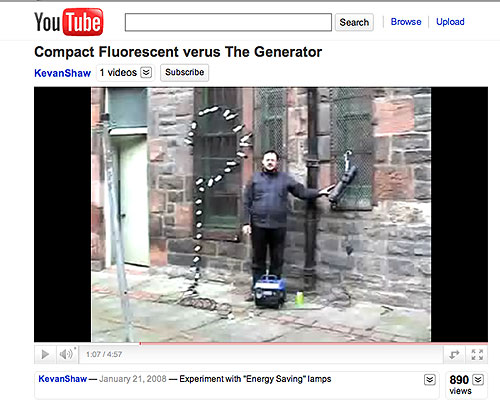
You can make up a “wall-o-light” consisting of CFLs as long as you bear in mind that CFL bulbs have very poor Power Factor and the harmonic currents they generate will stack on the neutral, and since there is no over-current protection on the neutral, can lead to overloading of the neutral. If you don’t take into account the fact that a CFL will draw twice the current for it’s wattage you may end up with a fire like the one that occurred in Vice President Dick Cheney's suite of offices in the historic Eisenhower Executive Office Building next to the White House on December 19, 2007. The cause of the fire that started in an electrical closet on the building's second floor was found to be the result of uninformed staff replacing all the incandescent bulbs on the floor with CFLs. Anyone who is unfamiliar with the excessive draw of CFLs, should check out this You-Tube Video:

CFL_vs_Gen_Dem.jpg

In his You-Tube video, “Compact Fluorescent verses the generator,” ( http://www.youtube.com/watch?v=LeCqreRMzKM) Lighting Designer Kevan Shaw compares the effect of equal wattages of CFLs and Incandescent lights on a small portable generator. In his test, he first operates a 575W ETC Source Four Leko with Quartz Halogen bulb on an 850W two stroke gas generator without problem. However, when he tries to operate an equivalent wattage of CFLs (30-18W bulbs) the generator goes berserk. Only after turning off half the CFL Bulbs does the generator operate normally with a remaining load of 15 - 18W CFLs (270 W.) What accounts for the erratic behavior of the generator in this video under a smaller load of CFLs? It is a combination of the poor Power Factor of the CFL bulbs and the harmonic currents they generate.

Even though the 15 CFL bulbs have a True Power of 270W (30x18W bulbs), the Watt indicator on Kevan's generator indicates that they draw twice that in Apparent Power (535W), or have a Power Factor of .5 (270W/535W =.504.) The fact that CFL bulbs consume double the energy (Apparent Power) for the 18 Watts of light (True Power) they generate, is only half the story here. Kevan Shaw’s video also clearly demonstrates the severe effect that leading power factor loads - like CFLs, HMIs, & Fluorescents - can have on the governing systems of conventional AVR generators.

When Kevan turns off the 18W CFL bulbs one at a time until the generator stabilizes, he is not only demonstrating that 15 – 18W CFL bulbs has roughly the same Apparent Power (535W), according to the generator’s Watt meter, as a 575W incandescent light; but, also that the maximum Leading Power Factor load a 850W conventional generator can operate satisfactorily is 270 Watts (15 – 18WCFL bulbs). Looked at from another angle, 576 Watts of Apparent Power with a Leading Power Factor (16 - 18W CFL bulbs) overloaded the generator, while 575 Watts of Apparent Power with a Unity Power Factor (the 575W Quartz Leko) did not. What accounts for this difference? Since the load is almost the same (576 & 575 Watts of Apparent Power respectively), the only factor that can account for the generator going berserk with the equivalent load of CFL lights is the harmonic currents that they generate, that the Quartz Leko does not. Without a doubt, Kevan Shaw’s video is a clear demonstration of the adverse effect that the poor Power Factor and harmonic currents generated by CFLs can have.

For this reason, I would recommend making your own fixture made up of several circuits rather than using one of those CFL Cluster sockets you see on ebay (they are extremely hazardeous if overloaded with to high wattage bulbs.) Only have as many sockets on each circuit as the circuit can carry (taking into account that the bulb will draw twice its load.) If you do this and beef up the neutrals in your fixture (so that they don’t overheat), and spread your load around, you should have no problem.

If a reader of this post still doesn’t entirely understand what I mean by the poor Power Factor of CFLs, I would encourage them to read this post – “Where do you get four socket adapters?” (http://www.dvxuser.com/V6/showthread.php?t=204478&page=2) - before attempting to build their own lights. In it, is a more detailed explanation of the basic electrical engineering principles behind Power Factor, harmonic distortion, and it’s adverse effects.

Guy Holt, Gaffer, ScreenLight & Grip, Boston, Ma
 
Which is why you either bounce them or point them through diffusion material.

.

Hmmm...

Chris is right. This will combine the smaller units into one source (no double shadow), but of course, will obviously soften the light as a source, and you may loose the desired hardness/spot&fill capability of a fresnel lens.

So... may I add or suggest to anyone reading this, if you don't mind taking the light through diffusion or off beadboard... You don't necessarily need a fresnel lens and thus I have two alternatives to a 2k fresnel which can give a bigger punch AND it's under 20amps per circuit.

1) Par 64 units/cans. If it's power you want, and you are using diffusion or bounce card, fresnels are almost* useless, because you are loosing light through the lens, which qualities are not even being utilized directly on the image. Par 64 cans (like a firestarter or narrow/spot beam fixture), are 1k (or 1.2k firestarter) parabolic lights which don't have a pretty output (like the even field and variable spot/flood fresnel) but it has PUNCH. Par cans put out harsh and powerful light. Watt per watt, compared to a fresnel the par can pushes more light out the front, by far. Use two par cans through diffusion or off a card and you'll probably see 150% or more light versus doing the same with the 2k fresnel.

Keep in mind though, despite these advantages, you can't turn the two par 64 bulbs into one 2k fresnel.

2) 4k Mole Softlite. Since you are already going to have soft light by combining small units (most likely fresnels or open faced).... why not go big, AND compact. So long as your taste in soft light isn't very refined (because there are differences between diffusion, bounce card, beadboard, showcard, muslin, zip coupes, and etc) you may find a zip light or softlite being a good way to get powerful soft light without the extra stand, board, or silk.

PLUS... the 4k softlite can have TWO 20amp edisons... each one powering two of the four 1k lights inside the unit. So if you have two circuits available, you can have a soft 4k bounce.

Of course, if you have a 2k softlite or zip light, I have a feeling it will produce more powerful softlight versus a 2k fresnel through diffusion or off board... hence I guess this is the THIRD recommendation of a better way to get a soft light without using a fresnel light source. AND when I say better, I mainly mean more efficient, powerful, and possibly simple/compact.


These are just two suggestions of how to get either more power
 
To throw another option into the mix, the 1.8K Arri MaxiPar. It's basically an open-face HMI. More punch than a fresnel lens but easier to control than the typical HMI PAR.
 
Chris is right. This will combine the smaller units into one source (no double shadow), but of course, will obviously soften the light as a source, and you may loose the desired hardness/spot&fill capability of a fresnel lens.

If you move the heads/diffusion further away, then the source gets harder. And, all you'd need would be some light diffusion like opal and place the heads are very close together anyway.

.
 
I have used the Par 64 cans before and am really looking to pick up a few. I like that you can select the beam spread, quality and power of the lights by changing bulbs, and you can then use them off a bounce source, or through diffusion for a softer light. And they are CHEAP.
 
@ Drew... yeah those new lights are awesome. I suggested going 1.8 HMI in my first reply to this thread. It's hands down the most powerful, simple, (but not cheap) solution on a 20amp circuit. It will put out tungsten light equivalent around 8k give or take. Right? Last I checked HMI's power to light efficiency was around 4 0r 4.5 times greater then tungsten.

If you move the heads/diffusion further away, then the source gets harder. And, all you'd need would be some light diffusion like opal and place the heads are very close together anyway.

.

True... but be careful. As you know, if you move the lights back, you'd be losing all the power (intensity) you just spent all that time trying to gain from using multiple units. :P That's a fine line and funny game of give and take you'd be playing.
 
I always keep a few Source 4 pars around. The improved efficiency of these lights make the 575 watt bulb a very good choice when building multi lamp reflector set-ups.

They are a bit more expensive than the standard par 64 but the price is well worth it IMO.
 
I'm really interested in these Par 64 cans. I never thought about using them because I thought they were strictly for stage.
 
Back
Top