5D replacement announcement next week

5DMK3 will indeed have to beat Magic Lantern to get customers to upgrade. But maybe Canon will just get new customers instead of grooming the old ones.

The headphonejack doesn´t mean much without audio-control and phantom-power. You will still need a dual-system to record proper audio. It will be ok for PJs though.

I doubt the 5D can get near the C300. The C300 has big photo sites and only needs to half from 4K to 1080p. Simple math. Still the C300 has a ventilation system built in. So there is some processing going on. In any case the ventilation will prevent the cam from shutting down after 20 minutes in a concert hall.

If the 5D gets simple audicontrols, peaking and handles aliasing a bit better than that will already be a nice evolution. If they include HDMI-uncompressed out (under Nikon´s pressure) that would be HUGE upgrade.
 
RE: ISO values - I downloaded Philip Bloom's shootout, loaded the low light tests into the editor, and looked at the waveforms from all cameras and settings: http://www.similaar.com/foto/iso/pbtest.html - this says nothing about usability (how much noise there will be in the final images), which would be the most important thing to take in mind; and, as Rick said, this gives only partial info about ISO, as tone curves may be very different from camera to camera - still, I take it as indication that "ISO 20000" on the C300 is, well, a pretty optimistic number
 
RE: ISO values - I downloaded Philip Bloom's shootout, loaded the low light tests into the editor, and looked at the waveforms from all cameras and settings: http://www.similaar.com/foto/iso/pbtest.html - this says nothing about usability (how much noise there will be in the final images), which would be the most important thing to take in mind; and, as Rick said, this gives only partial info about ISO, as tone curves may be very different from camera to camera - still, I take it as indication that "ISO 20000" on the C300 is, well, a pretty optimistic number

Unfortunately, it's just not a valid comparison. You're comparing log gamma to normal gamma in terms of straight luminosity performance. The problem with this, just like the problem of the original comparison to the 1dmk4, is that you're comparing a logarithmic gamma profile to heavily boosted normal gamma profiles - and given that, the C300 in log performance behaves exactly as would be expected. If you want to compare like to like amongst these cameras, you need to use a normal gamma from the C300 to compare. You'll get a waveform far closer to the other camera's than a log profile will give you. To say that the C300 ISO's aren't accurate because it's log gamma profiles are darker than normal gamma profiles just shows that you don't understand exactly what a log gamma is and does.

If you doubt the accuracy of the C300's ISO, take a look at the video "By the Light of the Moon" by Barry Goyette (which was shot in a normal gamma mode, I might add [again]) - and show me skin tones exposed by moonlight from any other camera.
 
Last edited:
yes, I know the comparison is skewed, and I stated so in my post - even so, I find it a useful exercise, that's why I uploaded the results, and posted it here - my conclusion "ISO 10000 on the C300 is not any brighter than ISO 6400 on the 5D2, and ISO 20000 on the C300 is actually darker than ISO 12800 on the GH2" is true, if somewhat irrelevant - what would make most sense would be to compare final graded images (e.g. color corrected to match the brightest one, and then graded with a simple look) and then look at the amount of noise from each camera and setting - I'd need all the original footage for that, though
 
I think the only thing you could really do is study when each RGB channel blows out to figure out what the digital ISO is compared to each camera. That's really what you want to know anyways, the hypothetical speed of the sensitivity. Given all the curves are different, what you really want to know is, how fast till a pixel blows out given a constant light source.

I'm not saying how it relates to *actual* ISO values on film, but, I'd calibrate to the same method. With a dimming light source, and waveform monitors on each, and probably a light meter, and maybe a bounce board, you can probably calculate this stuff pretty easy. Having the cameras a specific distance from the cameras, using a specific F-stop and exposure time. Change the light intensity until it just blows out, then you can measure the amount of light it is getting. It would give you the ability to test both cameras to each other.

I've not done a lot of the light calculations, but there are others here who are REALLY good at it.

But I gotta agree, comparing AND log setting to a filmic setting is like apples to oranges here. That 18% gray point is going to be at a different location in the stored video without question. Again, if you look at when they blow out at the same ISO setting, THEN you can determine if one is more or less pessimistic than the other.
 
Am I mistaken or people math about the Canon C300 pixel being much bigger than the 5d. I mean the the C300 is a 8 megapixel about apsc camera compared to a 21 perhaps 22 megapixel full frame photographic 35mm 5d. The crop is about 2 to 2.2 so we are looking more at a 18 to 22 megapixel density sensor. I might be mistaken but I think it is not far from that.
 
Am I mistaken or people math about the Canon C300 pixel being much bigger than the 5d. I mean the the C300 is a 8 megapixel about apsc camera compared to a 21 perhaps 22 megapixel full frame photographic 35mm 5d. The crop is about 2 to 2.2 so we are looking more at a 18 to 22 megapixel density sensor. I might be mistaken but I think it is not far from that.

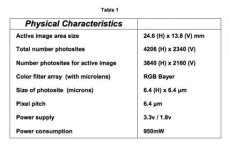
From what I am seeing, the pixel pitch for the 5D is 6.4um and the pixel pitch for the C300 is 6.4um. So it would appear to me, they are the same! (Never researched it before now)

Edit: I should add, that doesn't mean that is the size of the pixels, just the maximum size they could be, however, they can't be that large. There is interconnect and circuitry around the pixels that isn't used for active area. That said, the microlens over the pixels can pull the light from those inactive areas.

In current technology that I work in (28nm CMOS) 6.4um square is quite a bit of space. Not sure why I've never actually compared pixel area to what I work in, but pretty cool.

Yeah, I haven't looked into it, but pixel size is not dictated entirely by pixels to surface area. They can be small pixels even if they cover a large area. I wouldn't be surprised that the C300 has smaller pixels than the D4.
 
Apologies if someone else has already suggested this:

What if the 5DM3's big surprise feature is that it's mirrorless, with full-time live view, including a very, very high quality EVF instead of an optical VF?

Yes, I know it's an insane thought, but an unusually high quality EVF might explain the alleged price increase if the rumored price is for a body-only configuration.

I'm not saying the cam would have a different distance between the back of the lens & sensor. That would stay the same as the current 5D, so EOS lenses will all work. Only the optical VF would be replaced with an extremely good EVF, and of course the mirror mechanism would be removed.

Must've been something I ate. :-)
 
Last edited:
Apologies if someone else has already suggested this:

What if the 5DM3's big surprise feature is that it's mirrorless, with full-time live view, including a very, very high quality EVF instead of an optical VF?

Yes, I know it's an insane thought, but an unusually high quality EVF might explain the alleged price increase if the rumored price is for a body-only configuration.

No way, said it above, then you're throwing all the still photographers under the bus who would be REALLY resistant to giving up their mirror.

The price increase is likely the (if I heard correctly) upgrade from 1 processor to 3 processors. From a single digic-4 to two digic-5 and a digic-4
 
Yeah, I haven't looked into it, but pixel size is not dictated entirely by pixels to surface area. They can be small pixels even if they cover a large area. I wouldn't be surprised that the C300 has smaller pixels than the D4.

Here are the physical characteristics of the C300's sensor, for those interested.
Screen shot 2012-02-28 at 1.11.19 PM.jpg
Now, I don't want to hijack this thread too much, since it's supposed to be about the imminent 5DmkIII, but there seems to be a lot of unnecessary conjecture regarding the C300's sensor technology - and there's no need for it; Canon has published extensive white papers that take all the guess work out.

New 35mm CMOS Sensor for Cine Motion Imaging
RGB Resolution Considerations in a New CMOS Sensor for Cine Motion Imaging
Sensitometric Characteristics of the EOS C300 Digital Cine Camera

I promise, if you take the time to read and understand this information, there will be no need to come up with "theories" about how the sensor works (or doesn't, in whatever case you believe) and you'll know how it's different and why it's image is different from what you'll likely find in any DSLR.
 
No way, said it above, then you're throwing all the still photographers under the bus who would be REALLY resistant to giving up their mirror.

The price increase is likely the (if I heard correctly) upgrade from 1 processor to 3 processors. From a single digic-4 to two digic-5 and a digic-4

I hear you, but there can be many advantages to using a EVF instead of a OVF & mirror, whereas the main problem with most EVFs is their low image quality compared to OVF.

If Canon included an EVF with very high IQ, sure some folks might complain, but perhaps many (most?) would welcome it once they tried it and grokked the advantages of EVF.

I agree on your point about the advantages of a high quality EVF, but current technology just doesn't put the IQ on par with an OVF. I sincerely doubt Canon will forego the mirror with this iteration of it's professional DSLR line - it's just not viewed as a "professional" feature, and in fact, is really viewed as a feature of consumer cameras (much like the swivel screen). Until that attitude changes, or current EVF technology & IQ is vastly improved, I don't see this being included in Canon's line of professional DSLR's.
 
Here are the physical characteristics of the C300's sensor, for those interested.
View attachment 48774
Now, I don't want to hijack this thread too much, since it's supposed to be about the imminent 5DmkIII, but there seems to be a lot of unnecessary conjecture regarding the C300's sensor technology - and there's no need for it; Canon has published extensive white papers that take all the guess work out.

New 35mm CMOS Sensor for Cine Motion Imaging
RGB Resolution Considerations in a New CMOS Sensor for Cine Motion Imaging
Sensitometric Characteristics of the EOS C300 Digital Cine Camera

I promise, if you take the time to read and understand this information, there will be no need to come up with "theories" about how the sensor works (or doesn't, in whatever case you believe) and you'll know how it's different and why it's image is different from what you'll likely find in any DSLR.

The problem is, trying to compare what a 'pixel' is based on the size they give is impossible on it's own, but I also think it is interesting that they have the same pixel pitch which I had never looked up. It just goes to show that the size of the pixel is not the whole story. What is within those 6.4x6.4 areas is what is important. They don't publish that, for good reason.

I hadn't seen all three of these white papers and now that I see what their graph is trying to explain, I see what they are trying to show you, but, it's still a pretty poor graph at explaining that.

What they are claiming by their log capability is the ability to capture more detail over a broader range, if you look at the detail within each stop of light. But, that doesn't mean it actually captures a wider dynamic range overall, which is why it is confusing, and that's what it looks like the graph implies by the way it's labeled in the reduced information version.

If the current round of cameras allowed you to adjust the curves within them, you could do the exact same thing. Like I've said before, by not crushing the blacks and the highlights as much, you end up giving more dynamic range throughout the entire luminance range. With the 'normal' curve, you crush the top and bottom and expand the center. In terms of the incoming light, you *are* showing less information if you looked at the information across each level of light. In other words, you've taken a range of the mid-tones and given them more dynamic range, and taken it away from the highlight and shadows. Therefore, you've quantized out detail in the highlights and shadows.

So what makes sense to shoot depends on what it is you want to do in post. If you shoot log gamma, then you will reduce how much dynamic range is allocated to the mid-tones, but, you'll get more control (and detail) in the shadows and the hilights. If you shoot a normal S-curve, then you won't have the detail in the highlights/shadows if need to get that information back out. I am not saying one is better than the other, but it is important to understand what is happening.

I say all this because it is possible that one huge difference between the 5D and C300 is that the 5D might not have any support of clog gamma? Or, maybe they'll embrace it for photographers as well.
 
I agree on your point about the advantages of a high quality EVF, but current technology just doesn't put the IQ on par with an OVF. I sincerely doubt Canon will forego the mirror with this iteration of it's professional DSLR line - it's just not viewed as a "professional" feature, and in fact, is really viewed as a feature of consumer cameras (much like the swivel screen). Until that attitude changes, or current EVF technology & IQ is vastly improved, I don't see this being included in Canon's line of professional DSLR's.

Isn't the mirror used for phase based autofocus that is faster and/or works in different situations than the contrast based method that uses the sensor? I don't shoot photography, but I always thought that's why the mirror remained, to redirect the image as well for other purposes.
 
The OLED EVFs in the Sony a65 & a77 DSLRs have "2,359,296 dots". If Canon has the tech to up that to, say, 3M - 4M dots, maybe that would be enough to change some minds? Granted, that's a big if. We shall see.
 
What they are claiming by their log capability is the ability to capture more detail over a broader range, if you look at the detail within each stop of light. But, that doesn't mean it actually captures a wider dynamic range overall, which is why it is confusing, and that's what it looks like the graph implies by the way it's labeled in the reduced information version.

If the current round of cameras allowed you to adjust the curves within them, you could do the exact same thing. Like I've said before, by not crushing the blacks and the highlights as much, you end up giving more dynamic range throughout the entire luminance range. With the 'normal' curve, you crush the top and bottom and expand the center. In terms of the incoming light, you *are* showing less information if you looked at the information across each level of light. In other words, you've taken a range of the mid-tones and given them more dynamic range, and taken it away from the highlight and shadows. Therefore, you've quantized out detail in the highlights and shadows.

Alan Roberts' assessment of the C300 takes this into consideration in the Dynamic Range section and finds that c-log is the only way to get maximum possible DR from the camera, although adjustments to the knee setting helps normal gamma modes come closer:
Screen Shot 2012-02-28 at 2.16.51 PM.jpg

This is a really tiny image, apparently, so your best bet is to view section 2.6 of the paper here: http://blog.creativevideo.co.uk/wp-content/uploads/2012/01/canon_c300_alan_roberts.pdf

I say all this because it is possible that one huge difference between the 5D and C300 is that the 5D might not have any support of clog gamma? Or, maybe they'll embrace it for photographers as well.

It's a good question. The 5DmkII does have the "Technicolor Cinestyle" preset which does record the h.264 encoding into a log color space, so I would expect the same sort of log support. But it probably won't be the same as c-log, so final image results will be slightly different I would presume.
 
Isn't the mirror used for phase based autofocus that is faster and/or works in different situations than the contrast based method that uses the sensor? I don't shoot photography, but I always thought that's why the mirror remained, to redirect the image as well for other purposes.

Very good point, re: viewfinders
 
Alan Roberts' assessment of the C300 takes this into consideration in the Dynamic Range section and finds that c-log is the only way to get maximum possible DR from the camera, although adjustments to the knee setting helps normal gamma modes come closer:
View attachment 48776

If I am understanding what he is saying correctly, the issue comes down to the compression in the shadows for the curve you use, which I would also add noise floor as well. because a larger range of data is compressed into a smaller area, the quantization of the detail in the shadows to such small differences makes the differences difficult to see. That shallowness in the curve as he shows in plot b is where data is being lost (quantized away) and reducing the dynamic range.

That said, what's really interesting to think about is, based on luminance, dynamic range resolution is not constant, so you've got two things to think about. The ITU-709 is going to have more detail in the mid-tones, stretched out in the 8-bit, but, if you end up stretching out the shadows and highlights in post, you'll throw that detail away and be stretching out less detail from the top and bottom.

I really think the best thing is programmable curves to fit the shooting/post style you work with. That said, going from the 7D, to the AF100, to the FS100, being as how the curves are SO different in these three cameras, it REALLY took me a lot of shooting to understand what works best with these cameras and how to work with what the sensor sees.

The more I think about the 5D from a stills perspective, does log even matter? If you shoot raw, then you don't have a baked in curve, so you can do what you want with it in post. From a video perspective, yes.

Maybe the 5Dm3 and C camera will be VERY similar with differences based on still priority vs video priority. I could see the C not having a mirror, having no flash connectivity, differently tuned sensor? A lot of possibility.

That said, rolling shutter and moire are the two worst parts of the 5D in my opinion. (notice my opinion). I am curious to see if they've improved on these. Alan says the C300 has about a 5ms rolling shutter. That's 3 times faster than the FS100 and AF100 and I am okay with them for most things. That's 5 times faster than the 5Dm2.
 
Back
Top