
Navigation
Install the app
How to install the app on iOS
Follow along with the video below to see how to install our site as a web app on your home screen.
Note: This feature may not be available in some browsers.
More options
You are using an out of date browser. It may not display this or other websites correctly.
You should upgrade or use an alternative browser.
You should upgrade or use an alternative browser.
5D Mark III - 890 lines of resolution
- Thread starter jcs
- Start date
vladszp- halos can be avoided if in-camera sharpening is turned off.
To be honest, the only real reduction in information (resolution, detail) I'm seeing after sharpening the OLPF frame is due to what appears to be ALL-I compression for a high detail scene (and the halos from in camera sharpening). While making a "5D Mark IIIe" (like Nikon D800e) is entertaining, I'm not sure its necessary for those looking for ultimate sharpness and detail. If the existing high frequency information captured in the frame (not synthesized, it's already there only spread out non-linearly into neighboring pixels) can be amplified with post sharpening to look as good (or nearly so) as without an OLPF, better to leave the OLPF in place (warranty, moire protection when needed, etc.).
ALL-I and in camera sharpening create artifacts which cannot be fixed in post. Not clear why they are still testing detail shots that way.

Emanuel
Cross-Examiner
And I stand corrected my previous post, with this one placed here:I agree with the art statements: image quality is actually less important than script/story, even sound quality is more important. Personally, in the theater and on HDTV, I prefer a crisp image vs. a soft/blurry one. That's kind of the point to upgrade from an SD to HDTV, and why 4k projectors/theaters will ultimate replace 2k. Film directors and DPs can still deliver a softer image in 4k if they choose to do so for artistic reasons.
http://www.dvxuser.com/V6/showthrea...Canon-s-crippling&p=1986114792#post1986114792
from Vimeo:
Emanuel: Secondary OLPF?
James Miller: It has two of them. This is just the outer one that doubles as the self cleaning plate. An IR cut filter and 1st OLPF are fixed on the sensor assembly. Not removed here.
Emanuel: Thanks for your explanation. I didn't know that. That said, it is a very different talk.
James Miller: Indeed! : )
https://vimeo.com/39541733
aa filter strength is not written in stone....
some companies play safe some not..
http://fourthirds-user.com/2011/03/so_which_camera_is_the_resolution_king.php
12 mp beats 16 mp...
olympus e-5 has very weak olpf ....
some companies play safe some not..
http://fourthirds-user.com/2011/03/so_which_camera_is_the_resolution_king.php
12 mp beats 16 mp...
olympus e-5 has very weak olpf ....
by removing the AA filter you will get a 30% boost in detail and also better micro-contrast.. search Google...
thats real details ... u can not get that by simply sharpening image....
I found posts on forums regarding the D800/D800E, however no factual information and/or tests showing that removing the OLPF on the 5D3 will result in a 30% boost in detail? What is meant by "30% boost in detail"? Resolution, how it's measured, etc. 30% more resolution on a line chart would be impressive, however we're already looking at ~890 lines (horizontal res) and the practical limit is a little over 1000 lines (about 12.36% improvement is possible).
If removing an OLPF kicks the 5D3 up to 1000+ lines, that would be very cool for those looking for ultimate resolution in camera, however 890 lines with post sharpening isn't too shabby. Looking forward to seeing a resolution chart test.
Emanuel
Cross-Examiner
And here is another one from same James Miller who has removed the 2nd OLPF: https://vimeo.com/39147880http://www.youtube.com/watch?v=HhzwoPoO6FI
Some don't have a clue what they are seeing. Others just appreciate images, wether they are sharpened, lit, composed, whatever. Let images speak for themselves. I applaud the guys I linked. Instead of comparing this and that camera, they went out and shot, and shot well.
Emanuel
Cross-Examiner
We know. The point is the guy knows very well the tool he has between hands. Same who removes the filter. That clip shines because only certain guys are able to remove filters... ;-) It is not for everyone : D30% more area resolution not linear...
its about 15% linear resolution ...
@Emanuel
that one is with olpf...
30% more area resolution not linear...
its about 15% linear resolution ...
@Emanuel
that one is with olpf...
I processed the top image in PPro using a convolution sharpen and my GPU noise preset. I'm not seeing 15% increase in resolution in the removed OLPF version. In the With OLPF image I can see loss of detail in specific areas which may be related to lighting/contrast, and perhaps even ALL-I compression artifacts (trying to find out if James used ALL-I or IPB. IPB preserves details better in my tests). Entertaining idea, but not sure it's worth voiding the warranty and risking moire for that mod yet. A resolution chart will show any actual gain.
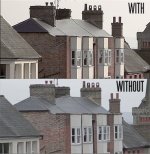
Post processing of top image: sharp & detailed.
of course u dont see ...
because resolution jump is on high frequencies (fine details) ...
i dont see much of that ...
find examples with hair feather and faces ...
ask James...
why dont u download video ....
i think its straight from camera...
In my day job I write image processing software. I've written real-time DCT-II code and developed spectral image processing algorithms from scratch. There's plenty of high frequency information in those images, especially in the mortar edges between the bricks, that's why he picked that shot.
So that we're clear on what is meant by high frequencies, I mean the spectral basis functions near the lower right corner of this image:
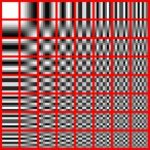
From: http://en.wikipedia.org/wiki/Discrete_cosine_transform
Again, ~890 lines with the OLPF is pretty solid. Still looking forward to the OLPF-removed resolution chart (no point pixel peeping other test images given the result of this last test- only a chart will tell us any actual resolution improvement).
Emanuel
Cross-Examiner
John,I processed the top image in PPro using a convolution sharpen and my GPU noise preset. I'm not seeing 15% increase in resolution in the removed OLPF version. In the With OLPF image I can see loss of detail in specific areas which may be related to lighting/contrast, and perhaps even ALL-I compression artifacts (trying to find out if James used ALL-I or IPB. IPB preserves details better in my tests). Entertaining idea, but not sure it's worth voiding the warranty and risking moire for that mod yet. A resolution chart will show any actual gain.
View attachment 51030
Post processing of top image: sharp & detailed.
It would be nice to see you apply the same post processing to both samples, can you?
E

John,
It would be nice to see you apply the same post processing to both samples, can you?
E
Others are welcome to! I can see areas missing detail in the OPLF image- thus the removed-OLPF image can ultimately look better (not clear how much- feel free to take a crack at it). However, it would be helpful to know if they used ALL-I or IPB. ...resolution chart...
John,
Isn't it fair to say that the (analog) AA filter can't be much of a factor on the 5DIII because that filter is calibrated for still photos, whereas the video image has pixel spacing (or effective size if it uses a 9x9 block) that is 1/3 the (spatial) frequency?
Further, can we surmise that since the C300 is video only, that its (analog) AA filter is tuned for video?
And finally, can we go further out on a limb and say that the good AA results of the 5DIII are due to digital AA? Is it possible that a well-tuned analog AA filter works better than digital low-pass filtering?
Speaking of digital AA filtering, isn't it necessary to do that using the full frequency band? I.e. you can't just average the 3x3 block and THEN do digital AA filtering, right? Otherwise, there's no way to know what's an aliasing artifact and what's not, correct?
As a corollary, would you agree that only the low-frequency performance of lenses is important on the 5DIII?
Thanks so much again!!

dustylense
Veteran
Oh no. The 5dmk3 is soft again. You guys are going to kill your eyes and brian cells in search of 100 lines. Now, it's all kinda just getting a bit silly. AA filters, 4k sony's, 8k sony's, blah blah blah blah. I miss my 10mp Leica M8, a camera that could smoke my Mk3 in resolution printed at any size. My hallway is decorated with M8 images I took in Jamaica using 1 lens where I took 2,500 images in a 5 day visit. They are still sharp to this day...