300w CFL "grow lights" for film use?

dv416

Well-known member
What do you guys think about using lights like these for film?

http://www.lightbulbsurplus.com/index.php?main_page=product_info&cPath=622_7_80_123&products_id=250

The CRI of 80 is a tad low I guess, but I am really curious to try like 3 of them in the photoflex constellation3 head, seen here. http://www.bhphotovideo.com/bnh/controller/home?O=&sku=554806&Q=&is=REG&A=details

am I missing something, or could this be a legit 900w / 2700-ish incandescent equivalent? anyone ever tried something like this?
 
There are all sorts of huge spiral (or in this case tubular??) flos in standard and mogul base out there - cool lights sells a nice mogul one. Get hold of a few and do some color tests.
 
Depending on what you are doing, the low CRI may/may not be a problem. I believe its still pretty common for a lot of the CFL's having a green tinge. I bought some 85 watt http://www.alzodigital.com/online_store/light_bulbs_compact_fluorescent-daylight.htm and I haven't put them to use yet. I am very concerned about stress the glass is under because the bulbs are so big (and heavy). When I tested the Alzo I saw more a blue tinge, but I don't have accurate equipment to measure with. I've read others here having a broken bulb issue (even on the 150w "smaller" bulbs). What to me these lights should be in is a trough like a softlight http://www.bhphotovideo.com/c/product/626912-REG/Smith_Victor_401409_SL270_3_Light_Video.html to support and protect them vs the configuration you posted (especially when transporting). It would make ME nervous running around with an almost $100 bulb which was intented/designed to be screwed in a light fixture once and replaced only when it died. Even for studio use the way most folk move lights around I suspect breakage would be a problem.
 
Well, the CFL manufactures throw out those "Equivalent light output" specs pretty freely actually and I am a little skeptical. I have done my own photometric testing on a lot of lights (A great reference tool to get a frame of reference for lighting, BTW) and was a little shocked with the CFL bulb I tested. Below is an example.

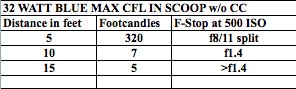
I did photometric testing on a 32 watt CFL bulb that said that it "Replaces" a 125 watt incandescent bulb. The bulb is a 5500 K with a CRI of 93 and has a standard E26 medium base (Standard household screw in socket).

Here are the photometrics with one of the bulbs in a Home Depot 8" scoop clamp work light:

32 WATT BLUE MAX CFL IN SCOOP w:o CC.jpg

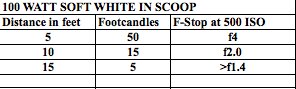
Now here is the photometrics of a regular household 100 watt Soft White incandescent bulb.

100 WATT SOFT WHITE IN SCOOP.jpg

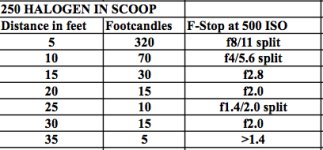
For comparison, here is the photometrics of a frosted screw in 250 watt halogen bulb in the same fixture, see below.

http://www.filmtools.com/nehoba2532qu.html

No doubt the bulb in the OP would be bright, but I would be wary in thinking that it is going to give you the same photmetrics as even a 2000 watt incandescent bulb in a pro fixture.

I also would not use a CFL bulb with the "Warmer" color temps and a CRI that is that low. The CFLs I noted above is a daylight bulb, called a "Full Spectrum" bulb (Take that with a grain of salt) and a pretty high CRI. It still has a green spike and I only used them with a sheet of 1/8 minus green gel. I still did not really like the color rendition under them and did not really give good skin tones. I have used the warmer CFLs with lower CRIs back when I was shooting SD and the color sucked.

I also ran into a reliability problem with the above CFLs on a low budget shoot. I had 10 of the bulbs and broke 2 of them and had another 4 just stop working on me. They just did not stand up to the handling that a light gets on a low budget movie set. Maybe that was just a bad brand of lights, but I kind of soured on CFLs.

250 halogen in scoop.jpg
 
I thought "grow lights" had extra UV output, which might not be healthy to look at. The description of this light doesn't mention UV, but it says the color temp is 6500K, which would be closer to UV than would most "daylight" fluorescents sold for cinematography. So, you're interested in the light because of its efficiency? :undecided But if you have to gel it in order to match the color temp of your other lights, you would lose some of the efficiency.
 
Am I missing something, or could this be a legit 900w / 2700-ish incandescent equivalent? anyone ever tried something like this?

What you're missing is accuracy and in particular, precision. You'll likely get considerably more bulb-to-bulb variance with these lamps. These bulbs will likely age differently (they won't shift at the same rate, or in the same direction, etc.). When you have to replace one you might get a larger than expected color shift, etc.

This is one of those deals where "you get what you pay for". The cost of an actual cinema bulb buys you more than just an accurate initial color temperature and a high CRI. Just sayin'.
 
When you start mixing this stuff up, you really really need to do tests.

CRI can be meaningless - between manufacturer's fudging an spikes that don't affect video. You need to see how the light works on a camera sensor, and be able to compare it to a neutral RGB gray - and a mathematical description of the RGB values can tell you how far off the light is.

My method isn't remarkably scientific, but it's worked for me: set a good DSLR to daylight. Use a lens you know to be fairly even (I have some vintage lenses with really milky flare - great for video, not for testing).

Get a "real" gray card - or even better, a set of white, black and grey cards. (Amazon sells a set of cigarette-pack sized for cheap). Shoot these under each of your daylight sources. Measure exposure from the gray, and shoot raw. Use a little dry erase board to note which light you're using. And frame the whole setup in gray to avoid flaring that might affect color. (Making notes of the exposure can tell you what the comparative output of each bulb is, as well).

Open the raw files in photoshop (you don't need a calibrated monitor for this), color temp "As shot". Eyedropper the gray. The RGB values should be very close - like R125, G125, B125. (eyedropper the white and black as well, and see if the variance of the values is about the same).

Create a patch of 125/125/125 and paste it in each shot and you'll see how even a few points off becomes visible when you have a grey reference to look at.

YOU DON'T NEED A CALIBRATED MONITOR - this is all about "relative" to a neutral gray, which you can display for comparison (125/125/125 is a good start).

Say you have a reading of R125, G133, B125 - that light is running green and will need some minus green to correct it. Reshoot with 1/8, 1/4, 1/2, etc and see what gets you closest. And take a sharpie and MARK THAT ON THE GLOBE'S BOX - just "1/4 minus green", for instance. Now you don't have to remember a thing on set.

Here's something a little more advanced:

I have a big CFL that runs yellow. The gray card photographs at something like 125r, 125g and 115 blue. Since the max of each channel in RGB is 255, I created a color swatch where I subtracted the difference between the other two channels (the blue channel was 10 points off the other two, so subtract 5 from each channel) - 250r, 250g, 255b. This makes a very light purple-blue. Stick a layer of this over your gray, and set that layer's visibility to "color" - and watch the gray under it go neutral. It's not perfect, but a lighting gel that looks close to 250r, 250g, 255b will be a good start to correct that bulb. (and when you create that swatch, you'll see that's about a 1/8 density). That won't give you an exact figure but will point you in the right direction.

You can google "RGB values for lighting gels" - there's a guy who's made an Excel file. I just do it visually.
 
Great post Michael. I have been shooting my test with my video camera and viewing the results on the scopes in FCP and Color, but have been doing it pretty much seat of the pants. That helps a lot. Thanks.
 
Yeah, with a video signal (at least for my uses) it's whatever profile the footage is going through - DSLR camera profiles or "Flat" settings, or Panasonic or Sony "cinema" settings - all of those are messing with color rendering (in a "good" way for artistic expression, just not for testing), so you may not get a pure, balanced grey. So I try to test the lights with a little more "purity" via raw stills - you can set up and test all your CFL's, biax, HIDs in an hour or two and know just what you've got - how they all relate to one another and get a baseline regardless of the actual settings and color temp you use on set.

One thing I found when I tested - those Alzo HIDs are "white". The closest "daylight" source I had to daylight. I use the hell out of those.

Great info Michael. Thanks.
 
What do you guys think about using lights like these for film?

http://www.lightbulbsurplus.com/index.php?main_page=product_info&cPath=622_7_80_123&products_id=250

The CRI of 80 is a tad low I guess, but I am really curious to try like 3 of them in the photoflex constellation3 head, seen here. http://www.bhphotovideo.com/bnh/controller/home?O=&sku=554806&Q=&is=REG&A=details

am I missing something, or could this be a legit 900w / 2700-ish incandescent equivalent? anyone ever tried something like this?


I bought one of these over a year ago to try out and put in a 24" x 36" softbox and man did it ever light up a room... I wasn't mixing it with other color temperatures but when I did my white balance I felt the colors were great even if the CRI rating was low. This is about equivalent to 1000w incandescent but already daylight balanced (sort of). For the money I paid I have no complaints and for cheap daylight fill I thought why not.

I haven't really used it since because I wasn't sure about the UV.
 
One note is that the listed lumen ouput seems rather low for a CFL. I would hope for at least 60-100 lumens/watt with 80-100 being fairly common, but 15000 lumens for 300 watts is only 50 lumens/watt compared to ~20 lumens/watt which is common for incandescent. Then again I usually take any listed specs with a grain of salt, and I usually expect unknown bulbs/lights to underperform their specs if anything.
 
Back
Top