3 CCD vs CMOS on LED Volume

tayproductions

Well-known member
We have just started filming on an LED volume, and we are having the typical troubles most people have when starting. We have pretty much got it dialed in on the shutter speed, but we can not move the camera because of the screen tearing and the moire at certain focal lengths. Does anyone know if cameras with CCDs have better luck with these screens?
 
I'd be surprised if anyone is using a LED volume anywhere in the world with anything but a CMOS camera. Do they even make CCD cameras any more?
I think whatever problem you have is unrelated to the type of sensor or number of sensors, else nobody would be able to shoot with an LED volume.
Just my opinion. Never used a volume . . . yet.
 
The simple answer is yes. CCD are by the nature of their readout are effectively the same as global shutters in performance. The much slower readout speed of CMOS, especially with larger sensor cameras, contributes greatly to image scan tearing. Combine a CCD with an ECS shutter, like most Sony ENG cameras have, and you end up with the ability to one, dial in a suitable matching scan frequency to your LEDs. And secondly with a typical readout, which on a late model 2/3" CCD is around 1 ms you have the ability to move around pretty much as you wish without suffering too much image tearing.

Moiré is an optical phenomenon that occurs when two patterns with similar frequencies interact with each other. This affects both CCD and CMOS sensors. This interference can happen at various focal lengths dependent on the pattern being shot. I've lost count of the number of times I've had to adjust focal length on zooms or move a camera backwards or forwards with primes when shooting striped shirts, hounds tooth pattern jackets. Absolutely ad nauseam for many moiré plagued interview shoots.

For the express reason of shooting scenarios that involve LED screens, walls, LED monitors and lighting etc. I still keep a 3 CCD Sony ENG with ECS shutter camera for those shoots. Usually DOF is not an issue with these scenarios, so a smaller CCD sensor camera that minimizes most of the above issues saves tons of heartache in the long run.

Chris Young

Shutters comparison.jpg
 
We have just started filming on an LED volume, and we are having the typical troubles most people have when starting. We have pretty much got it dialed in on the shutter speed, but we can not move the camera because of the screen tearing and the moire at certain focal lengths. Does anyone know if cameras with CCDs have better luck with these screens?

Have you GENLOCKED the camera to the screen?

Do you have a skilled operator of the volume?
 
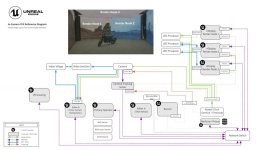
If you are talking about something more sophisticated than scan locking a camera to a LED Volume then yes you are going to need full genlocking. Like is carried out when using Unreal Engine with Nvidia graphics cards and Nvidia G-Sync, or AMD's FreeSync. Camera and GPU syncing is shown in the graphic below. G-Sync was primarily designed to avoid screen tearing. It forces the display to sync to the graphics output, rather than the graphics card adapting to the display. The graphics engine or engines and the camera/s are then all genlocked together.

All this is above my pay grade, but I listened to it with interest as this issue was being discussed in a production meeting a while back for a large sporting event that required a number of LED Volumes. Also discussed is what sort of cameras were to be used. Apparently, ARRI has a way of syncing cameras to GPUs via their data port and a proprietary cable. The links below were some of those in our production notes. May be of some help. Again, all of this is above my experience level. Just passing on what I have heard.

Chris Young

https://docs.unrealengine.com/4.26/en-US/WorkingWithMedia/InCameraVFX/InCameraVFXOverview/

https://docs.unrealengine.com/4.26/en-US/WorkingWithMedia/nDisplay/Synchronization/

Unreal Engine - In Camera VFX x 2000.jpg
 
We have just started filming on an LED volume, and we are having the typical troubles most people have when starting. We have pretty much got it dialed in on the shutter speed, but we can not move the camera because of the screen tearing and the moire at certain focal lengths. Does anyone know if cameras with CCDs have better luck with these screens?

Your original question landed at the right time. An interesting article here about the nest of problems when shooting LED screens. Also look for the Grass Valley white paper that you can download from this page. An interesting read.

The Challenging Relationship Between Cameras and LED Walls: A White Paper

https://ymcinema.com/2023/11/09/the-...a-white-paper/

Or you could go straight for the white paper here:

https://www.grassvalley.com/media/iz1k3xki/led_wall_ds-pub-3-1051a-en.pdf

Chris Young
 
Your original question landed at the right time. An interesting article here about the nest of problems when shooting LED screens. Also look for the Grass Valley white paper that you can download from this page. An interesting read.

The Challenging Relationship Between Cameras and LED Walls: A White Paper

https://ymcinema.com/2023/11/09/the-...a-white-paper/

Or you could go straight for the white paper here:

https://www.grassvalley.com/media/iz1k3xki/led_wall_ds-pub-3-1051a-en.pdf

Chris Young

Thank you so much for all the detailed info. It will take some time for me to wrap my head around some of this.
 
Is there a particular advantage in 3-sensor prism cameras, while cameras were moving towards single-sensor Sony and Panasonic still produced 3-sensor cmos models such as z280, and believed there was a special reason for that.
 
Last edited:
The simple answer is yes. CCD are by the nature of their readout are effectively the same as global shutters in performance. The much slower readout speed of CMOS, especially with larger sensor cameras, contributes greatly to image scan tearing. Combine a CCD with an ECS shutter, like most Sony ENG cameras have, and you end up with the ability to one, dial in a suitable matching scan frequency to your LEDs. And secondly with a typical readout, which on a late model 2/3" CCD is around 1 ms you have the ability to move around pretty much as you wish without suffering too much image tearing.

Moiré is an optical phenomenon that occurs when two patterns with similar frequencies interact with each other. This affects both CCD and CMOS sensors. This interference can happen at various focal lengths dependent on the pattern being shot. I've lost count of the number of times I've had to adjust focal length on zooms or move a camera backwards or forwards with primes when shooting striped shirts, hounds tooth pattern jackets. Absolutely ad nauseam for many moiré plagued interview shoots.

For the express reason of shooting scenarios that involve LED screens, walls, LED monitors and lighting etc. I still keep a 3 CCD Sony ENG with ECS shutter camera for those shoots. Usually DOF is not an issue with these scenarios, so a smaller CCD sensor camera that minimizes most of the above issues saves tons of heartache in the long run.

Chris Young


Hello Mr. Chris Young, I am curious to know what is the latest ccd camera ? Was any new model made after 2010?
Thank you
 
Hello Mr. Chris Young, I am curious to know what is the latest ccd camera ? Was any new model made after 2010?
Thank you

Yes, you are right. Apart from Sony's HDC studio / EFP cameras, the last of the CCD cams to my knowledge was the PMW-500 from 2010. It still delivers excellent images considering its age. And they are showing their age now in terms of noise etc. but they were at the pinnacle of CCD development, It has the same CCD sensors as the PDW-F800. How many 800's are there running around the world? Countless numbers of them.

Chris Young

 
Back
Top