2.35:1@HV20's anamorphic lens test -- Michael Pappas' new HV20 tests

Deimos, do you think that the blur on the sides is given by the cheap lens or it's a side effect of any anamorphic one?
Well, it's exactly the same that happens with cheap wide lenses: they tend to blur all the corners. With the anamorphic lens, the best way to avoid this, is to use a larger lens than the camera optics. That's beacuse your are not gonna use the worst part of the lens, and that part is of course, the edges.

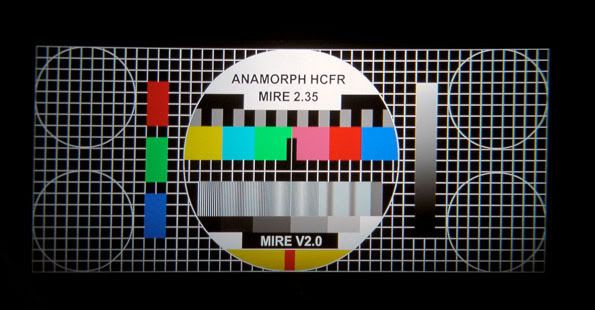
Unfortunately, when the same lens is attached to my projector I have more noticiable blur on the edges, because the beam has a wide angle, and even with the anamorphic lens directly in front of the lens projector, the edges are being covered with the picture, with a little vigneting, as you can see in this test pattern (not 100% accurate, beacuse the lens wasn't placed correctly and there's a shadow on the bottom).

DSC09924.jpg


But it still worth it, because the blur (and difraction) on the edges is only noticeable with projected windows desk or test patterns with white thin lines. Hard to find in a movie, even if it's HD.

DSC09924b.jpg


So, the bigger the lens is, the better. And if you plan to use an anamorphic lens with a camera with large optics, you MUST use a big anamorphic lens to avoid any blur.

And yes, with the anamorphic lens, the image on the display of the camera appears vertically streched.

It is actually about 70$
Right, I did the conversion backwards. :S
 
Last edited:
Deimos said:
I didn't shoot with cinemamode because I hate 1/25. In fact, film cameras never go so down wich reveals a weird setting for a mode called "cinema". In fact, they usually stay at 1/125 or 1/250. And it's a shame to not have real control of aperture and shutter in this camera, specially when we have pro features like zebra, guides, or audio level adjustment. ¡Even a cheap foto camera let's you control everything on manual!

I think is just a way to protect prosumer brand aginst the consumer one.

50 euros is about 40$... I think.


a regular film will generally shoot at a 1/48th equivalent shutter speed.

music videos may be shot at such a high shutter speed, or for intense battle scenes like saving private ryan. But generally speaking, shutter speeds stay around the 1/48th to maybe 1/75th.

and i am yet to comprehend the idea behind using an anamorphic adapter when projects can only be 16x9 and 4x3 in the first place.... The idea that you get more image is rediculous because framing the camera further away, then cropping in post will retain the same resolution as an over large, stretched anamorphic image that is then squeezed to fit into the 16x9 area...

Where is Barry at?>
 
I'm with you, PaPa. I think using an anamorphic and then stretching/squeezing is of very limited value, since there are no anamorphic video delivery systems. It's cleaner and easier to shoot 16:9 HD, and if you need 2.35:1, just letterbox/crop it down.
 
Now, it seems it's my turn to think I'm missing some piece of irformation around this here... :)

1st advantage: wider angle?

2nd advantage: the vertical res will always be 1080 native and not circa 25% less, even after when it will be cropped...

3rd advantage: the anamorphic feel spread all over the (blue) flare artifact, typical bokeh and highlights (the cropped motion pic won't decidedly/definitely have the same look...)

Last but not (the) least advantage: if I'll go to a 2K scan, for example in order to a film-out, wouldn't I save some pixels -- around 12.5% more* (even if taken from a fake horizontal 6.66% increase based on a 1920 uprez to 2048) from an anamorphized solution vs. a cropped one?

* But if cropped to 1:2.35/2.39 we'd lose at least 25% (of pixels less)...
 
OK but even not there, beyond those other cinematic advantages, we'd have a native lossless grain/noise reduction... That is, if we can get to keep the sharpness from the glass. :D
 
2nd advantage: the vertical res will always be 1080 native and not circa 25% less, even after when it will be cropped...
In exact numbers that will be this:

1440x790 real pixels in your cropped 2.35:1 footage.
1440x1080 real pixels in your anamorphic 2.35:1 footage.

And as Emanuel said, even if you plan to downsize to correct the aspect ratio, you are getting smaller video noise, and the usual sharpness of a downresized image.

3rd advantage: the anamorphic feel spread all over the (blue) flare artifact, typical bokeh and highlights (the cropped motion pic won't decidedly/definitely have the same look...)
This is an example of the lovely anamorphic blurred lights of Apocalipsis Now:
anamorphiclights0.jpg

anamorphiclights1.jpg


Edit: Here is a zooming test with and without the anamorphic lens. The loss of sharpness is noticable, so it is better to not use zoom with the lens:
http://www.megaupload.com/?d=VBSDI8AZ

When the subjet is closer, and the focus is not at infinite the zoom gives you an unfocusable image even in manual.
http://img.photobucket.com/albums/v347/deimoson/lenstest03.jpg

Here is another comparision. Keep in mid that the camera location is not exactly the same, in order the match the composition with and without lens:
http://img.photobucket.com/albums/v347/deimoson/lenstest01.jpg
http://img.photobucket.com/albums/v347/deimoson/lenstest02.jpg
 
Last edited:
that is some seriously weird bokeh.

ive been watching mostly 2.35:1 films lately and i have never seen bokeh stretched like that, nor does it make that much sense to me.

optically, the image is being stretched to fit on regular widescreen film that is then projected at the correct aspect ratio to create the 2.35:1 image. Why then, would the bokeh retain its anamorphic stretched image? Once it is projected all the proportions should go back to normal no?
 
ive been watching mostly 2.35:1 films lately and i have never seen bokeh stretched like that, nor does it make that much sense to me.
That's because the most popular film format today is "Super35", who uses espheric lenses and crops the prints in order to achieve 2.35:1. It's a shame, but today only a few productions are shot in real "35mm anamophic", like The Last Samurai, The Thin Red Line, Memoirs of a Geisha or The New World...

The reason to shot in 35mm anamorphic is to have the best posible image resolution, beacuse you are using the entire 35mm negative, wich is cheaper than going to 70mm.

The main reason to shot in Super35 is because is cheaper, with more depht of field (easy to focus), more luminous lens (allow you to shot with the light of a candle), and the posibility of doing an "open frame" for 4:3 tv broadcasts, showing more image in the upper / lower side of the image.

optically, the image is being stretched to fit on regular widescreen film that is then projected at the correct aspect ratio to create the 2.35:1 image. Why then, would the bokeh retain its anamorphic stretched image? Once it is projected all the proportions should go back to normal no?
And you will be right in a perfect world. But lenses are not perfect, and the more you open the anamorphic lens, the more you increase depth of field artifacts, and the particular bokeh (i hate that word) of anamorphic is in fact, one of this artifacts.

Here are two pictures of a similar shot with Super35 and 35mm anamorphic:
http://cinexilio.yuku.com/forum/viewtopic/id/1862
 
I'm just a fan of cinema photography.

By the way, you're right about shutter speed in film. As you said, it's usually 1/48, and is the angle of shutter what is increased in degrees, starting at 180º. Number that confused me.
 
its just that video 1/48th really does not always resemble film shutter.
and i sometiems question if 1/48th, upon viewing my footage is truly the universal shutter speed
 
A good deal of what you're seeing is spherical Super 35 3-perf. I think that the ratio is about 1.78:1. It is very close to 16:9 and provides a significant savings in raw negative stock - about a third less stock is used than in typical Academy aperture.

One fact should be clarified - today's three perf utilizes bespoke movements and gates that only expose the 22 x 14mm frame over three exactly corresponding sprocket holes (perfs per side). Unless you wish to achieve another aspect ratio (e.g., 1.85:1 or 2.35:1) in 3-perf, you would not crop the 22 x 14mm frame.

Academy is spherical 1.37:1, though it is often framed for widescreen (1.85:1). The stuff above and below is simply discarded, effectivley wasting over 25% of the negative above and below the theatrical release frame.

e
 
Last edited:
So you gain resolution for a film-out by using an anamorphic lense because you are using the entire sensor, but on the other hand, the introduction of another lense causes an additional blurriness (and an extremely expensive lens would defeat the purpose), so does it cancel out?

I mean, in the end, is the additional res with the anamorphic lense good enough to overcome the loss of sharpness introduced by an additional lense?
 
Last edited:
Hi,
I have a friend who is coming from europe next month, if the anamorphic lens is 50 euro, i'm all for it! Unfortunately the ebay link isn't working (it says something in german, i suppose its just that the ebay item is not available anymore). Could someone please give info regarding the brand/model of the item or the name of the store?

Thanks!

PS: And where to get the pistol grip and lens hood Michael shows in the pictures?

HV202.jpg
 
Last edited:
So this is because of anamorphic lens the sides of picture get blurry. I always thought that there was something wrong with movie theater projector. Anamorphic lens was invented to squish wider image into standard 35mm frame, this was pure economics, and the solution is not ideal as we see. I don't see why do you want to imitate the defects of anamorphically-shot movies in your videos. After all, unless you are targeting big screen, you will be watching your videos on a widescreen TV, which is 16:9. I don't see a point watching wider and shorther image with black bars on top/bottom and with fuzzy sides.
 
Deimos:

I've been looking for that anamorphic lens but the link you gave us doesn't work anymore.
I'm really intrerested in getting one but as I said I can't find the one you are talking about. :(

Cheers!
 
Back
Top