GH5 2/3” B4 lens for GH5

Jase

Member
I’m looking for a low cost solution to make my GH5 more user friendly for live events, primarily those that are also streamed. Never having used such a lens before I’ve done some research. From what I’ve seen online it looks to me that potential issues are vignetting and sharpness. Vignetting would be solved by using the right optical adapter but finding one at low cost is where I haven’t had any luck.

More than that is the question of sharpness. A number of reports speak of this, yet in the video I’ve seen, while not as sharp as it could be, doesn’t look bad to my eye, acceptable for the intended purpose is how I'd describe it. How much more sharpness is lost when streaming? I've always understood this to be more a factor of the streaming bit rate but perhaps I'm wrong.

Can anyone suggest a low cost ($200 or so) adapter they’ve been happy with and whether they’ve used it in HD or UHD. I’d prefer to continue shooting with UHD but could live with HD.

Thanks
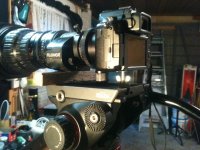
 
You also need a lens with a 2x extender, the extender almost always makes the image softer until you get up into the $15,000+ lenses (and then still often softer). This is from experience with lenses on multicamera sports remotes with lenses ranging from $10,000 to over $100,000 usd. For a GH5, I'd want an adapter that can support the camera, so something fairly stout, haven't seen any with a built in extender, this would make lens choice much easier. That and built in ND wheel would be a cool addition.
 
Having a 2x extender is my understanding for a purely mechanical adapter but that an optical one eliminates that need. All that I have found so far for in optical is way too high price wise. Fotodiox makes an optical adapter for M4/3 but for the pocket camera which of course has a different sensor size.
Yes, agreed about it being stout. Hadn't thought about the ND wheel, good suggestion.
 
AbelCine made One for the AF100, but no longer available. Yiu might find a used one somewhere. The closest I found was the 2X AbelCine S35 PL to B4 optically corrected adapter for $2500, which will require a MFT to PL adapter, another $200-500 for a good one with rail mount Support, which you are going to need, so you are at $3K to start. AbelCine and MTF Services made a X1.5 adapter for the 1-inch p/S16 sensor BM cameras, which would work in one of the window modes on a GH4/5, cost around $1500.

For $3500 you can get the new BM Ursa Broadcast Camera, which comes with a B4 Mount already atptached, no adapters required, and it shoots Extended Video color space for ready to use footage, similar to GH5S Extended Video mode, and film log or Raw.
Cheers
 
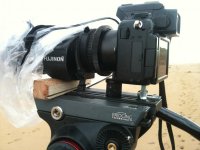
I've used a fujinon B4 lens that came with an adapter from RJ Camera supplies. Was a bit of a man cave job mounting it to a GH camera and getting it high enough to engage the extender. Got a range of 660mm from memory.These days I use a 100-300 Pana lense. The great thing about the Fuji lens was critical focus in CM's as opposed to MM's with the Pana. The look I got from the old B4 lens was interesting, but certainly not a modern look. The Manfrotto 502 head was never used again at those focal lengths...not nice at all.

IMG_1038.jpg
 

Attachments

  • IMG_1040.jpg
    IMG_1040.jpg
    76.3 KB · Views: 0
Last edited:
Thanks for all of your replies. I also found reference to the AbelCine. Seems like everything optical, if you can find it, would be expensive with the exception of the Fotodiox but thats really for a pocket camera so wrong sensor size. They also make a mechanical one that they demo on a G4. While they don't show it in the demo itself, they say in the comments that vignetting would be eliminated in ETC mode which does make sense to me, if you're in FHD.

Ned, I'm not surprised to hear it, but I'm curious to know more when you talk about the look being "interesting".
 
Having a 2x extender is my understanding for a purely mechanical adapter but that an optical one eliminates that need.

2x extenders that are built-in with the B4 lenses are optical and eliminate vignetting for MFT cameras. For Fujinon lenses, look for an 'E' in the part number. Here is an example.

https://www.ebay.com/itm/Fujinon-HA...487841?hash=item214086a9a1:g:XqsAAOSw3UZbDsBw


Here is an explanation of Fujinon part numbers. http://www.fujifilmusa.com/products...-uhd-hd-sd/uhd-hdtv-lenses/lens-id/index.html
 
Ned, I'm not surprised to hear it, but I'm curious to know more when you talk about the look being "interesting".[/QUOTE]

Jase, this timeline grab is shot at 8mm or 32mm FF. Bit of a bow in the horizon, but I wouldn't call it a sharp or saturated looking image. Focus is probably at the front of the board.

Fuji lens at 8mm or 32mm FF.jpg
 
Ned, what's the model number of that lens?

Jase, note that there are several generations (S, A, XA, HA) of Fujinon lenses and each has their own level of resolution. I've never seen them post anything technical (charts) about how they perform. You'd have to do quite some research to find out how any one particular generation of lenses performs.

Paul, I only had the lens for a week about 4 years ago, but I think this model number is the one from the actual lense I used, A20x8 BEVM-28. It was made well before the HD version and my friend bought it from another cameraman in England for about USD$400.
 
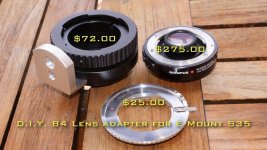
I have quite successfully used the following combination on an S35 E-Mount sensor using a B4 lens with a 2 x converter, aka a "doubler." I cannot see why the following combo wouldn't work on a GH5 M4/3 sensor but with a B4 lens WITHOUT a 2 x converter. All this can be achieved at a pretty reasonable cost. My reasoning is as follows:

GH5 sensor 17.3 x 13mm which gives you a image diagonal of 21.64mm.

Using 4K EX tele mode you have a crop of 1.4 which results in a 12.96mm diagonal crop. The diagonal of a B4 HD sensor is 11.2mm. Multiply that by 1.4 x of an Olympus MC-14 1.4 converter and that takes your image circle up to = 15.4mm.

In theory you should be able to use the 11.2mm image from a 2/3" B4 lens WITHOUT a 2 x converter in conjunction with an Olympus 1.4 tele converter and end up with an image diagonal of 15.4mm which should easily cover the EX tele cropped GH5 sensor diagonal of 12.96mm.

A 1.4 x converter will give you a 1 stop loss. Fairly accurate stop loss calculations with converters is easily worked out. Just divide the multiplier factor into your F/ stop. Example F/8 divided by 1.4 equals F/5.7, ie F5.6. Have no fear about the quality of the Olympus MC-14 1.4 x converter. It is quite stunning. The following video was the one that gave me the idea to try this option out. The comments about the forward protruding element don't apply when using a B4 to M4/3 adapter in conjunction with the MC-14 as there is ample space in the B4 to M4/3 adapter. Check out the image below, just ignore the M4/3 to E-Mount adapter ring. One proviso. I haven't tested the Olympus MC-14 with a GH5 but if they are compatible I see no reason this pretty cost effective solution won't work on a GH5 with some pretty amazing results. The B4 adapter was purchased off eBay for $72.00. One word of warning if you go this route. B4 lenses are pretty heavy so I would use some kind of lens rod support. Also a keep an eye on the small screws on the MC-14 as they can come loose. A dab of Loctite on all screws fixed this issue.

Chris Young

https://www.youtube.com/watch?v=BoPAfJQknAc

B4 to M43 Olympus 1.4 x Tele Converter to E-Mount.jpg
 
Paul, thanks for the Fujinon link. Very helpful. Unfortunate they don't tell you more about lens generations.Whats been tough with this is finding specifications. I'll try to find the same for Canon.

Ned, thanks for the screen shot. Disappointing but helpful.

Chris, I'll have to take a closer look at that option. In the end, I'm looking at B4 as a stop gap measure until I purchase a new camcorder. (Not in the budget right now) If the price gets too high, there isn't any point. The price of your suggestion is great but finding the right lens at an affordable price is the question.
 
Do you need power zoom? What about a parfocal still lens like the Canon FD 35-70 and 20-35? Not exactly on the long side, put they are parfocal. Couple them with a speed booster to get some of the wide end back and a little light gathering back.
 
The price of your suggestion is great but finding the right lens at an affordable price is the question.

Look for something like this:

https://ebay.to/2xCmq4k

These were around $22,000.00 in their day. They were the very top of the broadcast range in 18 x. Extremely decent quality for the price and I think for the money invested a good value solution. Don't forget to take into account that you would be using a 1.4 x converter with a B4 lens so a 7.6mm wide end would effectively become 10.64 in B4 2/3" terms and the long end 25.2mm using this 18 x as an example. So for sports, stage events, etc a very decent range.

Chris Young
 
These were good lenses in their day, not quite the same resolution as the newer HD lenses, but should work. They are Hybird lenses, in that they could shoot 4:3 or 16:9 aspect ratio with a change switch for the vertical resolution.
Cheers
 
All very true but surprisingly close. It was the best glass in its day and as they had no such thing as ALAC (Sony) or CAC (Panasonic) chromatic aberration compensation circuits to rely on all CA correction had to be done 100% optically. The main differences were that an SD lens by definition had to resolve in the order of 30 lines per millimeter as opposed to around 80 lpm for HD. On test I've found many of what were the very top end SD lenses can in fact deliver close on 80 lpm. I've actually observed this in Canon's own service facility. The main difference comes down to a difference in contrast and MTF which is better controlled in the high end HD lenses. In part this is contributed to by different lens coatings that are optimized to work at the higher detail µM frequencies experienced in HD.

Contrary to my above comments though I have observed a better overall performance from what were the very top end last model SD lenses from both Canon and Fujinon than from some of the lower cost HD lenses such as the Canon HDgc and Fujinon XS HD lenses. These often came as the 'kit' lens on some cameras. Some of which while being sharp exhibited some horrible CA at wider apertures and at certain zoom lengths. In a lens I would generally trade off super clinical sharpness and poor CA performance for a slightly smoother detail look and better CA performance any day. To get comparable performances to the top end SD lenses you really have to go to the top end HD glass. Then there is the matter of price and price was one of the concerns of the original poster.

Re your hybrid comment Denny I've found you can use the 4:3 aspect cross over converter on the 2/3" lenses on a 1/2" chip camera with great success. The HD image diagonal is 11mm. The hybrid cross over 4:3 image circle is 9mm for SD shooting and therefore covers the HD 1/2" sensor diagonal which is 8mm. Using the 4:3 cross over gives you about 20% more lens width on the 1/2" chip and close to .7 of an F stop in light gain and looks sharper. Works a bit like a Speed Booster, same principles.

Of course we are all now wondering how high quality HD B4 lenses are going to work on UHD and 4K where spatial frequencies are getting up around 200 lpm. Some interesting reading here:

https://www.fdtimes.com/2016/04/15/can-23-inch-broadcast-field-lenses-really-portray-4k-uhd/

Chris Young
 
Interesting comments Chris, and I agree thr top of the line SD lenses are better than the HD bottoms end kit lenses. I have seen several tests on this.
Cheers
 
Greg - As much as parfocal would be great in a still lens, I think a power zoom is essential. Of course being parfocal would minimize the need to refocus but if I had to both manually zoom and focus at the same time in a live event… that isn’t something I’d look forward to.

Chris and Denny - A lens like that could be the ticket. Later today I hope to go down to what is probably the oldest camera shop in town and see what they might have kicking around that I could rent for a day. FWIW, occasionally when shooting 4k I use a Century Optics 2x teleconverter, initally bought for a PD150. $500 back then. I doubt you’d want to pixel peep or project in a theatre but delivering in 1080 and watching it on a 50” TV, I see no appreciable difference. I also bought their wide angle, which I’d use as well but its a bayonet mount and I don’t beleive there’s an adapter to use it on a threaded mount.
 
Yes, but just about all the ENG Zoom lenses, especially the higher end ones, were parfocal. That was the
Lint, as an ENG camera operator, you would Zoom in quickly (zoom control was pressure sensitive and you could control the speed by how far you pushed the rocker down) then you would pull focus on on the subject with the other hand (left on Zoom, right under the lens on focus ring), and zoom back quickly to frame the shot.

All this was second nature, where riding the focus was/is important is when covering a moving subject or using the camera handheld, then you would need to be constantly adjusting the focus, but if you were wide, which was the case for most hand held shots, then depth of field on the wide lenses on a 2/3rds sensor kept most moving subjects in good focus.
Cheers
 
Last edited:
Back
Top