1DC: 1DC AUDIO tests-using camera as recorder via external recorder

eco_bach

Well-known member
Is anyone aware of any tests comparing the audio differences between the audio signal recorded IN CAMERA using the mic in from an external recorder and or preamp, vs the identical audio recorded in a external recorder like the ZoomH6 or H4N?

Especially with the new firmware update which gives proper line level signals for the mic-in, I'm wondering what advantage, if any, there is for doing dual audio?
If you are doing run and gun documentary/eng, then you don't need an external audio recorder, but you do get better audio having a good external preamp. Using a battery powered microphone direct into the camera is viable for many situations. But, an external recorder is better, and you get more options. If you are shooting commercials or drama, then a separate recorder is highly recommended, unless you really hate syncing audio. =) The reason is post processing. There is so much clean up in post for audio, it is nice to have more robust files already to go.

If you can't find anything, I will consider doing a test.
 
What kind of shooting are you going to do? Are you shooting interviews/ documentaries or drama? Even in documentaries, we do audio post and add some effects, external sounds etc among other things.

I know purists will howl. However, my personal experience is that if your microphone is placed at the right distance (ie. just not on top of the camera), and routed through decent preamps or atleast a preamp like a juicedLink, then if you record dialogue to the camera people will not know. The 1D C is 16bits. However, I feel those 16 bits are better than some of those cheaper recorders. Take it with a pinch of salt, as I had tested this camera long back before buying C300.

For dialogue, I may vary the levels, if required in rare instances as it is very important to place the microphone at the right distance pointed at the right angle. Apart from that I won't do much of massaging the audio. So even the 16 bit is fine in many situations.

Having said that, I will definitely use my SD 702T for recording various nature sounds, effects etc. And even when I am directly recording to the camera, I am also placing another microphone and recording to the SD 702T or to another recorder (mostly unmonitored after initially setting the levels).

The benefit of double sound is that you will be recording in wav files which will allow you to do push and pull in post.

These days with lower budgets, it is increasingly becoming difficult to budget for a sound guy. So asking for separate persons to hold the boom, mix etc is becoming tough. So I can understand your predicament.
 
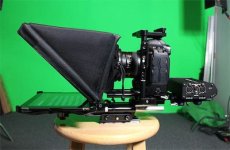
I routinely use a Sound Devices MixPre-D on rails directly behind our 1DC with very good results. Dial down the 1DC's levels and use the pre-amps on the MixPre-D to drive levels. Have not had the opportunity to use a external recorder yet to compare to the internal recording using this setup. The MixPre-D has a dedicated DSLR unbalanced out on a TA3 connector. This is a pic with our prompter set up with the MixPre-D hanging on the back.

1DC.jpg
 
Last edited:
I don't have a 1DC, but I have a 60D. I'm assuming the preamp on the 1DC is better. I test out the mix-pre D directly into a recorder through AES and also through the specialized DSLR output into the 60D. The sound was almost the same. The waveforms looked almost the same. I'm a sound guy and I was perfectly willing to record directly to the camera after the test. The only thing I noticed was that the low bass sounds under about 120HZ were a bit muddier into the DSLR than recorded directly from the mix-pre D. For dialogue or interviews, though, this didn't matter at all since I always use a high pass filter.

In short, recording directly into the mic input on a DSLR is a perfectly valid solution as long as your preamp is gained high enough to keep the preamp on the DSLR turned very low. Or, use a mix-pre d. Love that thing.
The manual gain on the 1D-C has to be very very low, in order to be very clean. In the lowest ~5% of the gain scale settings. So, whatever mic or preamp goes into it, it has to have some good clean output. So, something like a Mixpre-D is ideal. Something like a rhode battery powered thingy... maybe for something not critical. But, I agree, recording direct to camera is a very valid solution.
 
Actually my shop owner friend(head phone shop) sold me a dead stock Shure VF83F at half price, I will try to take it out for a try and compare on the streets next week, and share the result files.
 
Back
Top