10bit vs 8bit vs 7bit Log (beware: 3mb worth of images :)

10bit vs 8bit vs 7bit Log (beware: 3mb worth of images :)

  • I can see a difference between all 3 images

    Votes: 4 44.4%
  • I can see the difference only for the 7-bit one

    Votes: 0 0.0%
  • They look the same!

    Votes: 5 55.6%

  • Total voters
    9

bruceallen

Well-known member
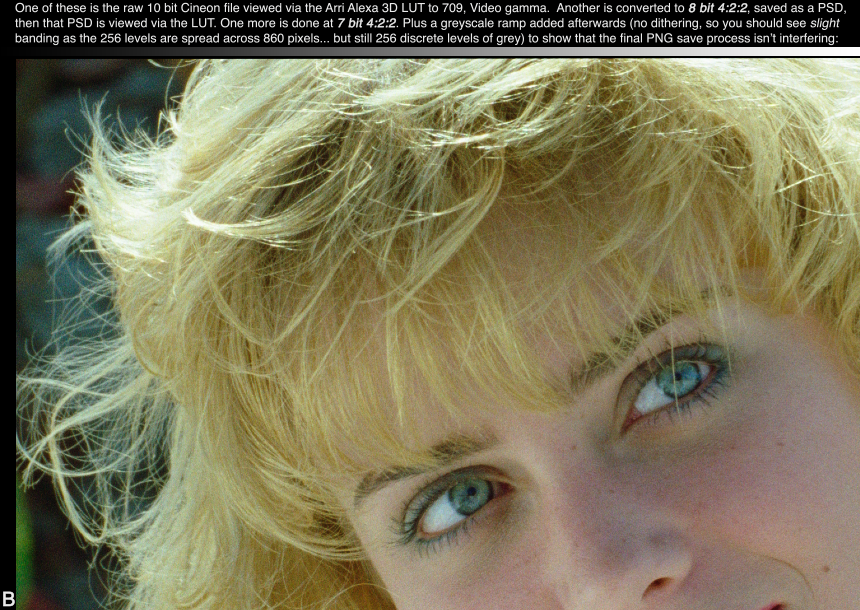
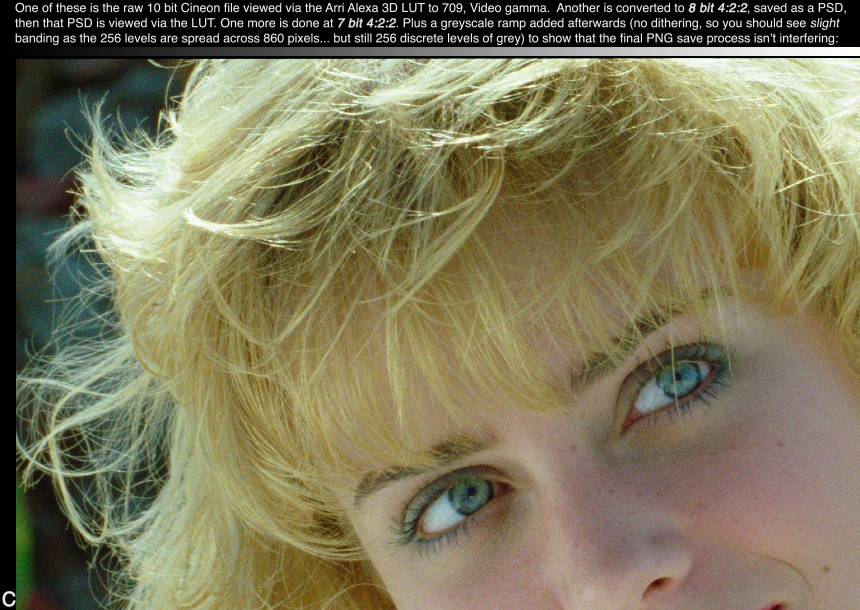
OK folks - everyone who has been saying that the Canon C300's 8 bit log 4:2:2 SUUUCKS - would you mind telling me which image is from the 10-bit log source, the 8-bit 4:2:2 log source, and the 7-bit 4:2:2 log source?

This is based on the Kodak reference image for the Cineon log format. And due to the film noise, scanning issues, etc... it's near impossible to tell the difference!

SENSOR IS KING. SENSOR IS OFTEN THE WEAK POINT IN THE CHAIN. If you criticize a camera from just the specs point of view without thinking about the sensor, you're silly.

The C300 has a 14-bit readout from a beautiful-looking sensor. If you set your camera right, you should have no problem getting a great image out of it.

Even if it is a 4:2:2 8-bit 1080p image... it could easily beat a higher-spec image (4:4:4 / 4K / whatever) from another camera if the sensor in the other camera isn't as good.

Everyone wants 4:4:4 color like the F3... but, um, can the Sony F3 even resolve 4:4:4 color? I don't think its sensors are full 1080p resolution for each color, are they? For that matter, can an original non-MX Red One capture as much detail in low light at 4K, 288mbps RAW (REDCODE36) as the C300 can now?

People who complain about the C300's tech specs (OMG no 4:4:4 10bit) without thinking about sensor should ask themselves:
Do I want a great microphone, recording at 44khz 16bit... (heck even to a MP3, or analogue tape).
Or an inferior microphone, recording at 96khz 24bit?

I'm not buying a C300 - but I just don't understand why people are going so nuts about it, many from a purely specs perspective. If you want to criticize specs, by all means criticize the lack of 60P at 1920x1080.

But if Canon comes up with a C305 that has 4:4:4 10-bit log and still no damn 60P at 1920x1080, it's all you guys' fault for picking the wrong specs to get nutso about :P

And sorry about the gigantic images. But otherwise someone would complain that the final compression was interfering.

Bruce Allen
www.boacinema.com

UPDATE: Added a grading latitude test since people were asking about it - and made the other images slightly smaller and clearer-worded :)

marcie_bitdepthsand444vs422_Latitude.png


marcie_bitdepthsand444vs422_A.png


marcie_bitdepthsand444vs422_B.png


marcie_bitdepthsand444vs422_C.png
 
Last edited:
yeah, I can totally TELL. . . its. . . its. .. ehm. . . well i guess i will give others the chance to look at it first before giving them the results! (:P , on a more serious note, i find it sad/fascinating that people bash the canon so hard and hype the scarlet like no cam before. . . 2k with 2/3 sensor and crappy low-light vs 1080p on S35 and beatiful images EVEN in low light. And with the streetprice of 15k, i think it's totally worth it compared to the rushed scarlet . . .)http://www.dict.cc/englisch-deutsch/fascinating.html
 
ImoI dont want 4:4:4 unless im shooting something big. 8bit 4:22 vs 10bit 4:22 obviously you cant tell the differnce until you grade it.On c300's case i wouldnt pay 20k if it doesnt have 10 bit. Lower tiered cams like ex1 ex3 nx5u and xf305 has em.Would you pay 20k knowing you wont get the best image you can get out of an awesome sensor?
 
ImoI dont want 4:4:4 unless im shooting something big. 8bit 4:22 vs 10bit 4:22 obviously you cant tell the differnce until you grade it.On c300's case i wouldnt pay 20k if it doesnt have 10 bit. Lower tiered cams like ex1 ex3 nx5u and xf305 has em.Would you pay 20k knowing you wont get the best image you can get out of an awesome sensor?

Because Canon's 10bit-supporting chipset isn't done yet?

I'm sure the chips are coming - but the XF305's chips are 100% reliable and I don't think Canon would risk messing up their reputation if the new chips weren't 100% working too.

The whole point of this camera is small and light and reliable. They want to attack Arri and Sony, not RED. What is Arri and Sony's advantage over RED? For one thing, reputation. Even though Sony and Arri both do some "Beta" stuff that fails, RED has a reputation as being the unreliable camera of the three.

So Canon is starting off by building a reputation for "just working" on set. They will upgrade the specs later when the silicon is completely ready. My 2c.

BTW, Sony and Panasonic could give us 10bit if they wanted to because they have the chips already working in their higher end cameras. Canon has never made a 10bit video camera.

Remember how RED ran way late on the Epic because making their chipset turned out to be really hard? And they offered all of the Red One owners the MX upgrade? EG the sensor was ready but the supporting chips weren't. This is the same thing - Canon did a "MX upgrade" (and PL / EF mount with ND filter upgrade, and LCD & VF upgrade) to the XF305 :)

RED's MX upgrade (just the sensor) cost $5750. Canon's sensor upgrade probably costs more because you get a whole new body and EF or PL mount, but the whole system is only $7500 more than the XF305.

But then... I suspect Canon won't match RED and give full trade in value on an upgrade from the C300 to the C400. That's why I'm a RED fan.

Bruce Allen
www.boacinema.com
 
Last edited:
I saw the camera yesterday. It's very slick. Many people will like it. It's just the forums that don't like it, based only on specs and price. If you saw the screenings or handled the camera in person, you'd forget about the specs.

Canon fully admits it doesn't have certain things like 1080/60P, 10 bits or 4:4:4. Their position is they tried to make this first camera appeal to as many as people as possible within the high-end television and film production community. If you need those extra features, there are cameras you can rent for that. Or maybe this camera isn't right for your application. They're okay with that.

IMO, Canon provides more of an "Apple experience" than RED. Canon is fully enabled and working out of the box, comes complete with everything you need (VF, LCD, battery, charger, AC adapter), uses very little power, and the codec is a good compromise between quality and not having to deal with so much data.
 
Bruce, considering that 99.9 % of the people will be watching these images on an 8 bit display, you're not going to see much difference visually even if the images presented were correctly mapped. The differences would have to be enhanced/exaggerated to display on an 8 bit monitor, so not a real world comparison.

Kodak's spec for cineon means that for film, the equivalent is that each pixel gets sampled in 30 bits. That's far more than Canon or even RED's scarlet. So as to an 8 bit LOG for this Canon, I have no problem with it if it's implemented well. Like any 8 bit sampling you lose the precision of the gradients of color though, no way around that. But your dyanmic range won't suffer much if it is mapped correctly to those 8 bit ranges for each color.

Canon are smart engineers. Conservative, but they do it well.
 
So as to an 8 bit LOG for this Canon, I have no problem with it if it's implemented well. Like any 8 bit sampling you lose the precision of the gradients of color though, no way around that. But your dyanmic range won't suffer much if it is mapped correctly to those 8 bit ranges for each color.

Canon are smart engineers. Conservative, but they do it well.

Yeah, I think the non-linear processing is happening at 13 bits for the green channel and 12 bits for the red and blue. Only after does it go to 4:2:2, 8 bit.

According to Canon's FAQ:

The video components within the EOS C300 camera are processed at 13-bit for Green and 12-bit each for Red and Blue. This allows excellent nonlinear processing of the video that ensures a superb tonal reproduction over the nominally exposed range (that is, from reference white down to capped black level). A contrast ration in excess of 500:1 is achieved. In addition this bit depth has sufficient overhead to handle overexposed signals. When the camera is set to 850 ISO and the Gamma transfer function is switched to Canon-Log an 800% overexposure is achieved – which translates to the camera being able to capture an Exposure Latitude of 12 f-stops.

The Red, Green, and Blue video signals are subsequently matriced to formulate the Luma video component and the two color difference signals according to the 4:2:2 coding structure preparatory to being compressed according to the MPEG-2 422Profile@High Level international standard. This standard firmly stipulates 8-bit. Accordingly, the fully processed 4:2:2 video components are transformed to an 8-bit depth before being sent to the compression engine. This process loses very little of the careful management of the nonlinear transfer function performed (as described above) at the higher bit depths.

The serial representation of the uncompressed 4:2:2 component set is structured from the parallel 8-bit component set and is fed to the camera's HD SDI interface allowing parallel outboard recording to be implemented if desired.
 
Because Canon's 10bit-supporting chipset isn't done yet?I'm sure the chips are coming - but the XF305's chips are 100% reliable and I don't think Canon would risk messing up their reputation if the new chips weren't 100% working too.The whole point of this camera is small and light and reliable. They want to attack Arri and Sony, not RED. What is Arri and Sony's advantage over RED? For one thing, reputation. Even though Sony and Arri both do some "Beta" stuff that fails, RED has a reputation as being the unreliable camera of the three.So Canon is starting off by building a reputation for "just working" on set. They will upgrade the specs later when the silicon is completely ready. My 2c.BTW, Sony and Panasonic could give us 10bit if they wanted to because they have the chips already working in their higher end cameras. Canon has never made a 10bit video camera.Remember how RED ran way late on the Epic because making their chipset turned out to be really hard? And they offered all of the Red One owners the MX upgrade? EG the sensor was ready but the supporting chips weren't. This is the same thing - Canon did a "MX upgrade" (and PL / EF mount with ND filter upgrade, and LCD & VF upgrade) to the XF305 :)RED's MX upgrade (just the sensor) cost $5750. Canon's sensor upgrade probably costs more because you get a whole new body and EF or PL mount, but the whole system is only $7500 more than the XF305.But then... I suspect Canon won't match RED and give full trade in value on an upgrade from the C300 to the C400. That's why I'm a RED fan.Bruce Allenwww.boacinema.com
If its really just 8bit, thats a real shame. At 20k too.
 
The problem is, the cleaner the output of the signal from the sensor, the more that gradients turn to steps when pushing color correction so far. In EVERY test I have seen where people take an older 8-bit camera and show how the posterization doesn't happen, close inspection of the area where it does happen shows that the newer camera is just exceptionally clean, and because of that, the noise doesn't help to dither between the colors.

I see the same things in the shots that are presented here. Look at the amount of grain/noise in those images! That helps to hide those transitions that become easy to see.

When I had my AF100, I shot A LOT of footage to examine why I was geting a lot of posterization. Two things led to this:

1) CLEAN image.

2) Overexposed channels.

When I dialed in to let the noise back into the image, those edges on a smooth wall or the sky disappeared. It was night and day. Sure, Panasonic/Sony could create some better algorithms on the down convert to 8-bit, especially though dithering, but 256 levels is 256 levels. If you have a sky segment that takes up 10 steps of the 256 and you stretch it, on a VERY clean image, you are going to see the steps if you push it.

You can ever recreate this sort of test in photoshop to understand when you create a perfect gradient and then expand it with levels.

If the C300 is a very clean camera, then I would worry about pushing footage too far. I've seen it in other 8-bit cameras including the internal codec of the F3.

All that said, I can live with 8-bit. I did it with the AF100 and I did it with the FS100. I just can't live with 8-bit at $20k, that seems VERY overpriced.
 
prolost.com stu maschwitz on the 'fetishits' read about the bits. heck ima find it and quote it. "Mike Seymour of fxguide and fxphd loves his Canon 7D, but on the splendid Red Centre podcast he bemoans one shortcoming of its video mode more than all others combined: 8-bit files. Line-skipping, heavy compression, weird form factor? Mike’s not concerned about that nearly as much as he is the noise, banding, and crunchy chunky nastiness that he knows is lurking within those apparently lovely images, just waiting to pop out and bite him when he’s keying a sky or brightening a face.Why Mike should relax: It’s just not that bad. It’s the compression more than the 8-bit recording that makes HDSLR video fall apart under stress. Get a good noise removal plug-in and watch your bit-depth magically appear to increase. And not every shot needs to be keyed. More professional photographers than will ever admit it shoot JPEG instead of raw. 8 bits is plenty if they’re the right eight bits." sobering...
 
that said, i've had bad experiences with clear blue sky... i dither with noise but very few times it doesn't work...
 
that said, i've had bad experiences with clear blue sky... i dither with noise but very few times it doesn't work...

When I say dither with noise, I mean coming from the camera, not in post. Mainly because you want it pre-compression down to 8-bit to begin with.
 
When I say dither with noise, I mean coming from the camera, not in post. Mainly because you want it pre-compression down to 8-bit to begin with.

Yes, totally. Old trick - I remember even on a Canon XM1 (the PAL version of the GL1) you had to sometimes turn up the gain a little to add noise that would prevent banding!

That's partly why my comparison above works so well - because the film grain hides any quantization issues.

Finally, you realize that you still have access to all of the C300's normal image controls, while in log mode, right? Unless you flick the "cinema lock" mode on, you can still tweak saturation, knee, etc.

If I were shooting on the C300, I would set it up to get in the vague range of the look I wanted (incl. saturation), allocate most of my 0-255 range to that, record it in log, and have a bit of room either side for compressed highlight and shadow info (with potential quantization artifacts).

Unless my sky was in that quantization range in the extreme highlights or shadows, I don't see why it would get banding.

Bruce Allen
www.boacinema.com
 
There are subtle differences in the highlight detail, but it's probably not something I'd notice if I wasn't specifically looking for it. I do notice some banding artifacts when I'm color correcting XF300 footage at times, though - a 10-bit codec would be a nice addition to Canon's already good cameras.
 
Yes, totally. Old trick - I remember even on a Canon XM1 (the PAL version of the GL1) you had to sometimes turn up the gain a little to add noise that would prevent banding!

That's partly why my comparison above works so well - because the film grain hides any quantization issues.

Finally, you realize that you still have access to all of the C300's normal image controls, while in log mode, right? Unless you flick the "cinema lock" mode on, you can still tweak saturation, knee, etc.

If I were shooting on the C300, I would set it up to get in the vague range of the look I wanted (incl. saturation), allocate most of my 0-255 range to that, record it in log, and have a bit of room either side for compressed highlight and shadow info (with potential quantization artifacts).

Unless my sky was in that quantization range in the extreme highlights or shadows, I don't see why it would get banding.

Bruce Allen
www.boacinema.com

The problem is, how clean is the C300? I say this because the FS100 is INCREDIBLY clean at low ISO. Moreso than any camera I have ever used. If you are shooting the C300 at low ISO and getting super clean images, then you can run into the same problem in the sky. Skies tend to be VERY clean gradients.

If the camera I am using is very clean, why would I want to add noise in if I didn't have too? Further, it's as if you would want to have noise be a function of ISO but cameras don't work that way. I'd like my images to be as consistent as possible, and when I do rotoscoping or compositing, I'd like NO noise as much as I can get, and if I need to match noise to other scenes, I can add in post in AE or such.

EVERY camera I have looked at that has no 8-bit banding has a lot more noise. Maybe there is always more noise in the C300 and that's how they solve the issue. Maybe they made it smart that it rolls off as you go up the ISO settings so it's more consistent. That I cannot say till I have access to one to shoot with.

We'll just have to wait for people to put the C300 through some tests :)
 
Back
Top