White Balance

Peter C.

Veteran
I recently ran into a situation where I'm not sure there is a way to set a proper white balance. I was filming a holiday feast where an audience are sitting a tables watching a performance while being served dinner. The venue is lit with brightly colored lights and each table can have a different color.

So the question is in the scenario I described how to set the camera to the right color temperature as experienced by the human eye? Note part of my job is film the audience.
 
There wasn't a single white light source anywhere? The performance was all colored light also?

For me generally interior performance based lighting is most likely to be based off 3200, so if there is an amber light it is a slightly warmer version of tungsten vs a radically warmed version of daylight. I'd start at 3200 and see if the colors fall into a space that matches the eye via the monitor, and perhaps adjust the bias cooler if the reds looked too ruddy or the blues too desaturated.
 
It can't be the first time you've run into this situation as a freelance/event videographer?...there are some environments in which the lighting is so mixed you have to settle on something and commit. Not everything will be perfect but a ballpark temperature will get you in that good-enough neutral state.
 
It can't be the first time you've run into this situation as a freelance/event videographer?...there are some environments in which the lighting is so mixed you have to settle on something and commit. Not everything will be perfect but a ballpark temperature will get you in that good-enough neutral state.
I actually have done the same event for many years. I end up winging it, using a default setting like 3200. In this instance I might have done 3500k. At the head table with the performers I can get a decent white balance.

The question is there a more scientifically repeatable approach to what I usually do. For example if I blacked out a room and pointed a red, blue, and yellow light at the wall. What is the perceived temperature to a human.
 
Last edited:
There wasn't a single white light source anywhere? The performance was all colored light also?

For me generally interior performance based lighting is most likely to be based off 3200, so if there is an amber light it is a slightly warmer version of tungsten vs a radically warmed version of daylight. I'd start at 3200 and see if the colors fall into a space that matches the eye via the monitor, and perhaps adjust the bias cooler if the reds looked too ruddy or the blues too desaturated.

This reminds me of a story from about 20 years ago. But first: stage lighting of yore was typically all tungsten. I have found that some (not all) of the modern LED stage lighting has a white base closer to daylight. I’m FOH (28 years running) for a live event every year here, and the stage used to be all PAR cans and a few ACLs. Some time in the last 12 years or so (can’t remember exactly), the event switched vendors for the stage lighting and we went all-LED. We’re surrounded by Christmas trees, and the tungsten-ish glow from all the tree lights provides a noticeable difference to the stage lights.

Which brings me to this:

The event I mix each year is a weeklong fundraiser, and we have a main stage that has performances throughout each day (lots of local choirs, dance groups,etc.).

One day, back when the Canon XL1 was the hot item, we had a dance school on stage and one of the dance dads set up with his new, shiny XL1 right next to the control booth… on my side of the desks. About two numbers into their performance, he leaned over to get my attention.

“Hey. Can you ask your lighting guy to put more white light on the stage?”

“Can I what, now?”

“White light. Can you have your lighting guy put more white light on the stage.”

Momentary pause for blank stare… I wasn’t sure what was happening. “Well, not really. He uses lots of color with the dance groups. The directors prefer that.”

“Well, every time he changes the lights, it makes my camera go crazy and all the color shifts all over the place. I need white light so my camera doesn’t do that.”

I looked at his flip-out LCD and saw the AWB icon.

“Sir, you need to change your white balance from Auto to Tungsten. Look for the light bulb icon.”
 
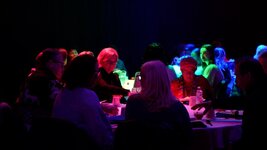
Here are a few captures of the event
 

Attachments

  • M1.jpeg
    M1.jpeg
    39.6 KB · Views: 12
  • m2.jpeg
    m2.jpeg
    58.6 KB · Views: 12
  • m3.jpeg
    m3.jpeg
    81.2 KB · Views: 11
Made hundreds of videos over the years that look like this.

From restaurants and corporate event spaces, all with mixed and dark lighting that is supposed to be flattering in real life.

Skin tones all over the place, underexposure, hot spots, dancing noise here and there because of imbalances, the nature of the task at hand.
 
Made hundreds of videos over the years that look like this.

From restaurants and corporate event spaces, all with mixed and dark lighting that is supposed to be flattering in real life.

Skin tones all over the place, underexposure, hot spots, dancing noise here and there because of imbalances, the nature of the task at hand.
"We gotta make the best of it, improvise, adapt to the environment, Darwin, **** happens, I Ching, whatever man, we gotta roll with it."
 
I recently ran into a situation where I'm not sure there is a way to set a proper white balance. I was filming a holiday feast where an audience are sitting a tables watching a performance while being served dinner. The venue is lit with brightly colored lights and each table can have a different color.

So the question is in the scenario I described how to set the camera to the right color temperature as experienced by the human eye? Note part of my job is film the audience.
When confronted with a total no white situation and every color of the rainbow ranging anywhere from 3200 tungsten to 5600 daylight temp, I set my white balance manually to 4400 K. 4400 being exactly halfway between 3200 and 5600. Ungraded, the results seem to attract very little if any, comment from viewers.
I find using either 3200 or 5600 as a base WB is too extreme in those situations and people will comment on the color overall. If I'm grading the footage and need to correct for a decent overall color look, pushing WB / tint a bit either way from 4400 is not a major issue for most modern NLE software. Pushing a long way up from 3200 or down from 5600 requires a lot more tweaking. I find it usually requiring RGB Splitter Combiner nodes and Parallel nodes to suck luminance and redirect luminance from the oversaturated channels to the low luminance color channels. 4400 leaves me in a place that doesn't require massive WB manipulation.

Chris Young
 
When confronted with a total no white situation and every color of the rainbow ranging anywhere from 3200 tungsten to 5600 daylight temp, I set my white balance manually to 4400 K. 4400 being exactly halfway between 3200 and 5600. Ungraded, the results seem to attract very little if any, comment from viewers.
I find using either 3200 or 5600 as a base WB is too extreme in those situations and people will comment on the color overall. If I'm grading the footage and need to correct for a decent overall color look, pushing WB / tint a bit either way from 4400 is not a major issue for most modern NLE software. Pushing a long way up from 3200 or down from 5600 requires a lot more tweaking. I find it usually requiring RGB Splitter Combiner nodes and Parallel nodes to suck luminance and redirect luminance from the oversaturated channels to the low luminance color channels. 4400 leaves me in a place that doesn't require massive WB manipulation.

Chris Young
Thanks. I went back and checked my camera that hasn't been used since that performance. Looks like I did as you suggested without knowing. I had set it to 4500k
 
Im on a job. Short answer.

Kodak 64. Daylight transparency film. Classic of National Geographic.

Its daylight balanced.

Sunset. Ecuador. A mountain hut with a tungsten bulb, the shot is wide.

The sky is purple, the light in the hut glows a warm yellow.

This is how it should look and it looks ace.

So.. put your camera on 5500k and leave it there. for ever.

--

As for those red LEDs.. they are horrid.. im mulling that over. Maybe use RGB WFM and avoid channel clipping... I have thoughts on that to expand on.
 
Im on a job. Short answer.

Kodak 64. Daylight transparency film. Classic of National Geographic.

Its daylight balanced.

Sunset. Ecuador. A mountain hut with a tungsten bulb, the shot is wide.

The sky is purple, the light in the hut glows a warm yellow.

This is how it should look and it looks ace.

So.. put your camera on 5500k and leave it there. for ever.

--

As for those red LEDs.. they are horrid.. im mulling that over. Maybe use RGB WFM and avoid channel clipping... I have thoughts on that to expand on.
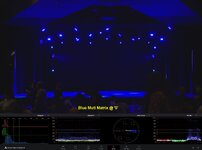
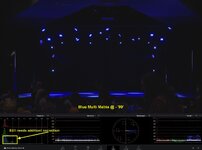
For RGB channel burn / clipping. If you know beforehand the channels that are going to clip, adjust that primary color/s down in your Multi Matrix. Certain venues I know that tend to light over the top on the blues, reds and magenta, I have preset scene files saved with the appropriate Multi Matrix settings already dialled in. Here is an example of how just adjusting the B channel Muti Matrix on a Sony camera from '0' to - '99' makes a massive difference. Just look at the over blown blue LED saturation and luma levels on the stage floor, and you can see the difference. The -99 on the Blue Multi Matrix shot makes the grading of the scene relatively easy, as the blue levels are not irreparably clipped. All other colors will be 99% okay.

If you have a heavily clipped oversaturated channel shot means you really have to use the sort of techniques and workflow found in the following video to salvage the grade as best as possible. It's doable, but it's just so much easier to start without clipped RGB channels.

Chris Young


Attachments

  • Multi Matrix 0 Blue channel scopes comp_1.1.1_1.2.1.jpg
    Multi Matrix 0 Blue channel scopes comp_1.1.1_1.2.1.jpg
    137.8 KB · Views: 1
  • Multi Matrix -99 Blue channel scopes comp_1.1.1_1.2.1.jpg
    Multi Matrix -99 Blue channel scopes comp_1.1.1_1.2.1.jpg
    136 KB · Views: 1
I actually have done the same event for many years. I end up winging it, using a default setting like 3200. In this instance I might have done 3500k. At the head table with the performers I can get a decent white balance.

The question is there a more scientifically repeatable approach to what I usually do. For example if I blacked out a room and pointed a red, blue, and yellow light at the wall. What is the perceived temperature to a human.
If there are “party colors”, then they need to show as party colors, because that’s what we’re seeing, too.
 
If there are “party colors”, then they need to show as party colors, because that’s what we’re seeing, too.
Agreed. As close as what you see with your eyes. Which is not the oversaturated clipped colors cameras are portraying them as due to their inability to handle the levels coming in. The Mk I eyeball is the best adaptive camera ever created. Not many men made cams can keep up with that. They need a little help, quite often in many scenarios.

Chris Young
 
As for those red LEDs.. they are horrid.. im mulling that over. Maybe use RGB WFM and avoid channel clipping... I have thoughts on that to expand on.

Really management of thes high saturation LEDs is a broad technical discussion.


Why do they clip so badly party lights seems 'special' (in a bad way)

-do these light 'leak' IR or UV and the sensors pick that up?
-could some IR/ND on lens filtration help

-it is great to see chris input.

--

Away from understaing spectra what can be done?

Maybe lights team run them at 50%
Maybe a soft fill light (china ball on a boom with an assistant) going around the tables?


My Lewes film (https://vimeo.com/1032612589?share=copy) had fire and little artificual light. I did struggle to 'grade' it. I wonder should I have stopped down to 'hold' the flames more in exchange to lose the crowd.
Here an ability to dig in the shadow like one can in theory on an alexa 35 could have actually been useful?


Again maybe to film the XMas party an alexa 35 would be useful.

Being 'stupid' there is an option of making a super DR camera with a mirror rig and expostion at two exposures.

Such a plan is probably stupid to film a christmas party.. but to film some explosion stunts on a theatrical feature less stupid. My warewolf film they failed to hold thighlights of the flame thrower. Ramping the ambient or a double exposure rig were both missed chances.
 
I was really happy with both of these wedding videos I shot, 6 years ago with the Panasonic GH5 (Raising Cain), and 2 years ago the Mexican wedding with the Blackmagic Pocket 6K, both graded in HDR10, the GH5 shot in VLog-L and the P6K BRAW, both using a fixed WB setting but the temp I don't recall with certainty. The Raising Cain was probably 5200K since it was outdoors, the Mexican wedding likely 4000K to start out for the sodium lights (they come on again at the end), and probably not changed after they were turned off. There's clipping for sure, but the Raising Cain video, outstanding skin tones after a heavy grade. Great band performance by the way, worth a look (and listen) to watch it all the way through.

The Mexican band used laser powered spotlights, extraordinary brightness and power, line array loudspeakers. These were not ordinary cocktail leds, so I would not agree IR, UV or colorspace causes the clipping, the brightness does! Watch them both in HDR if you can. If not, they still look decent imo but there is a definite pop with the HDR and more DR in the grade.

In general, my comment would be that yes, you want them to show up as party colors, but also to reveal the underlying accurate skin tones. It's not an "either or," it's an "and."

If you were trying to do this in camera 709 without a post-grade, hopeless.

 
The newer LED lights make this task more difficult. As stated, this often lands in the mid 4000's but is a game-time decision. This outlines the need for a trusted viewfinder on the job. You can then separate from the ambient light and make an informed decision on location.
 
Back
Top