OTHER: Thoughts on Blackmagic's Ursa Cine 17K 65mm camera

Imamacuser

Veteran
A few thoughts on Blackmagic's forthcoming Ursa Cine 17K 65mm camera.

It's a poor man's Arri Alexa 65 that can emulate Todd-AO/Super Panavision, intended for certain DP owner operators and rental houses.

It sounds like the price will be equivalent to the RED One's release price (if adjusted for inflation) or maybe cheaper, considering how RED nickel & dimes you on the necessary accessories.
Some YouTubers say Blackmagic is disrupting the industry, bringing 65mm to the masses, but there's one really big issue, lens availability.

Blackmagic didn't announce a partnership with an optical company to produce medium format lenses for their 65mm camera, although that could be secretly happening behind the scenes, but as far as we know, the only options are purchasing medium format photo lenses or renting Todd-AO, Super Panavision, or Arri DNA lenses, and I've heard the Arris are just rehoused medium format photo lenses.

Medium format lenses tend to be slow, have significant focus breathing, with very few focal focal length options.
Medium format lenses can give you better background separation at close distances, but you reach the point of diminishing returns very quickly when compared to fast VistaVision lenses.

The Ursa Cine 12K looks more appealing, as there are a myriad of affordable, light weight, fast cine and photo lenses that cover VistaVision.
VistaVision is the sweet spot in terms of wide aperture, light weight lenses.
Plus you can use a Kipon focal reducer to closely emulate medium format.

Perhaps companies like Rokinon will produce medium format lenses if there's more 65mm cameras in circulation, but we'll have to wait for the R&D process to run its course.

In conclusion, the advantages of the Ursa 65 are latitude, and resolution for VFX plates, if you can source compatible lenses.
 
Grant said 17K-65mm will not be able to contain internal ND. Captain Hook said It will accept PL, LPL and EF mounts, and that LPL and some PL will cover the full sensor, implausible as it seems, that is the claim. The pixel pitch, 2.9 µm is the same as the Cine-12K. The only difference with the 17K is the sensor dimension. The Cine-12K will have the same latitude and DR. Price has not been revealed on the 65mm 17K and it won't be available until December. I don't really feel BMD are intent on disrupting the industry. I think their ambition is to build the best camera that they can and see where it takes them. Grant said the same thing about the UMP12K, and it didn't receive mass adoption, but BMD has a pretty solid ecosystem in place for cloud collaborations, edit and color, sound, mixers, broadcast, and back up roles in film such as The Morning Show. At some point, Grant too will see the company go public, or sell as Jarred Land just did, but BMD is far broader postured than Red which had gone stale. To me, the most important benefit if the claim is verified, is 16 stops DR, or realistically 2-stops better than anything else they have made. The RGBWWW pixel structure is pretty cool for permitting good DR with small pixels and great color fidelity.
 
Grant said 17K-65mm will not be able to contain internal ND. Captain Hook said It will accept PL, LPL and EF mounts, and that LPL and some PL will cover the full sensor, implausible as it seems, that is the claim. The pixel pitch, 2.9 µm is the same as the Cine-12K. The only difference with the 17K is the sensor dimension. The Cine-12K will have the same latitude and DR. Price has not been revealed on the 65mm 17K and it won't be available until December. I don't really feel BMD are intent on disrupting the industry. I think their ambition is to build the best camera that they can and see where it takes them. Grant said the same thing about the UMP12K, and it didn't receive mass adoption, but BMD has a pretty solid ecosystem in place for cloud collaborations, edit and color, sound, mixers, broadcast, and back up roles in film such as The Morning Show. At some point, Grant too will see the company go public, or sell as Jarred Land just did, but BMD is far broader postured than Red which had gone stale. To me, the most important benefit if the claim is verified, is 16 stops DR, or realistically 2-stops better than anything else they have made. The RGBWWW pixel structure is pretty cool for permitting good DR with small pixels and great color fidelity.
+1 to all your comments! I feel pretty much the same. The 12K hits a pretty sweet spot all round. (y)

Chris Young.
 
If you want a modern lens pretty sure Tokina Vistas will cover Alexa 65. While not exactly cheap, they’re cheaper than many others. Their image circle is far larger than what the specs say. Many other companies are using them as donor lenses and making Alexa 65 coverage claims with them. (Panavision, Master Built, LVX optics)

Leica Thalias will definitely cover too.

We can’t really know till we have a camera to try.

PL and LPL don’t tell you anything as far as image circle really either.

I’m personally looking at Mamiya 645 lenses. They’re seem to look really good, inexpensive and easy to covert I believe. They’re pretty fast for medium format. Most are F2.8 and there’s an 80mm 1.9 and some zooms.
 
Blackmagic is still pretty far behind the times considering the LSST camera has 3200 megapixels, compared to Blackmagic's mere 140 megapixels.


Here is another upcoming option for a larger sensor lens.


I wonder how good the 4K and 8K of the 17K camera will be, as many would like a larger sensor but don't want to deal with the storage and memory card hassle of 17K.
 
If you scroll down the Blackmagic page they offer a storage calculator.

I have shot the og 12k and 6k and find Q3 to be a great compromise for high quality and low storage.

At Q3 open gate you get 1.3 hours per terabyte. About the same as a 12 bit 4k ProRes file.
 
Blackmagic is still pretty far behind the times considering the LSST camera has 3200 megapixels, compared to Blackmagic's mere 140 megapixels.


Here is another upcoming option for a larger sensor lens.


I wonder how good the 4K and 8K of the 17K camera will be, as many would like a larger sensor but don't want to deal with the storage and memory card hassle of 17K.
A pocket version of LSST may be under development, but it needs a large waistband for an 8x10 meter sensor.

For the 17K-65mm, it can shoot a 9K crop, no 4K.
 
Rick Lang at the Blackmagic Forum says the sensor is 55.9 mm diagonal, by 50.808 mm horizontal, giving an aspect ratio of 2.2 so this is not 65mm sensor. All that's known so far is what Grant Petty said about it. I'm going to rewatch his podcast to confirm what he said.
 
In the podcast, Grant showed the camera, and the sensor which he called the Ursa Cine 17K, and described it as a "full 65 mm in size," however, the active area is 50.808 by 23.316 mm, and the camera comes with LPL and Hasselblad mounts. Grant didn't say anything about PL or EF mounts, so I'll have to track down Captain Hook's remark about that.
 
I think the information about the Cine 17K supporting PL and EF lenses is wrong, came from the other camera, the Ursa Cine 12K. Sorry about that., my bad for posting it.
 
70mm film, commonly called camera 65

camera aperture: 52.63 by 23.01 mm (2.072 by 0.906 in)[25]

And

projection aperture: 48.56 by 22.10 mm”

From

Arri Alexa 65

“The Alexa 65 uses the A3X sensor, composed of three vertical ALEV III sensors, which has a 54.12 mm × 25.59 mm active imaging area.”

From

So bigger than camera 65.

I just googled this.
 
Last edited:
Still a pretty neat idea. I think now camera users can finally make the 65mm movies of their dreams instead of waiting until they have the right budget for it. I know a lot of camera users say, "who the Hell needs this?" Well I can say that if you're an indie filmmaker wanting the 70mm film look well, here it is. I can imagine someone trying to pull another Planet Terror with this camera.
 
Blackmagic is still pretty far behind the times considering the LSST camera has 3200 megapixels, compared to Blackmagic's mere 140 megapixels.


Here is another upcoming option for a larger sensor lens.


I wonder how good the 4K and 8K of the 17K camera will be, as many would like a larger sensor but don't want to deal with the storage and memory card hassle of 17K.
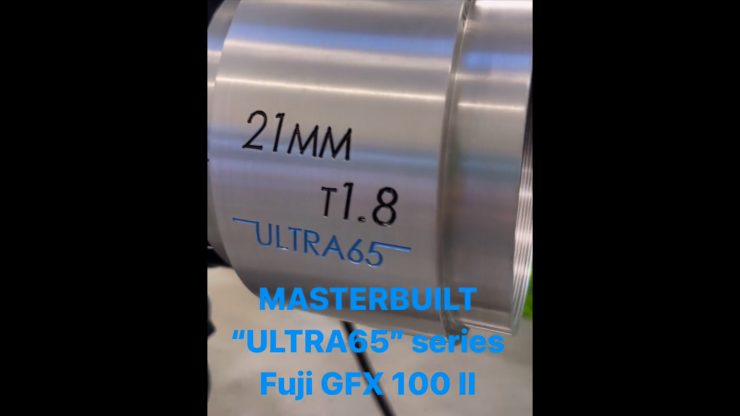
Masterbuilts are Tokina Primes. I prefer the Tokina originals really as they are more flexible in terms of a variety of looks. Plus the Masterbuilts have had some neg reviews for their mechanical use, plus massively more expensive.
 
That's actually more than I guessed, I thought it would be $25K, but I wasn't going to get one in either case.

The Ursa Cine 12K (Blackmagic really needs a less confusing naming convention) is more appealing from the standpoint of lens choice, but maybe companies will release 1.25x anamorphic knockoffs of Ultra Panavision lenses for the 17K.
 
$30k. Who is getting one?
I'd upgrade to a Blackmagic only when I've exhausted my Canon T2i to where I've made several short films, several music videos, and several commercials with it. Knowing how to do so much with so little, that way when I get something like a Blackmagic or Kinefinity it'll be like a superpower. If I can make my Canon T2i look as phenomenonal as filmmakers like Kendy Ty or the director of Slacker that'll be great. As a teenager I dreamed of making films like Robert Rodriguez did with El Mariachi on a 7 thousand dollar budget at the age of 23... Well I didn't get a chance to do that at 23, and I'm 30 yet have not made it in Hollywood yet... I'm getting old.
 
Last edited:
$30k. Who is getting one?
Not the Cine 17.5 for me, but the Cine 12K maybe. I have the Ursa Mini Pro 12K now, and love it, and the frame rates. I don't need these cameras, purely wants. I want to see proof the Cine 12K has 16 stops DR. I bought the Nikon Z8 a few months back and have been so impressed with it, the urgency of the 12K FF "want" has been supressed a bit. On the other hand, the BMD's perform above their pay grade. I love shooting from the shoulder, the OLED viewfinder is fantastic, versatile talents, the lens options match with my collection of EF and PL lenses. Shooting time is good with V-mount battery, codec is fantastic for its bitrate, framerate and frame size options. Color is superb. The Nikon Z8 has been electric for its go-anywhere ability. Battery life, AF, IBIS, convenience factors are good. I shoot exclusively 12k - 8K raws. Can't complain about anything, it's a great time. The negatives for the Cine 12K are its positives, battery system and media storage.
 
How does it achieve higher dynamic range? I remember Brawley directed me to an article a few years ago that dispelled the myth that larger sensors have more dynamic range. (Although I think it concluded that larger photosites achieve higher DR at high gain.) And the takeaway was that newer sensors generally had better DR because of improvements in engineering and design. So is the claim that it has higher DR because of the photosite size or because of other design improvements?
 
Uncertain. The 12K and 17.5K both have the same size photo sites, but they are still small, 2.9 micron. It's claimed the WRGB CFA improves it. Honestly Abe, the whole subject of DR is frought with uncertainty, and possibly even cheating. We have Imatest to thank for that. Sure, it's impartial, but can be tricked by baked in NR. I think Brawley is probably right. And this, Dieselgate II. I wish CineD would go back to just posting photos of the DR chart and leave the interpretation to us. I think all the cameras don't look that different, and have converged to the same basic DR including Alexa 35 if you could just separate out the processing.
 
Back
Top