Anyone know what camera set up this is in this video?

The show is from the summer of 2006 and in 1.78/1, i.e., HD.

So, without any easily available details, it could be any cameras that were popular on TV sets at that time, the pre-Alexa era.
 
The show is from the summer of 2006 and in 1.78/1, i.e., HD.

So, without any easily available details, it could be any cameras that were popular on TV sets at that time, the pre-Alexa era.

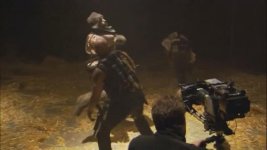
Yes, they showed glimpses of it in the youtube link at 53 seconds, thought someone who may have worked with a set up like that might ring a bell, I tried to screen grab the clearest of it
 

Attachments

  • Blade.jpg
    Blade.jpg
    36.3 KB · Views: 0
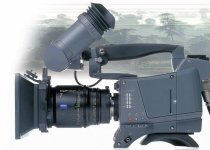
Not easy to make it out but given the timeframe as mid-2005 according to the slates and the few visual clues in that pic, I'm going to say that's a Thompson Viper Filmstream, a 2/3" camera made famous by its use in "Collateral". A good camera in its day but about to become eclipsed by the introduction of the Genesis mere months later due to the larger sensor and Panalog.

Click image for larger version  Name:	Viper-Filmstream-lookback.jpg Views:	0 Size:	74.0 KB ID:	5692066
 
Last edited:
Not easy to make it out but given the timeframe as mid-2005 according to the slates and the few visual clues in that pic, I'm going to say that's a Thompson Viper Filmstream, a 2/3" camera made famous by its use in "Collateral". A good camera in its day but about to become eclipsed by the introduction of the Genesis mere months later due to the larger sensor and Panalog.


Ok yes that looks about right, I've managed to see another shot of the camera and its spot on thank you for that!, are these hard to find now?
 
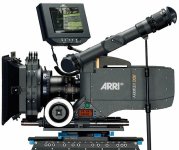
For the record, ARRI D20 was out in 2005 and used in a number of films. Not sure about its popularity on Hollywood TV sets. Off "shot on what?", it seems not to have been popular at all.

B_NAB06_Arri_D20.jpg - Click image for larger version  Name:	B_NAB06_Arri_D20.jpg Views:	0 Size:	73.0 KB ID:	5692075

PS. The next several months were sort of a watershed for the new high end cameras - Sony announced F-23 in December, 2006; Red One came out in 2007. Both F-35 and D21 came out in 2008.
 
DLD, the D20 had a very slow rollout and was still quite exotic while the Genesis was being used much more starting end of 2005 and into 2006. I worked on my first Genesis feature in spring '06 and we were still considered one of the first run of features to use it. Announcements are one thing but real-world usage is another. There were a lot of growing pains with these cameras and the workflow so it wasn't a quick adoption. It was thought at the time that Arri was protecting its film line and somewhat dragging its heels about getting into digital acquisition while Panavision had already started the ball rolling with the F900 years earlier. It was thus something of a surprise when the Alexa emerged a few years later and Arri jumped to the top of the heap, where they have (arguably) remained ever since.
 
Ok yes that looks about right, I've managed to see another shot of the camera and its spot on thank you for that!, are these hard to find now?

Once the S35 sensor cameras were introduced, few wanted to shoot theatrically on 2/3 cameras so that format was relegated back to its broadcast roots. where it remains to this day. The Viper had a good run with Collateral, Benjamin Button and Zodiac as the more notable features shot on the Viper. It's interesting to think about it in comparison to 35mm and 16mm film, which is a comparable paradigm in terms of imaging size. 16mm is seeing something of a surge now because of the look associated with it, primarily the grain structure. However 2/3" doesn't really have that distinction over S35 (although one can argue the virtues of CCD vs CMOS) so largely it comes down to a deeper depth of field as the primary distinction, which is not most people's preference these days.

I'd have a hard time imagining there are any ardent enthusiasts out there shooting on vintage Vipers but then again...
 
DLD, the D20 had a very slow rollout and was still quite exotic while the Genesis was being used much more starting end of 2005 and into 2006...

At that time, both in terms of quality and the existing workflow, film represented a feasible and, often, a superior alternative to digital. We've touched up on a number of things in recent and tangentially related threads but one factor that we may have omitted was that the movie theaters only began to convert to digital projection around 2002-2003, the process which took well over a decade. (Bloomberg had it at 84% by 2012 while whining about the disappearance of a small theater.) The TV industry had no such options. The complete switch of the OTA signal from the analog/SD/4:3 to digital/HD/16:9 was going to take place on June 12th, 2009 regardless, so one might as well had began shooting a "future proof' content.

PS. Of course, there's cropping and upscaling. And shooting on film provided an opportunity to do it with very little loss of quality anyway but, as we talked about the "Gilmore Girls", the switch toward digital TV production moved forward in earnest right around that time.

PPS. I distinctly recall a discussion on a sports site about the flat screen TV's right before the 2006 World Cup. ABC had it in HD, ESPN (cable) and Univision (OTA) did not. A 32" 720p LED/LCD was $1,000. 37" was $1,500. And plasma sets were way more.
 
Once the S35 sensor cameras were introduced, few wanted to shoot theatrically on 2/3 cameras so that format was relegated back to its broadcast roots. where it remains to this day. The Viper had a good run with Collateral, Benjamin Button and Zodiac as the more notable features shot on the Viper. It's interesting to think about it in comparison to 35mm and 16mm film, which is a comparable paradigm in terms of imaging size. 16mm is seeing something of a surge now because of the look associated with it, primarily the grain structure. However 2/3" doesn't really have that distinction over S35 (although one can argue the virtues of CCD vs CMOS) so largely it comes down to a deeper depth of field as the primary distinction, which is not most people's preference these days.

I'd have a hard time imagining there are any ardent enthusiasts out there shooting on vintage Vipers but then again...

Do you think the imaging of these early 2/3 cameras look better than the earlier blackmagics that later came out?
 
The original Pocket had a native 1080p small sensor and was very known for looking like 16mm film so some may see similarities and "vintage" characteristics, but that's a loaded question with subjectivity on the horizon. Charles will have his own opinion, but to me cameras like the BMCC and BMPC look more modern than some cameras that arrived 10 years after them.
 
The original Pocket had a native 1080p small sensor and was very known for looking like 16mm film so some may see similarities and "vintage" characteristics, but that's a loaded question with subjectivity on the horizon. Charles will have his own opinion, but to me cameras like the BMCC and BMPC look more modern than some cameras that arrived 10 years after them.

It seemed like the only people used the professionally was the indie circuits, were there any major productions that used the BMCC or BMPC?
 
Oh, in the beginning no one trusted the cameras.

I, per usual, was an early adopter of everything and paid $1600 for the $999 Pocket on eBay because I couldn't contain my excitement. It was so early back then that the camera had like 10 settings (with white balance, shutter and ISO being 3 of them) - and had no simple functions like a battery meter or being able to format the card inside the camera (had to use a computer).

But a lot of the world quickly forgave their reliability issues once they saw the quality (which was insane back then in 2012-ish...simply insane for the money).

And as quality-control on the conveyor belts improved, so did everything else about the cameras.

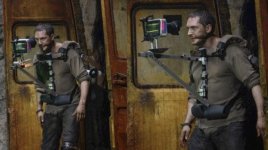
As far as major productions, the most famous example was the BMCC being used as a snoricam (photo below) on 2015's Mad Max, and there was Dolph Lundgren movie shot entirely with the URSA, but other than that I don't know. But probably some other productions here and there for TV, Lifetime, etc.

It's tough though because ARRI is a monopoly - in my opinion - and most productions don't really think about which cameras they will use (it's ARRI by default) unless they have some sort of relationship with a certain studio, company or a few wire transfers will take place.

Click image for larger version  Name:	BMCC.jpg Views:	0 Size:	63.2 KB ID:	5692096
 
Oh, in the beginning no one trusted the cameras.

I, per usual, was an early adopter of everything and paid $1600 for the $999 Pocket on eBay because I couldn't contain my excitement. It was so early back then that the camera had like 10 settings (with white balance, shutter and ISO being 3 of them) - and had no simple functions like a battery meter or being able to format the card inside the camera (had to use a computer).

But a lot of the world quickly forgave their reliability issues once they saw the quality (which was insane back then in 2012-ish...simply insane for the money).

And as quality-control on the conveyor belts improved, so did everything else about the cameras.

As far as major productions, the most famous example was the BMCC being used as a snoricam (photo below) on 2015's Mad Max, and there was Dolph Lundgren movie shot entirely with the URSA, but other than that I don't know. But probably some other productions here and there for TV, Lifetime, etc.

It's tough though because ARRI is a monopoly - in my opinion - and most productions don't really think about which cameras they will use (it's ARRI by default) unless they have some sort of relationship with a certain studio, company or a few wire transfers will take place.


Wow...No wonder I see so many RED's being sold..You're right about that, because almost every production is Arri from what i've noticed as well, especially just about everything on netflix.

However in those days of the b4 mount camera's I remember TV did alot of the Panasonic cameras, like for the lifetime movies the SD dvcpro's and the varicams were used alot
 
The Morning Show built an entire set around BMD production equipment for the story, and because the set was real they used it to film the TMS segments. Anything John Brawley shoots makes use of BMD cameras somewhere in the flow, as b-cam to ARRI in "The Great" or a-cam in The Desperate Hour.
 
Wow...No wonder I see so many RED's being sold..You're right about that, because almost every production is Arri from what i've noticed as well, especially just about everything on netflix.

However in those days of the b4 mount camera's I remember TV did alot of the Panasonic cameras, like for the lifetime movies the SD dvcpro's and the varicams were used alot

Some of those original Varicams were the most successful cameras in the world at one point, but Panasonic lost their way and never recovered.
 
Do you think the imaging of these early 2/3 cameras look better than the earlier blackmagics that later came out?

I have literally never shot a frame on a Blackmagic camera to date. I do recall that the early ones had an issue with the "black sun" effect, so there's that.

When we were doing F900 tests for "The Perfect Sleep", the 2005 feature I mentioned earlier, I was looking at available lens options for shooting 1.5x anamorphic. We shot some matching tests with those and the Digiprimes shooting 1:78 and cropping to 2:39, then filmed out the results. I asked them to print the takes to separate reels and set it up in the screening room with one on each projector and had the projectionist switch between them so we could easily see the difference. There was remarkably little, to the point where we all admitted that it was too subtle to substantiate. What one would expect to see with the originating-on-film paradigm was magnified grain with the crop version (similar to S35) vs anamorphic, but with digital not having that comparable metric (at native ISO), the grain added in the film-out was the same regardless of acquisition style. Very interesting. That film looked pretty good projected on film in the theatre, for the time. However there were some re-shoots done on Genesis that I wasn't available for and to me they stuck out noticeably by being a lot nicer, sharper, cleaner. I believe I even tried to knock down those shots in the grade but we didn't have nearly as many tools available then as now.
 
I asked them to print the takes to separate reels and set it up in the screening room with one on each projector and had the projectionist switch between them so we could easily see the difference. There was remarkably little, to the point where we all admitted that it was too subtle to substantiate. What one would expect to see with the originating-on-film paradigm was magnified grain with the crop version (similar to S35) vs anamorphic, but with digital not having that comparable metric (at native ISO), the grain added in the film-out was the same regardless of acquisition style. Very interesting.

Yes, very interesting CP. Always interesting to see how people observed and evaluated perceived quality as the move to digital gathered pace.

Chris Young
 
I have literally never shot a frame on a Blackmagic camera to date. I do recall that the early ones had an issue with the "black sun" effect, so there's that.

When we were doing F900 tests for "The Perfect Sleep", the 2005 feature I mentioned earlier, I was looking at available lens options for shooting 1.5x anamorphic. We shot some matching tests with those and the Digiprimes shooting 1:78 and cropping to 2:39, then filmed out the results. I asked them to print the takes to separate reels and set it up in the screening room with one on each projector and had the projectionist switch between them so we could easily see the difference. There was remarkably little, to the point where we all admitted that it was too subtle to substantiate. What one would expect to see with the originating-on-film paradigm was magnified grain with the crop version (similar to S35) vs anamorphic, but with digital not having that comparable metric (at native ISO), the grain added in the film-out was the same regardless of acquisition style. Very interesting. That film looked pretty good projected on film in the theatre, for the time. However there were some re-shoots done on Genesis that I wasn't available for and to me they stuck out noticeably by being a lot nicer, sharper, cleaner. I believe I even tried to knock down those shots in the grade but we didn't have nearly as many tools available then as now.

Thats exactly why I wish I can get my hands on a genesis, I don't know if anyone is selling one, but people were telling me to just get a F35 instead. Some were saying it was the exact same camera but I wasn't sure if that was true. In the retrospect of the comparisons test you mentioned, you printed on actual film, do you think flmconvert now would have done the same job if available then?
 
Thats exactly why I wish I can get my hands on a genesis, I don't know if anyone is selling one, but people were telling me to just get a F35 instead. Some were saying it was the exact same camera but I wasn't sure if that was true. In the retrospect of the comparisons test you mentioned, you printed on actual film, do you think flmconvert now would have done the same job if available then?

I seemed to remember that the sensor or processing in the F35 was a notch improved over the Genesis given the several years between them, but I think we were discussing this recently in another thread and it was suggested that wasn't the case.

As far as filmconvert doing the same thing as the filmout, if we are talking about grain structure, I suppose so. Given the range of resolutions in today's camera, the difference between S35 crop vs true anamorphic acquisition is not going to be that noticeable even projected (even at a higher ISO, noise can be managed now in a way that grain couldn't back in the day).

Ultimately this becomes a discussion about emulation. Many of the "defects" of film origination have become desirable now. In the past, cinematographers would often work to overcome and hide these phenomena and now it's trendy to recreate, amplify and revel in them.

Bringing this back to the Viper, I re-watched "Collateral" tonight. I don't really think anyone would get too hyped up about the performance of the camera these days. There are some scenes with harsh highlight rolloff, color fringing in highlights, edge sharpening, and slightly blurry motion cadence typical of that generation of cameras (I struggled with all that with the F900 myself). These are not considerd "sexy" defects...yet, at least. Perhaps in the future the "2005 look" will start trending!

That said, it reminded me that when "Collateral" first came out, I was blown away with the sensitivity at the bottom end. It was the first time I'd seen night skies with texture in them on screen. The city looked as it did to eye. That was a huge achievement compared to the more inky and crushed blacks in night scenes we'd seen before that.
 
Back
Top