Have I been wrong this whole time about resolution?

roxics

Veteran
I assumed I understood analog video resolution. I guess I thought it was like digital resolution. But I was doing some reading tonight about the Kell Factor (which I don't completely understand) and at some point it started to dawn on me that maybe I understood analog resolution all wrong. Maybe. That's what I'm here to check, and hopefully you can help correct me.

I've known for decades that NTSC is 480 lines of vertical resolution (visible out of 525). I assumed however that when people said VHS was 240 lines, they were talking about those same vertical lines. Basically NTSC is capable of displaying a max of 480 lines but VHS is only producing half that. Hi8 only 400 lines of those 480 max.

So what would be the horizontal resolution of those vertical lines? I assumed whatever the 4:3 ratio would be (thinking digitally). So for example VHS would be 320x240, Hi8 would be 600x400 or something like that.

But after reading various pages I'm thinking I've got this all wrong. Instead the constant is always 480 vertical lines, but the horizontal resolution (blue lines) changes. VHS then would be 240(blue)x480(red) and Hi8 would be 400x480. But how can that be? Is it just a lot of line spacing between those (blue) lines?

I know there are no pixels in analog video, so when you're like me and used to thinking in pixels I want to do the same for analog video. So in my head I'm thinking 240x480 is going to produce a vertical video. But I guess if there is more spacing between those (blue) lines (then the red lines) you can spread them out to end up with a 4:3 image, even though you really only have the resolution of a 1:2 ratio image.
That still seems wrong to me though.

Any clarity would be appreciated.
Bonus points to anyone who can explain the Kell Factor in English.

Also Happy Thanksgiving to my fellow Americans if you're reading this on Thanksgiving.
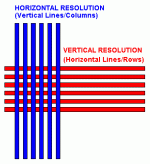
 

Attachments

  • photo129082.gif
    photo129082.gif
    4.1 KB · Views: 0
To add to the confusion, in days of analog video engineering, what they called horizontal "resolution" was not the same as the total number of lines. It was "per picture height" --- the fraction of the total if the screen were cropped to be a perfect square. The total number of lines for VHS was 320.

In analog video, when the horizontal resolution is less than 4/3 of the vertical, then the horizontal resolution is smeared across more TV pixels.

Digital video also can have non-square pixels. For example, DVDs are 720x480.

[TABLE="class: grid"]
[TR]
[TD]VHS[/TD]
[TD]320x483 (but color was only 40x483!)[/TD]
[/TR]
[TR]
[TD]broadcast NTSC[/TD]
[TD]440x483[/TD]
[/TR]
[TR]
[TD]S-VHS[/TD]
[TD]560x483 (but color was still only 40x483!)[/TD]
[/TR]
[/TABLE]
 
Last edited:
Lol...Doug straight to the point.

I can relate roxics because I have OCD as well, but DJ's right; it's stuff that's unclear and not many people are around who can discuss how many exact lines of resolution these inferior technologies had.

But, with that said, the Kell factor attempted to do just that, and based on a quick glance, it is a subjective number based on image perception that's used to analyze resolution (including resolution without any moire-like patterns they call "beat frequencies").

But, per usual, with many human theories, or experimentation, there may be conflicts in the findings based on a number of circumstances during the quantification.
 
What difference does it make in 2021?

It doesn't. I'm just a nerd for this kind of stuff. The older I get the more interested I become in understanding where it all comes from. I grew up with this analog tech and learned on it at first. Which on some level makes sense. I make my living using video technology. Understanding its history better seems like the right thing to do. Plus I ended up in a wikipedia rabbit hole. I went there because I couldn't remember if Hi8 was considered 400 or 440 lines of resolution. That page lead me to a link about TV lines which lead to a link about the Kell Factor and good luck understanding that page, it even says at the top it might be too confusing. So I googled more about it and I still couldn't find a clear explanation. But something sparked in my head that I might have a misunderstanding of analog TV resolution.
 
Back on the Thanksgiving in 1995, my cousin Slava from Minsk came to visit his mom/my aunt in Wisconsin. At one point, my dad also showed him around my parents house, including his 27" Sony Trinitron TV. Slava replied that his TV was better. My dad told Slava to stop spouting nonsense. But Slava was correct. The old Soviet system was borrowed/stolen from the French (SÉCAM) and it had a higher resolution at 819 lines. The French adapted it because they didn't want to copy the German developed PAL of 625 lines due to the a bout of a post-war peeve with the Germans. The East Germans adopted it because they didn't want their citizens to watch the West German broadcasts. The Soviets adopted it basically foe the same reason.

When the VCR's became popular in the USSR of the mid-late 1980's - popular, as in paying double the retail price - the conversion hardware made a lot of people a lot of money. Most of the VHS tapes that were smuggled into the country were either PAL or NTSC and wouldn't play on the Soviet TV sets.

Since then, Europe switched to DVB, while the US to ATSC. Not sure what Slava has now.
 
To add to the confusion, in days of analog video engineering, what they called horizontal "resolution" was not the same as the total number of lines. It was "per picture height" --- the fraction of the total if the screen were cropped to be a perfect square. The total number of lines for VHS was 320.

I'm still confused on that one. Something else (under The Circle Rule) I was reading was saying something similar about measuring only 75% of the horizontal resolution. I couldn't understand why they were doing that. I guess the goal was to get to a square ratio, but why?

In analog video, when the horizontal resolution is less than 4/3 of the vertical, then the horizontal resolution is smeared across more TV pixels.

Digital video also can have non-square pixels. For example, DVDs are 720x480.
[TABLE="class: grid"]
[TR]
[TD]VHS[/TD]
[TD]320x483 (but color was only 40x483!)[/TD]
[/TR]
[TR]
[TD]broadcast NTSC[/TD]
[TD]440x483[/TD]
[/TR]
[TR]
[TD]S-VHS[/TD]
[TD]560x483 (but color was still only 40x483!)[/TD]
[/TR]
[/TABLE]

Yeah I've worked with non-square pixels for years in DV and DVD. Although I never really understood why we were dealing with non-square pixels on those formats when they were digital. I thought it had something to do with analog video I just didn't know what.

So basically the second explanation I gave is right, it's always 480 (483) vertical lines, it's the horizontal resolution that is being talked about when people say 240, 320, 400, 720, etc?
And VHS was 320 horizontal lines not 240? So where does the 240 come from that I've read?
 
Back on the Thanksgiving in 1995, my cousin Slava from Minsk came to visit his mom/my aunt in Wisconsin. At one point, my dad also showed him around my parents house, including his 27" Sony Trinitron TV. Slava replied that his TV was better. My dad told Slava to stop spouting nonsense. But Slava was correct. The old Soviet system was borrowed/stolen from the French (SÉCAM) and it had a higher resolution at 819 lines. The French adapted it because they didn't want to copy the German developed PAL of 625 lines due to the a bout of a post-war peeve with the Germans. The East Germans adopted it because they didn't want their citizens to watch the West German broadcasts. The Soviets adopted it basically foe the same reason.

When the VCR's became popular in the USSR of the mid-late 1980's - popular, as in paying double the retail price - the conversion hardware made a lot of people a lot of money. Most of the VHS tapes that were smuggled into the country were either PAL or NTSC and wouldn't play on the Soviet TV sets.

Since then, Europe switched to DVB, while the US to ATSC. Not sure what Slava has now.

I remember you telling me that story before, just not with the details about the French and Germans. It's interesting. Slava probably has a 16K TV now. :D lol
 
Lol...Doug straight to the point.

I can relate roxics because I have OCD as well, but DJ's right; it's stuff that's unclear and not many people are around who can discuss how many exact lines of resolution these inferior technologies had.

But, with that said, the Kell factor attempted to do just that, and based on a quick glance, it is a subjective number based on image perception that's used to analyze resolution (including resolution without any moire-like patterns they call "beat frequencies").

But, per usual, with many human theories, or experimentation, there may be conflicts in the findings based on a number of circumstances during the quantification.

Yeah something to do with losing more resolution if viewing off-angle vertically. I'm not sure how that works but it was mentioned in something I read at some point.

I was looking for a better explanation somewhere. Kind of hoping somebody had made a video explaining the Kell Factor. And there are. Surpassingly three videos made last year that mention it, but they're all in hindi. So that doesn't help me. Kind of makes me wonder though what was going on last year in India that people were studying analog video resolutions.
 
The basic thing to remember is that the lines of resolution in an analogue display is not scanning lines, but test chart lines - as in based on the upper frequency response limit. So on the test chart the lines gradually converge as the high frequency content increases. The point where the two lines become joined produces the frequency response upper limit measured in lines of resolution - not scanning lines. We used to have things like Trinitron Sony's which because of their slotted shadow mask gave better resolution in one direction than the other - so you'd send a test signal to these and get what appeared to be more lines of resolution - they always looked super sharp compared to 3 colour triangular phosphors, but here in the UK we had 625 lines, which gave us a small increase in resolution due to the higher video bandwidth compared to NTSC.

Looking at your cameras, video recorder and display chain - all could limit the end bandwidth and drop the resolution - it also explains the copy loss we got when we re-record and edit on analogue, more noise and another drop in the quality - blurs that line even more - so the 240 or so could drop down even further.
 
Yeah something to do with losing more resolution if viewing off-angle vertically. I'm not sure how that works but it was mentioned in something I read at some point.

I was looking for a better explanation somewhere. Kind of hoping somebody had made a video explaining the Kell Factor. And there are. Surpassingly three videos made last year that mention it, but they're all in hindi. So that doesn't help me. Kind of makes me wonder though what was going on last year in India that people were studying analog video resolutions.

Although the language surrounding it and how it's applied may be confusing, it's a relatively simple concept to understand.

There's marketing resolution (what's on the paper in stores), and what engineers think is the correct resolution based on testing and any opinions they may have about the visual results.

In one of the Wikipedia links I read before, they mentioned a more modern example of the factor increasing to .9 for 1080p (which makes sense as it's kept increasing with resolution over the decades).

So you'd take .9 and multiply it by the H/V and have 1728×972. [1920 x .9 and 1080 x .9]

And that is what those engineers believed was the true resolution (at least in that testing) based on their .9 Kell Factor.
 
The basic thing to remember is that the lines of resolution in an analogue display is not scanning lines, but test chart lines - as in based on the upper frequency response limit. So on the test chart the lines gradually converge as the high frequency content increases. The point where the two lines become joined produces the frequency response upper limit measured in lines of resolution - not scanning lines. We used to have things like Trinitron Sony's which because of their slotted shadow mask gave better resolution in one direction than the other - so you'd send a test signal to these and get what appeared to be more lines of resolution - they always looked super sharp compared to 3 colour triangular phosphors, but here in the UK we had 625 lines, which gave us a small increase in resolution due to the higher video bandwidth compared to NTSC.

Looking at your cameras, video recorder and display chain - all could limit the end bandwidth and drop the resolution - it also explains the copy loss we got when we re-record and edit on analogue, more noise and another drop in the quality - blurs that line even more - so the 240 or so could drop down even further.

this is the pure-grade nerd knowledge you can't get anywhere else thanks paul. I'm a lot like roxics in being fascinated by the evolution of the technology.

I gotta say doug, it really does matter in 2021 to a lot of younger people. analog everything is cherished by tons of music fans eternally; there's been a revival of film photography. young people buy old vhs tapes in resale stores to watch with their friends ironically. I grew up with it & share the nostalgia. I kind of feel like it's here to stay like classic cars & rehashing the same fashion trends over & over. I still have all my cds but I don't see those coming back lol
 
Ha! It was run of the mill stuff back then. Sounds weird now looking back, its a bit odd to remember how we had a spec that used lines, but you couldn't really use it as a 'quality' descriptor. For instance we had Umatic, then VHS and Beta formats Betamax as the home one and Beta and Beta SP as the pro versions, and the high band recorders quoted maybe 400 lines compared to the usual 240ish. However, most of this extra 'quality' helped dubbing, remember that editing back then was just copying tapes so 1st gen tapes went down a bit but 2nd gen started to get rough. VHS (and beta) did have a kind of look - a sort of signature, and of course the studio cameras were mega money, but still quite low resolution, when measured by the test chart. Sticking the expensive lens on improved the chart resolution too, so people constantly went for the best they could get in the mechanical parts like lenses AND the electronics.

In the UK, loads of people have been buying HD TVs (and now 4K) for years, yet region TV stations are still using SD, so you go from a national programme in HD, to the regional news in SD, and nobody notices. You can see it, but the people buying really expensive TVs just don't see it. On paper, it means something.

The really nerdy stuff is on broadcast ¾" tape where the pictures got noisy when slowed down or paused because the stationary or slow moving tapes wasn't tracked properly by the heads. The solution was dynamic tracking, and this was really clever. The tape tracks were not followed properly at anything other than play speed, so the heads were electrically 'bent' - they actually moved in their slots controlled by a voltage that deflected them from the fixed path, to follow the tracks - amazingly clever for the time. Slow motion for sport suddenly became broadcastabke without nasty noise bars. That's nerdy!
 
Although the language surrounding it and how it's applied may be confusing, it's a relatively simple concept to understand.

There's marketing resolution (what's on the paper in stores), and what engineers think is the correct resolution based on testing and any opinions they may have about the visual results.

In one of the Wikipedia links I read before, they mentioned a more modern example of the factor increasing to .9 for 1080p (which makes sense as it's kept increasing with resolution over the decades).

So you'd take .9 and multiply it by the H/V and have 1728×972. [1920 x .9 and 1080 x .9]

And that is what those engineers believed was the true resolution (at least in that testing) based on their .9 Kell Factor.

I've seen some state it even at 1.0. I still don't entirely understand what it all means though.
 
The basic thing to remember is that the lines of resolution in an analogue display is not scanning lines, but test chart lines - as in based on the upper frequency response limit. So on the test chart the lines gradually converge as the high frequency content increases. The point where the two lines become joined produces the frequency response upper limit measured in lines of resolution - not scanning lines. We used to have things like Trinitron Sony's which because of their slotted shadow mask gave better resolution in one direction than the other - so you'd send a test signal to these and get what appeared to be more lines of resolution - they always looked super sharp compared to 3 colour triangular phosphors, but here in the UK we had 625 lines, which gave us a small increase in resolution due to the higher video bandwidth compared to NTSC.

Looking at your cameras, video recorder and display chain - all could limit the end bandwidth and drop the resolution - it also explains the copy loss we got when we re-record and edit on analogue, more noise and another drop in the quality - blurs that line even more - so the 240 or so could drop down even further.

Yeah I used to have a Trinitron and used to recommend them to others. They were the gold standard of TVs for decades.

So I think I understand what you mean. But I'm also a bit more confused now. Was I right in my first assumption that 240 vertical lines for VHS is just being produced over a canvas of 480 vertical lines? And if that's the case, what is the horizontal resolution? Or is it the latter idea where the 240 lines is the horizontal resolution and the vertical is always 480?

I'm still a bit messed up on this.
 
Then, there's another topic I bought up before - the built-into-TV's upscaling, from the 1990's on. The really high end line-doublers using the Faroudja chip delivered a pretty decent 480p. Sony's Improved Definition TV's - not an inexpensive set either at $5,000 retail in 1989-1990 - ghosted from any motion. My 27" IDTV that I bought in 2006 for $240 was excellent, the best value for the buck at the time when a 32" 720P LCD was $1,000 and 37" $1,500.

The consumer models also tried upscaling but with the interlaced signal. The big release was the 1989 Rear Projection Mitsubishi models 4501/02 and 5001/02 (01 was inside a wood cabinet, 02 was in jet black faux wood) that announced 760 lines, compared to Sony's existing 600. Those sets flew off the floor. We were out of stock for months.
 
I've seen some state it even at 1.0. I still don't entirely understand what it all means though.

It is the number that produces the results found in their calculations.

If you were asked to analyze 1000 lines of resolution on your monitor and found only 300 lines to be true lines of resolution based on your own rigorous methods of testing and high technical standards then the "Roxics Factor" would be .3. (.3 x 1000 = 300)

That's the easy part to understand. It's the rest of the engineering and testing and all of the definitions of terms and how they apply and all of the conclusions that make it convoluted (but as is the case with many subjects).
 
As far as having a factor of 1, what did you see it for?

Because that may definitely be the case in modern times as we have moved into very high-quality resolutions from even higher-resolution sensors.

So 4K from an exceptional 6K sensor with superior processing may be near visually perfect in some labs.

Yes. It was in reference to digital HD displays.
 
Video technology has had a messy and confusing history (no one to blame because there were naturally lots of growing pains as everything was being invented only a handful of decades ago).

It's cool to learn about it and what not, but at some point too much time in life passes by for a lot of the older information to have much value in our current existence and may even cause confusion when thinking about it and trying to apply it to what we're living with now.
 
Last edited:
Back
Top